Rust Evangelist Furious When the Rewrite Was Done - With AI
Why is this Languages meme funny?
Level 1: The Hand-Knitted Scarf
Imagine a grandmother who keeps telling everyone, "You should knit your own scarf — it builds character!" One day a kid bounces up wearing a scarf and says, "I did it! The scarf machine made it in ten seconds!" The grandmother's smile freezes... then turns into a scowl. The kid technically did what she asked, and the scarf is fine — but she didn't actually want a scarf to exist. She wanted the kid to spend a winter learning to knit. The fun of this comic is that frozen moment in the third panel where the grandmother realizes she got exactly what she asked for, and absolutely nothing she meant.
Level 2: Borrow Checkers and Blob Optimism
The pieces you need to get the joke:
- Rust: A systems programming language whose compiler enforces strict rules about who owns each piece of memory and who may borrow it, eliminating whole classes of bugs (use-after-free, data races) at compile time. The catch: the compiler rejects a lot of code that would "work" in other languages, and beginners spend weeks "fighting the borrow checker."
- "Rewrite it in Rust": A running joke/sincere movement where Rust fans respond to any bug, any CVE, any project announcement with the same advice. It's so predictable it became this meme's NPC line.
- NPC Wojak: The gray, blank-faced character representing someone who repeats received opinions automatically — a non-player character from video games, running someone else's script.
- AI-assisted rewrite: Asking an LLM to translate code between languages. It produces something that often compiles, but translation preserves the shape of the old design rather than adopting the new language's idioms — like translating a poem word-by-word with a dictionary.
If you're a junior dev, you've likely already felt both sides: the joy of an AI unblocking you instantly, and the discomfort of merging code you couldn't have written and can't fully defend in review. This comic is those two feelings staring at each other.
Level 3: Everest by Helicopter
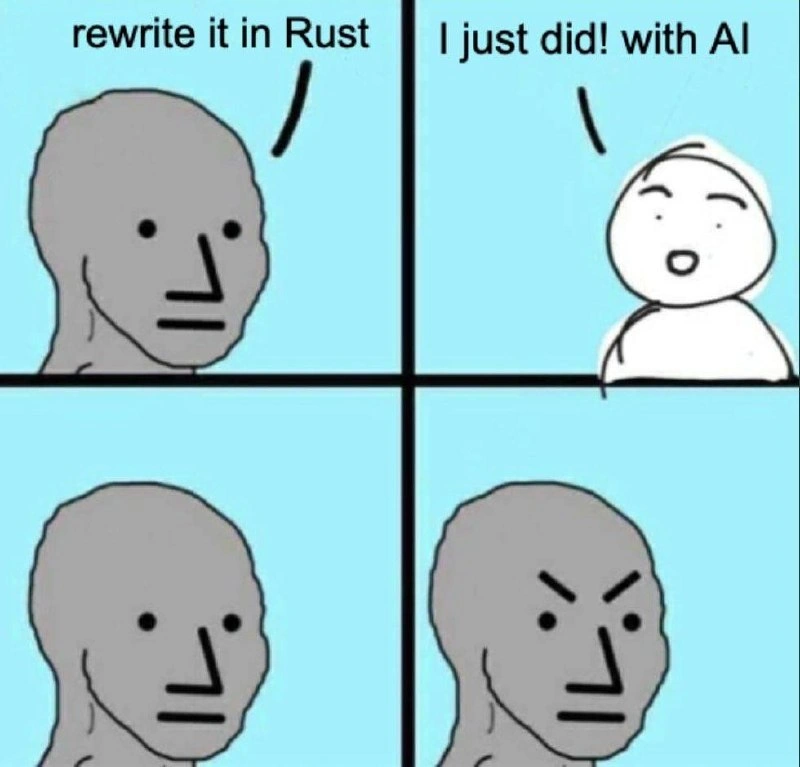
Four panels, two characters, one perfectly executed monkey's-paw wish. The gray NPC Wojak opens with the most reflexive utterance in modern dev discourse — "rewrite it in Rust" — and the cheerful white blob answers "I just did! with AI". Panel three is silence. Panel four is the NPC's eyebrows snapping into fury. The demand was satisfied to the letter and violated in spirit, and the comic understands exactly why.
"Rewrite It In Rust" (RIIR) was never purely a technical recommendation. It's a cultural identity bundle: memory safety without garbage collection, fearless concurrency, and — crucially — the implicit claim that the rewriter has earned something by passing through the borrow checker's crucible. The borrow checker is Rust's compile-time enforcer of ownership and lifetime rules, and learning to satisfy it restructures how you think about aliasing and mutation. RIIR evangelism is therefore a status claim wrapped in an engineering claim: "I suffered, I was transformed, you should be too." The NPC face is the meme's own self-aware jab — the suggestion has been repeated so often, so context-free, that it's rendered as the literal non-player-character meme template, dialogue produced by reflex rather than thought.
Enter AI-assisted coding, which breaks the status economy in two directions at once. First, it trivializes the ritual: an LLM will happily transpile a codebase into something that compiles, sprinkling .clone() on every ownership conflict and reaching for unsafe or Rc<RefCell<T>> whenever the borrow checker objects — technically Rust, spiritually C with extra steps. The safety guarantees the rewrite was supposed to buy get quietly traded away by a model whose only goal is making cargo build exit zero. Second, and more wounding, it exposes that the evangelist's currency — hard-won language mastery — can be counterfeited in an afternoon of vibe coding. The anger in panel four isn't really about code quality. It's the rage of someone whose hazing ritual just got automated.
The deeper industry pattern: every era's "you must rewrite it in X" advice assumed the bottleneck was willingness to do the work. LLMs removed that bottleneck without removing the judgment the work was supposed to instill. Now the gap between "code exists in Rust" and "code embodies Rust's invariants" is invisible until production, which is precisely where these two characters will meet again.
Description
A four-panel NPC Wojak comic on a light blue background. Panel 1: a gray NPC face says 'rewrite it in Rust'. Panel 2: a cheerful white blob character happily replies 'I just did! with AI'. Panel 3: the gray NPC stares in blank silence. Panel 4: the same NPC face now has angry slanted eyebrows and a grim expression. The meme skewers the 'Rewrite It In Rust' evangelism colliding with AI-assisted coding: the demand was technically satisfied, but an LLM-generated Rust rewrite defeats the entire point - borrow-checker enlightenment earned through suffering - and likely produced code that compiles only after a thousand `.clone()` calls and `unsafe` blocks
Comments
14Comment deleted
The point of rewriting it in Rust was never memory safety - it was the suffering. An AI doing it in an afternoon is like summiting Everest by helicopter
Interesting story to read through why they decided to move it all from zig Comment deleted
I don't see where it says in the PR that this is for Anthropic marketing purposes Comment deleted
average quality of Zig projects went up after this merge Comment deleted
Ladybird rewrote c++ in rust, and no one bats an eye. But when bun rewrites zig... Comment deleted
everyone knows that hopes for ladybird are probably lost, it's just that js programmers are loud Comment deleted
Ladybird is pre alfa afaik Comment deleted
since C++ templates are Turing complete and that probably requires nofuckingwaysafe keyword in Rust. Comment deleted
✌️😭🥀 Comment deleted
Bro, you literally can oom system with clever generic expansion in rust.... Comment deleted
Weren’t they going to rewrite it in Swift a year ago, because Swift “better suits web” than Rust or something Comment deleted
The tooling on swift was ass Comment deleted
What's the point here? Comment deleted
purity ig Comment deleted