The Duality of HTTP Error Handling
Why is this API meme funny?
Level 1: Only OK or Panic
Imagine a teacher who gives out different stickers to grade your work: a gold star for a perfect job, a silver star for doing well, a green smiley face for "pretty good, but not perfect," and a red frown face for "needs improvement." Now picture a student who decides that the only acceptable result is the gold star. If they get a silver star – which actually means they did well – they completely lose their cool. They tear up their homework and start crying because, in their mind, anything that isn’t a gold star is a total failure. Sounds silly, right?
Well, in this meme, a computer programmer is acting just like that extreme student. The internet provides many different little messages (like those stickers) to explain how a request fared, but this programmer only recognizes one message as a success – the one equivalent to a gold star (in web terms, that's the "200 OK" response, which basically means "All good!"). If he gets anything else, even something that isn’t actually bad, he basically throws a tantrum: his code immediately calls panic() and gives up. It’s funny because he’s overreacting in a ridiculous way – just like freaking out over a silver star when you actually did a good job. The meme makes us laugh at how absurd it is to treat anything that's not absolutely perfect as a total disaster.
Level 2: All-or-Nothing Error Handling
For those newer to APIs and WebDev, let's break down what's happening in this SpongeBob meme. HTTP (HyperText Transfer Protocol) is the foundation of web communication, and it uses numeric status codes in each response to tell clients what happened to their request. The official rules for these codes are written in documents called RFCs (Request for Comments) – basically the internet's rulebooks. One such RFC defines a bunch of HTTP status codes, organized into categories by their first digit:
- 1xx (Informational) – These are provisional responses. It's like the server saying, "I got your request, and I'm starting to process it." (For example,
100 Continuemeans "Everything so far is okay, please continue to send the rest of your request.") You don't see 1xx codes often in everyday web browsing, because they're mostly used internally to manage protocol handshake steps. - 2xx (Success) – These mean the request was successful. The most common is
200 OK, which literally means "The request succeeded and we have the result." But there are others in this family:201 Created(the request succeeded and a new resource was created, often used after a POST that adds something),202 Accepted(the request was accepted for processing, but the processing isn't done yet),204 No Content(success, but there's no data to return in the body). All of these are successful outcomes, just with slight differences in meaning. - 3xx (Redirection) – These codes mean you won't get the resource directly because you need to make another request to a different location, or take some additional action. For example,
301 Moved Permanentlyor302 Foundtell your client that the resource has a new URL (your client should then go and request from that new URL).304 Not Modifiedmeans "your cached copy is still good, nothing has changed," so the client can just use what it already has without downloading again. A 3xx isn't an error at all; it's like the server saying "go this way instead" or "you're up-to-date, no need to redo anything." - 4xx (Client Error) – These mean something was wrong with the request sent by the client. The server couldn't process it as asked. A classic example is
404 Not Found– the URL you requested doesn't match anything on the server. There's also400 Bad Request(the request was malformed or invalid),401 Unauthorized(you need to log in or provide credentials to access this),403 Forbidden(you're not allowed to access this even if you are logged in), and others. In short, 4xx codes imply the client made a mistake or needs to change something. It's not a server failure; it's the request that's the issue. - 5xx (Server Error) – These indicate the server tried to do something with the request but something went wrong on the server’s side.
500 Internal Server Erroris a generic catch-all for when the server encounters an unexpected condition (basically a crash or unhandled situation in the server app).502 Bad Gatewaymeans one server got an invalid response from another server it was trying to communicate with on your behalf.503 Service Unavailableoften means the server is temporarily overloaded or down for maintenance. A 5xx is basically the server's fault – the request might have been perfectly valid, but the server failed to fulfill it properly.
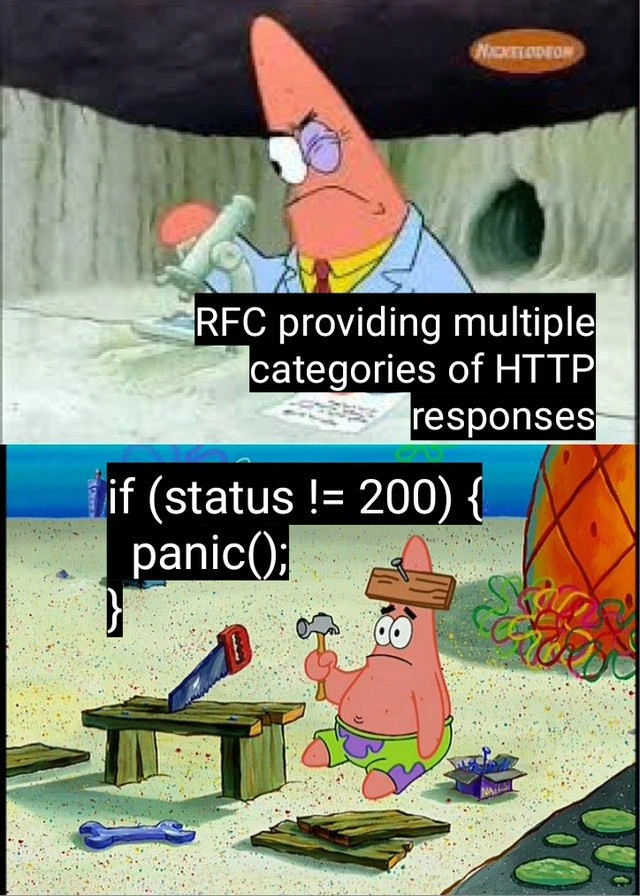
Now, in the meme's bottom panel, we see a snippet of code:
if (status != 200) {
panic();
}
Let's explain that in plain terms. This code is checking the status of an HTTP response, and it says "if the status code is not equal to 200, then call panic()." In many programming languages, calling something like panic() will immediately throw a runtime error or stop the program. It's like hitting a big red emergency stop button in the code. So what this developer wrote is essentially: "If I don't get a 200 OK response, I consider the whole request a failure and I'll abort everything (panic)." This means if the server returns anything other than 200, the code doesn't try to understand or handle it – it just freaks out and exits. That’s why we call this an all-or-nothing approach: the code assumes the only successful outcome is a 200, and anything else is treated as a fatal error.
Why is this a bad or at least a silly approach? Because, as we just outlined, there are many other status codes that are not errors at all! By doing if (status != 200) panic(), the developer would treat a perfectly normal situation like 201 Created as a failure. For example, suppose our program sent a request to add a new item to a database via an API. A well-designed API might reply with 201 Created to confirm the item was created. But this code would see "201 (which is not equal to 200) -> time to panic," effectively handling a success as if it were a crash-and-burn error. Similarly, 204 No Content (which means success, there's just no content to show) would trigger the panic simply because it's not the exact number 200. Even a redirect like 302 Found – which just means "the thing you're looking for is at a different place, go fetch it from there" – would be treated like a catastrophic failure by this code. In short, this is very simplistic (borderline lazy) error handling logic. It doesn't differentiate between a minor detour and a real roadblock; it just declares, "Anything that isn't the one expected success code must be an outright disaster."
Now let's connect this to the meme's visuals to understand the humor:
Top panel (Patrick in lab coat): Here we have Patrick Star (the pink starfish from SpongeBob SquarePants) looking serious, with glasses and a white lab coat, writing carefully on a clipboard. He's in a cave turned laboratory. This represents the smart, nuanced design of HTTP as described in the RFC. It's like saying, "The experts who created the HTTP standard thought everything through carefully and documented a response code for every scenario." Patrick in this scene is acting unusually brainy (for Patrick), symbolizing those RFC authors categorizing all the HTTP responses in a very scholarly way.
Bottom panel (Patrick with board on head): Now we see Patrick on a beach at a construction site. He has a wooden board nailed to his forehead and is holding a hammer, looking very confused and dazed. Tools and planks are strewn about. This silly image represents the programmer's implementation of the HTTP rules. In other words, the same character who was being all clever in the first panel is now doing something really dumb in the second panel. It's a visual gag: Patrick, known for not being very bright, is shown literally hurting himself with his own tools – much like the developer is sabotaging his own program with that one-line
paniccode. The textif (status != 200) { panic(); }is overlaid on this image to make it clear that this is the "code" our goofy Patrick-developer wrote. So, the top is the theory (lots of rules and categories), and the bottom is the practice (one crude check that ignores the rules).
The humor comes from the stark contrast between what is expected vs. what was done. The RFC gave us many categories of responses (like the teacher giving many kinds of stickers or grades), but the developer in the meme only cares about one outcome. It's funny in the way exaggeration is funny: obviously, real programs shouldn't literally panic on any non-200 status, but seeing it written out makes us chuckle and cringe at the same time. This resonates with developers because it’s a hyperbole of a real phenomenon – sometimes people do write code that only handles the "perfect" case and just fails otherwise. We find it funny because it's an absurd oversimplification, and yet it's a cautionary tale that reminds us of beginner mistakes.
For someone new to web development, the meme is basically saying: don't be like "Board-head Patrick" when you handle HTTP responses. In real life, when you write code to call an API or a web service, you should at least account for the possibility of other status codes:
- If you get a redirect (3xx), a good HTTP client (or your code using a library) will automatically follow the new location, or you handle it by making a follow-up request. Panicking in that case would be wrong because it’s not a failure, just a change of path.
- If you get a client error (4xx) like
404, you shouldn't crash everything; instead, you might handle it by showing a "Not Found" message to the user or logging, "Oops, we tried to get something that isn't there." It's an error, but it's an expected kind of error that you can handle gracefully. - If you get a server error (5xx), you also typically wouldn't just blow up without context. You might retry after a few seconds (maybe the server was momentarily overloaded), or you might at least report the error in a controlled way rather than just stopping the entire program.
- And importantly, if you get other 2xx successes like
201or204, you simply treat them as successful outcomes (maybe with slight differences, e.g. if it's 204 you know there's no content to process, if it's 201 you might take note of a new resource ID that was created). Those should absolutely not be treated as failures.
The meme uses a funny cartoon to underline a real best practice in API development and web services: handle your HTTP responses with some thought. Don't just assume only one scenario (200 OK) is good and everything else is an error. The Patrick Star with a plank on his head is a comical warning of what you look like as a programmer if you do that – a bit clueless and causing yourself pain. So, it's both a joke and a gentle lesson: HTTP gives you lots of information in its status codes; use it wisely, and don't panic over every little thing.
Level 3: Beyond 200 OK
In the top panel of this meme, Patrick Star is cosplaying as an RFC author in a cave-lab, studiously enumerating the multiple categories of HTTP status codes. This references how the official HTTP specification (like RFC 7231 for HTTP/1.1 semantics) defines a whole spectrum of response codes: informational 1xx messages, successful 2xx outcomes, redirection 3xx hints, client-side 4xx errors, and server-side 5xx errors. Each category and code has a distinct meaning and purpose – an elaborate taxonomy designed to help clients react appropriately to different situations.
Meanwhile, the bottom panel shows Patrick at a makeshift sandy construction site with a plank nailed to his forehead (a self-inflicted injury), holding a hammer in confusion. Overlaid on this scene is some source code: if (status != 200) { panic(); }. This one-liner captures an all-too-familiar anti-pattern: ignoring every nuance the RFC laid out and simply treating anything that isn't exactly 200 OK as a catastrophe. The careful distinctions in HTTP response codes get completely tossed out – it's essentially “200 or bust” error handling. The hapless developer's logic is basically "if it's not 200, it's not OK" (pun intended), and their only fallback is to panic (likely halting the program on the spot).
This contrast is both humorous and painfully relatable for seasoned developers. The RFC authors gave us an elegant, finely-tuned protocol with a code for every occasion, yet here we have a caveman-simple client implementation that squashes that richness into a binary outcome. We laugh because many of us have seen code like this in the wild or during code reviews – a piece of WebDev logic that only checks for status == 200 and treats anything else as an error without distinction. It's a textbook case of lazy error handling. Maybe you've encountered a script that inexplicably crashed when an API returned a 201 Created instead of 200 OK, or a novice developer who had no idea what to do with a 304 Not Modified and so just triggered a generic failure. Those experiences stick with you. The humor here is a coping mechanism: we see Patrick with a board nailed to his head and think, "Yep, that's what it feels like debugging a system that panics on every non-200 response."
From a CodeQuality and APIDesign perspective, this meme highlights a real gap between best practices and reality. Best practice in API development says: use the appropriate HTTP status codes and handle each category accordingly. If a resource is moved (301 Moved Permanently), your client should follow the redirect rather than combust. If the resource isn't modified (304 Not Modified), your client should use its cached data instead of treating it like a failure. If there's a client-side error like 404 Not Found or 400 Bad Request, your code might inform the user or let them correct the request; if it's a 500 Internal Server Error or 503 Service Unavailable, maybe you retry after a delay or show a "please try again later" message. In other words, good client code has branches for at least the broad status code categories (and sometimes for specific important codes). But our friend Patrick-the-Developer didn't get that memo. His code essentially screams panic whenever something unexpected comes back. It's an extreme form of naive error handling – or perhaps just not understanding HTTP response semantics beyond the absolute basics.
There's an irony here that many senior devs appreciate: when client code consistently panics on non-200 responses, it actually pressures API providers to dumb down their use of HTTP codes. Some services resort to always returning 200 OK with a JSON body containing an error status internally, just to avoid tripping up simplistic clients. This is a direct consequence of the mentality the meme mocks. It’s both funny and a bit tragic – the careful semantics of HTTP get reduced to a boolean check, “did we get 200 or not?”. The SpongeBob reference with Patrick Star drives the point home with cartoonish clarity: the smartest ideas on paper (the RFC’s nuanced plan) can be foiled by the dumbest code in practice. Every experienced developer gets a chuckle (and maybe a sigh) out of this image because it encapsulates a common pitfall in client-side API code: treating “not 200” as “not OK”, and going straight into panic mode rather than handling different responses gracefully.
Description
A two-panel meme format featuring the character Patrick Star from Spongebob Squarepants to contrast specification with implementation. In the top panel, a sophisticated-looking Patrick, wearing a lab coat and glasses, is studiously examining a document. The overlay text reads, 'RFC providing multiple categories of HTTP responses', representing the detailed and nuanced standards for web communication (e.g., 2xx for success, 3xx for redirection, 4xx for client errors, 5xx for server errors). The bottom panel shows the classic image of a confused-looking Patrick with a wooden plank nailed to his forehead, holding a hammer. The text overlay here is a code snippet: 'if (status != 200) { panic(); }'. This illustrates a common but lazy programming practice where developers ignore the rich information provided by different HTTP status codes, treating any response other than '200 OK' as a single, catastrophic failure. The humor lies in the stark contrast between the well-designed system and its crude, real-world implementation, a scenario all too familiar to experienced engineers
Comments
7Comment deleted
Why implement nuanced error handling when you can just treat every HTTP status code other than 200 as a request to reboot the entire internet?
Ship a client that panic()s on every non-200 and you’ve basically turned HTTP into a binary protocol - congrats, you just reinvented TCP with extra incident reports
After 20 years in the industry, I've learned that the difference between junior and senior developers is knowing that HTTP 418 'I'm a teapot' is the only status code that truly matters in production
This perfectly captures the eternal struggle between HTTP RFC authors who meticulously designed semantic status codes for every conceivable scenario (201 Created, 204 No Content, 304 Not Modified, 409 Conflict, 429 Too Many Requests) and the average backend developer who treats HTTP like a boolean: 200 means 'it worked' and literally anything else triggers an existential crisis. Bonus points if your error handling strategy is just wrapping everything in try-catch and returning 500 with a generic 'something went wrong' message, completely defeating the purpose of having 63 standardized status codes
HTTP gives you five classes and dozens of codes; our client implemented a boolean and wakes up on-call because a 204 dared to be empty
RFCs hand us a taxonomy for every failure mode; we reply with if(status !== 200) { summonSREs(); }
Our API wrapper: if (status != 200) panic(); - because why bother with idempotency, 201/202/204/304 semantics, or retries when you can compress the entire HTTP RFC into a boolean