Skip to content
DevMeme
1801 of 7435
Production Server Goes Full Glitch
OnCall ProductionIssues Post #2008, on Sep 4, 2020 in TG

Production Server Goes Full Glitch

Why is this OnCall ProductionIssues meme funny?

Level 1: The Soup Went Wrong

Imagine someone is eating from a bowl, and their friend shouts, "That is not honey!" Then, right when the friend is about to explain what it actually is, the whole picture gets scrambled like a broken TV. That is the joke. The computer system is so broken that even the explanation of what is wrong is broken too, which is exactly the kind of mess people dread when something important is live.

Level 2: Prod Is Melting

Production means the live system real users are using. A developer's laptop, a test server, or a staging environment can be broken without immediately affecting customers. When production breaks, the problem is public. That is why the post message says You prod server rn: it imagines the live server as this comic, visibly falling apart.

A production incident is a serious problem in that live system. It might be a crash, a slowdown, a data bug, a broken page, or a failed integration. On-call duty means someone is responsible for responding when alerts fire, often outside normal working hours. If the server is producing output that looks like the bottom-right panel, the on-call engineer is probably not enjoying a peaceful snack.

The corrupted panels work as a metaphor because software failures often damage the thing you use to understand them. Logs might be missing. Error messages might be too vague. A page might fail before it can render the diagnostic information. A service might be broken because another service is broken because another service changed a configuration value nobody documented. The visible mess becomes the clue.

The phrase debugging means investigating why code behaves incorrectly. In a calm situation, debugging is systematic: reproduce the bug, inspect logs, isolate the change, test a fix. In a production outage, it becomes more urgent because users are affected. You are still trying to be careful, but there is pressure from alerts, support tickets, managers, and the quiet knowledge that every minute of downtime is being converted into a meeting.

The meme is funny because the image itself demonstrates the problem. It does not say "the server is broken" in plain text; it shows a comic becoming unreadable. That is exactly how many production issues feel to developers: something ordinary suddenly turns into nonsense, and the only clear message is that the system is deeply unhappy.

Level 3: Incident In Pixels

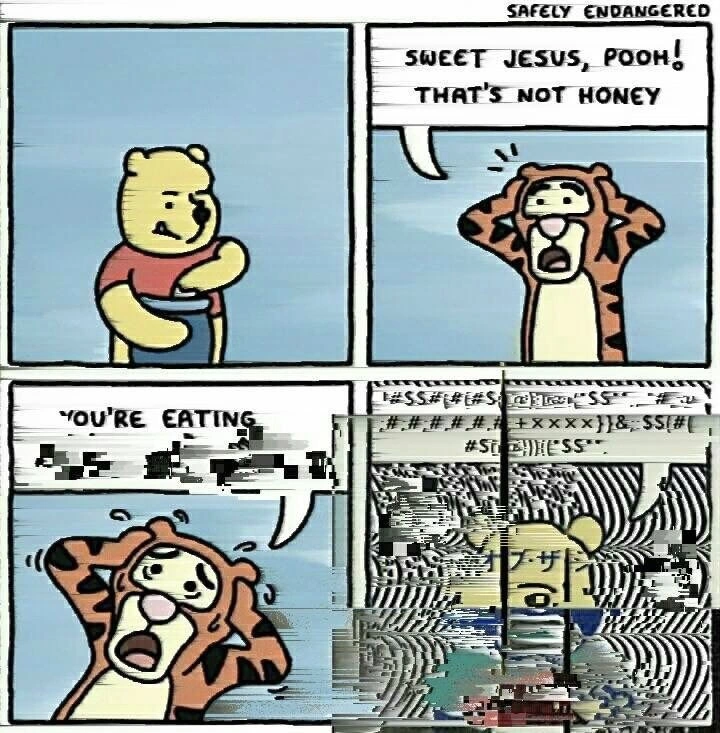
The comic starts like a normal setup: a Pooh-like bear calmly eats from a bowl, then a Tigger-like character panics:

SWEET JESUS, POOH!
THAT'S NOT HONEY

The next panel begins with:

YOU'RE EATING

Then the image itself breaks. The missing punchline is not merely hidden; it is eaten by horizontal tearing, blocky artifacts, repeated symbols, and visual corruption. The post message, You prod server rn, turns that broken comic into a production incident report with better art direction than most dashboards.

The humor is that the meme does not need to name the failing component. The corruption is the failing component. Anyone who has worked OnCall_ProductionIssues recognizes this category of failure: the system is no longer returning a clean error, a helpful stack trace, or even a normal bad response. It has crossed into "the output is so wrong that the interface is now evidence."

That is a very specific kind of production dread. A normal bug says, "The button does not work." A production outage says, "The payment flow is down." This image says, "The world is rendering through a corrupted framebuffer, and someone is still going to ask whether we can hotfix it before the next standup." The joke is dark because it captures the moment when diagnosis has not even started, but everyone already knows the blast radius is not polite.

The visual glitching maps neatly to real failure modes:

  • Bad deploys where a frontend bundle, backend schema, or API contract changed without its matching counterpart.
  • Memory corruption or unsafe native dependencies causing impossible-looking output instead of a clean crash.
  • Encoding or serialization bugs where bytes are interpreted under the wrong assumptions.
  • Caching failures where stale, partial, or mixed-version assets produce bizarre user-visible behavior.
  • Infrastructure incidents where logs, metrics, and symptoms all arrive out of order because the monitoring pipeline is also having a bad evening.

The best part is the obscured punchline. In the original comic structure, the missing noun would explain what Pooh is eating. In the production-server reading, that missing noun is the root cause. Everyone wants the final line, but the corruption has destroyed the exact information needed to understand it. That is incident response in miniature: the first casualty is always observability, followed closely by optimism.

This is why ProductionFirefighting memes resonate. The industry tells itself that modern systems are observable, tested, reversible, and resilient. Then prod emits striped visual static like a haunted barcode, and suddenly the runbook contains a lot of phrases like "try restarting the worker" and "does anyone remember who owns this service?" No one planned for the dashboard screenshot to become the postmortem's most accurate paragraph, but here we are.

Description

A four-panel comic labeled "SAFELY ENDANGERED" shows a Winnie-the-Pooh-like bear eating from a bowl, then a Tigger-like character shouting "SWEET JESUS, POOH! THAT'S NOT HONEY." In the lower-left panel, the speech bubble begins "YOU'RE EATING" but the rest is obscured by heavy digital corruption; the lower-right panel is almost completely broken into striped, pixelated glitch artifacts. The sibling metadata caption says "You prod server rn," making the corrupted comic a metaphor for a live production system currently failing in a spectacularly visible way. The humor comes from treating visual data corruption as the exact monitoring state of a server that has already moved past warning signs into incident response.

Comments

1
Anonymous ★ Top Pick When prod renders like this, the dashboard does not need a red status light; the pixels have already paged you.
  1. Anonymous ★ Top Pick

    When prod renders like this, the dashboard does not need a red status light; the pixels have already paged you.

Use J and K for navigation