When your reported bug turns out to be a literal insect inside
Why is this Bugs meme funny?
Level 1: A Real Bug
Sometimes one word can mean two different things and cause a silly mix-up. I told my friend I had a bug in my computer. He thought I meant the computer had a glitch or was broken (because people often use "bug" to describe a computer problem). But I really meant there was a real little insect crawling around inside my computer! When my friend realized I was talking about an actual bug, we both started laughing. Usually, when someone says their computer has a bug, they don’t mean an actual insect – they mean something is wrong with the computer’s program. That’s why this was so unexpected and funny: my "bug" was a bug for real, and nobody sees that coming!
Level 2: Not That Kind of Bug
In programming, a bug is a mistake or flaw in the code that makes a program do something wrong or unexpected. When developers talk about debugging, they mean they're trying to find and fix such software errors. We use the word "bug" so much that it's the normal way to say "there's a problem in the software." But of course, the word bug in everyday language usually means an insect – a little creepy-crawly creature. This meme plays with that double meaning in a direct (and literal) way.
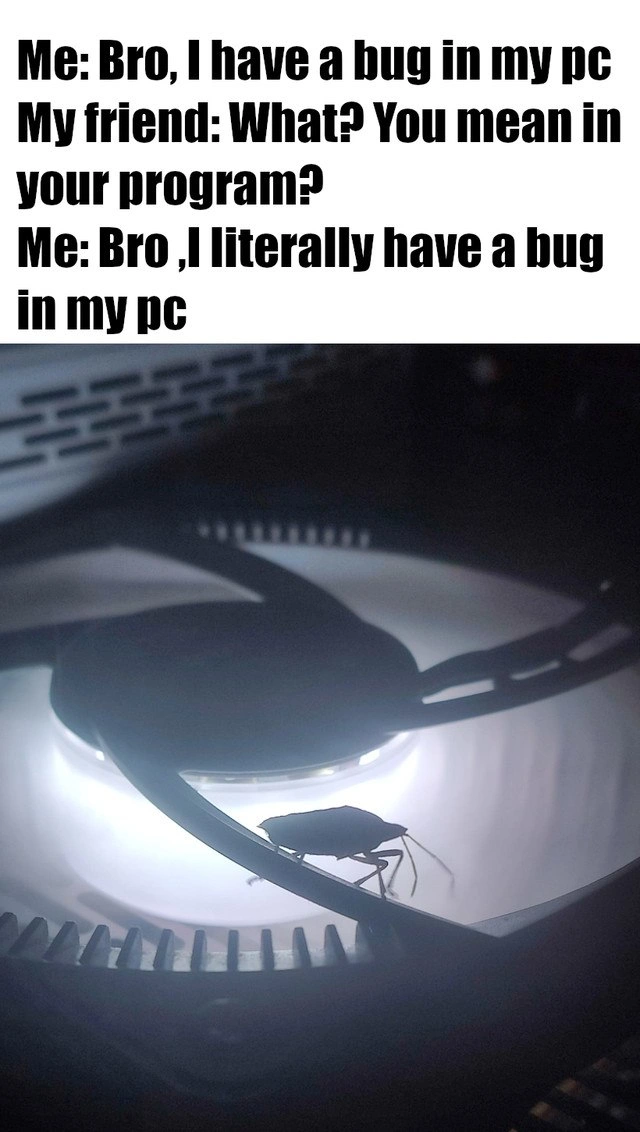
Look at the text conversation in the meme. I say, "Bro, I have a bug in my PC." Here, PC means my personal computer – the actual physical machine on my desk. My friend assumes I mean a software bug in a program (because that's usually what we mean in tech). So he replies, "What? You mean in your program?" You can sense his confusion: he's picturing me dealing with a coding error. But then I clarify, "Bro, I literally have a bug in my PC," and it turns out I'm talking about a real, live insect inside the computer case!
The bottom picture proves it – it shows the inside of a desktop PC with a glowing case fan (the fan that keeps the computer cool by moving air). And on one of the fan blades, there's an actual insect (it looks like a little beetle) casting a shadow against the white LED light. In other words, there's a literal bug in the PC. The humor comes from that misunderstanding. My friend thought I meant a software issue, but I was talking about an actual bug crawling around in my hardware.
This joke is especially funny to people who write code because we almost never mean an actual insect when we complain about "bugs" in our work. It's a playful reminder of a famous tech story: one of the first computer bugs ever documented was indeed a real insect. In the 1940s, engineers found a moth inside a huge early computer, and that’s where the term debugging came from – they literally had to remove a bug to fix the machine! So normally, debugging means fixing problems in code, but in this meme I'm literally debugging my PC by opening it up and removing the insect. It’s a lighthearted twist on our usual troubleshooting routine.
For someone new to coding, the key point is that "bug" can mean two different things. The friend in the meme heard it in the programming sense (a code problem), but the punchline is that it was the other kind of bug (an insect) all along. It’s a simple mix-up with a funny payoff. Anyone who's struggled with weird computer issues can laugh at the idea that maybe, just maybe, there's literally a bug causing the trouble this time.
Level 3: Entomology of Debugging
In the realm of developer humor, this meme taps into a legendary bit of computing history. In programming slang, a "bug" means a defect or glitch in software – a pesky error that sends us into debugging mode. But the term bug itself has a surprisingly literal origin. Back in 1947, computing pioneer Grace Hopper and her team were working on the Harvard Mark II computer when they discovered a moth stuck in one of its relays, causing the machine to malfunction. They taped the unfortunate insect into the logbook and joked:
"First actual case of bug being found." – Logbook of the Harvard Mark II, 1947
That incident became the genesis of the term debugging. Originally, it meant literally removing a bug!
Fast forward to today. The meme’s text conversation shows me saying, "Bro, I have a bug in my PC," and my friend responding, "What? You mean in your program?" It’s an automatic assumption in our field that a bug means a software problem (bugs in software are so common that nobody expects an actual insect). The punchline flips that expectation on its head. "Bro, I literally have a bug in my PC," I clarify – and the photo proves it. We see the silhouette of a real beetle perched on the rim of an LED-lit case fan inside the computer. In other words, a genuine insect invaded my hardware, making this a literal physical bug vs. software bug scenario. It's a brilliant play on words that brings the jargon back to its roots.
This double meaning resonates with seasoned developers because it's both funny and a bit nostalgic. We’re reminded that not all "bugs" are abstract bits of faulty code – sometimes they have wings and antennae. The friend’s misunderstanding (“You mean in your program?”) is a classic miscommunication moment. It highlights how ingrained the software definition of "bug" is in developer culture. We automatically think of code glitches, not creatures. That's why it’s hilarious when the situation turns out to be hardware-related in the most literal way. The meme straddles the line between software and hardware humor. On one side, it’s poking fun at our everyday coding troubles. On the other, it's shining a light (quite literally, with that bright case fan) on the kind of problem you’d hear about in PC repair folklore.
For veteran engineers, the image of an actual bug in a PC is a chuckle-worthy déjà vu. Maybe you’ve cracked open a faulty machine and found a nest of dust bunnies, or heard an anecdote of a moth shorting out a circuit. This meme takes that rare real-life occurrence and ties it back to coding culture. There's a sense of wishful irony here: we spend countless hours in frustrating debug sessions chasing invisible errors in logic (debugging frustration is real), but in this case the culprit is plainly visible and easily removed. For once, the solution to a "bug" doesn’t involve reading stack traces or deploying a hotfix – it just requires a tissue and some gentle shooing. If only every bug could be fixed that easily!
Ultimately, this meme delivers an almost educational punchline. It reminds us that our modern tech lingo has very real origins. When I say there's a "bug in my PC" and truly mean an insect, I'm echoing that famous first-bug story from the early days of computing. It’s like a tiny slice of history replaying itself as comedy. Seasoned developers appreciate this kind of layered joke: it's a goofy literal sight gag and a tribute to computing folklore at the same time. No wonder it hits home in programmer circles – it’s the kind of inside joke that makes coders grin and say, "I see what you did there," while maybe also double-checking their PC case for any extra live bugs.
Description
The meme is split into two parts. The top half is a white background with bold black text that reads: "Me: Bro, I have a bug in my pc\nMy friend: What? You mean in your program?\nMe: Bro ,I literally have a bug in my pc". The bottom half is a photo of a desktop-PC interior: a cool-white LED case fan fills most of the frame, and on the inner rim of the fan blade a real beetle-shaped insect is silhouetted, emphasizing the play on the word "bug." The humor comes from the developer double-meaning - software defect versus physical bug - echoing the historic origin of the term debugging and reminding engineers that sometimes hardware issues really are caused by tiny critters. Visually, the fan’s circular light, plastic blades, and case vent holes provide recognizable PC-hardware context, making the joke instantly relatable to anyone who has ever complained about “bugs” in code or machines

Comments
10Comment deleted
RCA just in: latency was caused by an unhandled InsectException lodged at the hardware abstraction layer. Next action items - add “pest injection” to the chaos engineering suite and budget for hermetically sealed racks
The irony is that after 20 years of explaining to non-technical stakeholders that 'bugs' aren't actual insects, you still end up filing a ticket for 'intermittent thermal throttling due to arthropod-induced airflow obstruction' - and yes, you'll need to update the runbook for this edge case
Finally, a bug report with full reproduction steps: it reproduces inside the case if you don't close the ticket fast enough
The etymology of 'bug' comes full circle: Grace Hopper found a moth in a relay in 1947, we abstracted it to mean code defects, and now we're back to literal arthropod-based system failures. At least this one's easier to fix than a race condition - just needs a vacuum instead of a mutex. Though I'd argue both require similar levels of patience and the willingness to get uncomfortably close to the problem
The rare hardware bug that self-resolves via natural selection - or starvation during a long compile
RCA: P1 at Layer 1 - an organic process preempted the fan; mitigated by deploying RAID (the spray, not striping) and adding an intake filter
RCA: thermal throttling from an undocumented third‑party dependency - a literal bug attached to the fan. Applied a tweezer hotfix and updated the threat model to include insects
Guess it’s a hardware related bug Comment deleted
https://www.youtube.com/watch?v=LIVv2Xeb0dk Comment deleted
фу клоп Comment deleted