When even typing "exit" is too hard at the end of shift
Why is this CLI meme funny?
Level 1: Too Tired to Quit
Have you ever been so sleepy that you start doing something but can’t even finish it? Imagine you want to say goodnight to your friend, but you’re so tired you only mutter “goo…,” then you trail off and fall asleep. That’s what’s happening here, but with a computer. The programmer wanted to tell the computer “exit” (which is like saying “I’m done, let’s close this now”), but he was so worn out that he only typed part of the word and hit the button early by accident. In other words, he was too tired to even finish quitting the program properly! It’s funny because we can all understand that level of tiredness — when even a super simple task feels impossible. The picture of the drained-looking guy and the half-entered command are just a techie way of showing that feeling. In plain terms: the poor coder is so exhausted that even his computer knows it.
Level 2: Tired Terminal Typos
In this meme, the top half is showing a command-line interface (CLI) on a Linux system. That black window with text is often called a terminal or shell. The green text starting with root@linuxbox:~$ is the Bash prompt. Breaking it down:
rootis the username (here, the user is the “root” administrator of the machine, meaning full privileges).linuxboxis the hostname (the name of the computer or server).~is the current directory (a tilde represents the user’s home directory).$indicates the prompt is ready for a regular user command (it turns to#for root, but many prompts still show$even for root in some configurations).
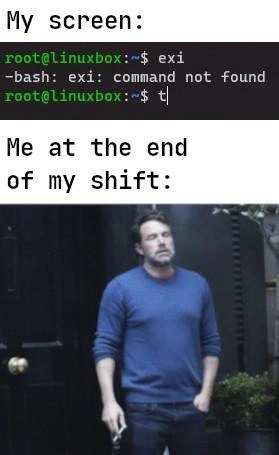
After that prompt, we see the user tried to type an exit command but only entered exi and pressed Enter. They intended to type the full word “exit” (which is the command to close the terminal session), but they stopped one letter short by mistake. Because “exi” is not a valid command, the shell returns an error: -bash: exi: command not found. That error message is basically the computer saying, “I don’t know what ‘exi’ is.” (The prefix -bash: just tells us it’s the Bash shell responding.) On the next line, we see a new prompt and just a lone t typed by itself. That lonely “t” is actually the last letter of “exit” that the user missed on the first try – it ended up on a new line by itself since the Enter key was hit too soon. Of course, “t” on its own isn’t a command either (if you hit Enter after typing just t, you’d get a similar command not found error for that).
So, basically, the developer meant to log out with the exit command, but he was so tired or distracted that he split it into “exi” and then “t” on two separate attempts. It’s a small typo, but it perfectly illustrates being exhausted while working in the terminal. As any beginner learns, the CLI is powerful but very literal — if you even slightly misspell a command, the computer won’t understand you. There’s no autocorrect on a plain command line. For example, if you type git stattus instead of git status, you’ll just get an error because “stattus” isn’t a real command. Here it happened with the word “exit,” which is about as simple as it gets, showing that no matter how basic the task, a fatigued brain can mess it up.
The bottom half of the meme captioned “Me at the end of my shift:” shows a tired individual in a blue sweater, looking utterly wiped out. This is the meme’s way of saying the person at the keyboard is as drained as that half-entered command suggests. After a long day (or night) of coding, it’s common to feel like that picture — out of energy. If you’ve ever stayed up late working on a school project or learning to code, you might recognize that foggy feeling where you start making silly mistakes. LateNightCoding and SleepDeprivation will do that to you! The combination of the terminal error and the exhausted-looking person is classic DeveloperHumor. It’s poking fun at the very real phenomenon of developer fatigue: when you’ve been programming for hours and your brain just checks out for the day. The meme gets a laugh from us because we’ve all been there in some way — trying to do something very simple and failing because we’re just too tired. It also carries a gentle lesson: when even typing “exit” is hard, it’s probably time to call it a day and get some rest. Computers will faithfully do exactly what you tell them, but if you’re half-asleep, you might not be telling them what you think you are!
Level 3: Half-Exit, Full Exhaustion
At the end of a long coding session, even logging out of a server can turn into a comic ordeal. The top panel shows a typical Linux Bash prompt with a failed attempt to type the exit command. We see:
root@linuxbox:~$ exi
-bash: exi: command not found
root@linuxbox:~$ t
Instead of the full exit, the user only managed to enter exi before hitting Enter, resulting in the shell responding -bash: exi: command not found. In the prompt that follows, there's a lone t entered by itself, as if the user's last bit of energy pressed the final letter on a new line. In essence, the command was split into "exi" and "t" due to pure exhaustion. It’s a literal CLI facepalm moment: the computer expected a proper command, but the developer’s fatigue turned a four-letter exit into a two-step error.
Under the hood, Bash (the shell shown by the -bash error prefix) treats each line you enter as a separate command. exit is a built-in instruction that normally closes the shell session. But exi by itself isn’t recognized as anything. When our bleary-eyed developer hit Enter prematurely, Bash dutifully searched the system for a program named “exi” (checking all the directories in your $PATH) and, not finding any, spat out the classic “command not found” error. The stray t on the next prompt is actually the last letter of “exit” that got typed a moment too late. It’s as if the shell is saying, “I have no idea what exi means,” right when the programmer’s brain is so fried it can’t even spell “exit.” The machine is mirroring the coder’s mental state: command not found – the brain’s command to call it a day isn’t registering either!
This scenario is painfully funny to any experienced developer because it’s so relatable. It captures that classic end-of-day or LateNightCoding moment where your brain is running on fumes and even routine tasks fail. Seasoned programmers have all experienced typing blunders when sleep deprivation hits: maybe you attempt to grep some text and end up typing grep grep, or you write sl instead of ls (so common that a joke program displays a steam locomotive when you do sl). Here, the mighty root user (the all-powerful admin on a Linux system) was humbled by a simple four-letter word. These kinds of tired CLI mistakes are practically a rite of passage in developer life. We chuckle because we’ve been there. In the trenches of TerminalLife, a simple exit can feel like climbing Mt. Everest when you’re mentally drained. The meme perfectly nails that “brain-fart” moment – a harmless typo that loudly announces, yep, time to pack it in.
On a more serious note, this screenshot is also a tiny cautionary tale about DeveloperProductivity and fatigue. When you’re this burnt out, your efficiency plummets and error messages start to become a journal of your brain’s misfires. It’s the reason wise teams encourage stepping away or calling it a night instead of brute-forcing through exhaustion. Pushing yourself beyond your limit often leads to diminishing returns (and sometimes silly errors like this one). There’s an unofficial rule many coders learn: don’t attempt critical commands or deploys when you’re dead-tired – you might end up worse off than a stray exi. The gap between best intentions and tired reality is huge: in theory, typing exit is trivial, but in practice end-of-shift burnout can even trip you up on something that simple. The humor works so well because it exaggerates a truth: when you’re exhausted, the simplest task on the computer becomes a challenge, and you might literally forget how to quit.
Finally, the bottom panel drives that point home visually. The image (a well-known meme of a completely wiped-out Ben Affleck on a smoke break) shows a person who looks absolutely done for the day. He’s standing with a slouch, cigarette in hand, gazing off in exhaustion. The caption “Me at the end of my shift:” frames him as the developer in this story. Pairing that with the “My screen:” terminal snippet makes it crystal clear: the human is as fried as the computer output suggests. Both are shown in a half-working state. The shell returned a half-typed command and an error, and the person is basically returning a half-hearted stare and a silent “error” of his own. He’s practically a shell of a developer (pun intended). The joke lands because the cause and effect are universally understood among devs: long hours lead to silly mistakes, and silly mistakes lead to that exact resigned, exhausted pose. A seasoned coder can’t help but grin and nod: sometimes the hardest part of the day is simply quitting for the day.
Description
The meme is split into two parts. At the top, the heading "My screen:" precedes a black terminal window that shows: "root@linuxbox:~$ exi", the error "-bash: exi: command not found", and another prompt "root@linuxbox:~$ t" - all rendered in green and white monospace text on a dark background. The lower half begins with the caption "Me at the end of my shift:" and displays a photo of a tired-looking person in a blue sweater, face blurred, standing outside and loosely holding a cigarette. The humor equates the half-typed "exi" and lone "t" with the developer’s own half-functioning state after a long day. Technically, it references a typical Bash shell on a Linux machine where an incomplete "exit" command throws a "command not found" error, a familiar mishap for anyone bleary-eyed at the CLI

Comments
18Comment deleted
Twenty years in and my end-of-shift shutdown routine still resembles a partially committed transaction: type ‘exi’, roll back, stare, eventually append the ‘t’ - if only bash supported two-phase commit
After 15 years of muscle memory typing 'exit', your fingers still betray you at 6 PM - proving that even senior engineers can't escape the universal law that typos increase exponentially with proximity to deployment windows and dinner time
Typing the leftover 't' on the next prompt is the human equivalent of resuming a failed transaction without rolling back
After 12 hours of debugging production issues, your muscle memory degrades from 'exit' to 'exi', then 'ex', and eventually you just close the terminal window like a barbarian. By Friday afternoon, you're typing 'quit', 'q', ':wq' in bash, and seriously considering 'Ctrl+Alt+Delete' as a valid logout strategy. The real exit code is the friends we made along the way... who also can't remember how to properly terminate a shell session
End-of-shift off-by-one: 'exi' denies escape, proving even builtins demand keystroke SLAs
By end of shift, exit isn’t atomic - it's a two‑phase commit: exi then t, with my motor cortex providing eventual consistency
Typing 'exi' on a root shell and getting 127 - a reminder to alias exi=exit before orphaned prod sessions become our longest-lived service
ctrl + d Comment deleted
Yes. Who would type exit? Comment deleted
alias :q="exit" Comment deleted
Good point😂 Comment deleted
who would exit their shell? Wait, what is a GUI? Wha-? Comment deleted
Btw talkimg from shell, did you know you can disable cmd by group policy? Comment deleted
yes. A horrible way to cripple your PC Comment deleted
And substitute it with PowerShell or maybe Cygwin Bash? Comment deleted
As of powershell idk, but almost any executable that is not ms signed wont run Comment deleted
shutdown now Comment deleted
!!t Comment deleted