Skip to content
DevMeme
3840 of 7435
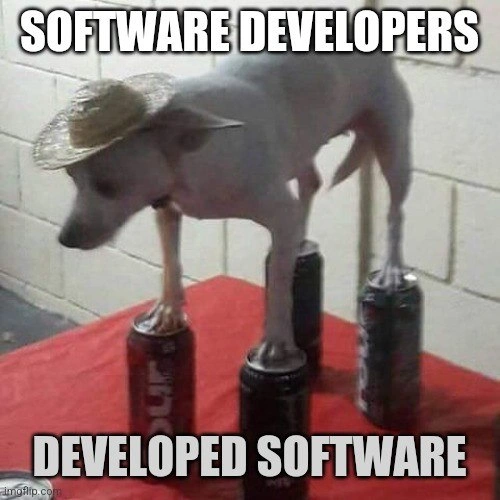
Developers precariously balancing on the fragile stack of their own software
CodeQuality Post #4183, on Feb 8, 2022 in TG

Developers precariously balancing on the fragile stack of their own software

Why is this CodeQuality meme funny?

Level 1: Shaky Building Blocks

Imagine you stack up a bunch of empty soda cans and then try to stand on them like a ladder. You probably know that feeling in your tummy – it's wobbly, and you're afraid everything might tip over any second. It's a pretty funny sight too, right? Picture yourself balancing up there, arms out, going "whoa!" as the cans shake. This meme is playing with that kind of idea. It shows a little dog in a cute hat doing something just as silly and risky: standing on a shaky tower of cans. The joke is that the dog is like a builder who made a wobbly structure and now has to stand on it. It's both funny and a bit scary at the same time. We laugh because the situation looks so ridiculous (dogs don't usually do that!), and we also feel the nervous excitement of "uh-oh, I hope this doesn't collapse!" So the picture makes us giggle and nod: it’s showing how people sometimes end up on a shaky creation of their own, hoping it all stays standing.

Level 2: Technical Debt Tower

Let's break this down in simpler terms. The meme is basically saying: developers often end up standing on a shaky pile of their own code. In the picture, the little dog with the straw hat represents the developer, and the four energy drink cans under its paws represent the software the developer wrote. The dog balancing on those cans is just like a programmer having to rely on code that isn't very stable. If the dog (developer) moves the wrong way or if one can (a piece of code) slips, everything could fall. That red tablecloth and sturdy cinder-block wall in the background make the wobbly stack look even sketchier – it's showing the difference between a solid foundation and what the developer actually has.

A few key terms and concepts help explain the humor here:

  • Technical debt: This is a metaphor in software development. Think of it like taking shortcuts in your code to get a feature working quickly, instead of doing it the right way. It’s called "debt" because, just like financial debt, you'll have to "pay" for those shortcuts later with extra work and problems. The more quick-and-dirty fixes you add, the more “interest” builds up in the form of bugs and messy code you need to fix eventually. In the meme, the shaky stack of cans is like a pile of technical debt the developer is now standing on nervously.
  • Code quality: This refers to how well-written, clean, and maintainable the code is. High code quality means the code is organized and easy to change without breaking things. Low code quality means the code is brittle and full of hacks. Here the code (the cans) has low quality – it’s not a stable, well-built platform. You can imagine high-quality code would be like a solid wooden stool, whereas low-quality code is like balancing on wobbly cans.
  • Spaghetti code: This is a slang term for code that is tangled and messy, kind of like a bowl of spaghetti. If a codebase has pieces that are all interconnected in confusing ways, we call it spaghetti code. It's hard to follow, and one change can unexpectedly affect something else far away in the code. In the meme, the supports under the dog are all separate cans that don't lock together – similar to how spaghetti code has a lot of loose, fragile connections. It’s easy for such code to "fall over" because it lacks a clear structure.

With those ideas in mind, the scenario becomes familiar even to less experienced programmers. Maybe you've written a school project or a small app where you were in a hurry and ended up with some messy code that "somehow works." You know that uneasy feeling when you have to fix or update that code later: you're a bit afraid that if you change one thing, it might break something else. That's exactly the feeling this meme is poking fun at. The developer in the picture is literally like a dog trying not to tip over a shaky construction – that’s how it feels to work on a fragile codebase.

It's also common programmer humor to joke about surviving on coffee or energy drinks. When deadlines are tight or bugs are critical, developers often stay up late fueled by caffeine. Here, the joke goes a step further: the empty cans of those energy drinks have become the pillars holding up the code. It's as if all those Red Bulls or Monsters the dev drank while rushing to finish the project turned into the actual support structure for the project! This witty detail connects developer culture (drinking energy drinks to push through crunch time) with the end result (a codebase held up by quick fixes).

Another way to think about it: building software without a solid design is like playing Jenga or building a tower out of cards. Each new feature or quick fix is like stacking another block or card on top. If you don't build it carefully, the whole tower can wobble and crash. In a well-engineered system (good code quality), adding a new piece won’t immediately threaten the stability of the whole. But in a rushed, patchwork system (bad code quality), every new addition is nerve-racking. Many junior devs experience this when maintaining an old project at their first job: you fix one bug and suddenly two more bugs pop up elsewhere because the code is so fragile. It's stressful, and this meme captures that stress in a funny, exaggerated way.

The text labels make the joke clear: "SOFTWARE DEVELOPERS" at the top and "DEVELOPED SOFTWARE" at the bottom. It literally labels who is on top (the developer) and what they're standing on (the software they built). The message is: if that software was built hastily or sloppily, the developer ends up in a risky position. It’s a warning wrapped in humor: if you build something flimsy, you'll have to stand on it later, and that can be a scary ride. Even as a newcomer, it's easy to see why that’s amusing and a bit alarming – no one wants to be the person worrying that their work might collapse at any moment.

In short, this meme uses a goofy image to highlight an important lesson in programming. It shows why more experienced folks always talk about writing clean code and paying off technical debt. Otherwise, you might find yourself like that poor dog: balancing on a janky tower of your own making, just hoping it all stays upright. It’s a lighthearted reminder that a solid foundation (in code or anything) is really important, because standing on a shaky stack is not fun!

Level 3: House of Cards Code

As any battle-scarred developer knows, there's nothing quite like balancing precariously on the fragile stack of quick-and-dirty code you wrote at 3 AM. This meme nails that too familiar scenario. The image shows a small dog in a straw hat standing on four tall energy-drink cans, labeled with the classic Impact captions: “SOFTWARE DEVELOPERS” (the dog) and “DEVELOPED SOFTWARE” (the wobbly cans). In other words, the developer is literally standing on top of the software they've built – and it's a perilously shaky foundation.

The humor here is both absurd and painfully relatable. Those four energy drink cans are a perfect symbol for a codebase propped up by late-night coding sessions and caffeine-fueled hacks. Each paw of the dog rests on a separate can, which is like a developer relying on several questionable code modules or fragile subsystems. One wrong move (or minor change in the code) and the whole stack could topple. The background even shows a solid cinder-block wall – real engineering uses concrete and steel, but our software structure is more like a teetering Jenga tower of soda cans. It's a visual punchline about tech debt: we didn't take the time to build a solid platform, so now we're literally balancing on empties (empty cans, empty promises).

For experienced engineers, this image hits a nerve. It evokes all those codebases held together by duct tape and hope, the ones we swear we'll refactor someday (but “someday” never comes). The top caption "SOFTWARE DEVELOPERS" above the dog suggests that developers often end up as unwitting acrobats, performing a balancing act on the very structures they rushed to build. The bottom caption "DEVELOPED SOFTWARE" names the shaky pedestal – our own creation threatening to collapse under us. There's an ironic role reversal: normally software is supposed to support the users and developers, but here the developer is literally supported by the software, highlighting how we become dependent on the unstable code we wrote.

Technical debt is the star of this show. That term (coined by Ward Cunningham back in 1992) compares hacky quick fixes to borrowing money – you get a short-term gain (speed, convenience) at the cost of long-term "interest" (the inevitable extra effort to fix problems later). In the meme, the "interest" is coming due as the developer tries to stay upright on a wobbly stack. Every seasoned dev knows the sinking feeling of standing on a house-of-cards codebase. You implemented feature after feature under tight deadlines, skipping tests and ignoring best practices, and now the whole thing is as stable as a drunk person on stilts. It’s funny in the cartoonish meme sense, but in real life it’s the kind of situation that gives you production outage nightmares.

We see common industry anti-patterns here. The dog’s four can-pillars could represent different components or services in an application, each one possibly a hacky workaround. Notice how none of the cans are firmly connected – just like microservices or modules that should work together but are held by fragile interfaces and band-aid fixes. If any one of those support cans (say, a critical piece of code) slips or fails, the whole system (and the developer’s peace of mind) comes crashing down. This recalls those infamous late nights where one tiny change breaks everything because the code was so brittle. In real life, that means a single bug in the wrong place can trigger a chain reaction of failures, and suddenly the on-call developer's phone is buzzing at 3 AM. The meme basically screams "spaghetti code" – a system so entangled and poorly structured that it's practically an accident waiting to happen.

The straw hat on the dog even adds to the absurdity: it's as if the developer is putting on a nonchalant face (a tiny fashionable hat!) while in a ridiculous predicament. It's a comedic exaggeration of confidence in a risky setup. We laugh at how silly it looks, but also wince because we've been in similar shaky situations ourselves. This whole scenario is the product of well-known trade-offs and pressures. In fast-paced projects, management often pushes for shipping features quickly. Developers pull caffeine-fueled all-nighters to deliver on time, stacking new code on top of old with minimal refactoring. The result? A precarious tower of technical debt that somehow holds up... until it doesn't. Everyone on the team is aware that the foundation is brittle, but since it's still standing, they tiptoe around it, much like that careful dog. The meme exaggerates it to a ridiculous degree – a dog on Red Bull cans – but it honestly isn't far off from what some production systems feel like: one weird workaround on top of another, improbably still working. It's funny because it's true.

To illustrate the contrast between what we aspire to and what we often end up with in software development, consider this typical project trajectory:

Best Intention Actual Shortcut Consequence
Plan: Solid architecture with well-defined layers Reality: Copy-paste patchwork code to meet the deadline Outcome: Brittle modules that break under pressure
Plan: Comprehensive testing and code review Reality: "Works on my machine" validation only Outcome: Hidden bugs waiting to surface in production
Plan: Regular refactoring to improve structure Reality: "We'll fix it later" (and never do) Outcome: Growing technical debt and fear of changing anything

We promise ourselves and our stakeholders a robust system, but end up with an improvised scaffold. The humor has an edge of truth cringe: we recognize that bright-red tablecloth in the photo as the flashy feature set, and the shaky cans as the skeleton underneath. In meetings we talk about scalable microservices and clean design, but behind the scenes we're guzzling a Monster energy drink at 2 AM while writing a quick fix function named fixPaymentBugTemp() that somehow becomes permanent. The next thing you know, your entire app’s critical feature rests on that "temporary" code (one of those cans), and you as the developer are desperately hoping it doesn't buckle under real-world pressure.

Ultimately, this meme resonates with developers because it captures a lived experience: relying on unstable code that we ourselves created under pressure. It's simultaneously a self-own and a cautionary tale. The dog balancing is us, and the energy-drink cans are our rushed creations. We chuckle at the silliness of a tiny dog doing a circus act, but also nervously grin because we know one day our luck might run out and that stack of cans (our code) will come crashing down — hopefully not while we’re still standing on it.

Description

A small white dog wearing a tiny straw hat balances each paw on the top of four tall energy-drink cans arranged on a red-covered table in front of a cinder-block wall. The top caption in bold white Impact font reads: “SOFTWARE DEVELOPERS,” and the bottom caption reads: “DEVELOPED SOFTWARE.” The visual joke equates the shaky, improvised platform of cans with the often fragile foundations of hastily shipped code. For experienced engineers, it satirizes how codebases held together by hacks and shortcuts can leave the creators themselves standing on unstable ground, underscoring perennial concerns about code quality and technical debt

Comments

7
Anonymous ★ Top Pick Current prod architecture: 600 Kubernetes pods balanced on four legacy singletons - kept upright by caffeine and a comment that says “TODO: refactor next sprint.”
  1. Anonymous ★ Top Pick

    Current prod architecture: 600 Kubernetes pods balanced on four legacy singletons - kept upright by caffeine and a comment that says “TODO: refactor next sprint.”

  2. Anonymous

    After 20 years in the industry, I've learned that the difference between 'it works on my machine' and 'it works in production' is exactly four glass bottles and a prayer to the load balancer gods

  3. Anonymous

    Four single points of failure, zero redundancy, and it passed UAT because nobody sneezed during the demo

  4. Anonymous

    This perfectly captures the moment when you realize your microservices architecture is actually just three monoliths in a trench coat, held together by Redis, prayer, and that one senior engineer who's afraid to refactor anything because 'it works in production.' The dog's expression mirrors every architect's face during a system design review when someone asks 'but what happens if one service goes down?' - we all know the answer is 'everything goes down,' but we've committed to the distributed systems narrative and there's no turning back now

  5. Anonymous

    Developers on Mountain Dew; software on three unchecked dependencies - one yarn audit away from collapse

  6. Anonymous

    Our microservice architecture: four single points of failure balanced on caffeine; product calls it shipped, SRE calls it the error budget wearing a cowboy hat

  7. Anonymous

    “Software developers developed software” has the same vibe as this architecture: technically it’s running in containers - four cans - and the SLA holds as long as nobody nudges the table

Use J and K for navigation