The Escalating Horror of Debugging Academic Code
Why is this Debugging Troubleshooting meme funny?
Level 1: It’s All Greek to Me
Imagine you’re helping to fix a broken toy, but you didn’t build the toy and the only instructions left behind are written in a foreign language full of strange symbols. At first, you’re happily playing (coding) and everything is fine. Then the toy breaks (there’s a bug). You say, “No problem, I can fix it!” But when you open the instruction manual, you realize two things: someone else wrote these instructions, and they’re basically an advanced math textbook page (like something out of a big encyclopedia). 😱 Suddenly, a simple broken toy feels impossible to fix because the “how to fix it” guide might as well be magic runes or Greek letters that you don’t understand. You go from calm, to worried, to completely overwhelmed. The meme is funny because it’s showing that exact feeling – starting out confident, and ending up with a face that says, “Oh no, what have I gotten into?” In everyday terms, it’s like trying to solve a puzzle but the clues are in a code you can’t read. That mix of surprise and fear when you see those incomprehensible instructions – that’s the heart of the joke.
Level 2: Inherited Code Conundrum
Let’s break down the technical elements for a newer developer (or anyone lucky enough to not have experienced this yet):
Legacy code: This refers to old code, or just code you didn’t write but have inherited. Often, legacy code runs critical systems (LegacySystems tag fits) but isn’t well understood by current developers. Here, “You didn’t write the code” indicates it’s legacy to you. Working with legacy code can be tricky because you don’t know why things were done a certain way. Imagine joining a project and dealing with modules written years ago by someone else – that’s legacy code, and it can feel like untangling someone else’s spaghetti (hence the SpaghettiCode reference).
Bug: A bug is an error or flaw in software that causes it to produce a wrong or unintended result. The meme starts with “There is a bug,” which is a common situation – something’s not working correctly and you have to debug (find and fix the issue). Debugging is usually straightforward if you know the code... but not this time.
Debugging someone else’s code: When it’s not your code, debugging is much harder. You don’t instinctively know what the code should do, so you must read and understand it from scratch. It’s like being handed a mystery novel at the climax – you need to piece together earlier chapters by yourself. New developers often first experience this when maintaining older parts of a codebase or jumping into an open-source project. It can be daunting. You might use tools like
git blame(which tells you who last modified each line) to get clues. In this scenario, runninggit blameis suggested by the git_blame_horror tag – meaning the results are scary. Often you find the last editor is a long-gone employee or a cryptic commit message like “temporary fix, will refactor later.” 😩 Not comforting!Wikipedia link at the top: Seeing a Wikipedia URL in a code comment is unusual, but it happens. It means the original programmer based this code on something from Wikipedia (or an academic description). For example, they might have copied pseudocode or formulas from a Wikipedia page about an algorithm. This becomes a form of documentation. Instead of writing detailed comments or design docs, they essentially said, “If you need to understand this, go read that Wikipedia article.” It’s better than nothing – it at least names the algorithm or approach – but it’s far from beginner-friendly documentation. Wikipedia articles on algorithms tend to include a lot of theory and math. So it’s a bit like if a chef told you to read a chemistry textbook to understand a recipe. The Documentation and CodeComments tags highlight that this is about documentation (or lack thereof). Usually, we hope for comments explaining in simple terms what the code does. Here we get the opposite: a pointer to something possibly even more complex.
Tons of math: This phrase indicates the code itself contains heavy mathematical logic – formulas, calculations, maybe even implementing equations from geometry, calculus, or number theory. In code, “tons of math” could look like lots of
sqrt(),pow(),sin()functions, summations, products, maybe matrices or weird constants. It’s not a typical if-else business logic or simple loops; it’s doing numerical computation that likely stems from some algorithm. For example, the code might implement an algorithm to solve a equation or find an optimal value. If you’re not comfortable with advanced math, reading such code feels like reading another language. Even if you are comfortable, you need to map each code line back to a mathematical concept. Often, variables will have short names (i, j, k, x1, x2) as in math formulas, rather than descriptive names, which adds to the confusion for newcomers.
To visualize what that might look like, consider a simplified example. Suppose the code is implementing the Newton-Raphson method (a classic algorithm) to calculate a square root. A developer might have left a Wikipedia link to “Newton's method” and then written code like this:
// Based on Wikipedia: Newton-Raphson method for computing square root
double approximateSqrt(double input) {
double tolerance = 1e-9;
double estimate = input / 2.0; // initial guess
while (fabs(estimate * estimate - input) > tolerance) {
estimate = 0.5 * (estimate + input/estimate); // Newton's formula
}
return estimate;
}
In this snippet:
- The comment at the top cites Wikipedia for Newton-Raphson. If you didn’t know what Newton’s method is, you’d have to go look it up to understand the formula used.
- The code itself uses a formula
estimate = 0.5 * (estimate + input/estimate)– where did that come from? It’s derived from math. Without explanation, it might look like “magic”. It’s actually an iterative method to converge on the square root ofinput(classic numerical algorithm), but a junior developer might not recognize it. - There’s a lot of math concepts:
fabs(absolute value), atolerancefor precision, a loop that keeps refining an estimate. This is not immediately obvious as “finding a square root” unless you know the algorithm.
Now imagine a far more complex scenario: the function might be hundreds of lines of calculations, perhaps implementing something like a Kalman filter for sensor data or a cryptographic hash function. The only hint is a comment “// See Wikipedia: Kalman filter equations.” You’d open that article and be greeted by linear algebra matrices and probabilistic formulas. As a newcomer, your eyes might glaze over. Even as an experienced dev, you’d need time to digest it. That’s why the character in the meme looks progressively more panicked.
Why do developers do this? Sometimes, for efficiency or due to requirements, programmers have to implement well-known algorithms. They might assume other developers also know these algorithms, so they don’t thoroughly comment on the basics. Or, they found the solution online and trusted it (perhaps without fully understanding it themselves), leaving the reference as the only breadcrumb. It’s a form of knowledge transfer – albeit not a very accessible one. The cryptic_wikipedia_reference and black_box_function tags underline that this code is essentially a “black box” – it works by some complex process that is not explained, only hinted at via a link.
For a junior developer tasked with debugging such a function, the process would be:
- Recognize that the code is implementing something mathematical (not just random code, it follows a known algorithm’s steps).
- Use the Wikipedia link as a clue. Open that page and try to understand the high-level idea. Wikipedia will likely show the formula or pseudocode.
- Map the code to the pseudocode or formula. For example, maybe the Wikipedia page has an equation ( X_{n+1} = \frac{1}{2}(X_n + \frac{S}{X_n}) ) (that’s the Newton’s method formula). You’d identify that in code, (X_n) is
estimateand (S) isinput. - Figure out where the bug might be. Is the code deviating from the algorithm? Did someone implement it incorrectly? Or maybe the algorithm has known edge cases the code didn’t handle (like input = 0 or negative numbers in the sqrt example).
It’s a tall order, especially if you’re new. Inexperienced developers might feel overwhelmed and not know where to start – which is exactly what the meme’s final expression conveys. You go from “Okay, let’s fix a bug” to “I have no idea what any of this means.” It’s a crash course in both debugging and self-learning. This kind of task shows why Documentation matters: if the original coder had written a short note like “Using Newton-Raphson to compute sqrt because it converges fast; watch out for input=0,” it could save hours. Instead, you get only “Wikipedia link + math,” which is like handing someone a puzzle without the picture on the box.
So, in summary, the meme’s situation for a junior dev:
- Programming: You’re writing code, confident in the parts you know.
- There’s a bug: Something breaks, you need to investigate. That’s normal.
- Not your code: You open the offending code and realize it’s completely unfamiliar – someone else’s work, possibly old or complex. This is scary because you can’t immediately trust your intuition; you have to read it carefully.
- Wikipedia + math: The first thing you see is an ominous sign that this code involves a lot of math theory. You’re essentially told “If you want to understand this, go study this complex topic.” It’s like hitting a brick wall of complexity.
The emotional journey is confusion -> concern -> dread. The tags like CodeOwnership and MaintenanceNightmares reflect how having to fix code you don’t own (didn’t originally write) can feel nightmarish. But it’s also a learning opportunity: many juniors come out of such tasks knowing a lot more about that algorithm (and about the importance of writing good comments next time!). As tough as it is, after surviving it, you earn some battle scars – joining the ranks of developers who chuckle (a bit bitterly) at memes like this because they know that feel.
Level 3: Black Box Blues
From a senior developer’s perspective, this meme perfectly captures the nightmare scenario of debugging legacy code. It’s a four-step descent into debugging despair:
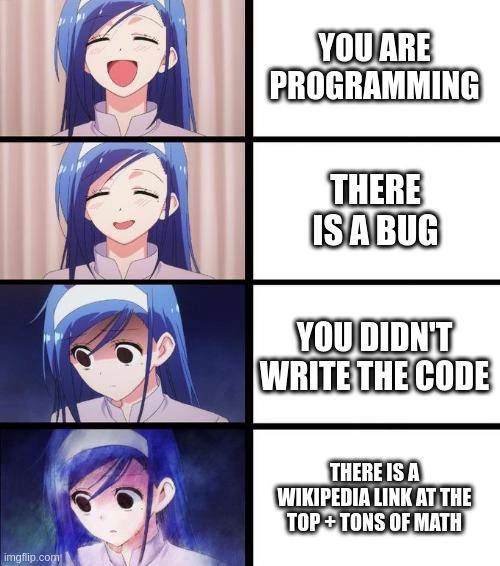
“YOU ARE PROGRAMMING” – Everything starts innocently. You’re happily coding along, blissfully unaware of the lurking issue. This is the calm before the storm, when ignorance is bliss and you assume the system just works.
“THERE IS A BUG” – Uh-oh. Something’s not working correctly. A bug report comes in or a test fails. Still, you’re not panicking yet – bugs are part of the job. Seasoned devs encounter glitches daily. You roll up your sleeves thinking, “Alright, let’s see what's wrong.”
“YOU DIDN’T WRITE THE CODE” – Now the dread creeps in. You locate the failing module and realize it’s not code you’re familiar with. In fact, nobody on the current team wrote it. It might be a legacy module inherited from a contractor or a developer who left years ago. This is the moment every developer’s stomach sinks a little. Why? Because when you didn’t write the code, you lack the mental model of how it’s supposed to work. You don’t know its assumptions, its intended behavior, or its dirty little secrets. It’s effectively a black box: you know inputs and outputs, but the inner workings are mysterious. At this point, you’re experiencing true DebuggingFrustration. You might run a
git blameout of desperation, only to find the code last touched 5 years ago by “SomebodyElse”. The commit message might as well say “Good luck, future maintainer!” This is prime MaintenanceNightmare fuel. 🙃“THERE IS A WIKIPEDIA LINK AT THE TOP + TONS OF MATH” – The final reveal. You open the source file to find a comment at the very top: perhaps something like
// Implementation based on Wikipedia: [Some Algorithm Name]. And below it... wall-to-wall math-y code. We’re talking dense formulas, unusual variable names (delta,mu,theta), maybe some bitwise tricks, and a complete lack of human-friendly documentation. This is the punchline that turns the scenario from worrisome to comically horrifying. It’s as if the original developer said, “I have no time (or ability) to explain this – here’s a link. Figure it out.” Your wide-eyed, cosmic horror reaction in that last panel? Totally justified. This is legacy_code hell.
Why is this so funny (in a painful way) to experienced devs? Because it’s relatable. Most have faced something like this:
- A critical bug appears in an old payment calculation module at 5 PM on a Friday. You crack it open and find a barely commented implementation of a “Normalized Such-and-Such Algorithm” straight out of a research paper. Cue the git_blame_horror: the author’s long gone, and the one-line comment just links to an academic article. You instantly feel out of your depth.
- Or perhaps it’s a piece of SpaghettiCode from early in the company’s life. Everyone has been treating it as a black box because “it mostly worked.” Now that it doesn’t, you’re the unlucky soul elected to untangle it. As you read, you discover the original dev attempted to implement a fancy mathematical_algorithm they found online. The math is over your head (and certainly over theirs too, which might be why there’s a bug).
This meme exaggerates the emotional rollercoaster:
- Initial Confidence: “I got this.”
- Surprise: “Hmm, a bug, let’s investigate.”
- Unease: “Wait, I have zero context for this code.”
- Dread: “Oh no... it’s full of cryptic math and the only clue is a Wikipedia article. I am so doomed.”
It’s basically the perfect storm of debugging:
- Unknown Code: You’re less efficient and more error-prone reading code you didn’t write. It’s like trying to solve a mystery novel without having read the first chapters.
- Poor Documentation: A Wikipedia link is a double-edged sword. It tells you what algorithm it might be, but now you have to educate yourself on that algorithm. It’s the opposite of clear in-line comments or an easy explanation. It says, “hope you like homework!” 📚
- Heavy Math or Theory: Now you’re not just debugging normal logic; you have to parse complex formulas or theory. If you’re rusty on your math, tough luck – the code assumes you know it. Many devs in industry don’t regularly use advanced math, so this feels like being back in an exam you didn’t study for.
- LegacySystem Context: Often such code sits in an old part of the system (a legacy payment calculator, a physics engine, a routing algorithm). It might be critical, and no one touched it for years because it worked... until now. That means zero recent experience or tests to lean on.
The humor is that every experienced engineer recognizes this scenario as both absurd and inevitable. We laugh (with a groan) because we’ve been there: the sinking feeling when a simple bug hunt turns into a PhD dissertation. It’s the facepalm realization that resolving this one-line bug might require an afternoon spent relearning calculus or reading an academic paper’s fine print. In meetings, we joke about “Wikipedia-driven development” or “Stack Overflow cargo cult code” – this meme nails that culture. It’s mocking the way developers sometimes just copy a complex solution from the internet, drop it in, and run, leaving the next maintainer to decipher the sorcery. The “tons of math” implies the code isn’t self-explanatory; it probably leverages some clever formula that’s optimal but impossible to intuit.
In essence, “Black Box Blues” means you’re stuck singing the sad song of the maintainers. You have a mysterious black box of code that everyone relied on and nobody truly understood. When it breaks, you feel the escalating dread exactly as depicted by the anime girl’s expressions. Veteran developers joke darkly about this because it’s a rite of passage: DebuggingFrustration at this level either breaks you or turns you into the cynical, battle-scarred senior who jokes, “There’s a reason I drink so much coffee.” The meme lets us laugh at our pain – it’s funny because it’s true.
Level 4: Eldritch Algorithm
At this deepest level, the meme taps into the arcane side of software debugging. When a bug surfaces in code backed by a Wikipedia-sourced algorithm, you're no longer just a developer – you’ve unwittingly become a student of theoretical computer science at 3 AM. The code isn’t a simple sequence of business logic; it’s implementing some academic algorithm or complex mathematical formula. In practice, that means the source code might as well be an ancient grimoire filled with Greek letters and cryptic formulas. The comment at the top is a Wikipedia link, hinting that the “documentation” is an entire encyclopedia entry on, say, Newton-Raphson iteration or the Ford-Fulkerson method. This is where debugging transcends routine programming and starts to feel like deciphering an eldritch tome.
To fix the bug, you might need to understand the underlying math the same way a researcher would. It’s not enough to know what the code does; you need to know why the algorithm works. Is it an implementation of Dijkstra’s shortest path algorithm? Perhaps a custom cryptographic function? Whatever it is, the logic is grounded in proofs, invariants, and edge-case considerations that were probably discussed in an academic paper or the Wikipedia page – not in the code comments you hoped for. The humor (and horror) comes from realizing that to find one stray bug, you must wade through theoretical concepts like convergence criteria or combinatorial optimizations. You may find yourself recalling long-forgotten college lectures on dynamic programming or big-O complexity, trying to deduce if the bug violates some mathematical invariant. In a sense, you’re performing software archeology: reading not just code, but also scholarly knowledge embedded by reference.
At this level, the meme hints at fundamental truths of computing. Some algorithms are inherently complex – so complex that even the original developer didn’t trust themselves to explain it in plain English. Instead, they summoned the authority of Wikipedia (or the academic world) as a guardian at the gate: “Here lies the sacred formula, proven and true – enter at your own risk.” The final panel’s cosmic purple glow isn’t just for drama; it’s a nod to the cosmic horror a programmer feels confronting the infinite depths of computer science theory hidden in their everyday work. Like a Lovecraftian codebase, peering too deeply into these inscrutable algorithms can drive one to madness (or at least long nights of head-scratching). It’s a reminder that beneath our high-level applications, there often lurk mathematical monsters and beautifully terrifying algorithms that only reveal their teeth when something goes wrong.
Description
A four-panel meme format featuring a blue-haired anime girl on the left, whose expression degrades from joy to terror, paired with corresponding text on the right. In the first panel, she is happy with the text 'YOU ARE PROGRAMMING.' In the second, her smile is calm with 'THERE IS A BUG.' In the third, she looks concerned, with the text 'YOU DIDN'T WRITE THE CODE.' In the final panel, her face is a mask of sheer horror as the text reads 'THERE IS A WIKIPEDIA LINK AT THE TOP + TONS OF MATH.' The meme perfectly captures a developer's sinking feeling when troubleshooting. The progression illustrates that a bug is routine, but a bug in someone else's code is annoying. However, the ultimate nightmare is discovering the bug lies within a complex, academic algorithm, likely copy-pasted from a scientific source, which now must be understood to be fixed
Comments
19Comment deleted
That moment you find a Wikipedia link in the code isn't just a bug, it's a peer-reviewed nightmare. You know you're not just fixing a null pointer, you're about to get a PhD in whatever arcane branch of mathematics the original author was into
Nothing says "welcome to maintenance" like opening a 600-line function named `process()` and realizing the original author outsourced the spec to Euler
The moment you realize the previous developer implemented a custom Fast Fourier Transform because "the library version was too slow" and now you're three Wikipedia tabs deep trying to understand why the Cooley-Tukey algorithm breaks at exactly 2^13 samples
Every senior engineer knows this progression: you're confidently refactoring, hit a bug in some inherited numerical library, trace it back to a single-letter variable function, and suddenly you're three Wikipedia tabs deep into Fourier analysis, questioning whether your CS degree adequately covered enough differential equations. The code works, the tests pass, but *why* it works requires a mathematics PhD you don't have - so you do what any pragmatic engineer does: add a comment saying 'DO NOT TOUCH: Here be dragons and eigenvalues' and slowly back away from the file
Traced the bug up the stack, only to find P vs NP squatting at the top with a Wikipedia tab open
You know you’re senior when a 3am page ends in node_modules, the file starts with a Wikipedia citation, and the postmortem is “changed <= to < and made the sort stable.”
Chasing a stack trace into a transitive dep whose header starts with a Wikipedia link - congrats, you’re now the maintainer of numerical stability and ABI compatibility
if you ever find such a bug that's meeeeeeeeeeeeeee :3 Comment deleted
Flashbacks to trying to test and debug researcher code. "why can't we just use Greek letters as variable names?" Comment deleted
i mean, that's a reasonable question if you have a paper that uses greek letters for designations Comment deleted
It does not make for terribly readable code though! Comment deleted
I'd rather see a lambda calculus interpreter say alpha_conversion, beta_reduction and eta_reduction than renaming_conversion, function_application and extensionality_optimization. At least the former names have a well-known associated meaning no one's going to interpret differently Comment deleted
Might be just me though Comment deleted
It all depends on the context and whatever Comment deleted
yeah Comment deleted
You can (if you use a compiler that's utf-8-aware enough) Comment deleted
meanwhile typical julia 😄 Comment deleted
Explain pls Comment deleted
when you asked a stem major to center a div Comment deleted