Gently Discouraging AI Bots with a 10GB 'Welcome' Mat
Why is this AI ML meme funny?
Level 1: Candy Jar Trap
Imagine you have a cookie jar that a sneaky robot keeps trying to steal cookies from. You’re tired of this robot taking your treats. So instead of just putting up a “Do Not Touch” sign (which the naughty robot ignores), you decide to play a trick. You fill the cookie jar with something ridiculously huge and useless – like 10 pounds of stale bread. The next time the robot reaches in expecting yummy cookies, it gets a handful of heavy, boring bread that takes forever to pull out. It’s stuck dealing with that big lump of bread for a long time, and in the end it still has no cookies.
This meme’s joke is just like that. A website owner didn’t want certain robot programs (automated scanners that collect website text) to grab his content. Telling them “no” politely wasn’t working, so he gave them a super heavy fake file (like the stale bread) to download. The robots waste time downloading 10 gigabytes of data – which is an enormous amount, kind of like an endless loaf of bread – and they gain nothing useful from it. It’s a funny tech way of tricking the “cookie thief” so they regret being greedy. The website basically says, “Sure, help yourself…” but secretly makes sure the only thing the thief gets is a huge, time-wasting blob. The humor comes from how ridiculously over-the-top this trap is, and how the naughty bots effectively prank themselves by falling for it. It’s a geeky high-five moment, where the good guy outsmarts the sneaky robot with a giant digital prank!
Level 2: Tricking the Crawlers
Let’s break down what’s happening in simpler terms. Websites often have a file called robots.txt at their root. It’s basically a set of polite house rules for bots (automated programs that crawl the web). For example, Google’s search bot checks robots.txt to see if it’s allowed to index certain pages. Site owners use it to say things like “User-agent: X, Disallow: /private-stuff” – meaning “hey Bot X, please don’t look in my /private-stuff section.” Good bots usually listen, but bad bots (or ones focused on building AI datasets) might ignore these rules. Recently, with all the buzz around AI and Large Language Models (LLMs), many website owners have started adding rules to block AI scrapers (bots that grab content for AI training). Cory’s AI blocking robots.txt refers to one developer’s shared list of known AI bot names to disallow – a community-driven attempt to tell AI data harvesters “keep out.”
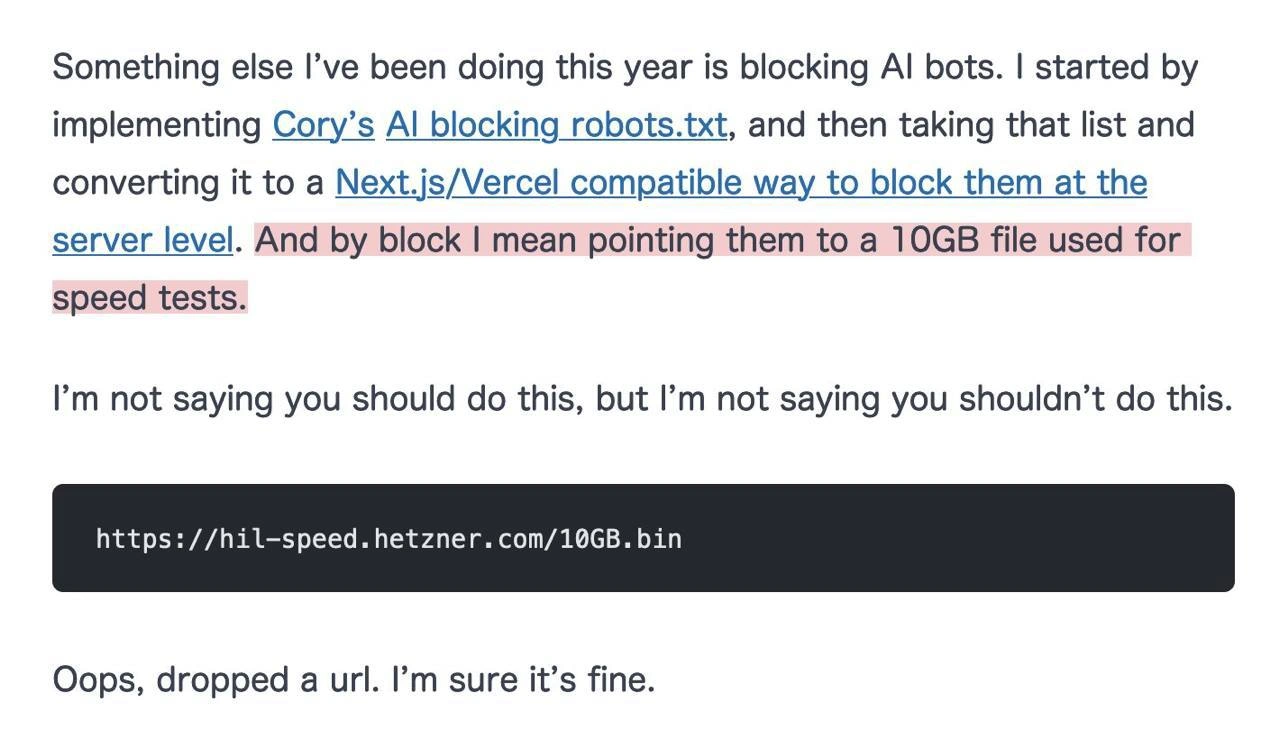
In this meme, the author went a step further: they didn’t just rely on the honor system of robots.txt. They implemented an actual server-level trick in a Next.js website (which is a popular React-based web framework for building web pages) hosted on Vercel (a platform for deploying Next.js apps). Next.js allows developers to set up custom rules for incoming requests. So what this person did was: if a request comes in from one of those known AI bots, the server doesn’t serve the page normally. Instead, it redirects the bot to a URL for a huge file – a 10 gigabyte file used for internet speed tests. A redirect (HTTP status code 302, for example) is like the server saying “Oh, you’re looking for this? Go over there and get it instead.” Here “over there” is https://hi-speed.hetzner.com/10GB.bin – a legitimate big file that’s 10GB in size. It’s as if the website is giving the bot a giant decoy to chew on.
Think about it: 10 GB is massive in web terms. That’s 10 billion bytes! Downloading that takes a lot of time and bandwidth. For a human browsing a site, a 10GB download is absurd – we’d never click that. But a bot that’s automatically scraping content might blindly follow the redirect and start downloading this huge file, not realizing it’s pointless. It’s a trap. By the time the bot finishes (if it even does), it wasted a ton of time and possibly resources. Meanwhile, the bot got zero useful content from the original site because it got sidetracked. This is essentially an ai_crawler_trap.
From a web development perspective, it’s a creative use of Next.js and Vercel’s capabilities. Next.js normally handles rendering your pages, but it also lets you intercept requests with middleware or config files. The developer likely used something like a rewrite rule in next.config.js or a middleware function to check the request’s User-Agent header. The User-Agent is a little piece of information every browser or bot sends, saying who/what they are (e.g., “Chrome” or “GPTBot”). By matching known AI bot names in that header, the server can single out bad actors. Then, instead of serving the normal content, it sends them a server_side_redirect_prank – essentially saying “Nope, take this instead!” This trick doesn’t hurt normal visitors at all; if you or I visit the site with a regular browser, we get the usual pages. But an unwanted AI bot gets the 10GB.bin detour. It’s a high-tech form of trolling the bots.
Why is this funny to developers? Partly because it’s karma for greedy scrapers. There’s a bit of an ethical debate these days: AI companies are scraping tons of data from the open web to train their models (that’s the AI_hype_vs_reality — the hype is AI is magical, the reality is it eats up our content). Many site owners aren’t happy about unknown bots vacuuming up their articles or images without consent. Simply asking them not to (via robots.txt) might not be enough. So seeing a developer not only block them but send them on a wild goose chase for a 10GB file feels satisfying in a cheeky way. It’s like the website is saying, “Oh, you want to devour my data? Here, chew on this huge chunk of nothing for a while!” The phrase highlighted in the meme – “And by block I mean pointing them to a 10GB file used for speed tests” – really drives home that mischievous tone. The author even playfully says, “I’m not saying you should do this, but I’m not saying you shouldn’t.” In other words, this is a prank, attempt at your own risk!
In summary, at this level: AI bots were supposed to be blocked by the usual rules, but instead they get redirected to a massive 10GB download. It’s a clever, tech-savvy joke at the expense of AI scrapers. Web developers and security folks chuckle because it flips the power dynamic: the bot wants to consume the site’s content, and ends up getting its resources consumed (time, bandwidth) by a meaningless file. It’s a modern twist on honeypotting (setting a trap for bad actors). And seeing that dark code-block in the meme with the URL hi-speed.hetzner.com/10GB.bin dropped in there – it’s basically the meme shouting, “Oops, did I just trick an AI bot into downloading a huge file? How savage!”
Level 3: Bandwidth Honeypot
This meme showcases a cunning DevOps prank that seasoned developers find both brilliant and brutal. Normally, a robots.txt file is a polite way of saying “Hey bots, please don’t go here.” It’s part of WebSecurity 101 on the web: search engines and scrapers check robots.txt for rules about what’s off-limits. But here the site owner weaponized that concept. They took a community-curated list of AI crawler user-agent names (inspired by Cory’s anti-ML robots.txt rules) and used a Next.js/Vercel server configuration to do something deviously clever. If an incoming request looks like an unwelcome AI scraper, the server doesn’t just say “Access Denied” – it issues an HTTP redirect pointing the bot to a 10 gigabyte file (10GB.bin) hosted on a high-speed server. In essence, it’s a robots_txt_honeypot: a trap where the bait is an endless data download. The unwitting bot happily follows the redirect and gorges on 10GB of garbage data, burning its bandwidth and time for nothing. It’s like the webmaster judo-flipped the script – turning the bot’s own appetite for data against it.
For senior engineers, the dark humor is immediate: this is security through obscurity taken to an extreme, or rather security through excess. We’re seeing an AI_ML arms race in real time. AI hype vs reality? The hype is these LLM scrapers hungrily vacuum up internet content; the reality is developers fighting back with bandwidth warfare. This “savage robots.txt upgrade” is essentially a server_side_redirect_prank: instead of politely disallowing, it trolls the bot. Picture some machine-learning data pipeline suddenly choking on a massive 10GB download it was tricked into — somewhere an engineer maintaining that scraper might be scratching their head at an unexpected spike in traffic (“why did our bot just download a 10GB speed test file from Hetzner?”). It’s bandwidth_bill_revenge: if AI companies won’t respect a simple “no trespassing” sign, hit ’em in the network I/O.
What makes this especially satisfying to veteran devs is the elegant mischief of it. It’s not outright attacking anyone; it’s using the HTTP standards and cloud configuration in a mischievous way. In a modern Next.js app on Vercel, you can define custom middleware or next.config.js rewrite rules (basically nextjs_rewrite_rules) to inspect the User-Agent header of requests. If the header matches one of the known AI bot signatures (like “OpenAI-GPTBot” or other AIGeneratedContent crawlers), the code can respond with a 302 Found redirect to that 10GB file. Vercel’s platform (and its edge functions, i.e., vercel_edge_functions) makes this possible at the very edge of the network, so the bot is sent away before it even hits the actual site content. It’s a bit like an automated “moat” for your website: friendly visitors walk right in, but invasive bots fall into an endless pit.
Of course, any battle tactic has its trade-offs (SecurityTradeoffs). Serving a 10GB redirect is extreme – one has to chuckle and also wonder, “hope they don’t inadvertently DDoS the poor Hetzner speed-test server with this stunt!” 😅 In practice, it’s a safe bet that only a few bots will ever follow that link, and it’s a file meant for stress-testing networks anyway. Still, using a honeypot like this is more of a tongue-in-cheek protest than a scalable solution. Experienced devs recognize the pattern: it’s reminiscent of tarpitting in network security (where you deliberately slow down attackers) or creating fake "sinkhole" data to frustrate scrapers. The meme lands because it perfectly captures that DeveloperHumor mood of “fine, if you’re going to steal my content, enjoy this 10GB of nothing!” – simultaneously WebDev clever and devilishly DevOps_SRE chaotic. It’s a high-tech practical joke on the rampant AI crawlers, and the senior folks love it because it’s one of those rare moments where a hack is both technically sound and hilariously satisfying.
Description
A screenshot of a text post detailing a creative and passive-aggressive method for handling AI web scrapers. The author explains that instead of simply blocking AI bots using robots.txt, they've configured their Next.js/Vercel server to redirect them to a 10GB file typically used for speed tests. The post includes the link to the file, followed by the mock-innocent phrases, 'I'm not saying you should do this, but I'm not saying you shouldn't do this,' and 'Oops, dropped a url. I'm sure it's fine.' The humor comes from the maliciousness of the solution; it's a 'tar pit' designed to waste the AI scraper's resources (time, bandwidth, storage) by forcing it to download a massive, useless file. This is a form of protest against the unsolicited scraping of web content for training AI models, a popular topic among developers
Comments
31Comment deleted
Giving an AI scraper a 10GB file to download isn't a denial-of-service attack; it's just an extremely high-latency API response
Finally a rate-limit strategy that scales linearly with Hetzner’s invoice - turn every unsolicited crawl into an involuntary load test
Nothing says 'your training data is valuable to me' quite like redirecting GPTBot to a 10GB speed test file. It's the digital equivalent of answering spam calls with a fax machine noise - technically serving content, just not the kind they bargained for when they ignored your robots.txt
Ah yes, the elegant solution to AI scrapers: death by a thousand megabytes. It's like a tarpit, but instead of slowing them down with computational complexity, you're just making them download the entire Lord of the Rings extended edition in raw binary. The beauty is in the simplicity - no fancy rate limiting, no complex bot detection algorithms, just pure 'here, have 10GB of nothing and think about what you've done.' It's the digital equivalent of answering a telemarketer's call and just leaving the phone off the hook next to a running faucet. And the 'Oops, dropped a URL' is *chef's kiss* - plausible deniability meets malicious compliance. Though I suspect the real victims here are the junior devs who accidentally curl that endpoint during debugging at 4 AM on their metered connection
Call it externalized rate limiting: when the User-Agent says “GPTScraper”, we 302 to Hetzner’s 10GB.bin - robots.txt is optional, egress charges aren’t
robots.txt for polite bots; real serverless defense rewrites scrapers to Hetzner's eternal speed test gauntlet
Robots.txt asks nicely; my Next.js middleware replies with a 302 to Hetzner’s 10GB.bin - the only rate limit that invoices the crawler’s ISP instead of my CFO
memes on this channel have gotten really bad Comment deleted
that's not a meme, dude. that's a call to action Comment deleted
Anyone have a link to the blog post or whatever this is from? Comment deleted
https://hil-speed.hetzner.com/10GB.bin Comment deleted
Tbf they can fix this pretty easily Comment deleted
Unless they actually proxy it Comment deleted
just return a file with br encoding, only need 328KB disk space on server for a 400GB data Comment deleted
this will cost server bandwidth... Comment deleted
I create a file for test: https://b.j2.cx/bomb400G.br use this with openresty lua code (use with cloudflare will be better lol) #from https://www.chenxublog.com/2020/11/16/web-bomb-eat-memory.html location /large { default_type 'text/html'; content_by_lua_block { local f = io.open("/home/ubuntu/bomb400G.br","rb") if not f then ngx.say("file not found") return end ngx.header["Content-Encoding"] = "br" local data while true do data = f:read(1024) if nil == data then break end ngx.print(data) ngx.flush(true) end f:close() } } Comment deleted
DAMN, how you edit your message into this.. Comment deleted
```yapping_language ```yapping_language *insert yapping* ``` ``` Comment deleted
eval $(echo "I<RA('1E<W3t`rYWdl&r()(Y29j&r{,3Rl7Ig}&r{,T31wo});r`26<F]F;==" | uudecode) Comment deleted
is this supposed to be a fork bomb Comment deleted
I can neither confirm nor deny the allegations Comment deleted
umm, what's the point of using lua? can't you just serve the file directly via nginx? Comment deleted
openresty = nginx + ngx_lua module Comment deleted
it ignore encoding in user's request header, force return br encoding Comment deleted
i'm admittedly somewhat out of my depth, but can't nginx do just that without scripting? Comment deleted
nginx conf location /br { default_type 'text/html'; add_header Content-Encoding br; more_clear_headers Content-Length; } but this can't hide Vary: Accept-Encoding, so can't cheat cloudflare Comment deleted
wtf is this Comment deleted
ایرانی Iranian Comment deleted
please use English in this chat Comment deleted
mhm Comment deleted
could they just check size with download metadata? Comment deleted