The Sweet Relief of a Predictable Failure
Why is this Debugging Troubleshooting meme funny?
Level 1: The Right Kind of Squeak
Imagine your bike makes a horrible mystery noise. For days you can't tell where it's from — sometimes the wheel, sometimes the pedals, sometimes nowhere. Then one afternoon you figure out it squeaks only when you turn left, every time you turn left. The bike is still broken — it squeaks exactly as much as before — but you're weirdly happy, because now you finally know where to look. The man in the picture is smiling that strange, tired smile because his thing is still broken, but it's broken in a way he finally understands — and somehow that feels like winning, even though nothing works yet.
Level 2: Errors Have Flavors
Early on, all errors feel the same: red text, broken app, vague guilt. Experience teaches you they come in two fundamentally different flavors. An unexpected error is the system telling you that you don't understand it — a stack trace pointing somewhere you've never heard of, a crash with no pattern. An expected error is one your current theory of the bug predicts: "if the config file is missing, it should fail right here with FileNotFoundException" — and then it does. Same red text, completely different meaning.
That's why developers deliberately chase reproduction first. A typical debugging loop looks like:
1. Observe mystery failure
2. Form theory: "the API call fails when the user has no profile"
3. Create that condition on purpose
4. See the EXACT error you predicted ← this meme, this face
5. Now (and only now) fix it
Step 4 feels absurd from outside — you worked hard to make the app fail and you're pleased — but it proves you've found the real cause rather than a coincidence. The first time you experience it (often during your first production incident, watching logs scroll by), you'll catch yourself saying "yes! There's the error!" out loud, with genuine joy, about a broken system. Congratulations: the known failure mode has replaced chaos, and chaos was the actual enemy. Harold's smile is what that joy looks like after the fourth hour.
Level 3: Deterministic Failure Is a Feature
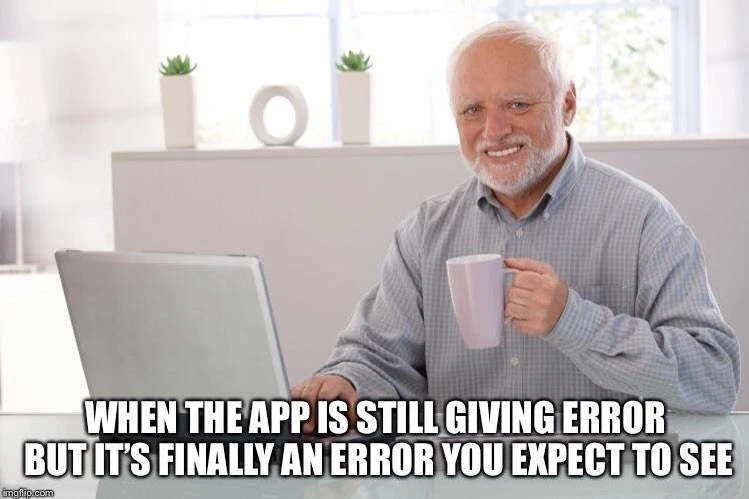
WHEN THE APP IS STILL GIVING ERROR BUT IT'S FINALLY AN ERROR YOU EXPECT TO SEE
Hide the Pain Harold — pale mug raised, succulents serene behind him, smile held together with willpower — is the only correct face for this milestone, because the milestone is real and the outside world will never understand it. To a product manager, "still erroring" means zero progress. To anyone who has actually debugged a system, converting an unexplained failure into an expected one is most of the work. Debugging is not primarily the act of fixing; it's the act of collapsing the space of possible explanations until exactly one remains. An error you can predict means your mental model of the system finally matches the system. The fix is usually the trivial epilogue.
This is why seasoned engineers treat reproducibility as the first victory condition. The taxonomy of bugs runs from the merciful to the damned: deterministic bugs at the top; then state-dependent ones ("only after the cache warms"); then the heisenbugs that vanish under the debugger because attaching it changes the timing; and at the bottom, the intermittent production-only failure that reproduces exclusively when you're not watching. Moving a bug up this ladder — from "sometimes 500s" to "always throws NullPointerException in the session handler when the token is expired" — is genuine engineering output, even though the user-visible behavior is identical: broken. The practice is institutionalized everywhere once you look: test-driven development literally begins by writing a test that fails in the expected way (red before green); SRE postmortems prize "we understand the failure mode" over "it stopped happening"; and the scariest sentence in operations is not "it's down" but "it started working again and we don't know why" — because an error that left without explanation has merely gone home to get reinforcements.
The Harold format adds the organizational layer. That strained smile is the face you make in standup saying "good progress on the bug" while the ticket's status remains, technically, on fire. The gap between internal progress (entropy reduced, hypothesis confirmed) and external metrics (error rate: unchanged) is a small, daily installment of the industry's chronic mismatch between what work is and what work looks like. Harold has clearly been here before. The mug is doing a lot of load-bearing.
Description
The image uses the 'Hide the Pain Harold' meme format. An elderly man with a grey beard and hair (Harold) is sitting at a modern-looking glass desk with a silver laptop. He is holding a light purple mug and looking directly at the camera with a forced, pained smile that doesn't reach his eyes. The background is a bright, out-of-focus office or home setting. A white, bold, all-caps caption is overlaid at the bottom: 'WHEN THE APP IS STILL GIVING ERROR BUT IT'S FINALLY AN ERROR YOU EXPECT TO SEE'. The watermark 'imgflip.com' is visible in the bottom left corner. This meme perfectly captures a nuanced milestone in the debugging process that experienced engineers know well. The humor isn't about solving the problem, but about making it predictable. An unexpected error is a mystery, but an expected error means your mental model of the system is getting closer to reality. It's the moment you've successfully isolated a condition, and while the system is still broken, it's broken in a way you understand and can now systematically address. The pained smile is the perfect representation of this feeling: relief at making progress, mixed with the exhaustion of the debugging journey so far
Comments
8Comment deleted
The five stages of debugging: Denial, Bargaining, Anger, 'Oh, *that's* the error I was looking for!', and finally, acceptance... that you just introduced three new bugs
Prod’s still throwing 500s, but the stack trace finally matches the chaos test scenario - congrats team, we’ve upgraded from Heisenbug to documented outage
That moment when you've successfully refactored the quantum state from "Heisenbug" to "deterministic failure" and can finally write a proper unit test for it
In debugging, a reproducible error isn't failure - it's the first green checkmark on the road to closing the ticket as 'works as intended'
Ah yes, the sweet relief when your error messages finally graduate from 'NullPointerException at line 2847 in a minified bundle' to 'Invalid API key format' - it's like your codebase finally learned to communicate in complete sentences instead of just screaming into the void. This is the debugging equivalent of a detective realizing the suspect they've been chasing actually exists, even if they haven't caught them yet. Senior engineers know this feeling well: when the error stops being a Heisenbug that vanishes under observation and becomes a predictable, reproducible failure, you're no longer debugging - you're just filling out the paperwork before the fix
After weeks of heisenbugs vanishing under scrutiny, a good old stack overflow feels like home
Senior win: it still errors, but now with the exact 409 you spec’d - failure finally went from Byzantine to fail-stop, complete with a trace ID
When the stack trace graduates from random ECONNRESETs to PreconditionFailedException, you know the failure finally moved from the network to your domain layer - deterministic enough to schedule behind a feature flag