A Tale of Two C's: The C++ Reality Check
Why is this Languages meme funny?
Level 1: The Friendly Dog's Wolf Cousin
Imagine you have a sweet golden retriever named Charlie. One day someone says, "Want to meet Charlie's cousin? Basically the same dog — look, the names even match!" So you walk up to pet it, and it's a wolf. Same general shape, same family, technically — but this one doesn't fetch, doesn't sit, and stares at you like it remembers things from the forest. The cat's frozen, wide-eyed face in the meme is that exact moment: the instant you realize the "very similar" thing you confidently approached operates by completely different rules, and it's too late to pretend you didn't already reach out your hand.
Level 2: The Garbage Collector You Didn't Know You Loved
Two key terms explain Tom's stare. Garbage collection (C# has it; C++ doesn't) means the language automatically cleans up memory your program no longer needs. Without it, you are the garbage collector: every chunk of memory you take must be given back, exactly once, at exactly the right time. Forget — that's a memory leak. Free it twice or use it after freeing — that's undefined behavior, where the program may crash, misbehave, or pretend everything's fine until demo day.
int* data = new int[10];
data[10] = 42; // one past the end — compiles fine, no warning,
// crashes... sometimes. Somewhere. Later.
In C#, the equivalent mistake throws IndexOutOfRangeException immediately, pointing at the exact line. That difference — being told what you did wrong versus being silently punished at a random future moment — is the usability gap the meme's author walked into. The "C" in both names is real shared ancestry: both descend from the C family's syntax, which is why the first ten minutes feel familiar (loops, braces, classes all look the same). It's the second hour, when the compiler emits a 400-line template error or the program dies with segfault, that produces the face in the bottom panel. This is a near-universal rite of passage; assuming related names mean related experiences is how everyone learns that language syntax is the cheapest part of a language.
Level 3: Sibling Languages, Estranged at Birth
The meme's setup —
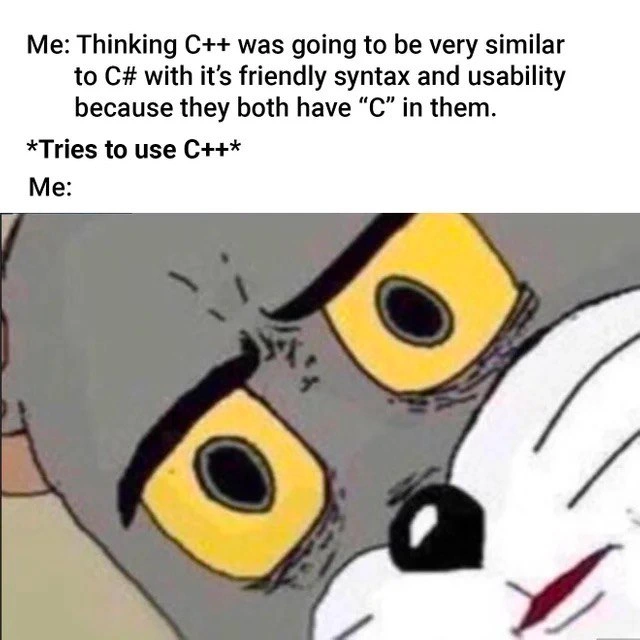
Me: Thinking C++ was going to be very similar to C# with it's friendly syntax and usability because they both have "C" in them.
Tries to use C++
— followed by Unsettled Tom's bulging, thousand-yard sideways stare, lands because the name-similarity assumption is almost defensible, which makes the betrayal worse. C# was explicitly designed in C-family syntax — curly braces, classes, even the ++ of C++ promoted to a # (visually, two stacked ++). Microsoft built it as a managed, friendlier answer to the C++/Java world. A newcomer who reads "C, C++, C#" as a version progression is committing the same fallacy as "Java is to JavaScript as car is to carpet" — but here the languages genuinely are relatives. The horror is in how far the family drifted.
The drift is philosophical, not cosmetic. C# runs on a runtime that manages memory for you: a garbage collector quietly reclaims objects, references are safe by default, arrays check their bounds, and a misstep throws a tidy exception with a stack trace. C++ hands you raw pointers, manual lifetimes, and the doctrine of zero-cost abstractions: you don't pay for what you don't use — and you also don't get safety you didn't explicitly build. The price of that control is undefined behavior, the language's signature dread: read past an array's end and the standard permits anything — a crash, silent corruption, or working fine on your machine and detonating in production. There's no friendly exception, just Segmentation fault (core dumped) if you're lucky.
Then there's the surface a learner actually touches. C# greets you with one IDE, one package manager, one build system, one massive standard library. C++ greets you with a choice of compilers, a build ecosystem (CMake and its rivals) widely considered a second job, header files versus translation units, and template metaprogramming — a Turing-complete sublanguage inside the type system whose error messages can run to hundreds of lines because you typo'd one iterator. Decades of accumulated standards (C++98 through C++23) mean every codebase is a geological dig: smart pointers in the new strata, raw new/delete in the old, and at least one macro from 2003 nobody dares remove. The meme captures the precise moment the learner's mental model collapses — Tom's face is not fear of difficulty, it's the deeper unease of realizing the map was wrong. Smart organizations keep making this mistake at scale, too: "we have C# devs, the C++ service can't be that different" has burned more sprint estimates than any compiler ever will.
Description
This is a two-part meme using the 'Unsettled Tom' or 'Concerned Tom' image from the cartoon 'Tom and Jerry'. The top section contains white text on a plain background that reads: 'Me: Thinking C++ was going to be very similar to C# with it's friendly syntax and usability because they both have “C” in them. *Tries to use C++* Me:'. The bottom section is a close-up image of the cartoon cat Tom, looking utterly horrified. His yellow eyes are wide with constricted pupils, and his expression is one of pure shock and terror, as if he's just witnessed something deeply disturbing. The humor comes from the dramatic gap in expectations versus reality. C# is a high-level, managed language known for its relative safety and developer-friendly features, while C++ is infamous for its complexity, manual memory management, and unforgiving nature. For an experienced developer, this meme is a nostalgic reminder of the brutal learning curve of C++ and the naive assumptions one might make when starting out. It's a classic rite of passage, moving from a language that protects the developer to one that gives them enough power to cause catastrophic errors with a single misplaced asterisk

Comments
8Comment deleted
C# asks you to wear a helmet and safety goggles. C++ hands you a loaded nail gun and says, 'Try not to shoot your foot off... again.'
Porting our C# service to C++ seemed trivial - right up until a 200-line template instantiation error reminded me that in this language the garbage collector is an unpaid internship, and I just got the job
The same junior who thought C++ and C# were similar is now convinced our microservices should use gRPC because "it has RPC in the name, just like our legacy SOAP services."
C# and C++ are similar the way Java and JavaScript are: legally distinct, spiritually hostile, and both ready to ruin your sprint estimates
Ah yes, the classic 'they both have C in the name' fallacy - like assuming JavaScript and Java are similar because they share four letters. The moment you realize C# is a garbage-collected, managed runtime paradise while C++ is a manual memory management gauntlet where you're one dangling pointer away from undefined behavior, that's when the cat face truly emerges. Welcome to the world where RAII isn't just a pattern, it's a survival strategy, and 'delete' isn't handled by a benevolent runtime - it's your personal responsibility, along with the segfaults that follow
Expected C# ergonomics; C++ handed me RAII, the Rule of Five, and an ODR/linker error that only appears under -O2 - the shared “C” apparently stands for “see you in the debugger.”
C++: Where the 'C' starts standing for 'Cursed' right after your first SFINAE error
I thought C++ was C# with extra pluses - turns out those pluses count the things you now own: lifetimes, allocators, ABI, and the linker’s mood