When the Ethernet cable literally becomes the computer virus your CS teacher dismissed
Why is this Security meme funny?
Level 1: The Cable Monster
Imagine your teacher tells you, “Don’t worry, a computer virus is just pretend in the physical world. It’s not going to jump out and hurt you.” That’s like someone saying there’s no monster under your bed. It makes you feel safe. Now picture this: right after the teacher says that, a computer cable on your desk suddenly sprouts little wire legs and starts crawling like a spider! 😱 It’s as if the “computer virus” came to life as a tiny cable monster. Of course, this isn’t real – it’s a joke. In real life, viruses in your computer don’t turn into actual bugs or creatures. But the idea is funny because it surprises you: something that can’t possibly happen is happening in the picture. It’s a playful way of saying the teacher’s assurance was immediately “proven wrong” by a super silly scenario.
Think of it like a cartoon: a teacher says, “There’s nothing to be afraid of,” and then a harmless object (like a cord or a toy) suddenly turns into a goofy monster just to make everyone laugh. The cable monster in the meme is made out of an Ethernet cable (those wires you use for internet) and it looks like a little spider on a notebook. It won’t actually bite, but it might give you a bit of a spook at first glance! The humor comes from taking a boring, safe thing and making it look scary for fun. It taps into that childlike part of us that imagines even our gadgets might come alive at night. In the end, it’s just a funny picture – a way to joke that sometimes our imagination can run wild, even though we know it’s not real.
Level 2: RJ-45 Creepy-Crawly
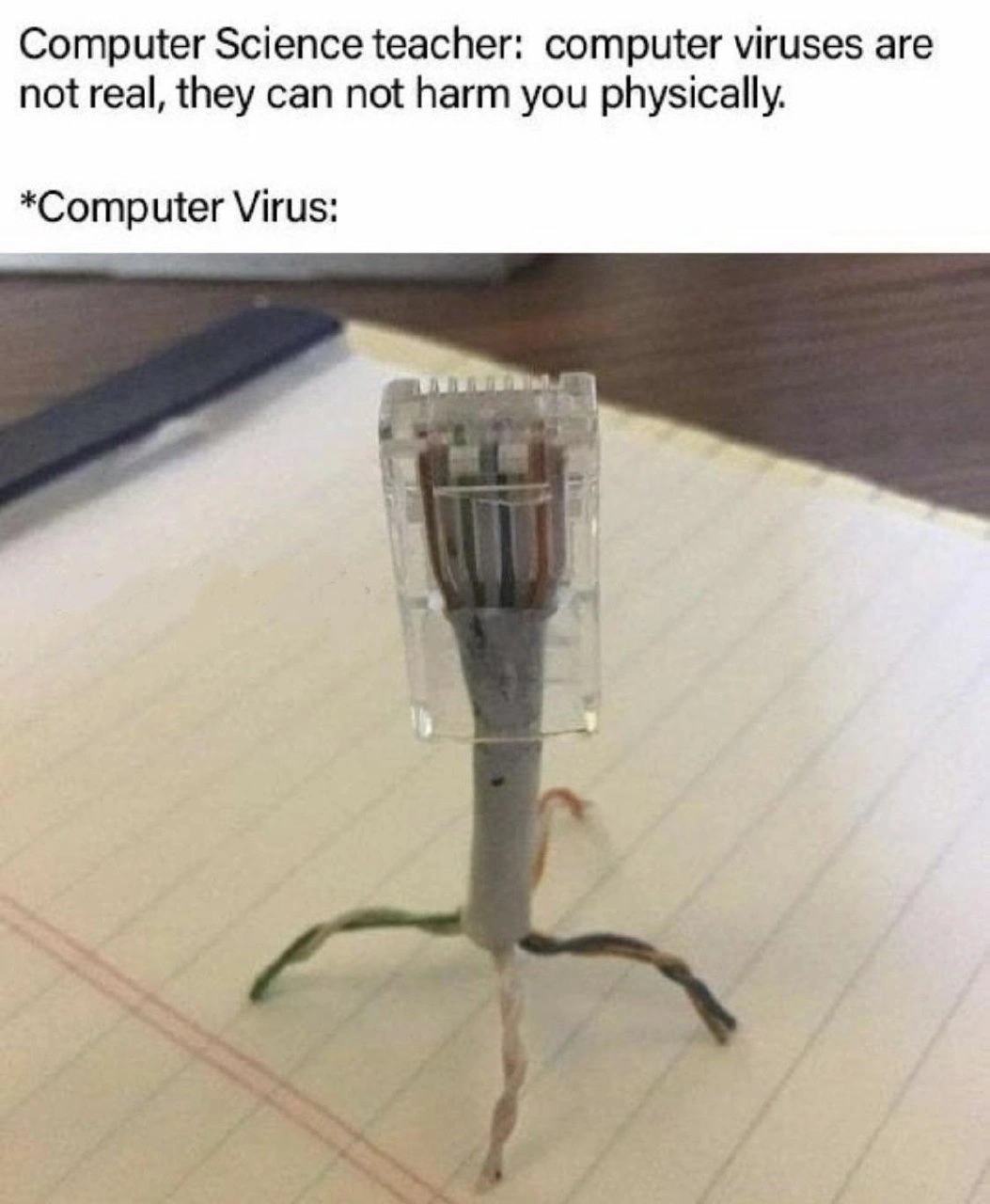
Let’s break down the meme in simpler terms, especially for those new to networking and security. In the image, we have an Ethernet cable – the kind you plug into your computer for wired internet – that’s been physically modified to look like a spider. The top text says: “Computer Science teacher: computer viruses are not real, they cannot harm you physically.” Then it shows "Computer Virus:" followed by that spider-like cable creature. Essentially, the meme is acting out a literal version of a teacher’s claim being proven “wrong” in a joke. The teacher says, “Viruses can’t hurt you in real life,” and the meme answers, “Here’s one that can!” – showing a computer virus personified as a little hardware monster.
First, what does the teacher actually mean by “computer viruses are not real, they cannot harm you physically”? In a basic computer class, teachers often explain that a computer virus is a program – a piece of software. It’s not a living organism. It can mess up your computer by deleting files, stealing data, or making your system crash, but it doesn’t cause you, the person, direct physical harm. You won’t get sick or injured from a computer virus like you would from a biological virus or a poisonous spider. The teacher is basically reassuring students that a computer virus is malware (malicious software) confined to the digital realm. It might give your computer a really bad day, but it’s not going to chase you down the hallway. In other words, “don’t panic, it’s not a literal creature.”
Now, the funny part of the meme is turning that reassurance on its head. The "Computer Virus:" shown is literally an Ethernet cable spider. Let’s identify the parts: the top plastic piece with metal contacts is an RJ-45 connector – the standard plug for Ethernet networking cables (often Category5/Cat5 or Cat6 cables in modern networks). This is the plug you click into your laptop or router to get internet via a wire. Coming out of the back of the plug, the usual cable’s outer rubber jacket has been peeled off and the internal wires are spread out. Inside an Ethernet cable, there are eight copper wires twisted into four pairs (called twisted pairs). Twisting pairs of wires together is a technique to reduce electrical interference so data can travel reliably. In the photo, those four pairs have been unfurled and bent to resemble legs. It looks just like a little spider or crab standing on your desk! Each “leg” is basically two wires still twisted together, which is why they’re a bit thicker – and if you count ends, there are eight individual strands, matching a spider’s eight legs. This crafty setup personifies the virus as a physical critter – a totally hardware-based monster. It’s a physical_hardware_meme gimmick: using actual computer parts to make a joke.
So why is this NetworkHumor and HardwareHumor? Because it takes a very literal view of how computer viruses travel. Think about it: how does a virus get from one computer to another? Often through networks – either over the internet, a local network, or via some physical media like a USB stick. In many cases, viruses spread over Ethernet cables (or Wi-Fi). The Ethernet cable carries data in the form of electrical pulses or signals. Those signals represent all kinds of information – could be your email, a website, or a malicious virus file being downloaded. The cable is part of the network infrastructure that the virus uses to move around. But normally, we don’t blame the cable for the virus – the cable is just a passive carrier, like a road that traffic (data) flows through. The virus is still just code riding along. In the classroom, a teacher might stress: “Hey, the virus is not some physical bug crawling through the wires, it’s just data.”
However, in this meme’s little world, the virus IS a bug crawling through the wires! It imagines that the cable itself turned into a creepy-crawly that could scuttle off the desk. This is funny because it’s such a literal and exaggerated interpretation. It’s a bit like a science-fiction twist on a simple statement. If you’re new to tech, just remember: in reality, an Ethernet cable won’t suddenly sprout legs. 😄 This picture is purely for laughs. It’s referencing how people new to cybersecurity sometimes have imaginative fears, and how teachers often try to clarify them. The tags like Malware, Security, and TechHumor all point to this being a lighthearted take on computer security concepts.
One cool thing for newcomers: this meme inadvertently teaches a tiny bit about networking hardware. By seeing the Ethernet cable opened up, you get a peek at its insides – those colored wires twisted together. Each pair usually has a color combination (e.g., orange/white-orange, green/white-green, etc.), which you can actually see in the “legs.” Those wires normally carry signals at high speeds, allowing computers to communicate. An RJ-45 connector has 8 pin slots to connect those wires. When everything is plugged in, data – including potentially a virus file – zooms through as electricity or light (if it were fiber optics). It’s all part of the physical layer of networking. But here, instead of imagining electrons flowing, the meme makes us imagine a tiny spider robot 😅. It’s a great example of computer_virus_personification – giving a non-human thing (malicious code) a human or animal-like trait (in this case, a body with legs).
Finally, consider the student-teacher dynamic here. The cs_teacher_quote at the top is something you might indeed hear in a class: a teacher assuring students that a virus can’t literally do physical stuff like in a sci-fi movie. Many beginners have heard scary stories about malware, so educators clarify the limits: “Your computer might get a virus, but it’s not going to explode and it certainly can’t infect you like a flu virus.” This meme then jokingly imagines the exact opposite – the nightmare scenario where the teacher’s calming words are instantly invalidated by a rogue cable monster. For a junior developer or a student, it’s a memorable (and laugh-out-loud) way to emphasize just how not real that scenario is. It’s a bit like an inside joke: “Remember when we thought viruses were like literal bugs in the machine?” Now we have a visual of that silly idea. In summary, it’s a fun, geeky reminder that while computer threats are serious, they thankfully stay on our screens – unless someone gets really creative with hardware and a twisted sense of humor!
Level 3: Twisted Pair Terror
The meme sets up a classic Security lesson gone awry. A computer science teacher confidently claims that computer viruses aren’t “real” in a physical sense – meaning malicious code can corrupt your files, but it’s not going to leap out of the screen and bite you. Cue the punchline: an Ethernet cable’s RJ-45 connector has been transformed into a spider-like creature, as if the network hardware itself became the virus and crawled out to prove the teacher utterly wrong. This hilarious visual gag merges Networking and Security humor, playing on the idea that something purely digital (a virus) could manifest in hardware form.
From a seasoned developer’s perspective, there’s rich irony here. We know that a computer virus is just a piece of malicious software – essentially a sequence of bytes that replicates and spreads. It lives in the logical world of bits and bytes, not the physical world of atoms. Viruses typically propagate via networks: they ride along electrical signals in an Ethernet cable or Wi-Fi radio waves, hopping from machine to machine. In the OSI model, the virus might exist at higher layers (application/operating system), but to get to your machine it still has to travel through OSI Layer 1 (Physical) – literally the wires (or fiber or wireless signals). The twisted pair copper wires inside that RJ-45 cable carry the digital infection as a series of electrical pulses. In reality, those pulses won’t reassemble themselves into a creepy-crawly robot, but the meme imagines exactly that. It’s the computer_virus_personification taken to an absurd extreme: the virus grew legs made of cable and is coming for you! 🕷️
This resonates with anyone who’s been through cybersecurity training or dealt with panicky users. We’ve all heard someone ask anxiously, “Can a virus destroy the computer hardware or hurt me?” and a teacher or IT pro responds, “No, no, it’s not like a real virus or a literal bug.” Technically, they’re right: a software virus doesn’t have a physical body. But this meme wittily reminds us that malware does have physical consequences in roundabout ways. For example, the infamous Stuxnet worm (a very real computer virus) didn’t sprout legs, but it did make Iranian nuclear centrifuges spin out of control, physically destroying them. Another virus, called Chernobyl (CIH), attempted to overwrite a computer’s BIOS chip, effectively bricking some PCs back in 1999 – about as close as a virus gets to inflicting physical harm on hardware. And let’s not forget malware that can blast your speakers, flash your screen, or even overheat components by running them full throttle. Seasoned security folks thus chuckle at the teacher’s blanket statement; they know the digital and physical worlds aren’t as separate as that teacher implies. It’s the kind of CyberSecurityMemes humor that senior engineers appreciate: the teacher’s simplification meets the literalist, nerdy rebuttal in visual form.
The hardware itself being “the monster” is an extra layer of cleverness. The RJ-45 plug – that crystal-clear plastic connector at the end of an Ethernet cable – is normally innocuous. It’s part of everyday networking hardware, used to link your computer to routers and switches. Inside, it has eight copper conductors which terminate the four twisted pairs of wires in the cable. Those twisted pairs (the meme shows them unshielded and splayed out) are arranged here like spindly legs. Fun fact: if you untwist the pairs, you actually get eight individual wires – exactly the number of legs on a spider. 🕸️ So this ethernet_cable_spider creature has the correct arachnid anatomy! Seeing a normally mundane hardware component turned into a mini-monster is both amusing and a tiny bit horrifying. It’s a physical metaphor for what a virus does: crawling through networks via cables. An experienced dev might jokingly say, “We found the bug in the network – turns out it’s literally a bug made of the network!” After all, the very first documented computer “bug” in 1947 was a real moth stuck in a relay – a physical insect causing a glitch. Here in 2022, we’ve come full circle with a pretend spider crawling out of an Ethernet port. History repeats, but with a sense of humor.
In short, this meme hits on a TechHumor sweet spot. It highlights a gap between academic claims and the murky reality of security. The teacher’s quote (the quintessential cs_teacher_quote in the setup) is meant to reassure, but any battle-scarred sysadmin knows to never say “never” when it comes to malware. Of course, no one literally expects a cable to turn into a spider – but the image encapsulates that spooky feeling you get when you realize a virus on your network can wreak havoc, if not by crawling on your desk, then by tangling up your hardware and data in knots. It’s a senior dev’s nightmare and comedy in one: a rj45_monster born from our worst NetworkHumor imaginings, reminding us with a smirk that in tech, the line between the real and the abstract is thinner than we think.
Description
Meme layout: At the top, bold black text on a white background reads, "Computer Science teacher: computer viruses are not real, they can not harm you physically." Beneath it, a second line says "*Computer Virus:" followed by a photo. The photo shows an RJ-45 connector standing upright on a ruled notebook page; the outer jacket of the network cable has been peeled back so the four twisted pairs splay out and bend like tiny legs, creating a spider-like creature. The improvised "virus" appears poised to crawl off the desk, humorously contradicting the teacher’s claim. Technically, the image plays on the difference between intangible malware and the very tangible hardware that transmits it, referencing network cabling, physical layers, and security misconceptions shared in many CS classrooms

Comments
7Comment deleted
Red-team report said the malware had “physical lateral movement” - didn’t realize that meant the Cat-6 would literally crawl across the rack to enumerate ports
After 20 years in the industry, I've seen malware take down critical infrastructure, but nothing prepared me for the day our network cables achieved sentience during a particularly aggressive ARP poisoning attack
Sure, computer viruses can't harm you physically - until you're on-call at 3 AM dealing with a ransomware outbreak that's encrypted half your production infrastructure, and you realize that the real virus was the technical debt and unpatched systems we accumulated along the way. The physical harm comes from the stress-induced cortisol spike, the RSI from frantically typing incident response commands, and the existential dread of explaining to the C-suite why your disaster recovery plan assumed backups would actually be tested
We locked down endpoints and segmented VLANs; nobody budgeted for malware that sprouts twisted‑pair legs, bridges the air gap, and walks into prod
Security says malware isn’t physical; then the RJ45 grew legs - turns out we’ve got a Layer‑1 worm. Meet the PHY‑sical virus
CS profs preach virtual threats; meanwhile, layer 1 arachnids turn cable trays into horror shows
Bacteriocomp Comment deleted