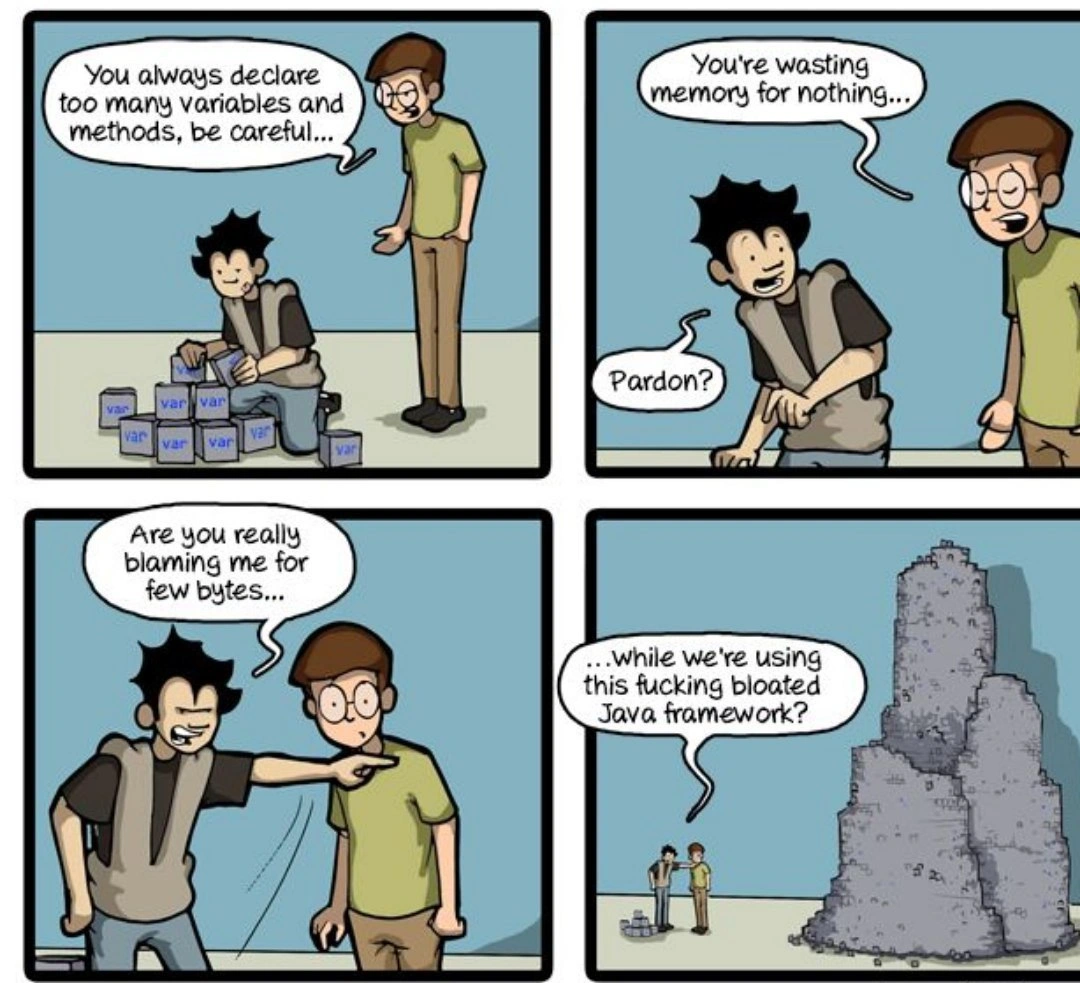
Complaining about extra variables while ignoring mountain-sized Java framework bloat
Why is this Performance meme funny?
Level 1: Candy Wrapper vs Trash Pile
Imagine you’re helping to clean up a playground with a friend. You drop one tiny candy wrapper on the ground by accident. Your friend gets upset and says, “Hey, don’t litter! That wrapper will make a mess!” Meanwhile, right behind your friend, there’s a huge pile of trash – like a whole mountain of garbage bags – that your friend is completely ignoring. You’d probably look at your friend and say, “Are you serious? You’re scolding me for one little wrapper while there’s a giant trash pile right there that’s the real problem!” It’s a funny situation because your friend is worrying about something very small and insignificant (the candy wrapper) but not seeing the extremely big mess that’s the real issue (the trash pile). In the meme, the tiny wrapper is like a few extra variables in code, and the giant trash heap is like a super big Java framework that’s using a ton of resources. We find it humorous because the friend’s priorities are clearly off: it’s silly to fuss over the little thing and ignore the giant thing. The joke makes us laugh at how ridiculous that is – it reminds us not to focus on a tiny problem and miss the huge problem right next to it.
Level 2: Micro vs Mega
Let’s break down what’s happening in simpler terms. We have two programmers talking about how code uses memory. One is accusing the other of using too many variables and methods in their code. A variable is just a name for a piece of data you store (like a box that holds a number or text). When you make a new variable, it does use a tiny bit of memory – but really a very small amount, often just a few bytes. For example, an int variable in Java might use 4 bytes (that’s 4 characters worth of data). A method (or function) is a set of instructions; having extra small methods doesn’t significantly waste memory either, it mostly just makes your code more organized. The brown-shirted developer in the comic is basically saying, “Hey, you’re wasting memory with all these little boxes (var containers) and extra tools (methods) in your code.” He’s giving a variable count warning, implying that each variable or method is a strain on the program’s efficiency.
Now, the funny part is what the black-haired developer points out: they are using a huge Java framework that is massively larger and more memory-hungry than any bunch of tiny variables could ever be! A Java framework is a big collection of pre-written code and libraries that developers use to build applications more quickly. Think of frameworks like Spring or Java EE – they provide a lot of features (database access, web servers, etc.) out of the box. However, because they do so much, they include tons of code. We call this framework bloat when a framework carries a lot of extra stuff that you might not even need, making the whole application much heavier (using more memory and processing) than a simple solution. In the comic, that bloated framework is drawn as a giant craggy tower of code looming over the tiny developers. It’s huge compared to those little cans of “var”! The black-haired dev is basically saying, “Wait a second – are you seriously blaming me for using a few extra bytes of memory, while this bloated framework we chose is consuming maybe millions of bytes?” It’s a hilarious contrast in scale (memory_vs_framework).
This humor highlights a common concept called premature optimization. That means trying to make something super efficient at a very early stage or in a part of the code that doesn’t really matter much. Often beginners worry about small things like one extra variable or an extra loop, thinking it will make the program slow or memory-hungry. But in reality, those micro-optimizations usually don’t improve the program in any noticeable way, especially if you have much bigger factors affecting performance. It’s like spending all day to polish one tiny function in your code for speed, while ignoring the fact that your program is slow because, say, it’s pulling data over a network or, in this case, because it’s running on top of a massive library that itself is slow. Experienced developers focus on the big picture: what are the main performance bottlenecks? Using an entire framework for a simple task can be an example of over-engineering – a kind of overEngineering where you use a super complex tool for a job that a simpler tool could do. That can lead to a lot of unnecessary overhead (extra work the computer has to do).
Let’s put this into a concrete example. Imagine we want to calculate the area of a rectangle in Java code. We could do it with a couple of variables or without them:
// Approach 1: Using a couple of variables
int width = 5;
int height = 10;
int area = width * height; // area is 50, using the two variables above
// Approach 2: Doing it directly without extra variables
int areaDirect = 5 * 10; // areaDirect is also 50, no separate width/height variables
In Approach 1, we used width and height as variables to store the numbers. That might use a few bytes more memory than Approach 2 (which computes 5 * 10 directly with no named variables for the parts). But the difference is tiny – on the order of 8 bytes (just enough to store those two integers). In a modern computer or a typical Java program, 8 bytes is nothing – your computer has billions of bytes of memory! Now imagine we also decided to use a big Java framework to help with our calculation (which is overkill, but just for comparison). The framework might automatically bring in code to, say, log the result, handle configuration, etc., and that could easily take millions of bytes in memory. So saving 8 bytes by not using width and height is absurd if we’re simultaneously using 50,000,000 bytes by running a heavy framework. That’s the irony the meme is pointing out with relatable humor: new developers or overly cautious colleagues sometimes focus on these little things (like an extra temporary variable) because that’s easy to see, while forgetting about the big things that actually slow down the program (like all the stuff a framework is doing behind the scenes).
Let’s clarify some of the key terms in the meme for a junior developer:
- Memory: This is like the working space the computer uses to store data when running programs. It’s often measured in bytes. A few bytes is an extremely small amount (think of it like a few drops of water).
- Variable: A named piece of memory for storing a value. Declaring a variable (like
int width = 5;) sets aside a tiny bit of memory for that value. Having 10 extra int variables might use ~40 bytes. By contrast, big things in a program can use millions of bytes. - Method: A reusable block of code (also called a function). Defining more methods might use a bit more space in the compiled program, but it usually doesn’t significantly affect memory at runtime for most cases. Methods are more about organizing code.
- Java Framework: A large collection of code libraries that provides a lot of functionality to build applications. For example, Spring Boot helps set up web servers, connect to databases, etc., with minimal coding from you. But including a framework means you’re adding all that framework’s code into your project. It’s like adding a big toolbox with every tool imaginable to solve one specific problem – you carry a lot of weight even if you only needed a hammer.
- Bloat: In software, bloat means something has become unnecessarily large or heavy. Framework bloat means the framework has a lot of extra stuff that makes it heavy (uses more memory or disk space) especially if you don’t need all those features.
- Performance Optimization: Tweaking code or design so that the program runs faster or uses less memory. The important part is usually to optimize what matters – often a small portion of code that is slow or memory-heavy.
- Premature Optimization: A famous term meaning trying to optimize or micro-manage performance too early or without evidence. It’s “premature” because you do it before you know if it’s needed. This can lead to wasted effort or even more complex code with no real benefit. The friend in the meme worrying about variables is doing premature optimization – focusing on an optimization (saving tiny bits of memory) that probably isn’t needed at all.
- Overengineering: Building a solution that is far more complicated or powerful than required for the task. Using a gigantic general-purpose framework for a simple job is often seen as overengineering. It’s like renting a moving truck to deliver a single pizza. Sure, it can do the job, but it’s overkill and consumes way more resources than necessary.
- Framework Fatigue: A joking term developers use to express being tired of always having to adopt the latest big frameworks or dealing with how heavy and complex frameworks can be. Frameworks can save time initially but often add their own headaches (like large memory usage, steep learning curves, or many configuration steps). In this meme, the “fatigue” comes from that giant rock-like framework dominating everything while the team bickers over tiny variables.
For a junior dev, the big takeaway from this meme is: keep perspective when optimizing. It’s good to write efficient code, but it’s more important to understand what really matters for efficiency. Don’t sweat the small stuff like a few extra variables or a few kilobytes here and there, especially not when there are much bigger fish to fry. Always look at your whole system: if your app is slow or using too much memory, it might be due to the tools and frameworks you’re using or an inefficient algorithm, not the fact that you wrote a for-loop with an index variable. The meme is funny because we recognize that mismatch in concern – it teaches a little lesson with a laugh.
Level 3: Elephant in the Heap
In this meme’s scene, a developer is nitpicking about memory usage at the tiniest scale while completely ignoring a gigantic, looming Java framework bloat right behind them. The standing developer warns the kneeling one, “You always declare too many variables and methods... You’re wasting memory for nothing.” This is a classic case of premature optimization and misplaced priorities. The joke lands with senior engineers because we’ve all seen someone obsessed with micro-optimizations (saving a few bytes or milliseconds) while the application is built on a mountain of heavy libraries consuming megabytes of memory and lots of CPU. It’s like worrying about a few extra var declarations (each just a handful of bytes on the stack) when the real memory hog is the massive framework that’s been pulled in.
This scenario embodies Parkinson’s Law of Triviality (aka bikeshedding): people tend to fuss over trivial details they understand (like a few local variables) and avoid the complex, important stuff (like the huge framework overhead). The result is ironic technical satire: the second dev chastises the first for minor performance issues (a few extra variables or small methods), while both are standing next to a “tower” of code — a bloated Java framework likely with thousands of classes loaded. The black-haired dev’s retort, “Are you really blaming me for a few bytes… while we’re using this bloated Java framework?” nails the punchline. It highlights the absurdity of complaining about teeny inefficiencies in code quality or memory usage (PerformanceOptimization gone wrong) when a Framework like this is the true elephant in the room (or in Java terms, elephant in the heap memory).
Consider what framework bloat means here: many enterprise Java frameworks (think Spring, Hibernate, or old-school J2EE stacks) bring along huge amounts of code and features — even features your app isn’t using. They might include dependency injection containers, ORMs, web servers, logging, and so on. All that convenience isn’t free: it costs memory (lots of objects, metadata, caches) and often some runtime overhead. By contrast, an extra variable or two in a method might use, say, 4 or 8 bytes each, which is microscopic compared to the megabytes the framework chews up. The comic exaggerates this by drawing the framework as a literal cliffsized pile of gray blobs (imagine that as millions of bytes of library code) next to tiny paint cans labeled "var". The irony is palpable to anyone who’s dealt with real production systems: that massive over-engineered platform is likely what’s slowing things down or consuming memory, not the trivial local code style choices.
From a senior developer’s perspective, the humor also pokes at misguided code quality critiques. Sure, writing superfluous variables or methods might sometimes hint at less clean code, but in terms of performance or memory it’s usually negligible. Often, readability and maintainability benefit from using a few well-named variables rather than cramming everything into one line to micro-optimize. The meme reflects a common frustration: teams will run a huge overengineering monstrosity in the background (because “we need an enterprise framework!”) and then somebody bikesheds about a loop using an extra index variable. It’s a relatable humor moment for anyone who’s gotten a code review nitpick about tiny inefficiencies while the codebase is dragging a ton of technical baggage.
In practice, seasoned devs know that real performance optimization should be guided by data and profiling. There’s the famous quote by Knuth: “Premature optimization is the root of all evil.” Worrying about saving a few bytes or microseconds in the wrong place can waste time and even harm code quality, especially when those “savings” are dwarfed by larger inefficiencies elsewhere. This meme exaggerates that concept perfectly. The big gray tower could represent, for example, a heavy Spring Boot application where even a minimal “Hello World” might spin up tens of megabytes of stuff. Meanwhile, a few extra int variables or an extra helper method in your code might not even register on the performance radar. The developer in green is basically penny-wise and pound-foolish: focusing on a penny’s worth of memory while the program is spending dollars’ worth on the framework. 😅
To visualize the absurd scale difference, let’s compare the micro-optimization focus versus the macro reality:
| Tiny Concern | Huge Reality |
|---|---|
Avoiding one extra int variable (~4 bytes) |
Using a full Java framework (tens of MB) |
| Merging two short methods to save a few bytes | Framework loading thousands of classes |
| Obsessing over a few KB of memory in code | Accepting a gigantic JAR dependency (overengineering) |
The table makes it clear why the black-haired dev is incredulous. The “few bytes” saved by limiting variables is nothing next to the "mountain-sized" memory usage of the framework. This contrast is the heart of the meme’s joke. FrameworkFatigue is real: developers often groan at how much bulk gets pulled in by modern frameworks. Yet, ironically, some team processes or old-school training still emphasize micro-level optimizations that made sense in the 90s or in embedded systems but are irrelevant in today’s contexts. It’s a comedic reminder to keep a sense of scale and priority when optimizing. We laugh because we’ve either been the person pointing out the giant problem being ignored, or (in earlier days) maybe even the one overly worried about a tiny detail. In short, the meme humorously calls out the folly of micro_optimization_irony – focusing on the wrong size problem – especially in the world of Java development where a few extra bytes is nothing compared to framework overhead.
Description
Four - panel comic with clean cartoon art and a muted blue background. Panel 1: A black-haired developer kneels beside several paint-can-sized containers labeled “var” while a second developer says, “You always declare too many variables and methods, be careful…”. Panel 2: The standing developer adds, “You’re wasting memory for nothing…”, to which the kneeling dev responds, “Pardon?”. Panel 3: The kneeling dev now standing, points back angrily: “Are you really blaming me for few bytes…”. Panel 4: Wide zoom reveals the two tiny programmers beside a gigantic craggy gray tower representing framework bloat; the speech bubble finishes, “…while we’re using this fucking bloated Java framework?”. The joke contrasts micro-optimizing variable declarations with the vastly larger memory cost of a heavyweight Java framework, mocking premature optimization and framework bloat in back-end development

Comments
6Comment deleted
Sure, I’ll shave those 4 bytes off the loop counter - right after our 1 GB Spring Boot container finishes loading its 600 transitive dependencies just to serve /ping
Getting a code review comment about a 32-byte string allocation while your Spring Boot hello world is sitting at 500MB idle because apparently we need 47 layers of abstraction to return JSON
This perfectly captures the enterprise Java developer's dilemma: spending hours in code review debating whether to extract three variables into a method to save 24 bytes of stack space, while your Spring Boot application idles at 500MB heap usage before handling a single request. It's the software equivalent of rearranging deck chairs on the Titanic - except the Titanic is your JVM, the deck chairs are local variables, and the iceberg is your 200MB of transitive dependencies that nobody has audited since 2015. But hey, at least those variable names follow the naming convention
The GC can reclaim your extra vars; it can't compact a framework's ego
Let me save 8 bytes by inlining that var - meanwhile our Spring Boot app warms up half of Maven Central and a GC cycle just to return 200 OK
Optimizing local vars in Java: like skimping on napkins at a Spring DI buffet flooding the heap