When code silently fails and leaves you questioning reality and debugging sanity
Why is this Bugs meme funny?
Level 1: Lost Without a Trace
Imagine you're building a LEGO car, and when you're done, the car is supposed to roll forward. You give it a little push... and it just falls apart or stops immediately. Something is clearly wrong. Normally, if we followed the LEGO instructions, we might spot a picture or a note showing which piece to fix or where something might have gone wrong. But here, pretend there's no instruction book, no hint at all. The car broke, but there's no sign telling you why. You just have a silent, non-working toy in front of you. You’re confused and maybe a bit annoyed, because you have to figure out what's wrong all by yourself.
This is exactly what that meme is talking about, but with computer code. The code is like the LEGO car: it’s supposed to do something, but it didn’t. And the error message is like an instruction hint or a warning light – except in this case there isn’t one. So the programmer has no idea what part of the "car" (code) is messed up. They have to search for the problem piece-by-piece, just like you'd have to check each LEGO piece or connection to find out why your car isn't working.
It's funny in the meme because the dinosaur (Philosoraptor) is making a face like, "Huh, what now?" It's the same face you might make if your toy broke for no clear reason. The humor comes from that feeling we all recognize: when something important fails and gives no clues, you can't help but stand there, scratching your head, feeling a bit like, "Is this for real?" So the meme is basically a silly way of saying, "My code broke and I have no idea why, and now I'm questioning everything!"
Level 2: The Silent Treatment
Let's break down what's happening in this meme in simpler terms. In software, a bug is any mistake or problem in the code that makes a program behave in a way it shouldn't. Debugging is the process of finding and fixing those bugs. Usually, when something goes wrong in a program, you get an error message or a warning. Think of an error message as the computer raising its hand and saying, "Hey, I can’t do that, something is wrong here," often with a clue about what or where the issue is (for example, "NullPointerException at line 42" or "Syntax Error: missing parenthesis"). These messages are incredibly helpful for developers; it's like a trail of breadcrumbs leading back to the bug.
Now, the scenario in the meme is basically when your code fails but gives you no error message at all. The program just doesn't work, and instead of showing a helpful hint or stopping with an obvious error, it either quietly does nothing or just produces the wrong result without any complaint. We call this a silent failure – the program failed (didn't do what it was supposed to), but it stayed silent about it. No pop-up, no red text in the console, nothing. It's as if you asked your friend for help and they just stared back blankly, saying zero words. Frustrating, right? That's why I call it "the silent treatment" from your code.
The top text of the meme says "WHEN THE CODE DOESN'T WORK" and the bottom text says "BUT THERE'S NO ERROR MESSAGE." The image behind those captions is the Philosoraptor, a classic meme picture of a green velociraptor looking thoughtful, like a philosopher. This dinosaur is often used in memes to pose deep or puzzling questions. Here, he's essentially pondering the paradox: "How can my code be broken if there are no errors?" It's a humorous exaggeration of a developer scratching their head, lost in thought because they have no clues. The combination of that confused/philosophical dino and the situation of a missing error message creates a relatable joke for programmers.
To someone new to coding, this situation can be super confusing. When you're learning, you rely on errors to tell you what went wrong – for example, your program might say you forgot a semicolon or used a variable that wasn't defined. You fix that, and you move on. But imagine running your code and it just...doesn't do the right thing, and nothing is telling you why. It's like pressing the power button on your computer and nothing happens – no lights on, no error beep, just silence. You'd wonder, "Is it even plugged in? Is the power out?" In coding, you'd start to wonder, "Did my program even run? Did it skip my code? Is the problem in a totally different place?"
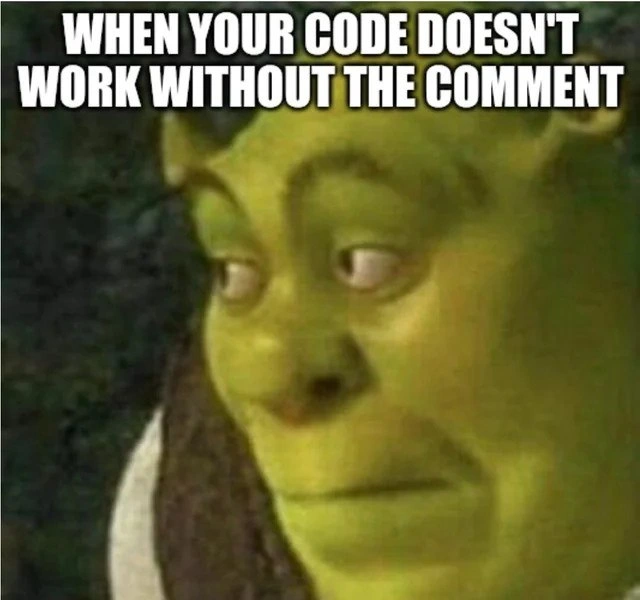
One funny (and absurd) example sometimes shared among developers is the idea that adding a comment – which is just a note in the code for humans to read – made the code work. A comment in code is text meant for other programmers or for yourself, explaining what the code does, and the computer completely ignores it when running the program. It has zero effect on how the program executes. So, if someone says "my code doesn't work without the comment", it's a tongue-in-cheek way to say "this bug makes no sense at all!" That would mean the presence of a totally inert line somehow affects the outcome, which shouldn't happen in any logical world. It's like claiming your car only starts if you have a particular bumper sticker on it – pretty ridiculous, right? 😊 But developers joke about this because when you're truly stumped by a bug, it feels like nonsense things (like a comment or a print statement) are the only difference between failure and success. In reality, if that ever appears to be the case, it's a sign something very weird (and advanced) is going on under the hood.
So, how do developers deal with silent failures? This falls under Debugging & Troubleshooting in the real world. We can't just magically know what's wrong, so we have to investigate. A common technique is to add those print statements or use a debugger tool to step through the code. For example, if a function isn't doing what you expect and not erroring, you might insert a print("Reached point A") line before it runs and a print("Reached point B") after. If you see "Reached point A" in your program output but never see "Reached point B", you know the problem is happening in that function (or between those two prints). You basically narrow it down by checking which parts of the code execute. This is tedious, kind of like searching for a missing puzzle piece by inspecting each piece one by one, but it's often how you have to do it when no obvious hints are given.
Remember, error messages are a developer's friend. A silent failure is like a friend who won't tell you what's bothering them. You have to guess and prod in the dark. Part of becoming a better programmer is learning how to build in safeguards: for instance, adding checks and logs that say "Hey, if this part fails, log an error with details." Experienced devs try to write code that fails loudly (with clear errors) rather than fails silently, because they know their future self (or teammates) will have a much easier time fixing loud failures. Good logging and error handling are considered best practices for good Developer Experience (DX) exactly for this reason — to avoid the scenario this meme jokes about. The tags like #Debugging, #DeveloperFrustration, and #CodingHumor attached to the meme are there because this is such a common frustration turned into a bit of humor. When you face it yourself, it might not be funny in the moment, but later on, you'll likely share the story and laugh about how utterly perplexing it felt.
In short, the meme is showing a green dinosaur deep in thought to represent a programmer facing one of the most puzzling situations: the code isn't working and there's no error message to explain why. It's a lighthearted take on a scenario that every coder will eventually encounter, and it reminds us that sometimes, programming is as much about problem solving and persistence as it is about writing code.
Level 3: Error Message Not Found
For seasoned developers, this meme hits on a very real and frustrating scenario: the code blows up (or worse, just quietly misbehaves) without any error message. It's the software equivalent of hearing a loud thud in your car but the dashboard shows no warning lights. That sinking feeling of "Something's wrong... but where?!" is instantly recognizable. The humor here is that every developer, at some point, has stared at a screen in disbelief because nothing was printed to stderr or logged to a file – yet the feature still doesn't work. The top caption "WHEN THE CODE DOESN'T WORK" and bottom caption "BUT THERE'S NO ERROR MESSAGE" perfectly encapsulate that moment of panicked confusion. It's essentially a 404 for your sanity: Error Message Not Found.
In a well-behaved world, when code fails, it should throw an exception, return an error code, or at least scream in a log file so you know where to start looking. In reality, especially in large or messy codebases, failures can be eerily silent. Why? Often because someone, somewhere, thought it was a good idea to catch errors and then do nothing. Consider a snippet in Python-like pseudocode:
try:
do_critical_task()
except Exception as e:
# Developer intentionally ignored the error, oops
pass
Here, if do_critical_task() blows up, the exception is caught and promptly discarded. The program will merrily continue as if nothing happened, maybe returning a wrong result or leaving things half-done. No crash, no log – just poof. A swallowed exception like this is a prime cause of ghost bugs. And guess what? When you run this code, it fails to do its job, but there’s "no error message" to be seen. Cue the Philosoraptor facepalm.
Common causes of silent failures include:
- Swallowed exceptions: "If we ignore it, maybe it will go away." The code catches an error and intentionally does nothing (no logging, no rethrow), leaving you with zero clues.
- Ignored return codes: Functions or system calls might indicate errors via return values (like
-1orNULL), but if the programmer neglects to check those, the code proceeds in an invalid state. (Classic C rookie move: callopenFile()without checking if the file actually opened.) - Logging misconfiguration: The error might have been logged at a verbose level or to a different location. If your logging level is set too high (e.g., only WARNING and above) or logs aren’t being collected, the failure message is effectively invisible. It's like the system whispered the answer, but nobody was listening.
- Logical errors: Not all bugs trigger exceptions. Maybe the code's logic is wrong (say, using
<=instead of<in a crucial check), so it simply produces an incorrect result or no result, all while technically "running fine". The runtime isn't going to yell about a logical mistake; it has no idea what your program was supposed to do in the first place.
The result? Developer frustration of the highest order. You end up playing detective with your code. Did the function even execute? Is the input what I think it is? You start peppering your code with print("got here") statements or console.log calls like a trail of breadcrumbs in a dark forest, trying to pinpoint the exact line where reality diverges from expectation. It's a brute-force approach: we call it printf debugging. Sure, you have fancy debuggers, but guess what – some bugs (looking at you, timing and concurrency issues) disappear when you try to debug them step by step. So you're left instrumenting the code with prints and logs, effectively asking the program, "Where does it hurt?" and hoping it whispers back something useful.
The Philosoraptor meme template is apt here. The dinosaur’s pondering expression mirrors a dev’s face after the third hour of scanning through code and logs: existential. You start questioning everything. "Is the server even running the new code? Did I deploy to the right environment? Is it caching an old version? Has the universe fundamentally changed the laws of logic overnight?" When nothing obvious is wrong, imposter syndrome can creep in too – "Maybe I'm just not smart enough to see it." It's comforting (in a perverse way) to know every programmer, from junior to senior, has been in that mental spiral. That's why we find this meme hilarious; it's an exasperated laugh at our own past trauma.
And let's not forget the classic anecdotal fixes. How many of us have done something absurd like adding a dummy statement or even a comment, recompiled, and suddenly the bug goes away? 😅 It sounds like voodoo, but it happens. One infamous joke in programming is the "mandatory print statement" or magic comment: code that only works when that seemingly useless line is there. Remove it and everything breaks again. Of course, logically a comment shouldn’t affect execution at all – which is exactly why it's so absurd and meme-worthy. It implies something truly weird is going on under the hood.
From a senior perspective, these silent-failure episodes often boil down to poor developer experience (DX) and missing safeguards. Over time, you learn defensive programming: check for errors, log important failures with clear messages, and avoid empty catch blocks like the plague. You also get a feel for common debugging troubleshooting techniques. Still, even veterans get blindsided. Especially in older legacy systems (perhaps riddled with On Error Resume Next-style thinking), you anticipate the occasional nightmarish bug hunt. It's practically a rite of passage in this field to have a story that starts with "It failed silently..." and ends with "...and that's how I found out it was a one-character typo in a config file."
In summary, the meme strikes a chord because it pokes at a universal pain point in programming: bugs in software that don't announce themselves. Instead, they lurk in the shadows, laughing as you comb through code and logs in vain. We laugh at the meme because, well, the alternative is to cry. And if you’ve never experienced this particular brand of debugging hell? Just wait – your time will come, and then this Philosoraptor will make you chuckle through the pain.
(Pro tip from a cynical veteran: these mysteries have a knack for appearing at 4:45 PM on a Friday, right before you were about to call it a day. Murphy’s Law of Debugging, indeed.)
Level 4: Schrödinger's Code
At the most granular technical level, this meme hints at elusive Heisenbugs and the unsettling reality of silent failures in software. In computing, a Heisenbug (named after the Heisenberg uncertainty principle) is a bug that seems to vanish or alter its behavior when you try to observe or debug it. It's as if the act of adding a print statement or running a debugger changes the program's timing or memory layout just enough that the bug hides – truly Schrödinger's code, simultaneously working and broken until observed.
Deep down, these kinds of bugs exploit the darkest corners of computer science. For instance, a subtle race condition in a multi-threaded program might only manifest when events occur in a precise order. Add a console.log() or even a no-op change, and you inadvertently change the thread timing or flush a cache, preventing the race from happening. The bug disappears without leaving a trace – no exception, no crash, nothing – because the program didn't violate any rules in a detectable way. It's still broken logically, but the computer can't tell: as far as the CPU is concerned, it executed valid instructions.
Memory bugs in lower-level languages like C or C++ can be especially mystical. An undefined behavior (say, using an uninitialized pointer or reading memory out of bounds) might not immediately trigger a segmentation fault or any error; instead it could silently corrupt some data or skip a branch. The wild part is that such a bug's behavior can depend on seemingly irrelevant changes. Remove a line (even a comment, which should do nothing) and the memory layout or timing shifts, possibly causing a crash – or vice versa, the crash disappears and the program limps on incorrectly. It's like the code exists in a quantum superposition of working/not-working until an observer effect (your debugging) collapses the waveform.
The lack of an error message here is a feature, not a bug (pun intended), of how our systems work. Many failures aren't caught by the runtime or OS because they aren't type errors or illegal instructions – they're logical errors. The program doesn't know that something "wrong" happened, because from its view, it followed the CPU's orders perfectly. In theoretical terms, it's related to why the Halting Problem exists: a general program can't always determine if another program (or itself) is going off the rails or will loop forever. The machine only catches what it's explicitly told to check. So if our code fails in a way we didn't anticipate or guard against, it fails silently. No automatic red flags, no exceptions thrown – just incorrect behavior or a halted process with zero context.
For the battle-scarred engineer, this scenario is the ultimate nightmare. It means breaking out the heavy arsenal: specialized debuggers, memory analyzers, or even digging into assembly and core dumps to find that ghost hiding in the machine. And yes, sometimes the solution is as bizarre as it sounds – like leaving a seemingly irrelevant printf in place because without it, some delicate timing causes a crash. It's a last resort hack, almost like balancing the code on a needle to keep the universe stable. No surprise that after wrestling with such spectral bugs, developers half-jokingly question reality: "Is it my code, or is the universe glitching?" When a failure gives you nothing to go on, you're peering into the abyss of computation, where deterministic machines suddenly feel oh-so inscrutable.
Description
The meme uses the classic Philosoraptor image: a green velociraptor head with one claw posed thoughtfully under its chin, centered on a two-tone green radial background. In bold white Impact font with black outlines, the top caption reads, "WHEN THE CODE DOESN'T WORK" while the bottom caption states, "BUT THERE'S NO ERROR MESSAGE." The visual juxtaposes prehistoric philosophical pondering with modern developer pain, highlighting the dreaded scenario where software misbehaves without throwing exceptions or logs. The humor resonates with engineers who know that silent failures can consume hours of breakpoint hunting, printf debugging, and existential reflection on their tooling and assumptions
Comments
21Comment deleted
If a microservice silently returns 200 OK and none of the five observability dashboards notice, congrats - you’ve just promoted undefined behavior to production-grade “feature.”
After 20 years in this industry, I've learned that some comments are load-bearing - they're the software equivalent of that one USB cable in the server room nobody dares to trace because removing it might take down production
Ah yes, the Schrödinger's comment - simultaneously documentation and load-bearing architecture. You know you've achieved peak legacy code when removing a // TODO triggers a production incident because it was actually preventing a race condition by adding just enough CPU cycles to change the timing. At that point, you're not debugging code anymore, you're performing digital archaeology on a system held together by comments, prayers, and the faint hope that nobody ever runs the linter
If deleting a comment breaks prod, you didn’t remove documentation - you undeployed your only mutex
Adding a comment to failing code is like deploying a README to production - observability goes up, the error budget doesn’t; Git bisect will still name you
Load-bearing comments: the silent infrastructure keeping legacy monoliths from cascading into oblivion
//pleaase Comment deleted
//FIXME Comment deleted
some_method();//) Только если такой комментарий... Comment deleted
В некоторых языках есть условные комментарии. Например, в паскалеподобных {$I-} - отключение проверок ввода-вывода {$I+} - включение проверок ввода-вывода Comment deleted
Хмм... Спасибо, буду знать Comment deleted
Хотя пайтон тут будет лучше, так что Comment deleted
Some_method()#) Comment deleted
Let me guess... typescript? Comment deleted
I'm planning to go for type script Is it that annoying? Comment deleted
Nah It’s cool Comment deleted
just don’t over-use it and you’re good Comment deleted
Reminds me of that one guy who dug into some js library code. He found if (1 == 1) {} in there. Removed the redundant code, but the library stopped working 🙃 Comment deleted
В джиндже комменты работают максимально тупо Comment deleted
Race conditions! Gotta use a synchronizing pattern Comment deleted
This happened to be once. I burned the project. Comment deleted