Invisible overtime: solving production bugs in your sleep, but boss won't pay
Why is this CorporateCulture meme funny?
Level 1: Working in Your Sleep
Imagine you have a really hard puzzle or homework problem that you couldn’t solve during the day. You go to bed still thinking about it. Then, in your dream, you figure out the answer! It’s like your brain kept working on the puzzle while you were asleep. You wake up and you’re happy because you know how to solve it now. But here’s the catch: if you never actually wrote down the solution or showed your work to your teacher, would you get any credit for it? Probably not. Your teacher can’t see inside your head or your dreams, so as far as they know, you didn’t do the homework at all, even though you know you solved it.
This meme is joking about that kind of situation at a job. The programmer solved a tough computer problem in his sleep, but his boss doesn’t count that as “working.” To the boss, if you weren’t in the office or logged on doing the task, it’s like it didn’t happen. From the programmer’s side, it feels unfair (and also funny) because hey, he really did spend energy and brainpower on it, just not while sitting at his desk. It’s a funny way to show the difference between visible work (like actually typing on a keyboard) and invisible work (thinking really hard about something, even in your dreams!). We find it amusing because of course no company is going to pay you for dreaming, even if your dream helped the company by solving a problem. It’s like doing your chores in a dream — you might imagine you cleaned your room, but when you wake up the room is still messy, and your parents certainly aren’t going to accept “but I dreamed I cleaned it!” as getting the work done. The meme makes us laugh about that reality: sometimes you do important things in your head or off-hours, and no one else sees it, so it doesn’t “count” in the official sense. It captures the silly and relatable feeling of working hard in your sleep and jokingly wishing you could get paid for it.
Level 2: Invisible Backlog
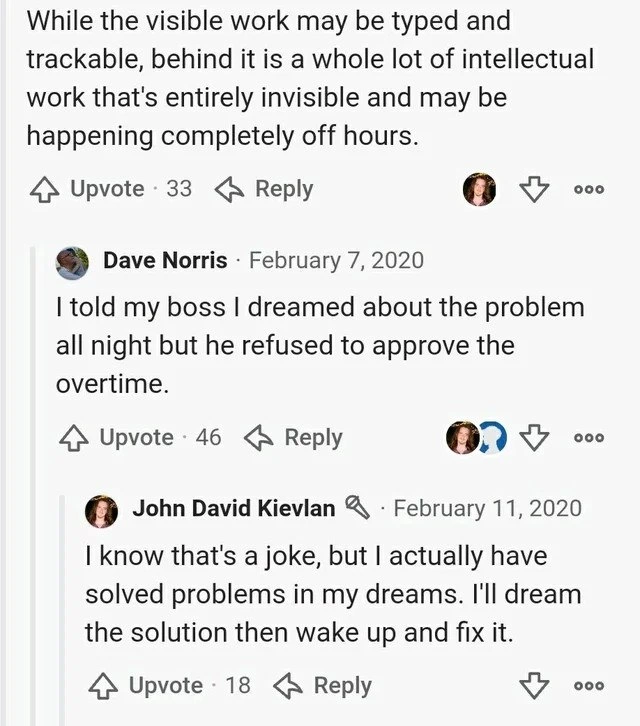
Look at the image and you’ll see a series of comments in what looks like a Reddit or LinkedIn thread. The discussion format is familiar: comments with upvote arrows and reply links nested underneath. The topic they’re joking about is how a lot of a programmer’s work is mental and often happens outside the office or official work hours. The top comment basically says: “Sure, you can track the coding I do that’s visible, but there’s a ton of thinking and problem-solving I do quietly in the background (sometimes not even during work hours) that you can’t see.” If you’ve ever seen a developer staring off into space, they might actually be actively debugging something in their head. That thinking part is invisible and doesn’t show up in any report, but it’s absolutely real work.
Then Dave Norris replies with a witty comment: “I told my boss I dreamed about the problem all night but he refused to approve the overtime.” He’s joking that he literally worked on the issue in his dreams, but of course no boss is going to accept “I dreamt about it” as a claim for overtime pay. Overtime usually means you were at your desk late or logged on working extra hours beyond the normal day, often approved for extra pay. Dreaming about work doesn’t count as “official” overtime — it’s not like you can start a timer when you fall asleep and stop it when you wake up to record those hours! Dave’s humor highlights a real feeling though: as developers, we often continue to think about issues after we’ve “stopped working” for the day. It’s poking fun at the idea that if thinking in your sleep solves the problem, shouldn’t that count for something? But in corporate reality, only trackable work counts (time in the office, commits made, tasks completed). A dream doesn’t go into any report. Dave’s boss not approving overtime for a dream is the comedic exaggeration that makes us smirk, because it’s true no manager would ever do that.
Another person, John David, replies saying, essentially, “Joke or not, I’ve actually solved problems in my dreams. I dream the solution, wake up, and then fix it for real.” This might sound a bit crazy, but many developers (and other creative professionals) will tell you similar stories. When you work on a hard bug or a complex design all day, sometimes your brain keeps working on it in the background. You might wake up with a sudden idea of what went wrong or how to fix it. It’s like your brain has an invisible backlog of unsolved issues it continues to churn through even when you’re not consciously working. John’s comment validates that the scenario Dave joked about isn’t entirely fantasy; solving_problems_in_dreams can and does happen. It’s a nifty developer trick our brains pull off occasionally – you “sleep on it” and sometimes the answer appears. There’s even a common phrase for non-programmers: having a “shower thought,” meaning an insight that comes while your mind is relaxed doing something routine (like showering or, in this case, sleeping!). For a junior developer, it might be surprising to hear that stepping away from a problem (or literally going to sleep) can be part of the solution process, but it’s a well-known phenomenon in creative and technical fields.
Now, what’s all this say about CorporateCulture and how companies value work? In many workplaces, especially in tech, there’s a tension between work-life balance ideals and the reality of projects and deadlines. Officially, your work is measured by visible outputs: Did you close that ticket? Commit that code? Resolve that incident? There’s no column in the spreadsheet for “hours spent thinking deeply about architecture while off the clock.” That’s what we mean by InvisibleWorkInTech. It’s not that managers are evil or anything; it’s just hard to quantify thinking. A lot of DeveloperProductivity happens silently: maybe a programmer spends an hour sketching ideas on a whiteboard or mentally simulating how a new feature should integrate with the old system. From the outside, it looks like “nothing’s happening.” But then suddenly the coder writes a perfect solution. How? Because they did a ton of invisible mental work beforehand. In the meme, the “dream” is an extreme case of this invisible work. And the boss’s reaction (refusing overtime) is a funny way of saying: businesses only pay for what they can see or measure. If you can’t measure dreaming or thinking time, it doesn’t count in those terms.
For a newer developer or someone not in tech, it’s worth understanding that software development isn’t just typing code. It’s a creative and logical process that often requires intense focus and even mental rest to let ideas mature. The thread is humorous, but it also gently educates: coding isn’t like flipping burgers where you clock in and out and leave it at work. Part of a programmer’s job lives in their head. That’s why you’ll hear a lot of advice about taking breaks, getting enough sleep, and not staring at a bug for 12 hours straight — because often stepping away leads to the answer. The meme is basically a funny anecdote about a boss who doesn’t “get” that concept, and the developers who do. It resonates with tech folks because they’ve been there: lying in bed, eyes open at 2 AM, thinking “aha, I know why the server kept crashing!” and then having to wait until morning to actually implement the fix. It also touches on MentalHealth and WorkLifeBalanceTips: it’s a reminder that if you’re literally dreaming about work every night, you might need to disconnect a bit more. The laughter it generates is a knowing one — laughing with empathy, because so many of us have experienced the scenario of the unsolvable problem that our brain insists on solving during our supposed rest time.
Level 3: Dream-Driven Development
Behind every slick code commit or bug fix, there’s a hidden layer of invisible work that only the developer knows about. In the meme’s discussion thread, one commenter outlines this perfectly: the visible part of our job (writing code, pushing commits) is just the tip of the iceberg. Underneath is a massive amount of intellectual labor — mental debugging, system design rehearsals, scenario simulation — all churning away in a programmer’s head, often off the clock. Senior engineers nod knowingly here: it’s common to spend an entire day chasing a stubborn production bug, give up for the evening, and then eureka! the solution strikes while you’re lying in bed at 3 AM. This meme is poking fun at that exact phenomenon: solving_problems_in_dreams. It’s the ultimate form of off-hour developer productivity, a tongue-in-cheek variant of extreme DeveloperProductivity where your brain effectively does a deploy while your body’s in REM sleep.
Now, in any sane world you’d get credit (or at least a thank you) for these nocturnal epiphanies. But corporate reality rarely works that way. If it’s not in the ticketing system or time sheet, did it even happen? One commenter jokes, “I told my boss I dreamed about the problem all night but he refused to approve the overtime.” This line drips with sarcasm that every overworked developer recognizes. Companies love to track measurable output — commits, Jira points, hours — and CorporateCulture often overlooks the brain cycles off the clock. If you can’t point to a commit timestamp or a pull request, your manager might assume the fix was trivial or magically instantaneous. The invisible_backlog of thinking, which could span your commute home or haunt your dreams, isn’t easily quantified. It’s much like a background thread in a program that’s doing all the heavy lifting with no log output. In fact, here’s a little pseudocode for the situation:
if (dreamSolvedProblem) {
implementSolution();
// Boss does not approve "dream overtime"
}
The humor here comes with a dose of pain: we laugh because it’s absurd to even ask for overtime pay for dreaming about work, yet we’ve all felt that twinge of “hold on, that was actual work!”. The reality is many developers have had solving_problems_in_dreams moments. John’s reply in the meme isn’t just jest — he admits he’s literally dreamed up solutions and then used them the next day. This is a real cognitive phenomenon: when you step away from a hard problem, your subconscious often keeps chewing on it. It’s like your brain runs an overnight build or a lengthy unit test suite while you sleep. By morning, you have the answer (if you’re lucky). From a technical perspective, you could liken it to a complex algorithm finally converging once it’s allowed to run in the background without interruption. But from a workplace perspective, that critical background processing is utterly invisible. There’s no Git commit at 3:47 AM reading “Fix bug (in a dream)”. So management remains blissfully unaware that your brain’s night shift just saved the day.
This disconnect exposes a classic engineering WorkLifeBalance issue. Modern tech culture preaches about keeping a healthy balance, yet here we are — developers joking that even our dreams belong to the company. It’s a bittersweet joke reflecting reality: passionate devs often carry tough problems home in their head, voluntarily pulling unpaid_overtime in the form of late-night contemplation or even SleepDeprivation. A cynical veteran engineer might quip that this is the only industry where you can work a second shift in your sleep and still get dinged for missing an 8 AM standup. The meme strikes a nerve because it highlights how traditional management metrics don’t capture the InvisibleWorkInTech we do. Sure, we can track logged hours or lines of code, but how do you log “dreamt about refactoring the service layer”? You can’t — so it becomes this darkly funny, shared secret among devs. We compensate with humor: “Haha, maybe I should start a startup where we bill dream-hours!” But the laughter has an edge to it, because deep down we know it points to a real issue in how our industry values (or fails to value) mental effort.
In practical terms, every senior developer has stories of “shower thoughts” or midnight aha! moments that saved a project. We’ve learned to accept that part of the job happens off the keyboard. However, management and CorporateCulture at large often still evaluate work the old-fashioned way — by visible output. That gap in understanding is exactly what this meme lampoons. It’s saying: the next time you see a miraculous bug fix first thing in the morning, consider that someone might have been mentally working on it all night. And if you’re that someone, well, your DeveloperHumor about “invisible overtime” might be the only compensation you get. It’s a wry acknowledgement of the dedication (and borderline obsession) many devs have, solving problems in dreams and getting zero official credit. In the end, the message to seasoned devs is clear: you’re not alone in your 3 AM brain debugging sessions, and yes, it’s both hilarious and frustrating that those hours are seen as “free” by the company.
Description
Screenshot of a social-media comment thread with a light grey background and familiar upvote arrow, reply icon, and three-dot menu. The top comment reads, “While the visible work may be typed and trackable, behind it is a whole lot of intellectual work that’s entirely invisible and may be happening completely off hours.” (33 upvotes). A reply by Dave Norris dated Feb 7 2020 says, “I told my boss I dreamed about the problem all night but he refused to approve the overtime.” (46 upvotes). John David Kievlan answers on Feb 11 2020: “I know that’s a joke, but I actually have solved problems in my dreams. I’ll dream the solution then wake up and fix it.” (18 upvotes). Visually it’s a typical nested discussion UI, but the humor highlights a real engineering pain point: the cognitive work - design decisions, debugging strategies, mental simulations - that happens off the clock, often during commutes or even REM sleep, yet remains unrecognized by managers or time-tracking tools. The meme resonates with senior developers who’ve mentally refactored code at 3 a.m. and exposes the cultural gap between measurable output and invisible intellectual effort
Comments
9Comment deleted
Asked accounting to open a cost center for “subconscious compute” - HR called it shadow IT, Legal reminded me my dreams are already company IP
The only distributed system harder to debug than Kubernetes is the one running in your subconscious at 3 AM, and at least K8s doesn't bill you for the compute time in REM cycles
The eternal struggle: your brain runs a background daemon that solves production issues at 3 AM, but management only approves billable hours for foreground processes. At least the subconscious doesn't require Docker containers or Kubernetes orchestration - though it does have its own memory leaks and occasional race conditions when you're trying to sleep
Boss logs 40 hours/week; reality: 168 hours of distributed cognition across neural nodes, no SLA on REM commits
We measure PRs and lead time, but not the nightly cronjob where the hippocampus garbage-collects a solution - finance still logs that as non-billable CPU idle
Jira won’t let me log “3 REM cycles spent resolving a race condition,” yet that scheduler is the only one that ever preempted our deadlock
bruh too bad <copypasta about profunctor 3 days ago> Comment deleted
I debugged while dreaming and it worked when fixing the code accordingly after waking up. Comment deleted
While I've been writing my thesis, I've been doing just that: Whenever I got stuck, I took a nap and while I was napping I actively organized my thoughts by dreaming mindmaps and roadmaps and whatever. Then I would wake up again and manifest the thigs I came up with. Comment deleted