A Visceral Explanation of FIFO vs. LIFO Data Structures
Why is this CS Fundamentals meme funny?
Level 1: What Goes In Comes Out
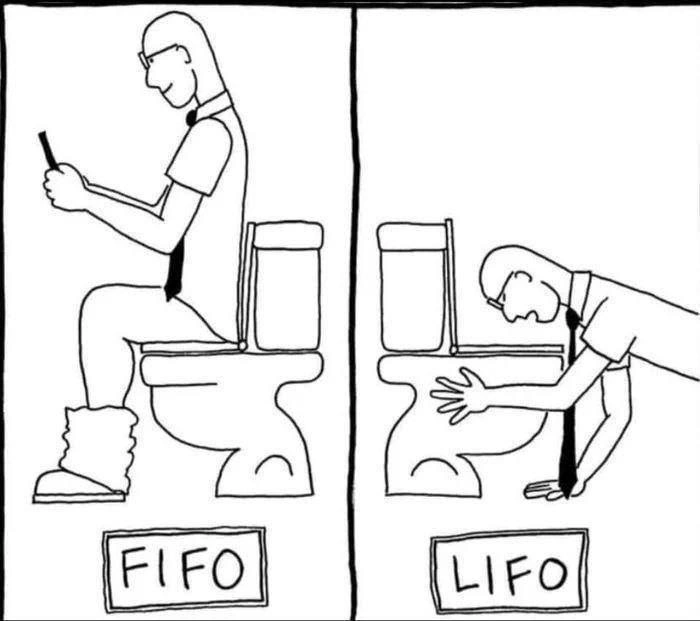
Think about when you line up to use a slide at the playground – the first kid who gets in line is the first one to go down the slide. That’s FIFO: first in line, first out the slide. Now imagine stacking books: if you pile books one on top of the other, the last book you put on the stack is the first one you can take off from the top. That’s LIFO: last on the pile, first off. This cartoon shows those two ideas in a really silly, gross way. In the left picture, the man is sitting normally on the toilet, meaning things are coming out in the same order he ate them (first dinner, then dessert later – first in, first out, all normal). In the right picture, he’s puking into the toilet, meaning the last thing he ate or drank is the first to rush out (that extra candy bar he shouldn’t have eaten comes out first – yuck!). It’s funny because it takes a serious computer idea and turns it into a bathroom joke we can all kind of understand. Basically, don’t overload yourself too much – whether it’s food, drinks, or even work – or you might end up like the guy on the right, learning the hard way that the last thing in can be the first thing out! ❤️
Level 2: Line Up vs Pile Up
Let’s break down the geeky terms and the gag here. FIFO stands for First-In, First-Out. Imagine a queue, like a line of people waiting: the first person to get in line is the first person to leave when served. Computers use FIFO all over the place – for example, when you send jobs to a printer, they usually print in the order they were submitted (first job in gets printed first). In the left panel of the comic, the developer on the toilet is used as a metaphor for FIFO: presumably the first things he ate are the first to, um, exit. It’s the normal order of digestion – a “queue” through the loo if you will. Everything proceeds in a tidy, chronological order.
LIFO, on the other hand, means Last-In, First-Out. This is how a stack works. Picture a stack of plates in a cafeteria: you put plates on top of the stack, and the last plate you put on is the first one someone takes off the top. The last item added is the first item removed. In code, a stack is used for things like the undo button (the most recent change is undone first) or the call stack when functions call each other (the last function called returns first). In the right panel of the comic, the poor developer is experiencing a LIFO in real life: the last thing he threw into his stomach (maybe that last drink or slice of pizza) is the first thing to come back out, unfortunately in the form of vomit. It’s a gross but spot-on analogy for how a stack handles things – the most recent input gets popped out before anything older. No one really wants to think about their happy-hour nachos in terms of a “stack overflow,” but here we are! 🤢
To put it simply in programming terms, here’s how you handle a queue vs a stack in code:
# FIFO example using a list as a queue
queue = []
queue.append("Breakfast") # First meal in
queue.append("Lunch") # Second meal in
first_out = queue.pop(0) # First meal out (FIFO: "Breakfast" comes out first)
# LIFO example using a list as a stack
stack = []
stack.append("Dinner") # Earlier meal in
stack.append("Late-night tacos") # Last meal (or drink) in
first_out = stack.pop() # Last meal out first (LIFO: "Late-night tacos" comes out)
In the FIFO queue, we append items and remove from the front (pop(0)), so the first item added is indeed the first out. In the LIFO stack, we append (push) items and also remove from the top (pop() removes the last item), so the last thing added is what comes out first. The comments joke about meals because that’s exactly what the meme is visualizing: in a normal situation (FIFO) your breakfast would pass before your lunch does. But if you abuse your stomach (LIFO), those “late-night tacos” you crammed in last are coming right back up first! The meme uses an everyday bathroom metaphor to cement these concepts. It’s funny to developers because we love seeing dry computer science ideas come alive in weird real-world ways. Even if you didn’t know the terms FIFO or LIFO beforehand, the comic’s labels and imagery together help you infer what they mean by comparing a calm toilet session (orderly exit) vs a violent puke session (reverse order exit). And the little heart in “Don’t drink too much today ❤️” is basically the meme-maker saying: we’ve all been there, take it easy – you don’t want to be a LIFO situation! It’s tech humor with a friendly life lesson attached.
Level 3: Evacuation Algorithms
At first glance this meme mashes up data structure theory with, well, digestive reality. The left panel labeled FIFO (First-In-First-Out) shows a developer calmly processing output on the toilet in the usual direction (pants down, phone in hand). The right panel labeled LIFO (Last-In-First-Out) has the same poor soul reversed and hugging the porcelain, clearly undoing his latest input via vomit. It’s a hilariously literal take on how queues vs stacks handle order: the normal bathroom trip is a queue - the earliest thing you consumed is first out - whereas a sudden boot-and-rally over the bowl implements a stack - the most recent thing you gulped down is the first to come back up.
For seasoned developers, the humor hits on multiple levels. We spend our days thinking about ordering rules like FIFO and LIFO in code, then life comes along and serves up a bodily metaphor. It’s the juxtaposition of a pristine computer science concept with a messy human scenario that sparks the laughter. The meme also winks at the stressed developer lifestyle: many of us have been that office worker pushing code at 2 AM, then pushing our luck at happy hour. The caption “Don’t drink too much today ❤️” drives it home – one too many energy drinks or beers after work, and suddenly your digestive tract starts acting like a data structure in a stress test. Last tequila shot in, first tequila shot out, as the algorithm hangover dictates.
From a technical perspective, FIFO and LIFO are fundamental principles that shape many systems we build. A queue (FIFO) is fair and predictable – think of tasks in a job scheduler, network packets, or messages in a microservice pipeline. Everyone gets served in the order they arrived, just like people lining up for coffee (or like meals moving through your body in order). A stack (LIFO) is efficient for recent items – think of the call stack in programming (the last function called returns first) or undo histories in editors (your last action is the first to undo). It’s great for backtracking algorithms and parsing expressions. But if you misuse a stack where a queue is expected, things can get messy… much like using your mouth as the exit route when nature intended the other end. The comic’s absurd scenario brilliantly illustrates a real truth: order matters. Whether in a data structure or your digestive system, the policy for what comes out first can totally change the outcome (and the clean-up!).
What elevates this to senior-engineer humor is the tacit understanding that we often see the world through code-colored glasses. Only a developer would label bathroom positions with “FIFO” and “LIFO” and immediately get the joke. It’s a bit of gallows humor about how deeply work infiltrates our brain – you can’t even have a bout of food poisoning without thinking in terms of algorithmic processes! Moreover, there’s an insider nod to the consequences of crunch culture: the FIFO panel looks almost relaxed (scrolling on his phone, as if finally taking a break), while the LIFO panel screams “production release party gone wrong.” Seasoned devs exchange war stories about all-nighters and ill-advised celebratory drinks; this meme distills that into a single, stark before-and-after image. In essence, it’s a cautionary tale wrapped in nerdy humor: know your data structures and your limits, or you might end up debugging a very personal “core dump” the next morning.
Description
This is a two-panel, black-and-white line-drawn comic that provides a graphic analogy for fundamental computer science data structures. In the first panel, labeled 'FIFO' (First-In, First-Out), a person wearing glasses and a tie is sitting calmly on a toilet, looking at their phone. This illustrates a queue, where items are processed in the order they arrive, similar to normal digestion. In the second panel, labeled 'LIFO' (Last-In, First-Out), the same person is shown bent over the toilet, vomiting. This illustrates a stack, where the last item added is the first one to be removed, grimly analogized to the last meal eaten being the first to be expelled. The humor lies in applying abstract, sterile data structure concepts to a messy, universal human biological function, creating a memorable, if crude, mnemonic

Comments
10Comment deleted
A perfect visual metaphor for a message queue calmly processing events (FIFO) versus an unhandled exception bubbling up the call stack (LIFO)
Pro tip: when your Friday deploy causes enough back-pressure, even the most robust engineer will switch from Kafka-style FIFO ingestion to stack-unwinding LIFO - right into porcelain stdout
After 20 years in the industry, I've finally found the perfect metaphor for explaining to junior devs why our legacy message queue system occasionally processes events out of order - turns out someone implemented it as a LIFO when the bathroom was under maintenance
This perfectly captures why you should never implement a LIFO bathroom queue in production - sure, the theoretical performance characteristics look identical to FIFO, but the practical implementation details and user experience are... significantly different. It's the kind of architectural decision that looks fine in the design doc but causes serious problems when you actually have to maintain it. Also explains why senior engineers always insist on understanding the full context before choosing between a stack and a queue
FIFO: Smooth dequeues. LIFO: When your last push causes a stack overflow in the pipes
The only system that auto-switches between FIFO and LIFO under load is the human GI scheduler - rollback latency approaches zero
System design doc says FIFO; PagerDuty enforces LIFO - when backpressure turns into overflow, you debug like a stack and pray the flush is O(1)
Didn't see memes for devs for a while.... It seems these memes are all about the same old stuff that they've used to joke way before Comment deleted
So, people implement a stack and a queue simultaneously. People are doubly linked lists? Comment deleted
It's an accounting meme as well! We do have "First In First Out" for those products that contain spoilage materials in it, while on the other side, we have "Last In First Out" for those products that don't get used any spoilage materials in it like chairs, tables and etc. Comment deleted