The Unsung Heroes of Abstraction Layers
Why is this CS Fundamentals meme funny?
Level 1: Shoulder Ride
Imagine you’re at a parade, and there’s a little kid who wants to see the floats. The kid’s parent picks them up and lets the child sit on their shoulders. Now the kid has an amazing view and is having a great time, pointing at balloons and clapping, completely happy. From the kid’s perspective, it feels like they’re effortlessly on top of the world – they might not even think about how they got so high. But underneath, the parent is carrying all the kid’s weight, making sure they don’t fall. The parent might be tired, shoulders hurting a bit, but they keep holding the child up so they can enjoy the parade.
This meme is just like that. The happy kid on top is the high-level programmer using easy tools, and the strong parent underneath is the low-level programmer doing the hard work. It’s funny because the people on top sometimes don’t see the people below, just like a kid might forget that dad is lifting them up. We laugh at the picture because it shows the truth in a clever way: the fun and simple stuff is only possible because someone else is quietly doing the heavy lifting behind the scenes.
Level 2: Meet the Stack
Let’s break down the layers shown in this meme from bottom to top, and explain who these groups of programmers are and what they do (in real-world terms). The image is essentially illustrating a software stack – a set of layers, where each layer lies on top of a more fundamental one. Each label represents a type of programmer working at a certain layer of abstraction, from the most low-level (close to hardware and machine) to the most high-level (close to human-friendly creativity).
People who know what "machine code" is – This refers to developers who understand machine code or assembly language. Machine code is the very lowest-level code – the native instructions for the computer’s CPU. It’s not a programming language in the usual sense; it’s what languages get translated into so the processor can execute them. Knowing machine code means you can read or write instructions like
0x89 0xD8(which in x86 assembly meansMOV AX, BX, an instruction to move data between CPU registers) or understand what an assembly snippet likeADD EAX, 5does (it adds 5 to a value in a register). These are the folks who might debug a program by looking at a hex dump or who write critical sections of code in assembly for performance. It’s pretty rarefied knowledge nowadays – not many programmers write raw assembly on a daily basis – but understanding it gives insight into how all software ultimately works. Think of them as the base of the tower: they deal with the nitty-gritty details of CPU architecture, memory addresses, and binary opcodes. They know thatmachine_codeisn’t magical – it’s just very detailed and low-level programming that tells the computer exactly what to do, step by step. Without machine code (and people who understand it), nothing above could actually run, because the CPU only speaks this language.Interpreter Programmers – These are developers who create interpreters or work on language runtimes. An interpreter is a program that executes code written in a high-level language directly, by reading each instruction and doing what it says on the fly. For example, the Python language is usually run by an interpreter (the CPython interpreter, which is written in C). When you write
print("Hello")in Python, the interpreter is the program that reads that line and actually triggers the lower-level system to output text to the screen. The meme lumps these folks as a group of soldiers just above machine code, meaning they act as a crucial bridge between human-friendly code and the raw machine execution. They write software like the JavaScript engine in your web browser (for instance, Chrome’s V8 engine), the Python interpreter, Ruby’s MRI, or the .NET Common Language Runtime. These systems take the high-level commands and interpret them using lower-level instructions. Sometimes interpreters also include a JIT compiler (just-in-time compiler), which translates hot portions of the high-level code into machine code on the fly for efficiency. So, interpreter programmers need to know both worlds: the high-level language design (so they can implement it correctly) and the low-level details (so they can map that design to something the machine understands). They often use languages like C or C++ to implement these interpreters because those give the control and speed needed to manage everything. In short, interpreter programmers build the engines that run languages like Python and JavaScript. They ensure that when you, as a high-level dev, write a loop or draw a shape, there’s something that actually steps through that loop or translates that draw call into real output. If you’ve heard of terms like garbage collection, bytecode, or virtual machine, those are in the domain of these programmers..NET Programmers – In the meme, one tier is labeled “.NET Programmers.” This references developers working with Microsoft’s .NET framework, typically using languages like C# or VB.NET. .NET is a platform that includes a runtime (called the CLR – Common Language Runtime) and a large class library. Code written in C# (for example) isn’t compiled directly to machine code ahead of time; it’s usually compiled to an intermediate language (IL), which is a bit like an assembly for a fictional CPU (the CLR’s virtual CPU). Then the CLR, at runtime, interprets or JIT-compiles that IL into actual machine code for the real CPU. .NET programmers, especially those who build the runtime or performance-critical .NET libraries, have to think about things like JIT compilation, memory management with the garbage collector, and how to interoperate with the operating system. They sit a layer above C++ in many cases because parts of the .NET runtime itself are written in C/C++ for speed, and the .NET framework uses those lower-level implementations to provide features. For example, when you use a
List<T>in C#, the concept is high-level (a resizable array), but internally it will use lower-level array memory operations (which ultimately rely on C/C++ code in the runtime). .NET devs often use tools to inspect IL code or performance metrics to ensure their high-level code will behave well on the underlying system. In the broader sense outside the meme, .NET programmers are application developers too, but here they’re likely meant to represent those working on the guts of the platform (like building the ASP.NET runtime, or the CLR’s JITter, etc.), as well as advanced C# developers who need to have an understanding of lower-level workings to get the best performance.C++ Programmers – This group is shown on par with .NET programmers in the meme and is often considered the classic low-level developer. C++ is a powerful language that gives a lot of control over the system. Code in C++ is compiled by a compiler (such as GCC, Clang, or MSVC) directly down to machine code or assembly for the target platform. C++ programmers often build the foundational software that everyone else uses. Examples: the core of operating systems (parts of Windows, macOS, Linux kernels use C or C++), game engines (like Unreal Engine is mostly C++), database engines (like MySQL, which is in C++), or the rendering and compute engines in browsers (Chrome’s Blink rendering engine and V8 JS engine are C++). Working in C++ means you handle manual memory management (you decide when and how to allocate/free memory, unless using smart pointers or garbage-collected sub-systems), deal directly with system resources, and optimize for performance. These developers need a strong understanding of data structures and algorithms at a low level – for instance, knowing how to layout structures in memory for cache efficiency or how to avoid costly CPU branch mispredictions. C++ is also used to write compilers and interpreters themselves (like many interpreter projects are in C++ because of its speed and control). So, C++ devs are like the heavy-duty construction crew of the software world: they build the sturdy scaffolding and engines that higher-level languages ride on. They might not be dealing with the prettiest user interface or high-level scripting logic; instead, they’re dealing with things like a segmentation fault (when a program accesses memory it shouldn’t), pointer arithmetic, and optimizing math operations. They have to be extra careful, because a small mistake (such as off-by-one on an array index or forgetting to free memory) can crash the entire program or introduce security vulnerabilities. In the meme, they are one tier below the top-surface programmers, implying that many high-level environments (like Python’s interpreter, or the p5.js library’s core) are themselves written in C/C++ or rely on C/C++ libraries to function.
processing.py programmers & p5.js programmers – Now we reach the top of the stack, the folks on the grass enjoying the sunshine. These represent the high-level, creative coders who use very user-friendly libraries and environments to make things, often visual art or interactive media, without needing to worry about the technical details underneath. Processing.py is essentially the Processing creative coding framework available in Python. Processing (originally just “Processing”) began as a project to make programming accessible to artists, designers, and beginners, so they could code visual art easily. The original Processing was in Java, but Processing.py allows you to write Processing-style code in Python. For example, instead of having to set up a whole graphics context and deal with buffer swaps, you can just call
ellipse(x, y, w, h)and a circle appears on the screen at the given coordinates – it’s that simple from the user’s perspective. p5.js is a JavaScript library that plays a similar role: it’s inspired by Processing and brings those easy drawing functions into the web browser world. With p5.js, a programmer can write a few lines of JavaScript in an HTML file, and draw shapes, animate them, handle mouse input, etc., without needing deep knowledge of how the browser’s canvas or WebGL works internally. These programmers operate at a high level of abstraction: they’re thinking in terms of creative concepts (“draw a circle here, make this shape follow the mouse”) rather than computer science concepts. They typically don’t manage memory, don’t compile code, and don’t worry about CPU instructions. The abstraction layers beneath them take care of all that.For instance, if a p5.js programmer draws a rectangle on the canvas, what happens? Their JavaScript code calls a function from the p5.js library (written in JavaScript as well), which in turn might use the browser’s canvas API. The browser (which is built in C++ mostly) translates that into OpenGL or DirectX calls to the graphics card. The graphics driver (also low-level code) then issues machine code to the GPU to actually color the pixels. All of that is hidden – the p5.js coder just sees a rectangle appear as intended. Similarly, a Processing.py programmer writing in Python might be using the Processing library under the hood. That library might call Java-based Processing functions or use Python bindings to some graphics library. Ultimately it ends up making system calls or OpenGL calls that are handled by compiled code.
The key point is, these high-level programmers rely on everything below. They can be productive and creative quickly precisely because the heavy lifting (window management, rendering algorithms, memory allocation, etc.) has been done by others. In the meme, they’re depicted as standing on solid ground, unaware that it’s actually people holding them up. That’s often the case in real life: a beginner who uses Python to, say, sort a list doesn’t realize that under the hood, a highly optimized C routine (in Python’s list object implementation) is doing the sorting. Or a web developer toggling a CSS property to animate a div might not realize a C++ program in the browser’s engine is computing all those geometry changes. It’s not that these high-level devs are ignorant by choice – it’s that they don’t need to know this to get their job done, thanks to abstraction.
In simpler terms, each category of programmer in the meme corresponds to a layer in the software stack:
- The bottom layer: machine code and assembly – the pure language of computers.
- A layer above: the runtime and interpreter layer – implementing programming languages and their features (like the Python interpreter, JavaScript engine, or .NET runtime).
- The system language layer: C, C++ (and also systems like the OS or core libraries) – providing the infrastructure (compilers, engines, drivers) that higher-level runtimes and frameworks rely on.
- The managed language layer (ex: .NET, Java) – offering a high-level environment but still closely tied to system performance considerations.
- The framework and library layer for creative coding (Processing, p5, etc.) – giving an extremely easy-to-use toolbox for end-users by encapsulating all the complexity below.
Each layer is built on the one beneath it. This is how modern computing works: it’s like a skyscraper of technology, with each floor supported by the sturdiness of the floors below. When you code in Python or JavaScript, you’re essentially on one of the higher floors enjoying the view – but there’s a whole building under you. The meme humorously personifies these layers: the higher floors are calm and scenic, the lower floors are a warzone of effort.
For a junior developer or someone new to programming, the takeaway is: abstraction is what allows us to manage complexity. High-level languages are easier to work with because they provide abstraction layers that hide the complex details. But those details don’t disappear – they’re just taken care of by someone else’s code. The "low-level language soldiers" are the developers (past and present) who implemented those details.
Some key terms defined from this meme:
- High-level language: a programming language that is closer to human language and abstracts away most hardware details (examples: Python, JavaScript). Easy to write, but you don’t control exactly how the machine runs your code.
- Low-level language: a programming language closer to machine code, with little abstraction, giving more control over hardware (examples: C, C++, and ultimately assembly). Harder to work with, but you can manipulate system resources directly and programs can run very fast.
- Abstraction layer: a way to hide complexity behind a simpler interface. Each layer provides services to the layer above it. For instance, a graphics library (like Processing) provides a function
line(x1, y1, x2, y2)to draw a line – that’s an abstraction over the hundreds of low-level operations needed to actually draw that line on a screen. - Compiler: a tool that translates code from one language (usually high-level) into machine code or an intermediate lower-level form, all at once. C++ uses compilers (you compile a .cpp file into an executable). It’s like preparing a whole meal in the kitchen before serving it.
- Interpreter: a tool that reads high-level code and executes it on the fly, instruction by instruction. Python and JS typically use interpreters or JIT engines. It’s like cooking a meal while you’re simultaneously serving it, one bite at a time.
- Software stack: the set of layers (both software and sometimes hardware) that make up the execution environment for programs. Think of it as all the technologies piled on top of each other that ultimately allow a high-level program to run.
The meme “High-level creative coders standing on the shoulders of low-level language soldiers” is basically a visual way of saying: every easy-to-use tool you have is supported by a lot of complex tools built by others. As a new developer, it’s a reminder to both appreciate those lower layers and maybe be curious about them. If you love how simple Processing.py makes drawing, imagine how much work went into writing the Processing library and the Python interpreter and the hardware drivers. It’s layers of human effort all supporting each other. And, of course, it’s okay if not everyone specializes in low-level stuff – that’s the beauty of abstraction! You can be productive in a high-level language without being an expert in assembly. But the meme gives a respectful (if comical) nod to those experts in assembly, C, and runtime engineering. Without them, none of the fun stuff up top would exist.
Level 3: Abstraction’s Unsung Heroes
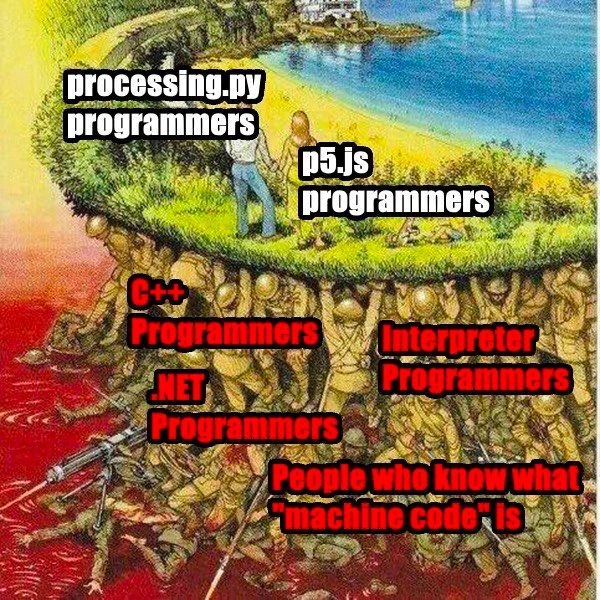
This meme strikes a chord with experienced developers by humorously highlighting the hidden hierarchy of a software stack. On the sunlit grass at the top, the processing.py and p5.js programmers are having an easy, carefree time, much like artists at a peaceful seaside picnic. They represent high-level developers who work with user-friendly languages (Python, JavaScript) and creative coding libraries. They’re blissfully focused on making cool visuals or interactive art, probably unaware of all the low-level grit that makes their coding experience so smooth. The meme shows them standing literally on solid ground – which is actually the shoulders of a column of exhausted soldiers. Those soldiers are labeled C++ Programmers, .NET Programmers, Interpreter Programmers, and at the very bottom People who know what "machine code" is. The visual joke is clear to any seasoned dev: modern programming is built on layers of abstraction, and those who operate at the lowest layers are the unsung heroes holding everything up.
For a senior developer, the humor here is a mix of pride and gentle cynicism. We’ve all seen situations where a newcomer writes a few lines in Python or JavaScript and marvels at what they can do – draw on the screen, connect to a website, use a machine learning library – without ever thinking about how it’s working under the hood. It feels like magic. Seasoned folks know it’s not magic; it’s a mountain of complexity that’s been carefully engineered away by others. The meme exaggerates this disparity by portraying the lower-level devs as war-weary soldiers literally bleeding to support the happy-go-lucky high-level coders above. It’s a playful jab at how high-level developers sometimes stand on the shoulders of low-level experts without even realizing it. The truth is, someone, somewhere had to wrestle with C++ memory management, optimize an interpreter in C, or even write assembly code, so that others could have a nice high-level API like ellipse(x, y, w, h) to draw a circle on the screen.
Many experienced programmers reading this meme nod knowingly because they’ve either been one of those soldiers, or they’ve come to appreciate them. For instance, a graphics programmer in C++ might spend weeks optimizing how pixels are drawn to a canvas, so that a p5.js programmer can call a draw function and get 60 FPS animation without dropping frames. A .NET framework engineer might toil over the garbage collector’s algorithm or JIT compilation performance, just so that a high-level C# developer (or IronPython/Processing.py user) never has to think about allocating or freeing memory explicitly. There’s a sense of shared industry lore here: we joke that "Python is slow," or "JavaScript can’t handle big numbers well," but we also know that under the hood, there are teams writing C/C++ in the Python interpreter or the V8 engine trying to improve that. When something goes wrong in a high-level app (“Hmm, my p5.js sketch is stuttering”), often the cause or the fix involves diving into lower layers (maybe a limitation in the browser’s canvas API, or a need to use a typed array which is closer to raw memory). Senior devs have learned that abstractions are built on other abstractions, and performance or bugs often require understanding those deeper layers.
The meme also reflects a bit of real-world tension (served humorously): low-level programmers sometimes feel underappreciated by those who use their work. It’s not uncommon to hear a systems programmer joke, “Yeah, your Python script is great, but you’re welcome – it’s running on my C code.” There’s an element of truth and teasing: high-level devs can sometimes be oblivious to the feats of engineering that make their one-liners possible. This image captures that sentiment perfectly, with the top folks enjoying the “creative coding” high life, while underneath, red-faced C++ and .NET warriors strain under the load. The text in bright red and the blood-tinted ground dramatize the sacrifice – long hours, difficult debugging, maybe a bit of personal toll – that often accompanies low-level and systems programming. It’s funny because it’s true: writing a compiler or an operating system module can feel like going to battle with the machine, whereas coding a quick visual in a sandboxed environment feels like a walk in the park by comparison.
From an industry perspective, this meme is also a commentary on abstraction layers in software engineering. Every time we use a high-level library or language, we’re leveraging work done by others at a lower level. Seasoned developers often encourage newbies to eventually peek under the hood because understanding what the next layer down is doing can make you a better programmer (and save you from nasty surprises). The meme’s comedic delivery aside, it carries that implicit lesson: don’t forget the layers below. In tech history, we progressed from machine code to assembly, to C, to C++, to managed languages like Java/C#, and now to highly abstracted scripting languages and frameworks. Each step made programming more accessible and let us build more complex systems faster – but each step also added a layer of indirection. As a result, we now have specialists: some people focus on making the lower layers ultra-efficient and reliable, and others focus on building cool stuff using those layers.
One example that senior devs might recall: the JavaScript vs C++ debates. JavaScript developers can build entire web apps without worrying about memory, thanks to the V8 engine (written in C++) doing all the hard work. There’s a famous quip in programming circles: “JavaScript is built on C++, which is built on C, which is built on assembly, which is built on binary, which is built on quantum physics… so don’t get too cocky.” In essence, every high-level technology owes its existence to lower-level foundations. This meme is basically a big, humorous “thank you” (or at least an acknowledgment) to those foundation builders – the unsung heroes. The image is funny, but it’s also a bit heartwarming for veteran engineers: it shows that the community does recognize, albeit jokingly, the invisible army that holds up the fancy new tools. Those "low-level language soldiers" are analogous to infrastructure engineers in a company – they rarely get the flashy credit, but without them everything collapses.
When showing this meme around the office, the LanguageWars cease for a moment: the Python dev, the C++ dev, the C# dev all laugh together, because it’s a reminder that it’s not really a "war" at all – it’s a teamwork across generations of technology. Sure, they might tease each other (“Python devs don’t know what a pointer is!” vs “C++ devs spend 3 days chasing a semicolon bug”), but ultimately this picture encapsulates how all these languages coexist in a stack. It’s simultaneously a gentle roast and a celebration of that coexistence. In simpler terms, the meme is hilarious to insiders because it says: “Go ahead, enjoy your fancy high-level coding – just remember somebody dug the trenches and laid the wires underneath that pretty lawn.” And if you are one of those trench-digging low-level devs, you chuckle and perhaps share a knowing sigh – at least a meme out there gets your struggle!
Level 4: Down to the Metal
At the very bottom of this meme’s hierarchy lies the world of machine code – the raw binary instructions that a computer’s CPU actually executes. Machine code is extremely low-level: it’s composed of operations like moving values between registers, arithmetic on binary numbers, and jumping to different memory addresses. Each instruction is just a pattern of bits that triggers electronic signals in the processor’s circuits. The folks labeled "People who know what 'machine code' is" are those rare engineers who can read or write these instructions (often via assembly language, a human-readable form of machine code). They understand how the CPU’s instruction set architecture works (for example, knowing what MOV or ADD does at the hardware level). These are the programmers who truly work "down to the metal," manipulating memory addresses, CPU registers, and bits with surgical precision. They deal with the fundamental constraints of computing, like CPU clock cycles and memory alignment.
Building up from pure machine code, we encounter Interpreter programmers. These are the wizards who write the engines that execute higher-level languages (like Python or JavaScript). An interpreter is essentially a program that takes source code and performs what that code describes, step by step. For example, the standard Python interpreter (CPython) is a complex program written in C that reads each line of your Python code, parses it into lower-level operations, and then executes those operations by calling machine-level functionalities. Writing an interpreter involves advanced concepts: parsing source text into an AST (Abstract Syntax Tree), possibly compiling into a bytecode (an intermediate binary form), and then either interpreting that bytecode or JIT compiling it into machine code on the fly. The engineers who create language runtimes (like Python’s runtime, the JavaScript V8 engine, or the .NET CLR) have to deeply understand both the high-level language semantics and the low-level details of memory and processor instructions. They implement garbage collectors to manage memory automatically, optimize hot code paths with techniques from compiler theory, and handle things like cross-platform bytecode execution. Essentially, they build a virtual machine that sits on top of the real machine. This is where heavy computer science theory meets real-world engineering: concepts from automata theory and compiler design (tokenization, grammar parsing, operation scheduling) are used to make your high-level code run efficiently. It’s an intricate dance – and any inefficiency or bug at this level can cascade upward to every program running on it.
Above the interpreter layer, we see groups labeled .NET programmers and C++ programmers. These represent developers working in languages that are closer to the hardware and often used to build the core platforms and libraries. C++ is a prime example of a powerful low-level programming language: it’s typically compiled ahead-of-time into machine code by a compiler like GCC or MSVC. C++ offers direct manipulation of memory via pointers, manual resource management, and access to system calls – meaning C++ programmers must manage complexity and performance themselves. They often write the engines and frameworks that everyone else relies on (for instance, the rendering engine of a web browser, the JS engine that powers p5.js, or the Python interpreter itself are largely written in C/C++ for speed). These developers battle issues like pointer arithmetic, buffer overflows, memory leaks, and concurrency at the thread and CPU-core level. They think about cache lines, CPU branch prediction, and algorithmic complexity to ensure that the layers above run smoothly. The meme’s imagery of soldiers straining under the weight hints at the blood, sweat, and tears (and bits) that go into low-level systems programming – one misplaced pointer in C++ can bring an entire high-level application crashing down.
Meanwhile, .NET programmers (and by extension, folks in the Java world or other managed environments) occupy an interesting middle ground. They write in high-level languages like C# or Java, but those languages are backed by robust runtime systems (the .NET CLR for C#, the JVM for Java) that must still translate their code to machine instructions. When a C# programmer writes code, a compiler turns it into an intermediate bytecode (MSIL for .NET). Then at runtime, the JIT (Just-In-Time) compiler inside the CLR translates that into actual machine code specific to your CPU. The .NET runtime itself is a complex piece of software (much of it written in C/C++ as well) that handles things like memory management (via a garbage collector), thread scheduling, and interoperability with the operating system. So .NET programmers, especially those who work on the runtime or performance-critical .NET libraries, need deep knowledge of how high-level constructs (like List<T> or LINQ queries) ultimately boil down to memory allocations and processor instructions. They often use tools like profilers and delve into IL code to make sure their high-level code will run efficiently on the metal. In the meme’s stack, .NET devs stand alongside C++ devs as part of the foundational support holding up the even higher-level scripting and creative coding layers.
This entire picture is a classic illustration of abstraction layers in computing. Each layer exists because it makes life easier for the layer above, by providing a simplified model of the computer. High-level languages (Python, JavaScript) abstract away things like memory management and direct hardware access, letting programmers focus on logic and creativity. But those conveniences are only possible because lower layers (C++, system libraries, interpreters, compilers) are doing the hard work behind the scenes. There’s an old saying in computer science: “All abstractions are leaky.” It means that even if you are coding in a very high-level environment, the realities of the lower levels can still affect you (like when your Python script runs slow because it can only go as fast as the C interpreter implementing it, or when a weird bug in the underlying C++ library causes your p5.js sketch to behave oddly). Seasoned engineers know that ultimately everything becomes machine code and runs on physical hardware bound by the laws of electronics and physics. The meme comically reminds us that even the most magical high-level coding experience is supported, at the end of the day, by countless hours of gritty low-level programming. It’s a software stack of soldiers: each level boosting the next one up, layer after layer, from transistors to Processing.py.
To put this into perspective, here’s a simplified chain of what happens when you run a creative coding script in something like Processing.py:
Your Processing.py (Python) code
-> Python interpreter (written in C) executes your code
-> Processing library (Java/C++ under the hood) handles drawing
-> Graphics API (OpenGL via C/C++ driver) draws to screen
-> GPU/CPU hardware executes machine code to render pixels
It’s a long journey through abstraction layers, with each step built by different groups of skilled programmers. The meme’s humor, at level 4, comes from recognizing this elegant yet complex tapestry of technology: every colorful visual you create with a few lines of Python or JavaScript is ultimately enabled by millions of lines of lower-level code and decades of computer science research. It’s both humbling and awe-inspiring – a bit like realizing that a simple light switch in your house is connected to an entire power grid. The low-level language soldiers in the meme have done the heavy lifting so the high-level coders can create with ease. A senior developer can’t help but smile at how accurately (and dramatically) this image captures the beautiful complexity of modern computing.
Description
This meme uses the 'Pillars of Society' or 'Holding Up Civilization' art format to illustrate the layers of abstraction in software development. The top, peaceful layer shows a grassy landscape by the water, where 'processing.py programmers' and 'p5.js programmers' are casually standing. This idyllic scene is physically held up by a massive, chaotic battle scene below. In this lower section, struggling soldiers represent the foundational programmers and concepts: 'C++ Programmers', '.NET Programmers', 'Interpreter Programmers', and at the very bottom, 'People who know what "machine code" is'. The meme humorously and effectively visualizes how high-level, easy-to-use creative coding frameworks are built upon decades of complex, low-level engineering that is often invisible to the end user
Comments
7Comment deleted
The entire software industry is just ever-higher levels of abstraction, to the point where a frontend dev can now ask an AI to write a component, which is then transpiled by a tool written in Go, which runs on a kernel written in C, executing on a CPU that barely understands the concept of '1'
That serene p5.js gradient exists because six layers down a C++ engineer sacrificed a weekend hunting a misaligned cache line - abstraction is just someone else’s PagerDuty
The deeper you go in the stack, the more you realize everyone above you is just abstracting away the same memory leak you've been debugging since 1987
The real irony here is that the people in 'hell' who understand machine code are the ones actually keeping the paradise dwellers' abstractions running - turns out every layer of heaven is built on someone else's inferno of bit manipulation and register allocation
C++ devs strut in the middle like low-level heroes, but machine code monks at the base know they're the only ones paying the full CPU cycle tax
Every smooth p5.js/Processing.py sketch is just a thank-you note to the C++/.NET and VM folks who already wrestled ABIs, JIT safepoints, and cache coherence so your draw() doesn’t segfault mid‑frame
Abstractions are great until a p5.js sketch stutters and the fix is an ABI-safe tweak to a C++ allocator, a .NET JIT hint, and a ping to the only person who still reads objdump