Skip to content
DevMeme
1864 of 7435
The True Cost of a Cheaper Developer
Stakeholders Clients Post #2072, on Sep 21, 2020 in TG

The True Cost of a Cheaper Developer

Why is this Stakeholders Clients meme funny?

Level 1: You Get What You Pay For

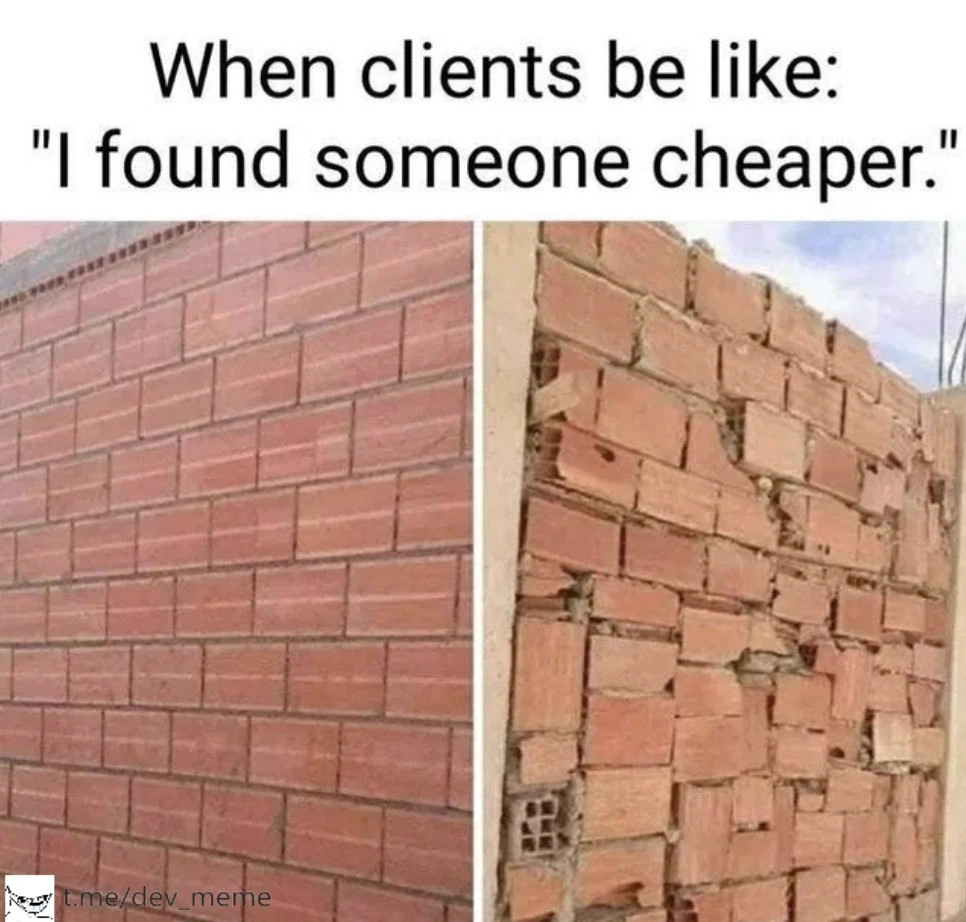
Imagine you want a toy or a new gadget. You have two choices: one is from a well-known brand that costs more, and the other is a super cheap knock-off version. You decide to save money and buy the cheap one. At first, you’re happy – it looks okay and you still have money left. But the next day, the toy breaks while you’re playing with it. Pieces fall off, and it doesn’t do what it’s supposed to do anymore. Now you’re upset and wish you had the better toy that wouldn’t break so easily. This meme is joking about the same idea, but with building things (and secretly about coding). The picture shows a nice, strong brick wall on one side and a crooked, broken brick wall on the other. It’s like saying: if you hire someone to do a job and you only choose them because they’re the cheapest, you might end up with the broken wall – a bad result. But if you pay for someone who knows what they’re doing (even if it costs more), you get the strong, nice wall that won’t fall down. In simple terms, it’s a funny reminder that cutting costs can backfire: spend a little more now to get good quality, or you might spend a lot more later fixing a big mess.

Level 2: Cracks in the Code

This meme highlights a lesson every junior developer eventually learns: you get what you pay for in software, just like anything else. The image shows two brick walls side by side. The left wall is neatly built with even rows – this represents software built with care and quality. The right wall is a disaster – bricks are crooked, some are even missing or broken. That ugly wall represents a software project done “on the cheap,” where the client chose a less experienced or lower-quality developer to save money. The caption “When clients be like: ‘I found someone cheaper.’” is basically the developer’s eye-roll response, meaning: “Sure, you found a cheaper dev, and now look at the mess you got instead of a solid product.” It’s a mix of relatable humor and a cautionary tale commonly tagged as cheap_vs_quality or quality_tradeoff.

Let’s clarify some terms. A client in software is like a customer – the person or company who needs an app or website built. They often have stakeholder expectations (desires for features, timeline, budget) and sometimes those include keeping costs as low as possible (BudgetConstraints). When a client says they found “someone cheaper,” it means another developer or team offered to do the project for less money. From the client’s perspective, this sounds great – who doesn’t want to save money? But often, a cheaper price is low for a reason: the person might be less experienced, might rush the work, or might not follow best practices that ensure high code quality. Code quality refers to how well-written and maintainable the code is – things like clarity, correctness, and reliability. Good code quality means the software runs smoothly and other developers can easily understand and modify it later. Poor code quality might still run (at least initially), but it’s full of problems: it’s hard to read, full of bugs, and fragile when you try to change anything.

The brick wall analogy is perfect for junior devs to visualize these ideas. Building software is often compared to building a house or a wall. If you hire a master bricklayer (an expert developer), you get that left wall: straight, strong, with all bricks properly placed (like functions and modules well-organized) and mortar filling every gap (like tests and documentation ensuring everything is solid). If you go with the cheapest option, you might get someone who lays bricks with gaps and misalignments – the wall might stand for now, but it’s weak. In coding terms, this could mean the cheaper dev wrote messy, spaghetti code (code that’s tangled and hard to follow). Maybe they didn’t bother to handle edge cases or errors properly, or they skipped writing any unit tests (small tests that check if pieces of your code work correctly) to save time. The result is software that might just barely work when delivered but starts breaking as soon as you try to extend it or use it seriously. This is often how bugs and crashes start popping up in what was supposed to be a "finished" project.

We also talk about Technical Debt here. This is an important concept: it’s like when you do something quick and dirty in code, you incur a “debt” that you’ll have to pay back later. For example, if a developer skips writing tests or doesn’t refactor a clumsy piece of code now, someone else (or future you) will spend extra time fixing or improving it down the road. It’s called “debt” because, much like a credit card, you saved time/money now but you’ll pay interest on that decision in the form of bigger problems later. Junior devs often first encounter this when maintaining an older codebase full of shortcuts – suddenly a small change takes forever because you have to untangle the previous sloppy work. The cheap dev in the meme likely introduced a lot of technical debt: the code works, but it’s not clean, so the interest payments will be the many hours of debugging and refactoring needed soon after.

Another term: outsourcing. Sometimes clients will outsource a project, meaning they hire an external developer or team (often from another country or a freelance marketplace) to save money. This can work well with the right people, but it’s risky if the choice is based only on the lowest bid. That’s one of the outsourcing_pitfalls hinted by the meme. A team that promises to do a complex app for an unrealistically low price might cut corners or lack the necessary expertise. As a junior dev, if you ever inherit an outsourced project that was done cheaply, you might find the code is undocumented (no explanations or comments), uses weird hacks, or is built with outdated frameworks because the devs only knew that one tool. It can be a real learning experience (and not a fun one).

A famous concept often shared with new developers is the Project Management Triangle: Good, Fast, Cheap – pick any two. This means if a project is done fast and cheap, it likely won’t be good (high quality). If it’s good and fast, it won’t be cheap. And if it’s good and cheap, it won’t be fast – because a skilled developer might lower cost only if they have a longer timeline to compensate. In this meme’s scenario, the client tried to get good software but prioritized cheap (and probably also wanted it fast). The result was predictable: it wasn’t good. Understanding this trade-off is crucial as you grow in your career; it helps you set realistic expectations with stakeholders and manage scope so that quality doesn’t completely fall by the wayside.

To put it plainly, here’s a quick comparison inspired by the meme:

High-Quality Code (💎) Cheaply-Made Code (💸)
Well-organized structure (clear modules, MVC, etc.) Messy spaghetti code with no clear structure
Proper error handling and validation Errors often ignored or left unhandled
Thorough testing (unit and integration tests) Little to no testing – “hope it works in production”
Good documentation and comments Minimal or no documentation; mysterious functions
Easy to maintain and extend later Hard to change without breaking something (“fragile”)
Few bugs in production Frequent bugs and crashes, requiring constant fixes

As a junior developer, you might have already experienced a mini version of this: maybe in a rush to finish a school project or meet a tight deadline, you write some quick code that “works” but you know it’s not pretty inside. Later, when you or a teammate tries to modify it, it’s confusing or breaks unexpectedly – that’s the crumbling wall effect. In contrast, when you take time to write clean code and tests (even if it’s slower), future changes are much smoother – that’s the sturdy wall.

The humor and relatable humor of this meme come from the fact that many developers have had to clean up a mess created by someone who underbid a project. It’s a rite of passage to open a codebase and say, “What on earth happened here?” only to learn the original dev was given impossible constraints. The meme is basically a gentle smack on the forehead to those situations. It tells new devs: quality matters. And it reminds clients (in a joking way): be careful when going for the lowest quote, because you might just end up paying more later to fix the issues. After all, in software (and in life), you get what you pay for.

Level 3: Penny Wise, Code Foolish

When a client proudly announces "I found someone cheaper," every seasoned developer cringes internally. We've seen this movie before: the project gets handed to the lowest bidder, and the result is a codebase that looks fine on the surface for about five minutes, then starts falling apart like that crooked brick wall on the right. The meme’s side-by-side brick wall analogy perfectly illustrates the difference between high-quality software and a rush-job driven by budget constraints. On the left, you have the pristine wall – every brick is neatly aligned, just like well-crafted code where each module fits together, the structure is solid, and there’s plenty of mortar (think: tests, documentation, and good design) holding everything in place. On the right, you’ve got the crumbling mess – bricks misaligned and gaps everywhere, exactly like a quick-and-dirty code job overflowing with technical debt and fragile hacks. It might stand up just long enough to call it “done,” but one deployment later it’s ready to implode.

At a deep technical level, what’s happening here is a classic quality trade-off. The client thinks software is a commodity – as if any code is good enough as long as the app runs. But experienced devs know code quality is a real asset: it determines how well the software scales, how easily new features can be added, and how many midnight outages you’ll have. The cheaper developer often cuts corners to meet the low price (or due to inexperience). This can mean skipping unit tests, using copy-pasted code from StackOverflow without fully understanding it, ignoring proper architecture or design patterns, and generally writing the kind of spaghetti code that works by accident rather than by design. The end result? A system held together by duct tape and prayer. It might function on day one, but any change (even something minor) risks bringing the whole shaky structure down.

Let’s break down the differences that the two halves of the image represent in software terms:

  • Solid Foundation (Left Wall): Well-structured codebase with clear module boundaries, consistent naming, and adherence to best practices. This is like having straight, level bricks with proper mortar. Everything is documented, and there are comprehensive tests ensuring each part behaves as expected. Future developers can add features without fear because the foundation is reliable.
  • Shaky Patchwork (Right Wall): A hodgepodge of quick fixes and poorly written functions thrown together under time pressure. Bricks are crooked: variables might be misused or global, functions do too many things. Big gaps in the wall: critical features might be missing or half-implemented. The “mortar” is sparse – no documentation, few tests (if any), and lots of workarounds for things that should have been done correctly. As a result, bugs slip through and the first big load or change causes cracks everywhere.

Think of technical debt as the “interest” you pay on a quick-and-cheap solution. In financial debt terms, using a cheaper dev is like taking out a high-interest loan on your codebase: you save money today, but you incur a debt of problems that will need fixing tomorrow. The longer you wait, the more “interest” (in the form of escalating maintenance costs and bug-fix hours) piles up. For example, a cheap developer might hardcode values instead of making them configurable; it works for now, but when the client needs to handle a new scenario, suddenly the code breaks and needs an urgent (and expensive) rewrite. Or they might ignore security practices, and six months later the application is riddled with vulnerabilities that require a costly overhaul. This is classic TechnicalDebt — shortcuts taken now become the liabilities that a more experienced team has to pay off later, often at a much higher cost.

Moreover, this scenario is all-too-familiar in outsourcing pitfalls stories: a company picks an ultra-low quote from an underqualified team to build their app. Initial delivery looks okay (the wall is standing!), and the stakeholders celebrate saving money. Fast forward a few months: new requirements arrive or real users push the system, and it all starts collapsing. Suddenly the same client is desperate, calling up senior developers (the ones they originally passed over) to rescue the project. Now those experienced devs have to dig through a pile of brittle, baffling code — essentially trying to reinforce a crooked wall without knocking it over completely. It’s often more work to fix a bad system than it would have been to build it right in the first place. In construction terms, sometimes you just have to tear down the rickety wall and rebuild from scratch, which blows the budget wide open. Not so cheap anymore, is it?

There’s a reason the industry lives by the mantra “good, fast, cheap – pick two.” If a client insists on cheap and fast, they’re naturally going to sacrifice good. The left half of the meme (the nice wall) is what you get with “good + maybe slower/more expensive.” The right half (the wrecked wall) is what “cheap + fast” often buys you. No miracles here – software engineering follows the laws of trade-offs. Seasoned devs find dark humor in this because we’ve all had that meeting where a non-technical stakeholder cheerfully says, “We found a cheaper solution!” and all we hear is the sound of a brick wall crumbling in the distance. It’s the kind of situation that leads to war stories of all-nighters, where a team must stabilize a failing product under insane pressure because someone wanted to save a buck.

In the end, this meme is a bit of a sarcastic "I told you so" from developers to penny-pinching clients. The visual joke lands because even without any code on screen, you immediately understand the gap in craftsmanship. It’s construction imagery that anyone can grasp – a wall built by a skilled mason vs. one slapped up by an amateur. Code quality isn’t as visible as a brick wall, but its effects are just as real. A well-built software system (like the left wall) might cost more upfront, but it stays strong and maintainable. A poorly built system (like the right wall) is cheap initially, but you’ll be paying for the massive refactor or complete rebuild later. As the old saying goes:

“If you think a good developer is expensive, try hiring a bad one.”

Description

A two-panel comparison meme with the caption at the top reading, 'When clients be like: "I found someone cheaper."'. The left panel shows a perfectly constructed, neat red brick wall with clean, even mortar lines, representing high-quality, professional work. The right panel shows a chaotic, poorly constructed brick wall where bricks are misaligned, crooked, and haphazardly slapped together with crumbling mortar, symbolizing the low-quality result from the cheaper option. A small watermark for 't.me/dev_meme' is visible at the bottom left. The meme is a classic visual analogy in the tech world for the principle of 'you get what you pay for.' It speaks to the frustration of skilled developers when clients undervalue their work, only to end up with a product riddled with technical debt, poor architecture, and bugs that are far more costly to fix in the long run
Comments

7
Anonymous ★ Top Pick The difference between my rate and the 'cheaper guy' is that my version of the wall doesn't come with a pre-installed backdoor and a recurring task to manually re-stack the bricks every sprint
  1. Anonymous ★ Top Pick

    The difference between my rate and the 'cheaper guy' is that my version of the wall doesn't come with a pre-installed backdoor and a recurring task to manually re-stack the bricks every sprint

  2. Anonymous

    We call the right wall a “micro-masonry architecture” - each brick ships independently, no contract tests, and gravity provides the eventual consistency

  3. Anonymous

    The cheaper developer's code passed all the unit tests because they only tested if bricks existed, not if they were actually load-bearing

  4. Anonymous

    This is the software equivalent of choosing a $500 contractor to build your production infrastructure because the $5000 architect 'seemed expensive' - sure, both deliver walls, but only one will still be standing when you try to scale to handle Black Friday traffic. The real kicker? You'll end up paying that expensive architect triple to fix the cheap one's work, plus the opportunity cost of six months of downtime. As we say in the industry: 'Fast, cheap, good - pick two. And if you pick fast and cheap, we'll see you again in three months when you need good.'

  5. Anonymous

    Procurement saved 20% by picking the cheapest vendor; we repay 200% as compounding tech‑debt interest, collateralized by SLO breaches and 3am pagers

  6. Anonymous

    “Found someone cheaper” is just client-speak for “we’re fine with eventually consistent walls” - looks okay until gravity hits prod and your pager becomes a hardhat

  7. Anonymous

    Clients chase hourly savings, but end up with a monolith refactor billed by the quarter-million

Use J and K for navigation