Debugging, the Ultimate Game of Charades
Why is this Debugging Troubleshooting meme funny?
Level 1: Solving an Invisible Puzzle
Imagine you’re playing a game where you have to act things out, like pretending to be animals or doing sports, and your friends guess what you are. Now, what if the thing you have to act out is fixing a problem in a computer program? 😅 That’s really hard to show, right?
It’s funny because fixing a computer problem (debugging) mostly happens in your head and on a screen – there’s nothing big to see from the outside. It’s like someone told you to act out “doing a tough math problem” or “figuring out a mystery” without any props. You might just scratch your head, stare into space, or wiggle your fingers like you’re typing on an invisible keyboard. But to everyone else, that doesn’t really look like anything clear – certainly not like, say, “playing basketball” or “riding a bike” which have obvious moves.
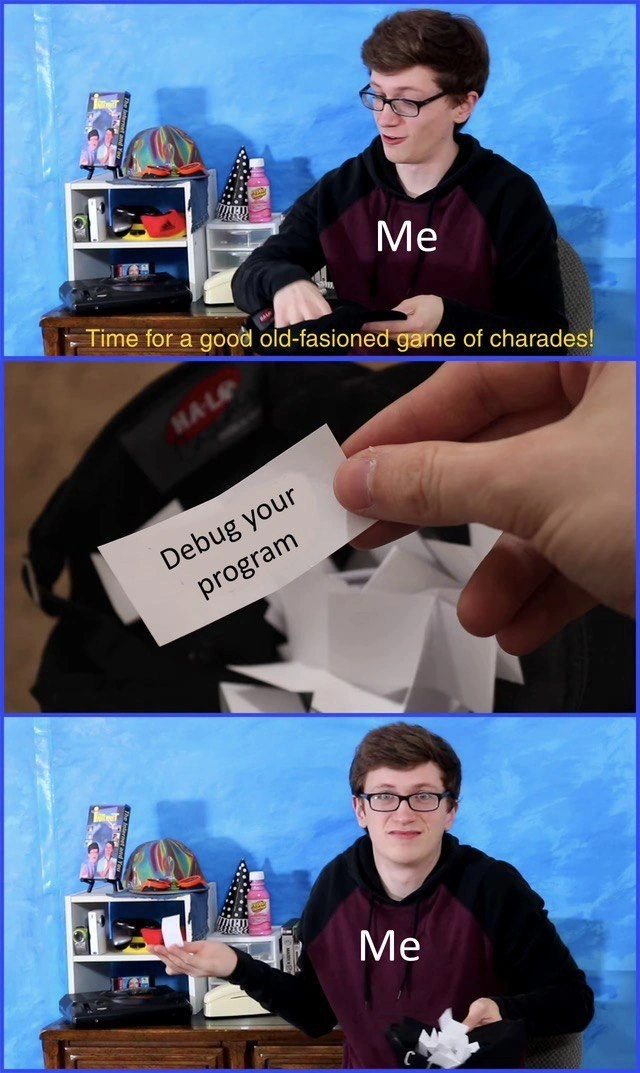
In the picture, the person got a note that says “Debug your program,” meaning “find and fix the bug in your code.” They look at the paper, and then they just shrug with a confused smile, holding up some blank slips. That shrug basically means, “Umm… I have no idea how to show that!” Their face is like 😕 because they’re stumped. And that’s the joke: they’ve been asked to act out something that’s impossible to show with gestures.
Why is it impossible? Think of a bug in a program like a hidden mistake or a little gremlin causing trouble in a machine. When programmers debug, they are like detectives: they look for clues in the code, think really hard, maybe try different things to see what happens. From the outside, a person debugging might not do much more than click around or read stuff. There’s no simple action like “flapping arms for a bird” that you can do. It’s all thinking and looking, which doesn’t make for a good charades performance!
So the humor here is a bit like if you were asked to mime “invisible man” – how do you show something you can’t see? You’d probably end up just shrugging too. The meme makes us laugh because it’s true: a lot of what computer folks do is hard to explain or show to others. It captures that awkward and funny moment when a person realizes the thing they do every day (debugging their code) is so abstract that it’s silly to try to act out.
In simple terms: They tried to make the programmer act something that lives in his imagination and computer, not in the physical world. He can’t! So he just gives a “I can’t do this” gesture. Everyone who’s ever tried to explain a complicated idea to friends can relate – sometimes you just end up saying “Never mind, it’s hard to show.” That’s why this is funny: it’s showing the impossible task of acting out an invisible puzzle, and the poor guy just gives up with a grin.
Level 2: Bug Hunt Basics
Let’s break down what’s happening here in simpler terms. The meme is about debugging, which means finding and fixing errors (called bugs) in a computer program. When your program isn’t working correctly – maybe it crashes or gives the wrong answer – you have to do troubleshooting to figure out why. This process is called debugging (literally “removing the bugs”). It’s a huge part of a programmer’s life. In fact, many new developers are surprised how much time is spent not on writing new code, but on debugging existing code that misbehaves. It can definitely be frustrating – hence tags like DebuggingFrustration and CodingFrustration, because every coder can relate to that “ugh, why isn’t this working?!” feeling. Some even joke that being a programmer is basically being a professional bug hunter or a detective solving a mystery. 🔍
Now, charades is a party game where you act out a word or phrase without speaking, and your team tries to guess it. Usually, the phrases in charades are things like movie titles, actions, or objects – stuff with a clear physical representation. For example, if the phrase is “juggling,” you can pretend to juggle invisible balls. If it’s “Harry Potter,” you might mime waving a wand. The challenge in the meme is that the phrase drawn from the hat is “Debug your program,” which is not a simple action but an abstract task. There isn’t a clear, universally understood gesture for "debugging a program" because it’s not something you can see. It’s all in the mind or happening on a computer screen. So the poor developer in the meme has picked a phrase that’s nearly impossible to pantomime. They’re sitting there with a blank look, shrugging and holding slips of paper, basically saying, “How on earth do I act that out?!”
To understand why this is funny to those in software development, think of what debugging involves in real life. When a programmer debugs code, they might do things like:
- Read error logs: These are detailed records of what a program was doing when it ran into trouble. The developer scans through lines of text (like a detective reading clues) to find where things went wrong. Not exactly an action you can mime easily – pretending to read a book might be interpreted as just “reading,” nothing specifically about debugging.
- Use a debugger tool: Many IDEs (Integrated Development Environments) have a debugger, which lets you run your program step by step. You can pause the program (hit a breakpoint), inspect variables’ values, and see the flow of execution. It’s a bit like doing surgery on the code while it runs. But again, how would you show that physically? Pantomiming pressing a pause button or peering into a pretend microscope? It wouldn’t clearly convey “I’m examining the state of an array in memory.”
- Add print statements (print debugging): This is a very common, simple debugging method. You might add lines like
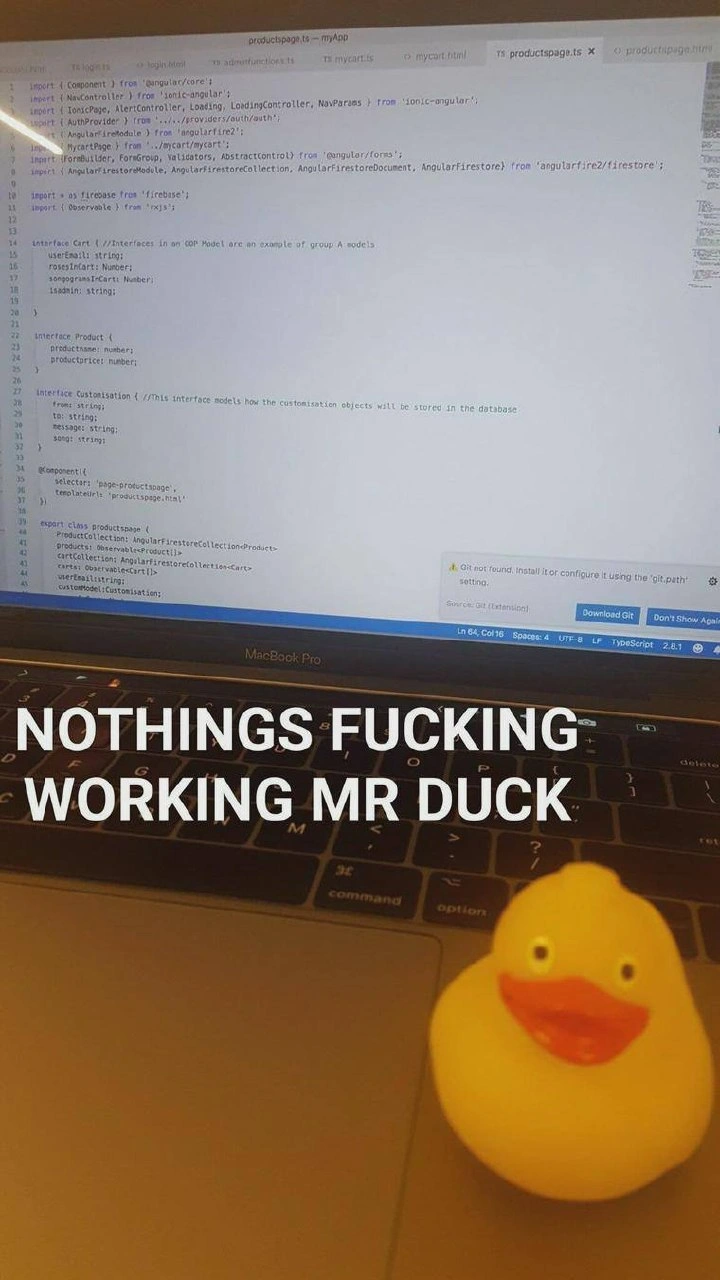
print("Got here")orconsole.log(variableValue)in your code, then run it to see if the program reaches certain points or what values variables have. It’s like leaving breadcrumbs for yourself to follow the program’s trail. In charades, maybe you could pretend to write something, then look really closely at an imaginary paper or screen? But again, to someone guessing, that could just look like “writing” or “checking notes.” Not specific enough for “debugging.” - Brainstorm and think hard: Honestly, a lot of debugging is thinking. You form a hypothesis (“Maybe the user input is null and causing a crash here?”), then test it, then refine your idea. You might sketch something out on a whiteboard or simply lean back and ponder. Maybe you discuss with a teammate or, humorously, with a rubber duck on your desk – yes, rubber duck debugging is a real thing where you explain your problem to a toy duck to clarify your own thinking. How would you act out “thinking deeply” in charades? Typically, an actor might tap their temple or stroke an imaginary beard – but that’s just the generic gesture for “thinking,” not specifically “debugging a program.”
So, the person in the meme shrugging with those blank slips is basically every developer who realizes their work is quite abstract. The category labels like Debugging_Troubleshooting and Bugs are spot on: this meme is about the trouble of debugging a bug. It’s taking that very technical, internal process and plopping it into a casual game context, which highlights how weird and hard to explain that process can be.
For a junior developer or someone learning coding, it’s worth noting: bugs in software are normal and happen all the time. You might write some code and it doesn’t do what you expected – that’s a bug. Debugging is the art (and science) of finding that mistake and fixing it. Sometimes it’s straightforward: an error message might point you right to the problem (like “NullReferenceException on line 42” – meaning you tried to use something that was null). Other times, it’s a real puzzle: you might have to trace through many parts of the code, or the bug could only show up when multiple conditions are just right (those are the worst kind, often called “heisenbugs” or intermittent issues). New developers quickly learn that patience and methodical thinking are key to debugging. It can be frustrating (hence terms like DebuggingPain), but it’s also super satisfying when you finally squash that bug and the program works as intended. 🎉
This meme is relatable humor because it exaggerates a common feeling: trying to show non-developers what debugging is like. Many of us have had that experience of a friend or family member peeking at our screen and seeing just a wall of code or text and asking, “What’s that?” Explaining it in simple terms can be hard – how do you convey that you’re, say, checking if a variable stays in range through a loop or tracking down which function misbehaved? It often ends up as, “Oh, I’m just trying to fix something in the program.” Now imagine compressing even that into a silent charades act – quite daunting!
The [CONTEXT_TAGS] like acting_out_debugging and charades_meme underline that context: acting something out. And impossible_to_pantomime is basically the scenario – debugging is practically impossible to pantomime indeed. The humor isn’t mean-spirited at all; it’s more a playful nod to the fact that what developers do can seem inscrutable or even magical to outsiders (and sometimes to ourselves!). It’s the same kind of joke as wearing a t-shirt that says “I don’t have bugs, I just develop random features” – it’s lighthearted, self-referential developer meme material.
In summary for this level: Debugging = finding and fixing code errors. Charades = acting things out without words. Trying to act out debugging is funny because debugging has no clear actions, just a lot of thinking and computer work. So “Me” in the meme is left shrugging, which is the only logical “move” when you get a charades prompt that abstract. Every developer recognizes that sigh and shrug, because we’ve all been stumped by a tricky bug (or a tricky interview question, or in this case a tricky charades clue). It’s a clever way to highlight the intangible nature of our work to anyone who’s ever wondered, “What is debugging, and why does it drive coders crazy?”
Level 3: Acting Out the Invisible
At the senior engineer level, this meme hits home because debugging is fundamentally an invisible mental battle. The humor comes from the absurd idea of pantomiming a complex, internal process like debugging during charades. It’s a relatable scenario steeped in developer humor: we’ve all spent long nights in debugging hell trying to pinpoint a pesky bug, and the thought of acting that out physically is both hilarious and painfully true.
In the first panel, “Me” (the developer) cheerfully sits down for a “good old-fashioned game of charades!” – nothing seems amiss. But then comes the nightmare fuel: drawing the prompt “Debug your program.” In real life, debugging a program isn’t a single action; it’s an exhaustive, often frustrating investigative process (the ultimate in DebuggingFrustration). We’re talking about staring at endless log lines, stepping through code in a debugger, reasoning about variables and system state – none of which have obvious gestures or movements. How on earth do you mime reading a stack trace or pondering a race condition? The second panel’s close-up of that slip “Debug your program” is the punchline setup – it’s an impossible to pantomime task that every developer recognizes as a daily struggle.
The third panel’s shrug says it all: there’s just no way to physically demonstrate debugging. This shrug is basically every developer’s reaction when a non-techie asks, “So… what are you actually doing to fix the issue?” You might wave your hands over an imaginary keyboard or squint as if reading invisible code, but to onlookers that’s indistinguishable from just typing or thinking. The meme labels this hands-up moment as “Me” utterly stumped. It satirizes the disconnect between software development work and how others perceive it. The relatable dev experience here is that much of our work happens in our heads; it’s cognitive, not physical. The comedic gold lies in that contrast: charades is a game of obvious actions (think jumping, driving, swimming), but debugging is a subtle mental puzzle.
Experienced devs see another layer: it’s also poking fun at how product managers (PMs) or non-engineers might not grasp what debugging entails. The [POST_MESSAGE] caption, “When PM plays charades with you,” hints that maybe a well-meaning PM threw “Debug your program” into the charades hat, thinking it’d be funny or easy. The result? The dev is left holding a blank slip (or a bunch of them), shrugging in defeat. It’s an inside joke about how bugs in software and the act of fixing them are hard to explain to outsiders. After all, the tools of our trade – code editors, debuggers, logs – live on a screen and in our brains. There’s a shared, unspoken trauma among engineers: those countless hours of troubleshooting weird bugs that only show up in production at 3 AM. How would one mime that? Maybe by pretending to fall asleep at your desk, jolting awake, and frantically miming typing and pulling your hair out. But even that doesn’t capture the true essence.
This meme lands so well because it captures the coding frustration of debugging in a single absurd scenario. It’s relatable humor: every developer has thrown their hands up like that at some point, mentally exclaiming “I have no clue what I’m doing!” (or maybe verbally, after the third energy drink). The “nightmare called debugging” is a universally recognized struggle in programming culture – entire threads on Stack Overflow and countless developer memes riff on how debugging can feel like chasing ghosts. We joke that 90% of coding is actually debugging and the other 10% is writing the bugs in the first place. Here, the charades format exaggerates it: imagine having to act out that nightmare in front of your friends or coworkers. It’s funny because it’s true: debugging often feels like performing some esoteric ritual that only makes sense in your head.
From a senior perspective, there’s also a slight dark humor in how impossible debugging can feel, even outside of charades. Sometimes, tracking down a bug is like performing an elaborate interpretive dance with your codebase: you probe, you hypothesize, you test, you get cryptic errors, you backtrack. None of this is spectator-friendly. The meme cleverly visualizes that disconnect. It reminds veteran devs of all those “why is this happening?!” moments where explaining your process to someone else is as futile as pantomiming it. It also hints at how debugging is an underrated skill – one that’s hard to demonstrate, literally and figuratively. You can show off a new feature in a demo, but you can’t easily show off how you cleverly found the one-line fix for a memory leak. The heavy cognitive load remains invisible, only the outcome (fixed or broken code) is visible.
Interestingly, there’s a bit of tech history that adds an extra wink for the seasoned folks: the term “bug” for a software glitch actually comes from a real-world bug. In 1947, computer pioneer Grace Hopper famously logged an incident where a moth was found taped inside a relay of the Harvard Mark II computer – a literal bug causing a malfunction. They had to physically “debug” the machine by removing the moth. Now that is a scenario you could act out in charades (imagine plucking an imaginary moth out of an imaginary computer and triumphantly showing it). But modern debugging usually doesn’t involve actual insects – it involves logic errors, memory leaks, off-by-one mistakes, misconfigured dependencies – all abstract things. So unless our charades player plans to mime pulling a moth from a computer, they’re stuck shrugging. This historical tidbit emphasizes why the meme is so apt: unless a software bug is literally a bug, debugging remains an internal, intellectual exercise.
In essence, the meme uses the charades_meme format to highlight a core absurdity in programming life: debugging is crucial, but it’s completely intangible. It’s like trying to act out “remember what you forgot” or “imagine a color no one’s seen” – you just end up standing there looking baffled. That’s the joke! Seasoned devs chuckle (and maybe wince a little) because they’ve lived that scenario metaphorically. We’ve all had those moments where someone expects a simple explanation or demonstration of a complex problem-solving process, and we can only shrug and say, “It’s complicated.” This meme nails that feeling in a way only developer humor can, turning our debugging pain into a shared laugh. It’s a comedic reminder that what we do is a kind of invisible art – one that’s really hard to show on demand, whether to our managers or in a silly party game.
Description
A three-panel meme based on a video by YouTuber Scott Wozniak. In the first panel, a young man with glasses, labeled 'Me,' sits against a blue background and announces, 'Time for a good old-fashioned game of charades!' as he pulls a slip of paper from a hat. The second panel is a close-up on his hand holding the paper, which reads, 'Debug your program.' The final panel shows the same man, again labeled 'Me,' with a look of resigned frustration, gesturing helplessly as if to say, 'Well, what am I supposed to do with this?' The post's caption, 'When PM plays charades with you,' adds another layer of meaning. The meme humorously equates the often non-intuitive and frustrating process of debugging with a guessing game like charades, where one must interpret silent clues to find a solution. For senior engineers, this resonates deeply, as debugging complex systems can feel like trying to understand an entity that cannot clearly communicate its problems. The added context of a Project Manager turns the joke into a commentary on receiving vague requirements that require developers to 'guess' what needs to be built
Comments
8Comment deleted
Senior-level debugging is just a high-stakes game of charades, but the clue is 'intermittent race condition,' it only happens in production, and your teammate is the CI/CD pipeline
Charades prompt says “debug your program” - so I’ll spend the next two minutes staring into space, mime git-bisecting 300 commits, sprinkle invisible printlns across imaginary microservices, then collapse while whispering “works on my laptop.”
The only game where everyone loses is when production decides to play 'guess which microservice is causing the memory leak' at 3 AM on a Friday deployment
Debugging is the only 'game' where you're simultaneously the player, the opponent, and the person who wrote the rules - and somehow you still lose. The real kicker? You can't rage-quit because production is down, the stakeholders are watching, and that 'quick fix' you deployed last Friday just drew you the debugging charade card for Monday morning
Pulled “Debug your program” in charades, so I stared into space, tail -f’d imaginary logs, flipped phantom feature flags, then shrugged - everyone guessed “prod-only Heisenbug.”
My charades plan for “debug your program”: mime git bisect, sprinkle printf, then freeze the moment anyone watches - perfect Heisenbug reenactment
Heisenbug charades: mime the stack trace before it collapses from observation
didn't expect Scott the Woz meme here. Makes it even better! Comment deleted