
The Duality of ML: One for the Resume, One for Production
Description
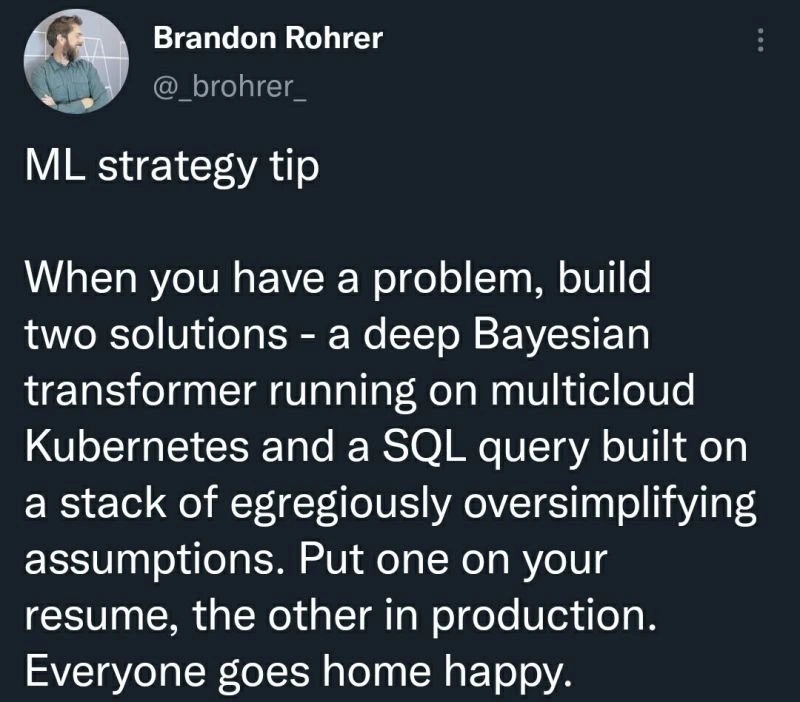
A screenshot of a tweet from Brandon Rohrer, an ML expert. The tweet, under the heading 'ML strategy tip,' outlines a cynical but pragmatic approach to problem-solving in the tech industry. It advises building two solutions: one is a highly complex, buzzword-heavy system described as 'a deep Bayesian transformer running on multicloud Kubernetes.' The other is a simple 'SQL query built on a stack of egregiously oversimplifying assumptions.' The final instruction is to 'Put one on your resume, the other in production. Everyone goes home happy.' This meme perfectly captures the concept of resume-driven development, where engineers build overly complex systems using hyped technologies to boost their careers, while the practical, simple, and often more robust solution is what actually gets deployed. It's a satirical commentary on the frequent disconnect between perceived engineering excellence and real-world business needs, a sentiment deeply understood by experienced practitioners

Comments
7Comment deleted
The best system architecture is Schrödinger's microservice: it's simultaneously a complex, event-driven saga pattern during your tech talk, and a monolithic SELECT * FROM users query when the incident page goes off
Rename the 30-line SQL heuristic to “Bayesian warm-start” in the slide deck, keep the 1,000-GPU transformer in the appendix - finance approves the AI budget, ops ships by Friday, and nobody audits the WHERE clause
After 20 years in the industry, you realize the real Bayesian prior is that the SQL query will outperform your transformer in production while using 0.01% of the compute budget - but good luck explaining that to the hiring committee reviewing your GitHub
The eternal duality of ML engineering: your LinkedIn profile features a transformer-based, attention-mechanism-laden, multi-GPU distributed training pipeline with custom CUDA kernels, while your actual production system is a cron job running a SQL query that someone wrote in 2015 and nobody dares touch because it just works. The deep Bayesian transformer gets you through the interview; the SQL query gets you through the on-call rotation. Both are essential survival skills, just for very different predators
SOTA for slides, SELECT for SLAs - ship the window function, brag about the Bayesian transformer on multi‑cloud
Resume models boast infinite scalability until prod metrics reveal the SQL query's eternal 99.99% uptime
Call it CQRS: Curriculum vitae Query vs Real Service - the Bayesian transformer burns your cloud credits, the 20‑line SQL keeps SLAs green