Skip to content
DevMeme
2849 of 7435
Angry C coder weaponizes pointer cast to brutally unfloat your float
LowLevelProgramming Post #3146, on May 20, 2021 in TG

Angry C coder weaponizes pointer cast to brutally unfloat your float

Why is this LowLevelProgramming meme funny?

Level 1: Square Peg, Round Hole

Imagine you have a toy that’s meant to float in water, but you’re so mad at it that you grab it and force it into a shape sorter’s round hole just because you can. Of course, the toy doesn’t magically become the right shape; you’ve just jammed it in where it doesn’t belong. This meme’s joke is just like that. The programmer got upset with a float (a number with a decimal point, like in a game or a calculator) and decided to treat it as if it were a whole number in a really brute-force way. It’s as if they said, “I don’t care what you’re supposed to be, I’m gonna use you however I want!” The result is pretty silly: it’s not how you’re meant to handle things, and it probably won’t give a sensible result – but it sure shows how frustrated they were. The humor comes from recognizing that this action is over-the-top and kind of ridiculous, just like shoving a square peg in a round hole out of sheer stubbornness. Even if you “make it fit,” you end up breaking the rules (and maybe the toy!). In plain terms, the programmer basically broke the toy to get what was inside, and everyone who sees it is laughing, because it’s a crazy way to solve a problem that most people wouldn’t dare to do!

Level 2: Pointer Cast Shenanigans

Let’s break down what that scary-looking C code i = *(long*)&y; really means, in a way a newer programmer can digest. This line involves pointers in C, type casting, and a big no-no called undefined behavior. Don’t worry, we’ll define these as we go. First, consider we have two variables: y which is a float (a floating-point number, used for decimal values like 3.14), and i which is a long (an integer type that can hold whole numbers, typically a pretty large range). Normally, if you wanted to convert the float in y to an integer in i, you’d do something safe like i = (long)y; – that would cast the value of y to a long in the usual way (dropping any fractional part, for example). But that’s NOT what’s happening here. Instead, *(long*)&y is doing something wildly different: it’s reading the raw memory of y as if it were a long, without any numeric conversion.

Here’s how it works step by step:

  1. &y gets the address of y in memory. In C, & is the “address-of” operator. If y lives at memory location say 0x7ffeABCD, &y is that address. Its type would normally be float* (pointer to float).
  2. (long*) then casts that address to a different pointer type. Now we’re pretending that address points to a long instead of a float. We have essentially said, “trust me, at 0x7ffeABCD there’s a long value.”
  3. The * in front of (long*)&y is the dereference operator. It means “go to the address and get the value stored there.” So we go to 0x7ffeABCD (where our float y is stored) and read a long worth of bytes from there. That value is then assigned to i.

In code form, it’s doing something like:

float y = 3.14f;
long *pretend_ptr = (long*) &y;
long i = *pretend_ptr;  // <- grabbing the bits from y, treating them as long

This is a shenanigan because y is actually a float, not a long. We’re tricking the compiler and saying “nah, it’s fine, just treat those 4 bytes of float as if they form a long integer.” What could go wrong, right? A lot, actually! This kind of trick is called type punning – it’s like a pun where one thing is used as if it’s another. You’re punning the type of y. And it’s considered unsafe code because it can easily lead to problems. Why? Because floats and longs have different representations and alignment expectations. For instance, a float is typically 32 bits in IEEE 754 format (with specific bits for sign, exponent, and fraction), whereas a long on some systems might also be 32 bits (or 64 bits on others) but is interpreted as a straightforward binary number. When you read a float’s bytes as a long, you’re likely to get a totally meaningless number if you were expecting a straightforward conversion. It’s not at all the same as rounding the float or anything – it’s literally reading the raw binary bits.

Now, about undefined behavior: this is a term in C (and C++) that means “the language standard doesn’t define what happens here.” It’s like stepping off the marked trail – you might find something that looks okay, or you might fall off a cliff, or a bear might get you. The compiler could do anything when it encounters undefined behavior because it assumes well-behaved code never does that. In our case, accessing a float through a long pointer breaks an important rule, so the C standard says “all bets are off.” The program might crash, produce gibberish output, or even appear to work correctly on one compiler version and then break when you upgrade or change optimization settings. This unpredictability is what makes it a bug time-bomb. Seasoned developers avoid this by either using safe methods (like using a union or memcpy to copy bytes) or by simply not doing it at all.

To put it plainly: *(long*)&y is an abuse of pointers. C will not stop you from doing it – there’s no error or immediate explosion – but it’s a bit like removing the safety guard from a power tool. It might cut exactly what you intend, or it might kick back and hit you. The meme is highlighting this crazy stunt. The code literally “unfloats your float,” meaning it strips away the float interpretation and just gives you raw bits in an integer. If you printed that integer, you wouldn’t get 3 or something intuitive; you’d likely get a weird huge number that corresponds to the internal binary of the float. For example, if y was 3.14f, an actual long read might output 1078523331 – which obviously has no apparent relation to 3.14 in human terms. That’s why this is mostly done only by experts who really know the system-specific details, or by programmers writing low-level code who have no other choice and ensure it’s safe in their particular case.

In summary, this meme’s code is showing a pointer cast being used in a naughty way. Newer C developers are usually warned: don’t do this at home! It violates type safety (the guarantee that data is only accessed in ways compatible with its type) and can mess up memory safety too (if the sizes differ or alignment is off, you might even read invalid memory). It’s a one-line gateway to unpredictable behavior, and that’s why more experienced folks find it both cringe-worthy and amusing. C gives you this power, but wielding it is like playing with a live wire.

Level 3: Type Punning Pandemonium

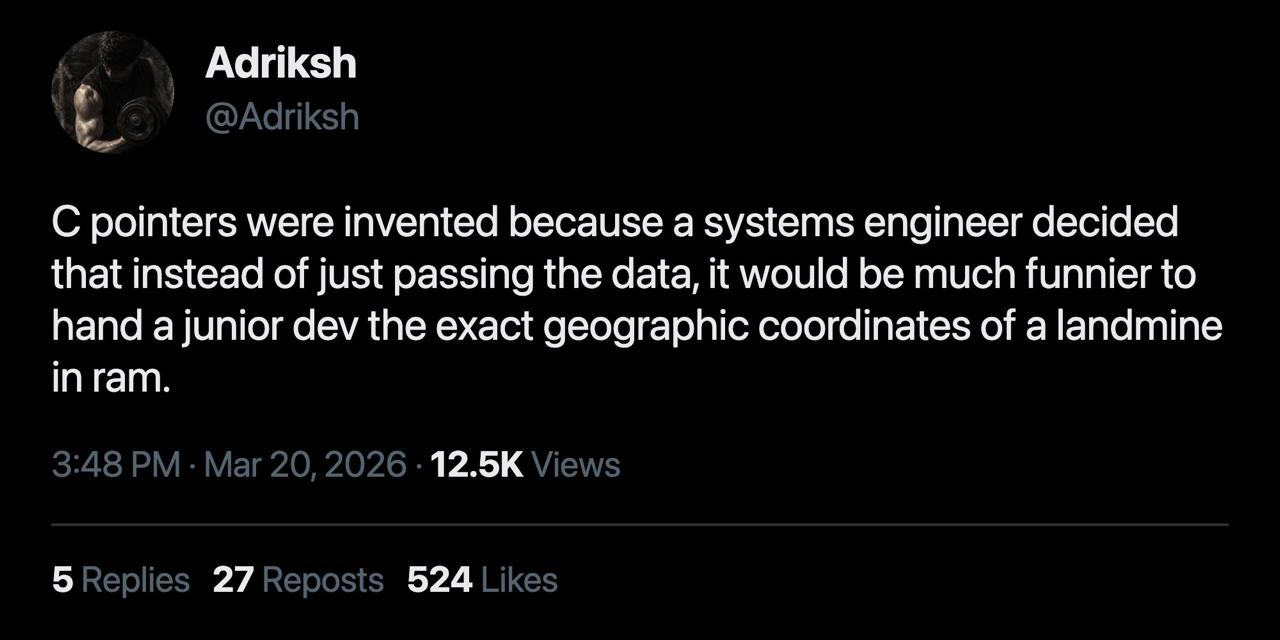
For seasoned C developers, this meme hits like a flashback to bug-hunting war stories. It’s showcasing a notorious C trick: using pointer casting to reinterpret data types on the fly – basically type punning with a vengeance. The top text “You know what? Fuck you” sets the tone: a fed-up programmer who’s rage-quit any pretense of doing things the right way. The bottom text “Unfloats your float” delivers the punchline by describing the act of forcefully treating a float’s bytes as an integer. The humor here is equal parts technical absurdity and shared trauma. Anyone who’s debugged CFamilyLanguages code can practically hear the collective groan: “Oh no, not this again…”.

Why is this funny to an experienced dev? Because it satirizes the moment a programmer throws up their hands and goes full unsafe mode to solve a problem. Perhaps they were frustrated by floating-point precision issues or sick of proper conversions, so in a fit of pique they essentially say, “I’m gonna rip the value out of this float raw.” It’s akin to an IT veteran joking about using a nuclear option for a trivial bug. We’ve all been there (at least in thought): the code isn’t doing what you want, and a little devil on your shoulder whispers, “Just cast the damn pointer and grab the bits. That’ll show ’em.” It’s the programming equivalent of using a sledgehammer to fix a wristwatch. Senior engineers recognize this as a textbook anti-pattern – something you could do in C, but definitely shouldn’t in clean code. That recognition is what elicits a chuckle (and perhaps a pained wince).

This meme also pokes fun at how C gives you the power to shoot yourself in the foot. In safer languages (Python, Java, Rust), you simply cannot treat a float as an integer without an explicit conversion that changes its value. But C is a low-level programming playground (or minefield) where if you’re crazy enough, you can interpret memory however you please. Seasoned devs have a love-hate relationship with this freedom. On one hand, pointer casting can be a legitimate tool (for instance, reading raw bytes from a buffer or implementing clever serialization). On the other hand, it’s infamous for causing Bugs that are nightmarish to debug. The phrase “UndefinedBehavior” is basically a ghost story around the campfire for C developers – and *(long*)&y is exactly the kind of thing that conjures those ghosts. A veteran coder sees *(long*)&y and immediately thinks: “Uh-oh, someone got desperate (or clueless) enough to break the type system. What subtle bug is this hiding?”

The meme’s text “Unfloats your float” riffs on a recent meme format where someone says “**** you” and then describes an over-the-top action (“X your Y”) as a form of retaliation. Here, the action is hilariously technical: brutally reinterpreting the bits of a float as a long. It’s absurd because in reality this action doesn’t solve a typical problem – it’s more likely creating one! It’s a wink to those in-the-know: we laugh because we’ve seen this kind of code in wild legacy codebases or under-commented hacky functions, and it usually heralds trouble. Maybe the original coder did this to quickly get an integer bit pattern for debugging, or to do some bit-level manipulation without memcpy. But doing it with a cast is like playing with fire. Type safety is thrown out the window, and we’re left with pandemonium if anything changes. For example, if some other part of the code or compiler assumed y (a float) isn’t modified through an integer pointer, it might keep using an old value in a register – meaning our *(long*)&y could fetch stale or utterly unexpected data. That’s the Bingo aspect of UndefinedBehavior – you don’t know what prize (or punishment) you’ll get.

In summary, at this senior perspective, the meme is funny because it highlights a common folly in low-level C programming: the moment when a programmer knowingly invokes dark, non-portable magic out of exasperation. It’s a shared joke about how C lets you do ridiculously unsafe things with a single cast. The “weaponizes pointer cast” phrasing isn’t an exaggeration – this code is basically doing violence to the program’s stability. And yet, we laugh, because every experienced C dev has either done something similarly sketchy or spent long nights debugging why someone else’s clever cast blew up. It’s a coping laughter at the absurd power (and peril) C gives us.

Level 4: Strict Aliasing Showdown

Deep in the bowels of C’s memory model, this one-liner declares war on the language’s strict aliasing rule. In C (and C++), the compiler assumes that objects of different types (like float and long) do not alias, meaning they won’t occupy the same memory address. This assumption lets compilers perform aggressive optimizations. But our angry coder’s statement i = *(long*)&y; flips the table on that assumption. Here’s what’s happening under the hood:

  • &y takes the memory address of variable y (which is declared as a float).
  • (long*) casts that address to a pointer-to-long, essentially reinterpreting the bits at that address as if they were a long.
  • The unary * then dereferences this faked long* pointer, reading whatever bits are in y’s storage and treating them as a long value.

This is a classic case of type punning – treating the same raw bytes as two different types. According to the C standard’s aliasing rules, reading a float’s memory through a long* is outright illegal. It’s like performing a secret alias heist that the compiler never saw coming. The result? Undefined behavior. And undefined behavior in C is the stuff of nightmares (or dark humor): the program might seemingly work on one compiler and explode on another, or even change behavior under different optimization levels. The compiler, under the assumption that no long* would ever alias a float, might optimize away some code or reorder memory accesses. When you violate that assumption, you invite chaos – anything from getting a garbled integer to causing bizarre runtime errors is on the table. Seasoned systems programmers joke that undefined behavior can make “demons fly out of your nose” (a famous quip in the community), meaning absolutely anything can happen and you can’t complain because you’ve left the realm of defined C semantics.

Why would anyone do this then? Historically, low-level programming sometimes calls for extracting a float’s raw bits – for example, to examine its IEEE 754 binary representation (sign bit, exponent, mantissa) or to perform hacky bit-level operations. Before modern C standards tightened the rules, old-school C code would do such casts as a trick for performance or convenience. It’s essentially a form of pointer black magic to reinterpret memory. However, modern compilers (post-C99) take aliasing rules seriously. Unless you compile with flags like -fno-strict-aliasing (turning off those optimizations), this stunt can break in spectacular ways. The UndefinedBehavior might manifest as “works on my machine” but segfaults or yields nonsense on another. In short, the coder here is weaponizing a pointer cast to bypass C’s type system entirely, performing an unauthorized bit-level transmogrification. It’s a showdown between the coder and the compiler’s optimizer: the coder says “I do what I want,” and the compiler shrugs, possibly loading the shotgun of unpredictable results.

For a concrete sense of the brutality, imagine y was the float 3.14f. In memory (per IEEE 754), 3.14f might have the 32-bit binary pattern 0x4048F5C3 (in hex). If you interpret those same 32 bits as a long (on a system where long is 32-bit), you’d get the integer value 1078523331. That’s not a sensible numeric conversion – it’s just the raw bits of the float pretending to be an integer. The code “unfloats your float” by ripping out its binary guts. There’s no rounding or value change like a normal cast would do; it’s a direct bitwise reinterpretation. This is essentially an aliasing violation bloodbath: the float’s bytes are read by the wrong type. On some architectures, if sizeof(long) is larger than sizeof(float), this pointer cast would even read out of bounds memory or misaligned bytes (inviting hardware-level faults). So we’re not just breaking a rule in a book – we could be reading random memory beyond the float! In summary, at Level 4 we see the full horror and brilliance of this one-liner: it leverages C’s lack of memory safety to pull a stunt that’s as likely to summon bugs as it is to retrieve a value. The meme’s dark humor comes from this flirtation with disaster – a single C statement that essentially says “Rules be damned, I’m getting those bits, come hell or high memory corruption.”

Description

A meme on a solid black background features large bold white text across the top that says, "You know what? Fuck you". Centered beneath it is a dark-theme code snippet showing the C statement “i = *(long*)&y;”, where the variable ‘i’ is green, the keyword ‘long’ is blue, and the punctuation is light gray. At the bottom, equally large white text reads, "Unfloats your float". The gag is that the programmer angrily reinterprets the raw bits of a float variable by casting its address to a long* and dereferencing it, a classic type-punning hack that violates strict aliasing rules and triggers undefined behavior. The humor plays on low-level memory manipulation, unsafe code practices, and the perils of C’s permissive pointer arithmetic that senior systems developers know all too well

Comments

28
Anonymous ★ Top Pick Sure, C++20 gave you std::bit_cast, but the real greybeards still keep *(long*)&y around - nothing boosts job security like compiler-level Russian roulette
  1. Anonymous ★ Top Pick

    Sure, C++20 gave you std::bit_cast, but the real greybeards still keep *(long*)&y around - nothing boosts job security like compiler-level Russian roulette

  2. Anonymous

    This is what happens when you let that one cowboy coder who insists 'real programmers don't need type safety' near your financial calculations - suddenly your $1.99 becomes 1073741823 and accounting wants to know why the quarterly report shows the company is worth more than the GDP of Earth

  3. Anonymous

    This is the programming equivalent of telling your compiler 'I don't care about your type system, I'm reading these bytes MY way' - a power move that works until it spectacularly doesn't, usually on a different architecture at 3 AM in production. Senior engineers recognize this as the kind of code that makes you simultaneously impressed by the audacity and horrified by the implications, knowing full well that the next person to touch this will be debugging why their float calculations are returning the meaning of life, the universe, and everything (but as an integer)

  4. Anonymous

    i = *(long*)&y; works until -O3 and strict aliasing shake hands on LP64 vs LLP64 - std::bit_cast exists so you can sleep

  5. Anonymous

    *(long*)&y: unfloats your float, gaslights your debugger, and summons strict-aliasing demons - exorcised only by -fno-strict-aliasing

  6. Anonymous

    Type punning: C's polite way of telling the compiler to mind its own damn business

  7. @ZgGPuo8dZef58K6hxxGVj3Z2 5y

    Ahh yes the classic way of casting unmanaged data without conversion

  8. @FLIPFL0P_T 5y

    Practical example :D

  9. @SuperiorProgramming 5y

    Segmentation fault

    1. @beton_kruglosu_totchno 5y

      how so

      1. @SuperiorProgramming 5y

        * a pointer operator and & address of operator right?

        1. @SuperiorProgramming 5y

          Dereferencing a casted pointer is illegal.

          1. @beton_kruglosu_totchno 5y

            >* a pointer operator and & address of operator right? Yes. >Dereferencing a casted pointer is illegal. If you mean the strict aliasing rule then basically yes but if you need it to be 100% correct you can make it correct or just disable strict aliasing rule in compiler. Linux is compiled with 'no-strict-aliasing'

            1. @SuperiorProgramming 5y

              So this doesn't create a segmentation fault? I think it touches a memory address that it doesn't have access to.

              1. @beton_kruglosu_totchno 5y

                1) There is a concept of undefined behavior in C and C++. Accessing a stored value by pointer of any type other than char is UB and your compiler can kick your ass with optimizations that assume this rule. This is the only reason why this code can cause problems and specific software can prefer to compile with 'no-strict-aliasing' and validly use this code. 2) But it won't ever result in segmentation fault in any scenario because interpreting memory region as a different type does not make the memory address invalid. 3) You can use union as an intermediate union { float f; long l; } This would be valid in all cases.

                1. @SuperiorProgramming 5y

                  Thanks for a brief explanation.

                2. @cringy_frog 5y

                  for me, the preferred way of avoiding the strict aliasing issues in such scenarios is to use memcpy: long i; memcpy(&i, &y, sizeof(long)); // assuming long and float have the same size unions have their own non-obvious pitfalls (like, you must read from the same member you've written to last time; reading from i when last written to f, IIRC, is not a standards-compliant behavior)

                  1. @beton_kruglosu_totchno 5y

                    My bad, I was totally unaware about the requirement to read from same member.

                3. Deleted Account 5y

                  3 is not valid in c++, bc it violates object lifetime, the only way to type-pun a value in c++ (except using memcpy) is to use std::bit_cast

                  1. @affirvega 5y

                    I don't get it, how does it violates object lifetime? Shouldn't union be a single object?

                    1. Deleted Account 5y

                      union members in c++ are objects themselves, and accessing the inactive variant of a union means accessing an object, whose object lifetime hasn't started yet. There is a cppcon talk about about this problem, imma find it

                      1. Deleted Account 5y

                        https://www.youtube.com/watch?v=_qzMpk-22cc that's the video yea

                        1. @affirvega 5y

                          Thanks, imma check this out

                        2. @affirvega 5y

                          There's so many ways I can write UB code now, thanks xd

                          1. Deleted Account 5y

                            no problem))

              2. @rush_iam 5y

                if it is about Quake 3 trick - long and float are 32 bit in 90s

                1. @SuperiorProgramming 5y

                  Another additional info, sweet.

  10. Deleted Account 5y

    yeaah❤️

Use J and K for navigation