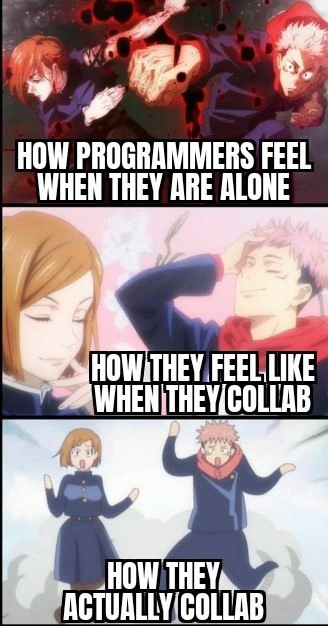
Solo Coding Swagger vs Real Pair Programming Awkwardness in Anime Meme
Why is this Communication meme funny?
Level 1: Three-Legged Race
Imagine you’re really good at doing something on your own, like running fast in a race by yourself. You feel like a champion when you run alone, right? Now imagine you decide to run a race tied to your friend (like a three-legged race where your leg and your friend’s leg are bound together). You might imagine, “Wow, the two of us together will run twice as fast and it’ll be awesome, we’ll high-five at the finish line!” But when you actually start running, it’s awkward: you and your friend have to move your tied legs at the same time. If you haven’t practiced, one goes left when the other goes right, and – oops! – you both almost tumble or have to stop and awkwardly shuffle to get in sync. It’s not smooth at all at first.
This meme is just like that. Working alone as a programmer is like running solo – you can go at your own pace and you feel super strong. Working together with someone on the same computer is like that three-legged race – you think it’ll make you super-team heroes, but initially it’s tricky to coordinate. It feels a bit clumsy and you might even laugh because you and your friend keep mis-timing your steps (or in coding, your ideas). The funny pictures with the high-fives show this: the characters think they’ll do an amazing high-five when working together, but they end up kind of missing each other. It’s a playful way to say, “Teamwork is great, but it can take a little while before you’re really in step with each other.” And that little truth makes us smile, because we’ve all been the two friends tied together, trying not to fall over, and eventually getting it right.
[^1]: Williams, L. et al., Strengthening the Case for Pair-Programming, IEEE Software, 2000 (Among other studies, found that paired programmers often produce higher quality code with roughly 15% more time investment than solo)
Level 2: Awkward Team Sync
Let’s break down the meme step by step, especially for those newer to coding or not familiar with the anime reference. The meme uses three panels (scenes) from an anime to compare a programmer’s solo work feelings vs. collaborative work reality:
| Meme Caption (Panel) | What’s Happening in the Scene & Meaning for Developers |
|---|---|
| HOW PROGRAMMERS FEEL WHEN THEY ARE ALONE (dark, intense battle scene) |
Two anime characters are fighting with dramatic intensity (blood and action everywhere). This represents a programmer working alone feeling super powerful and confident. In real life: when coding by yourself, you might get into a groove (the “flow”) and feel like you’re conquering challenges easily, almost like a lone hero battling through code and bugs. |
| HOW THEY FEEL LIKE WHEN THEY COLLAB (sparkly epic high-five scene) |
The same characters now appear against a bright, sparkly background, going for an enthusiastic high-five. This stands for how programmers imagine working together will feel. They expect an epic team-up, where two programmers collaborating will have perfect synergy, celebrating victories together (hence the big high-five). It’s the ideal picture of pair programming or teamwork: fun, energetic, and perfectly in sync – basically two friends saving the day together. |
| HOW THEY ACTUALLY COLLAB (awkward almost-high-five scene) |
In this final scene, the characters are in a calm, plain setting and their attempt at a high-five is awkward – their hands are up but not connecting, and they look unsure. This shows the reality of how working together often goes: a bit clumsy and uncomfortable at first. For developers, it means that when they actually try to code together (collaborate on the same task), it doesn’t feel as smooth or heroic as expected. It might involve awkward pauses, miscommunication, or uncertainty – like a failed high-five. |
Now, what is this meme really talking about in software terms? It’s highlighting pair programming and the gap between expectation and reality. Pair programming is a practice where two developers work together at one computer on the same code. One is often typing (called the “driver”) while the other is thinking along and reviewing (the “navigator”), and they swap roles periodically. It’s an idea from Agile methodologies (specifically Extreme Programming) meant to improve code quality and share knowledge. New developers might think, “Cool, if two of us work on it, we’ll get it done in half the time and it’ll be twice as awesome!” – that’s the sparkly high-five panel feeling.
However, in reality, especially the first few times you try pair programming, it can feel slow or awkward – like that fumbled high-five. This is due to what we call communication overhead. That term means the extra effort and time it takes to communicate with someone while doing a task. For example, if you’re coding alone and you hit a bug, you just decide quietly how to fix it and do it. If you’re coding with a partner, you’ll stop and discuss: “I think it might be the API call causing this, shall we check the response? What do you think?” – that discussion is necessary, but it takes time. It’s overhead that you don’t have when you’re alone. The meme is poking fun at this by showing how the smooth imagined collaboration (no communication issues, just instant agreement) contrasts with the actual hanging-in-the-air moment (where it’s not clear if we’re in sync).
There’s also the issue of mismatched workflows or styles. Every developer has personal habits: maybe you like to write pseudocode or outline your approach before coding, or you prefer using certain keyboard shortcuts and a specific IDE. Another dev might dive straight into coding or use a different editor. When you pair up, these differences can make the collaboration a bit bumpy initially. It’s like two people trying to drive one car at the same time – if one wants to turn left and the other wants to go right, the car kind of weaves or stops. In programming, this could be as simple as one person saying “let’s refactor this now” while the other was in the middle of writing a new function. If you’re not used to it, you both might pause and do a “uh, you go ahead” back-and-forth. The result is that Developer Productivity feels lower together at first, even if two minds are ultimately working on the problem.
This meme falls under Communication and Developer Experience because it humorously showcases a communication problem. The phrase “CollaborationPainPoints” from the tags refers to exactly these kinds of awkward issues that arise when developers work together: things like misunderstandings, waiting for each other, or feeling out of sync. It’s a very RelatableHumor moment in developer culture because many people in software have experienced a situation where a team project or pair coding session didn’t go as smoothly as planned. Maybe you’ve done a school coding project with a friend and found that you spent half the time figuring out who codes what, or helping them set up the environment, rather than doubling the coding speed. That can be frustrating in the moment, but later on, it’s a bit funny because it happens to everyone.
The anime aspect (using scenes from Jujutsu Kaisen) is there to exaggerate and make the meme visually engaging. You don’t need to know the anime, but for context: Jujutsu Kaisen is an action-packed series, and these particular scenes show characters Yuji and Nobara being intense fighters (panel 1) versus being goofy friends (panel 2) versus being in an awkward situation (panel 3). The meme creator chose these because they perfectly map onto the feelings developers have:
- Alone = intense and confident (you’re “in the zone” like a warrior in battle).
- Imagined collaboration = epic friendship moment (you think working together will be power-up time).
- Actual collaboration = a bit uncomfortable (initially stiff or uncertain, like two people who aren’t sure how to high-five properly).
In simpler terms, the meme is saying: “When I code by myself, I feel super strong. When I think about coding with a buddy, I imagine it’ll be even cooler – we’ll be an unstoppable team. But when we actually try to code together, it’s kinda clunky and we’re not as smooth as we hoped.” This highlights the common team dynamics issue: working with others has a learning curve. Even though teamwork can lead to better results, you have to get past that early stage where you’re adjusting to each other. The humor here is good-natured – it’s not bashing teamwork, but it is acknowledging that every developer has felt that “why is this so awkward?” moment when pairing up.
If you’re new to programming, it’s worth knowing that pair programming can actually be very beneficial despite this initial awkwardness. The meme exaggerates the awkward part for comedy. In practice, once two people get used to each other’s style and communicate well, they might start completing each other’s sentences (or code lines!) and truly become a strong duo. That’s the ideal that the middle panel is dreaming of. But it doesn’t happen magically; it takes practice, good communication, and sometimes a sense of humor to get there. This meme resonates with developers because it’s basically a funny reminder: “Hey, don’t worry if your first collaboration attempt felt weird – that’s normal!” It’s a shared little joke about DeveloperExperience: we’ve all had our solo superstar moments and our team misfire moments.
In summary, the meme uses an anime high-five fail to represent a classic programming expectation vs reality scenario. Expectation: two programmers coding together will be twice as cool and efficient (cue the sparkles and victory pose). Reality: at least at first, it’s awkward and slower as they learn to work in tandem (cue the missed high-five and sweat drop). It’s funny because it’s true, and seeing it in dramatic anime form makes the contrast even more clear (and entertaining!). Whether or not you’ve seen Jujutsu Kaisen, you can appreciate the comic exaggeration and think, “Yep, been there, done that,” especially if you’ve ever tried to share a project or do a group coding assignment.
Level 3: Dynamic Duo Disconnect
For seasoned developers, this meme hits on a too-familiar scenario: the contrast between coding solo and coding alongside someone else. The first panel shows two Jujutsu Kaisen characters engaged in a ferocious battle, blood flying – captioned “HOW PROGRAMMERS FEEL WHEN THEY ARE ALONE.” It’s an over-the-top visualization of the flow state you hit when solo coding. Every experienced programmer knows that rush: you’re in the zone at 2 AM, refactoring like a fearless anime hero, obliterating bugs and implementing features with confidence. The imagery of a high-stakes anime fight perfectly captures that solo coding swagger – you feel invincible, like you have cursed energy powers against your backlog demons. It’s a bit tongue-in-cheek (we’re usually just typing, not literally slaying monsters), but emotionally it rings true. In that state, you’re making rapid progress and maybe even thinking, “I’m a coding god right now.”
Move to the second panel: suddenly the colors turn bright pastel, sparkles everywhere, and our battle-hardened anime duo goes for an epically choreographed high-five. The caption reads “HOW THEY FEEL LIKE WHEN THEY COLLAB.” This is poking fun at our expectations when we think about pair programming or team-up coding sessions. We imagine a perfect synergy – like we’ll become the legendary dynamic duo of the dev world. It’s the idealized version of collaboration: two programmers riffing off each other’s ideas in real-time, finishing each other’s code sentences, high-fiving after squashing a tough bug, and generally feeling like team rockstars. Senior devs have all heard (or given) the pep talks about how “two heads are better than one” and how collaboration will yield cleaner code and shared knowledge. That sparkly high-five scene is exactly how managers and agile coaches describe successful pair programming sessions – full of positive energy, seamless cooperation, and mutual triumph. It’s essentially the DeveloperCulture vision of teamwork: combining strengths to achieve something greater, with a side of celebratory flair. We feel like it’s going to be an anime dream team moment where everything just clicks.
Then comes the punchline: the third panel switches to a plain pale background (almost no effects now), and our two characters are standing apart, arms awkwardly half-raised as they attempt a high-five that either misses or just fizzles out. The caption “HOW THEY ACTUALLY COLLAB” brings us back to Earth – reality ensues. Every veteran developer can relate to this awkwardness. Real-life pair programming or any close collaboration often starts off a bit clumsy. Maybe both people reach for the keyboard at the same time, then both pull back (“Oh, you go ahead…” “No no, you first…”). Or one person suggests an idea just as the other starts typing something else, and an awkward pause follows. It’s the software engineering equivalent of a missed high-five – you go in confident, but end up with a weird shoulder pat or just standing there feeling a bit silly.
Why does this happen? Communication overhead is a major factor. When you’re alone, you don’t have to explicitly explain your thought process; your brain and hands are in immediate sync. The moment you pair up, you have to vocalize your thoughts: “Hmm, maybe we should refactor this function… what do you think?” That talking, even if it’s brief, is overhead that interrupts the flow. It’s like two dancers who haven’t practiced a routine – they might both be great dancers solo, but without coordination, they’ll keep stopping to say “oops, you were going left, I was going right.” Experienced devs have sat through those collab sessions where half the time is spent just clarifying what the problem is or deciding on an approach. That’s time not coding — necessary time, sure, but it immediately feels slower than just hacking away solo. This is one of those CollaborationPainPoints we all share: the friction introduced by having to stay in sync with another person. It doesn’t mean collaboration is bad (in fact, it often leads to better designs or catches bugs early), but boy does it feel less blazing-fast than our solo sprint.
Another factor is mismatched workflows and styles. By the time you’re a senior dev, you’ve developed your own toolkit and rhythm – maybe you write a quick unit test first, or you prefer pseudo-coding on a whiteboard, or you navigate code with vim shortcuts at lightning speed. Now pair up with someone who has a different rhythm: say, they like to discuss design aloud for 15 minutes before touching the keyboard, or they use an IDE with point-and-click debugging. The result can be comically awkward. It’s like two musicians trying to improvise together in different genres – one is doing jazz riffs while the other is playing classical sheet music. The meme’s final panel body language (stiff, arms half-up) is exactly that vibe: “Uh, are we doing this together or…?” Seasoned developers have felt that minor frustration of having to slow down to explain a keyboard shortcut or speed up because the other person is already writing code before you’ve agreed on the approach. Those are CollaborationChallenges that can make the process feel cumbersome initially.
Let’s not forget the human element: team dynamics and personal comfort. Pair programming can feel like performing with an observer constantly at your side. Even a confident coder can get self-conscious with someone watching their every keystroke. You worry about typing too slow, or using the “wrong” approach in front of your peer. This can lead to hesitancy – you triple-check a simple syntax because you don’t want to look dumb making a typo while your colleague watches. We’ve all had that quiet session where both partners are overly polite: “Should I write that function name now?” – “Sure… if you want to…” – pause, type slowly. The imagined high-five victory dance is replaced by cautious, tentative moves. Senior devs might chuckle (or cringe) remembering the first time they paired with the tech lead: initially, it felt like a driver’s test with the instructor silently judging, until rapport was built. The SharedPain here is real – even the best of us have experienced that first-day pair programming awkwardness.
The meme nails these nuances through exaggerated anime humor. Jujutsu Kaisen fans might appreciate the specific reference: the characters Yuji Itadori and Nobara Kugisaki actually have great chemistry in the show, which makes it extra funny that the meme depicts their high-five failing. It’s a wink to how even a great team can have an awkward moment. But you don’t need to know the anime – every developer recognizes the expectations vs. reality scenario on display. It’s essentially a dev inside joke: Solo, I’m a 10x developer in my own mind; paired, I’m suddenly hitting the wrong shortcuts and talking over my partner. The intensity drop from panel 1 to panel 3 is the comedic exaggeration that brings out laughter (and maybe a resigned sigh).
In the workplace, this gag reflects why many of us both love and dread pair programming. Best case, it truly can be like panel 2: energizing and effective (when you pair with someone you click with, you might actually feel that spark of “Yes! We nailed it, high-five!”). But often, especially at the start, it’s panel 3: a bit of a stumble as you adjust to each other. It’s important to note – and seniors know this – that if you push through the initial weirdness, pairs do develop a groove. The meme is focusing on that initial contrast for humor’s sake. And it works because it taps into a universal developer experience: that initial collaboration clunkiness. It’s a gentle roast of our DeveloperExperience (DX) when forced out of our comfortable solo zone and into synchronous teamwork.
Some real-world scenarios that mirror this meme’s point:
- Onboarding a new team member via pairing – You hope it’ll be seamless knowledge transfer (heroic mentor-mentee montage!), but it often starts with awkward silence and lots of “Actually, let me google that real quick…”.
- Pair debugging a nasty bug – Two heads should find the bug faster. Instead, you spend 30 minutes ensuring you’re both looking at the same log output and not stepping on each other’s analysis.
- ”Mandatory” pair programming rotations – Management says “Everyone should pair up to improve code quality.” Developers picture joyful collaboration (and maybe some do have it), but many pairs end up sitting together semi-awkwardly, with long stretches of one person typing while the other watches, then swapping. The high-five moment of shared victory is rare; more often it’s “Uh, break time? Yeah, let’s take a coffee break.”
In summary, the senior perspective sees this meme and nods knowingly. It’s a humorous reflection of a TeamDynamic that’s well-intentioned but tricky. It underscores that even though we preach collaboration in software development, the transition from solo warrior to cooperative pair isn’t instantaneous or magical. It takes effort, and until that clicks, we’re basically those two anime characters giving an “almost high-five” – trying to sync up and just slightly out-of-step. And the fact that we’ve all been there is exactly why this meme is so relatable and funny in developer circles. We laugh because it’s true: coding alone can feel like a badass battle, while coding together can feel like learning to high-five for the first time.
Level 4: Two Threads, One Keyboard
At the most technical level, this meme highlights a pair programming paradox reminiscent of parallel computing challenges. When two programmers work together on one task (like two threads on a single process), you might expect double the productivity, but Amdahl’s Law and real-world factors kick in. In computing, adding more threads only speeds things up if the work can be parallelized; any part of the task that is inherently sequential becomes a bottleneck. In pair programming, the act of typing code is essentially a single-threaded process – only one person can really “drive” at a time (one keyboard, one screen). The second person contributes by reviewing or suggesting (a parallel mental thread), but both can’t execute concurrently on the same line of code. This is analogous to two CPU cores trying to share one ALU: they end up waiting on each other or incurring context switch overhead.
From a theoretical standpoint, there’s also the concept of communication overhead. In distributed systems or multi-threading, threads/processes must coordinate (using locks, semaphores, etc.), which can diminish the gains of parallelism. Similarly, two programmers must constantly synchronize their understanding of the code (“Wait, what function were you about to call?” “Let’s clarify the approach before writing.”). Each synchronization point is like acquiring a lock – it ensures both people (threads) are on the same page but introduces delay. Fred Brooks famously generalized this in The Mythical Man-Month: adding manpower to a software project often slows it down because of increased communication channels and coordination complexity. With just two people, Brooks’s observation still applies on a micro scale: the pair spends time discussing who does what, explaining ideas, and resolving differences in real-time. This A→B communication is analogous to the latency in a two-node network or the overhead in a synchronization barrier in parallel algorithms.
There’s also a cognitive science aspect. A solo developer in a flow state (a term from psychology for deep focus) can operate with all mental resources on the task. Introduce a partner, and part of each developer’s brain cycles must now go to real-time communication and awareness of the other. It’s like how a real-time operating system has to allocate CPU time to coordination tasks in addition to the actual work. The high-energy first panel of the meme (the blood-spattered battle scene) symbolizes a programmer at 100% CPU usage on code, no interrupts. The later awkward panel is full of “interrupts” – each developer is context switching between coding and communicating. Flow interruption is costly: research in HCI and workplace studies shows that even a short interruption can significantly extend the time to complete a task. In pair programming, you intentionally interrupt each other to collaborate, which can sacrifice the blazing speed of solo problem-solving for the potential benefits of shared knowledge and error-catching.
The meme’s humor, at this deep level, comes from the ideal of synergy smashing into the laws of human and technical systems. In theory, two minds should solve a problem faster (just as two processors should crunch numbers faster). In practice, if the work isn’t perfectly divisible or the coordination is hard, you hit diminishing returns or even delays. It’s akin to Amdahl’s Law: if a task is, say, 90% coding and 10% communication, adding a second person doesn’t halve the time; the communication overhead might even make it take longer. The “HOW THEY FEEL LIKE WHEN THEY COLLAB” panel (sparkly high-five) is the myth of linear speedup – the hope that 1 + 1 = 2. The “HOW THEY ACTUALLY COLLAB” panel (awkward almost-high-five) is the reality of sub-linear speedup, or even a slowdown at first, due to synchronization overhead. And yet, just as in multi-threading, the benefit of doing it (when done right) might lie elsewhere: fault tolerance (catching bugs, like redundancy) and shared cache of knowledge between the two brains. But the punchline is that those benefits aren’t immediately felt in the moment – what you feel is the sluggishness and clumsiness, much like two CPU cores thrashing on a shared resource.
Lastly, consider the Extreme Programming (XP) angle – pair programming was popularized as a core XP practice in the late 1990s to improve software quality. Think of it as an experiment in human concurrency control. Academically, studies on pair programming found interesting results: pairs often produce higher-quality code and catch errors early (analogous to error-correcting by having two sets of eyes), but the actual coding takes about the same time or even longer than coding solo for a given task[^1]. This meme wryly dramatizes that experiential truth: the feeling of speed and power (solo ninja coder cutting through code at warp speed) versus the measured reality of collaborative work (two people moving cautiously, sometimes stepping on each other’s toes). It’s a small-scale illustration of the eternal software engineering balancing act between individual productivity and team collaboration – a balance that even the most advanced methodologies and theories acknowledge is tricky to get just right.
Description
Three-panel anime meme using scenes from Jujutsu Kaisen. Panel 1 (dark, high-contrast reds and blacks) shows two blood-spattered characters fighting ferociously with the caption “HOW PROGRAMMERS FEEL WHEN THEY ARE ALONE,” conveying unstoppable solo-coder confidence. Panel 2 shifts to a pastel, sparkly background where the same characters grin and raise their arms for an epic high-five; text reads “HOW THEY FEEL LIKE WHEN THEY COLLAB,” illustrating the imagined synergy of pair programming. Panel 3 flips to a pale sky backdrop where the pair stand stiffly apart, arms half-raised in an awkward almost-high-five, under the caption “HOW THEY ACTUALLY COLLAB,” highlighting the clumsy reality of real-world developer collaboration. Technically, the meme pokes fun at communication overhead, mismatched workflows, and the contrast between individual flow state and the friction of synchronous teamwork common in software engineering
Comments
15Comment deleted
Pair programming always sounded like horizontal scaling - until you realize both cores are locking on the same keyboard semaphore and throughput drops to single-threaded small talk
After 15 years of architecting distributed systems that handle millions of requests, you'd think I'd have mastered human-to-human communication protocols. Yet here I am, still buffering during standup, dropping packets in code reviews, and experiencing complete connection timeout when someone asks 'how was your weekend?' At least my microservices talk to each other better than I do
Senior engineers know the truth: solo coding feels like wielding god-tier powers with perfect flow state and zero context switching. Collaborative coding in theory promises elegant mob programming and seamless knowledge transfer. In practice? It's two architects spending 45 minutes debating whether to use a factory pattern while both secretly wishing they could just merge their conflicting PRs and move on. The real collaboration happens asynchronously in code review comments at 2 AM
Pairing promises parallelism, but between Amdahl’s Law, Slack pings, and merge conflicts, collaboration is basically a distributed mutex on two seniors
Solo I’m a hot path; collab feels like SIMD; actual pairing is two threads contending on the “who’s driving?” mutex until Git returns a merge conflict and someone schedules a meeting
Solo: Domain expansion refactor nirvana. Collab: Cursed spirits clashing over tabs vs spaces
Сложна Comment deleted
Please only use english in here, @s2504s Comment deleted
that's "hard", but incorrectly, because of the meme Comment deleted
In admin's defense, admin can't read russian Comment deleted
doesn't that mean that he need to learn it? Comment deleted
:/ Comment deleted
I've already got enough work on my hands, don't need that as well Comment deleted
I'm just a mod, not an admin Comment deleted
Source Comment deleted