The Escalating Horrors of Programming Errors
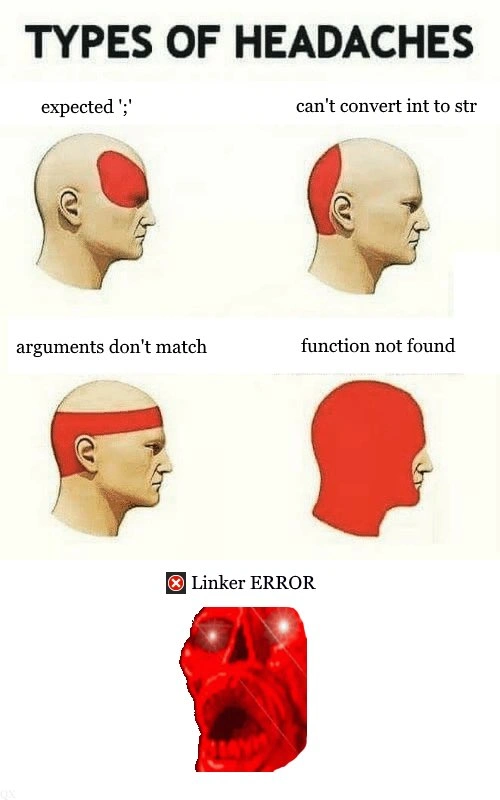
Why is this Bugs meme funny?
Level 1: Missing Puzzle Pieces
Imagine you’re building a big jigsaw puzzle. At first, you make a small mistake – maybe you put one piece in the wrong spot. That’s like forgetting a semicolon in code: a tiny error. You notice it (or someone points it out), you fix that piece, and your puzzle (program) is fine. No big headache. Next, you try to fit a piece that doesn’t quite belong, like trying to attach a square block where a round one is needed. That’s similar to using the wrong type of data in a program (like mixing up numbers and text) – it doesn’t fit, so you swap it with the correct piece and move on. The puzzle gets a bit tricky when you realize you’re using the wrong pieces in a section – say you’re putting pieces from a different puzzle or in the wrong order. This is like calling a function with the wrong inputs; things don’t line up until you rearrange them correctly. It’s a bit frustrating, but you can handle it. Now imagine you’re almost done, but one puzzle piece is just completely missing. You look everywhere, it’s not there. This is what a linker error feels like in programming: you did everything else right, but the final result can’t come together because something invisible is missing. In the puzzle world, you’d have a big gap in your picture – super annoying, right? In the programming world, the program won’t build at all. The meme is funny because it’s showing how each of these situations makes your “headache” worse: from a tiny “oops” with a quick fix to a huge “oh no!” that makes you want to scream. By the time you realize a crucial puzzle piece (or code piece) is missing and you can’t finish, you feel like that red, screaming skull in the picture. The joke is really saying: small mistakes are like small headaches, but some problems are so tough they feel like your head is exploding – and every programmer has felt that!
Level 2: Compile vs Link 101
Let’s break down the technical terms and phases referenced in this meme, in a beginner-friendly way. When you write code in languages like C, C++ or Java, there’s a process that turns your code into a running program. Understanding that process helps to clarify why some errors are mild and some are dire:
The Compilation Process: Think of it as two major stages – compile and link.
- During the compile stage, the compiler checks your code for correctness and translates it into a low-level form (machine code or an intermediate representation). It’s like proofreading an essay and then translating it into another language. Most of the errors you see first (syntax and type errors) happen here.
- If compilation succeeds, we move to the link stage. The linker is a tool that takes all the compiled pieces (and any libraries you’re using) and tries to assemble them into one cohesive program. If any piece is missing or doesn’t fit, the linker will complain. This stage is a bit like assembling a puzzle or Lego set out of pieces that were individually crafted in the compile stage.
Now, let’s match the meme’s “headaches” with what they mean in simple terms:
expected ';': This message means the compiler was looking for a semicolon and didn’t find it. In many languages (C, C++, Java, JavaScript, etc.), a semicolon;is like a period at the end of a sentence — it signifies the end of a statement. Forgetting it is a common syntax error. For example:printf("Hello, world!") // Oops, missing a semicolon hereThe compiler sees the
printf("Hello, world!")and then something unexpected instead of;. It will throw an error (often literally containing the phrase “expected ‘;’”) and point to the location. This is usually the easiest error to fix: just add the missing;and re-run the compile. It’s like a tiny hiccup in writing code, usually caught instantly.can't convert int to str: This indicates a type mismatch error. Here,"int"(integer) and"str"(string) are two different types, and the code is trying to use one where the other is expected. Languages with static typing (C++, Java, C#, etc.) are strict about types. If you have:int number = 42; std::string text = number; // Error: cannot convert int to std::stringThe compiler will balk because you’re assigning an integer to a string variable without conversion. It’s like trying to plug a USB-C connector into a USB-A port – they’re not compatible without an adapter. The error message
"can't convert int to str"is a simplified way of saying “these two types don’t match, so I (the compiler) refuse to mash them together.” To fix it, you either change the types to match (e.g., make them both int or both string) or perform a proper conversion (like usingstd::to_string(number)to turn the int into a string). This error is still at compile time; the program won’t compile until you resolve the type clash.arguments don't match: This refers to a function call mismatch. Functions in code have definitions that specify what kind of and how many arguments (parameters) they accept. If you call a function with the wrong number or wrong types of arguments, the compiler gets confused because it can’t find any version of that function that fits what you wrote. For example:// Suppose a function is defined (or declared) as: int add(int a, int b) { return a + b; } // ...later in code, you attempt to use it: int result = add(5);Here,
addexpects 2 arguments (two integers), but we only provided one (5). The compiler will error out with something akin to “error: too few arguments to function ‘add’” or “no matching function for call toadd(int)”. In the meme’s terms, "arguments don't match" means the way you're calling the function doesn't line up with any known definition. Maybe you got the order wrong (e.g.,doSomething(name, count)vsdoSomething(count, name)), or you missed an argument, or gave an extra one. This is again a compile-time error. The fix is usually straightforward: check the function’s definition and adjust your call to have the correct arguments (or update the function if you intended a different usage).function not found: This one can be a bit confusing because it might happen at compile time or link time, depending on the situation. At face value, "function not found" means you tried to use a function that the code doesn’t know about. For instance, you might callcalculateTotal()but forgot to declare or include the header wherecalculateTotalis defined. The compiler in that case will say “I have no idea whatcalculateTotalis,” often phrased as “implicit declaration of function” or “‘calculateTotal’ was not declared in this scope.” That’s a compile-time error – you correct it by spelling the function name right, including the proper file, or defining the function.However, there's another scenario: you declare a function (so the compiler is happy) but never actually provide a definition by link time. For example, in one file you might have
int doMagic();(declaration) and you calldoMagic()inmain(). The compile stage is fine because the compiler assumesdoMagic()exists somewhere. If you never actually wrote the functiondoMagic(or didn’t link the object file that contains it), the linker will scream that it can’t find it when building the final program. That’s a linker error variant of "function not found," often called an undefined reference error. It’s as if you had all the puzzle pieces except the last one – the compiler laid out the puzzle and left a gap, expecting the linker to fill it, but the linker can’t because the piece is truly missing.Linker ERROR: This is the grand finale and the biggest headache in the meme. To a newcomer, the term linker might not yet be familiar. The linker is the tool that runs after successful compilation to tie together all your code and libraries. If compilation is like making individual puzzle pieces, linking is assembling those pieces into the full picture. A linker error means the puzzle can’t be completed. The meme shows a Windows-style error icon with "Linker ERROR" to emphasize it's a system-level failure, not just a quick code fix. Common linker errors include messages about "undefined references" (couldn’t find the body for a function you used) or "duplicate symbols" (found more than one body for something, which it doesn’t know how to handle either). These errors are notorious because the messages can be hard to decipher for beginners. For example:
undefined reference to 'SomeFunction'– The linker is telling you, "I neededSomeFunctionbecause code mentioned it, but I looked through all compiled files and libraries given to me, and it’s nowhere. I cannot proceed." This often means you forgot to compile or link a file that containsSomeFunction, or maybe you have a typo in the function name between the declaration and definition.multiple definition of 'SomeVariable'– The linker found two separate places whereSomeVariableis defined (which is illegal in C/C++). Maybe the same global variable is defined in two different .c files. The linker doesn’t know which one to use, so it throws an error.
For someone new, encountering a linker error is daunting because it doesn’t point to a specific line of your source code. Instead, it might reference object files or libraries. For example, “Undefined reference in module
main.o” or an error with no direct mention of your source code at all, just symbol names. It requires understanding that, oh, something’s missing in the build. The fix could be as simple as adding a missing file to the compile/link command, or as complicated as needing to obtain and link the correct library for a function (like linking against-lmfor math functions in C, because forgetting to link the math library causes undefined references tosin,cos, etc.). This is where the Build Systems & CI/CD angle comes in: in professional projects, you often rely on build configuration (Makefiles, project files, etc.) to include everything. If those are misconfigured, boom – linker errors.
So why does the meme specifically crown the linker error as the king of headaches? Because new developers usually struggle first with syntax errors (like missing semicolons) and simple type errors, which are quickly resolved. As you progress, you learn to fix those quickly and move on. But then you hit that first linker error and it’s a whole new ballgame: “What is a linker and why is it angry at me? Everything compiled, didn't it?” It’s an initiation into a deeper level of understanding of how compiled programs are built. The humor is that experienced devs remember that learning curve all too well – and even as you get experienced, linker errors still have a way of catching you off guard. This meme basically says: We’ve all been through these stages of pain, and we all agree – that last stage is the worst! It’s a classic piece of developer humor that takes a rather niche concept (compiler vs linker errors) and makes it visually and viscerally understandable as “increasing levels of headache.” Even if you don’t get all the terms at first, you can relate to the idea that some problems just cause more pain than others. And for those who do know the terms, it’s a tongue-in-cheek summary of a hard-earned lesson about compiling code.
Level 3: From Migraine to Meltdown
This meme capitalizes on a shared inside joke among developers: not all errors are created equal. Sure, all bugs and build errors are headaches, but some are the equivalent of a mild tension headache while others feel like a full-blown migraine that makes you question your life choices. The chart of red-shaded heads, culminating in a demonic skull, wittily illustrates this progression from minor annoyance to catastrophic frustration. Each label corresponds to a classic scenario in coding:
expected ';'– The Tiny Throbbing Temple: This is the most basic error, a syntax error. Almost every programmer has missed a semicolon (or a curly brace, or a parenthesis) and immediately gotten a clear error message. It’s the kind of headache you get from maybe one too many cups of coffee but it goes away quickly. You facepalm, add the;, recompile, and it’s like taking an instant painkiller – problem solved. In the hierarchy of problems, it’s a newbie rite of passage and even seniors still occasionally get bit by it (especially in languages like C, C++, Java where every statement must end with;). The humor here is that something so trivial is depicted as a very localized, minor head pain. It’s annoying but extremely fixable."can't convert int to str" – The Squeezing Forehead Band: Now we’re into type errors or semantic errors. This message hints at trying to use or assign incompatible types (for instance, treating an integer like a string). In strongly-typed languages, the compiler blocks you with an error because, say, you tried to do something like
string name = 42;or passed anintwhere astd::stringwas expected. For a newer dev, understanding why you can't just mash types together might cause a bit of a headache until you learn about how types work. The meme shows this pain wrapping around the side of the head, a bit more intense. Seasoned devs chuckle because we’ve all seen absurd attempts to force one type into another and the compiler essentially goes, “Um, no can do, I can’t magically convert anintto astring.” It’s a step up in headache severity: you might have to refactor code or use a conversion (likestd::to_stringor proper casting), but once you see the error, it’s usually clear what needs fixing."arguments don't match" – The Forehead Slap: This refers to a function call error where the arguments (parameters you pass into a function) don’t match any known version of that function. Maybe you called
doSomething(1, 2)but only adoSomething(int)is defined, or you swapped the order of parameters of a library call. The error message might say something like “no matching function for call todoSomething(int, int),” which at least tells you what doesn't match. The meme’s third head has a big red band across the forehead, implying a more sizable headache. Why? Because these errors often occur when integrating code – perhaps you updated a function’s signature in one file but not everywhere else. It’s a common debugging troubleshooting scenario: you see the error, then realize, "Oops, I called that function with the wrong number of arguments." It can be a bit frustrating, but once spotted, you adjust the call or the function definition. Still not a build failure of epic proportions – it’s basically the compiler saying “I don’t think that function is used correctly.” You fix it, recompile a couple times, no big deal."function not found" – The Full Red Face: Now things are getting serious. A completely red-filled head in the meme corresponds to a situation where you try to use a function that the compiler can’t find. This is often phrased as "undefined function" or "not declared in this scope" depending on context. It could be a simple mistake like a typo in the function name or forgetting to include the header where the function is declared. For example, you call
CalculateTotal()but either spelled itcalculateTotal()elsewhere (C++ is case-sensitive, so that matters), or you never told the compiler about it. This error is a show-stopper at compile time – the build halts because the compiler refuses to proceed without knowing about this function. It’s a bigger headache because now you might have to search through your code or project settings to figure out why the function isn’t recognized. It might be defined in another file that isn't being compiled or an external library you didn't link (which bleeds into the link stage). The meme placing this as the second-worst headache is apt: by now the entire head is pounding. Every programmer has had that "wait, why is this not recognized?" moment and spent longer than they'd like searching for the cause (Did I misspell it? Did I forget an#include? Is this the wrong version of a library?). Yet, we still haven’t hit rock bottom.
Then the meme drops the final panel: Linker ERROR with a Windows-style error icon and a terrifying all-red screaming skull. This is the ultimate developer migraine, the catastrophic linker error. The humor sticks the landing here because practically every programmer who works with compiled languages (especially in complex C/C++ projects or with elaborate build systems like Make, CMake, Visual Studio, etc.) has experienced this special kind of agony. Why is it so bad? Several reasons make a linker error uniquely infuriating:
- Timing and Context: A linker error happens after you thought everything was okay. You fix all the syntax and type issues, the code compiles 100% with no errors... and only then, at the very end, the linker says “Nope, I can’t finish building this program.” It’s like running a marathon and tripping on the finish line tape. You often have sat through a long compile (in large projects, possibly minutes or more), only for the build to fail at the last step. Talk about a blood pressure spike!
- Cryptic Messages: Unlike syntax errors (which point to a file and line) or type errors (which mention variable names and types), linker errors often throw out raw symbol names and module names. For example, a classic GCC linker error might be
undefined reference to 'SomeClass::someMethod(int)'. If that method is templated or overloaded, the error can look even scarier (mangled names with lots of gibberish). On Windows, you might getLNK2019: unresolved external symbol __imp__SomeFunction referenced in function _main. The average dev sees that and their brain just screams “What does this even mean?!” The meme’s glowing-eyed skull is a perfect embodiment of exasperation — by then your brain feels like it’s on fire trying to decode the error. - Possible Causes: Linker errors aren’t as straightforward to fix because they could result from any number of issues: missing object files in the build, forgetting to link a library (
-lSomeLibnot passed to the linker), mismatched function signatures (declaredint func(int)but definedint func(double)somewhere else), wrong linkage specifications (like a missingextern "C"on a C function called from C++ causing name mismatch), or one of those fun times when you have two definitions of something (leading to a "multiple definition" linker error). It can be deeply frustrating to debug. You might have to dig into build scripts or linker command lines. It’s not always as simple as opening the code editor to a specific line. - Environment Sensitivity: Sometimes code compiles fine on your machine, but you hit a linker error on the CI server or on a colleague’s setup because of an environmental difference (like a library not installed, or a different compiler version). These build failures can be nightmares to reproduce and fix, causing that shared pain among teams — everyone has some war story of "it compiled on my machine, then Jenkins threw a linker error at midnight." Cue the collective groan (and the meme’s resonance in a DevOps or CI/CD context).
The senior developer perspective appreciates how this meme captures a spectrum of developer pain. It’s funny because it’s true – we laugh as a coping mechanism. The image exaggerates the pain levels (no, your head doesn’t literally glow red... usually) but emotionally, it feels accurate. The progression from a tiny red spot on the head (tiny bug) to a whole-skull inferno (system meltdown) is a perfect visual metaphor for those late-night debugging sessions. This is developer humor at its finest: turning the esoteric frustrations of compiling code into something we can all nod and chuckle at. We’ve all been that skull at some point, eyes burning after staring at linker error output for an hour thinking, “Why on Earth can’t you find this function? I wrote it, I swear!”
In summary, the meme ranks errors by headache intensity, hinting at the unwritten rule in programming: the later in the development process an error is caught, the bigger the headache. A missing semicolon is caught early and is trivial; a linker error surfaces at the very end and can be hair-tearing. It taps into a bit of tribal knowledge: Compiler errors (syntax/type errors) are usually easier to fix than linker errors. That’s why the final panel isn’t just a red head – it’s a skull screaming in torment. Every experienced dev sees that and goes, “Haha... yep, been there.” The meme may be humorous, but it’s also almost a little PTSD-triggering for those who have battled obscure build failures at 3 AM. And that blend of pain and laughter is exactly what makes this kind of inside joke so relatable in the programming community.
Level 4: Undefined Reference Hell
At the deepest technical level, this meme pokes fun at the compilation pipeline — especially the arcane final boss known as the linker. In low-level languages like C and C++, building a program is a two-step dance: first the compiler checks syntax and types, translating source code into object files, and then the linker swoops in to stitch those pieces into a single executable. Each "headache" in the meme corresponds to a failure at a different stage of this pipeline:
- Syntax parsing is where a missing semicolon (
expected ';') will make the compiler instantly complain. This is a straightforward grammar violation; the compiler knows exactly where you messed up, and it tells you unambiguously. - Semantic analysis and type checking catch issues like
"can't convert int to str"or"arguments don't match". These errors mean your code's logic or function calls violate the language’s type system or function signatures. The compiler flags them before it even bothers generating machine code. - Code generation might succeed if all syntax and semantics are correct. You get your
.oor.objfiles (machine code for each source file). If you see “function not found” during compilation, it typically means a reference to an identifier the compiler has never seen declared. But if the compiler has seen a declaration (say from a header file) and trusts a definition will be available later, it happily generates an object file with an unresolved symbol. That unresolved symbol is a promise to the linker: “I don’t know wherefoo()is, but I assume you’ll provide it from somewhere else.”
It’s in the final linking stage that those promises come due. The linker is like a meticulous accountant: it takes all the compiled object files and libraries and tries to resolve every symbol (function names, global variables, etc.) to an actual memory address. A linker error occurs when it can’t finish that job – it's asked to glue together something that’s missing or duplicated in impossible ways. For example, if you declared void doTheThing(); in one file but never actually defined it in any file, the compiler was fine with it (no compile error), but at link time you’ll get an “undefined reference to doTheThing” (in GCC) or an ominous LNK2019 unresolved external in MSVC. The meme’s final panel – the red skull with glowing eyes – perfectly captures how developers feel when confronted with a linker screaming “I can’t find that function you said would be there!” after a long build. It’s the thermonuclear headache because the error appears after waiting for the entire compilation to finish, and often the message is indecipherable without deep knowledge.
Why are linker errors so notorious? Partly because linkers operate at the binary level of symbols and addresses, not at the nice source-code level with helpful context. A missing semicolon error might point to an exact line in a .c file, but a linker error might spit out a cryptic symbol name mangled beyond recognition. (Ever seen something like _Z3fooIiEvv? That’s a C++ linker symbol for a templated function, practically an encrypted message to the uninitiated.) There’s also a combinatorial complexity in linking: the more files and libraries in a project, the greater the chance something wasn’t compiled or referenced correctly. Build systems (like Make, CMake, or modern CI/CD pipelines) automate this process, but one misconfigured linker flag or missing library, and you’ve got a mysterious failure. Seasoned engineers know that tracking down an unresolved external can feel like hunting a needle in a hex dump. It often involves digging through compiler documentation, makefile scripts, or linker map files — tasks that can make one’s head throb.
In short, the meme humorously ranks headaches by aligning them with increasingly deep compiler/linker issues. It resonates with anyone who’s ventured beyond trivial programs into larger codebases. A missing semicolon is a paper cut, a type mismatch is a sprain, but a catastrophic linker error is a full-on migraine with the lights flashing (just like the meme’s red glowing skull). The absurd escalation to “Linker ERROR” as the ultimate pain is a nod to how build failures at the linker stage are an entirely different pain domain – one that blends software engineering with a bit of black magic. For veterans, this is funny because it’s true: after you’ve solved all the easy compiler errors, the linker might still get you in the end, cackling like an evil boss fight you never saw coming.
Description
This meme uses the 'Types of Headaches' format to illustrate the increasing severity of different programming errors. The image displays five panels. The first four show diagrams of a human head in profile with escalating areas of red indicating pain, each corresponding to a specific error: 'expected ';'' (a spot over the eye), 'can't convert int to str' (a patch on the back of the head), 'arguments don't match' (a band around the head), and 'function not found' (the entire head is red). The final, fifth panel dramatically escalates the theme. Below the text 'Linker ERROR', which is prefixed with a red 'X' icon, is a distorted, glowing red, screaming face representing an extreme level of agony. The humor is derived from the relatable experience of debugging. Simple syntax or type errors are common and usually easy to fix. However, linker errors are notoriously difficult to diagnose. They occur during the final stage of building a program when the compiled code is linked with libraries. These errors often have cryptic messages and can stem from complex issues like missing libraries, version mismatches, or incorrect build configurations, making them a significant source of frustration for even the most experienced developers
Comments
7Comment deleted
A syntax error is the compiler telling you that you made a typo. A linker error is the compiler summoning the ghost of a library you didn't even know you were using to tell you your entire life is a lie
Syntax errors are a twinge and type errors a throb, but when the linker bails it’s the universe reminding you that your “modular” build graph is really a decade-old Jenga tower held together by undefined symbols and tribal lore
The real nightmare isn't the linker error itself - it's explaining to the PM why a missing symbol in a third-party library we don't control just added three sprints to the timeline
The progression from 'expected semicolon' to 'Linker ERROR' perfectly captures the developer's descent into madness - starting with a minor syntax typo that takes 30 seconds to fix, escalating through type system battles and signature mismatches, until you reach the ninth circle of build hell where the linker cryptically informs you that somehow, despite everything compiling fine, nothing can actually be assembled into a working binary. At that point, the entire head turning into a crystallized mass of pain is anatomically accurate
Nothing humbles a senior like realizing the fix for a day-long linker error was 'move -lfoo after -lbar' - ABI sanity restored, ego not so much
Syntax errors build character; linker errors remind grizzled architects that after 20 years, unresolved symbols still own your weekend
Syntax errors cost minutes; type errors cost hours; linker errors cost your weekend - turns out it was link order and an ABI mismatch hiding behind rpath