Skip to content
DevMeme
3354 of 7435
Handling C++ like it’s a live grenade in your kitchen
Languages Post #3685, on Sep 12, 2021 in TG

Handling C++ like it’s a live grenade in your kitchen

Why is this Languages meme funny?

Level 1: When Dinner Explodes

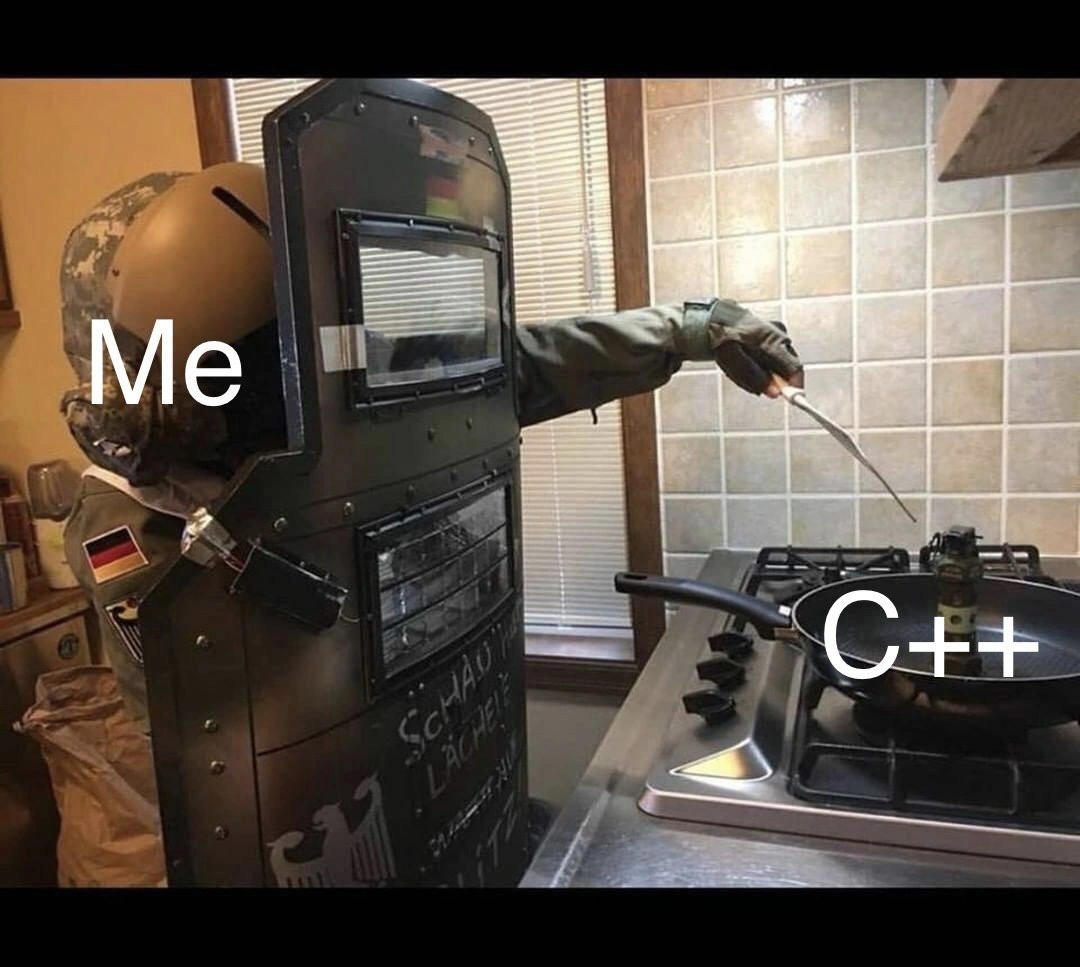
Imagine you’re trying to cook dinner, but in your frying pan there’s a live grenade instead of food. 😮 You’d probably be extremely careful, right? Maybe you’d put on heavy protective gear and use long tongs to take it out, super slowly, hoping it doesn’t explode. It’s a ridiculous situation – nobody has a grenade in their kitchen for real! – and that’s why it’s funny. This meme is saying that writing code in the programming language C++ can feel as risky as that crazy cooking scenario.

For a programmer, a “big explosion” means the program crashes or breaks in a scary way. C++ is a very fast and powerful language, but if you make a tiny mistake while using it, the program can unexpectedly “blow up” (stop working or produce wild errors). The picture shows the person labeled "Me" (the programmer) treating the code (labeled "C++" in the pan) like it’s an explosive. It’s a silly exaggeration that captures a real feeling: working with C++ means you have to be extra cautious, almost like a bomb expert, or else your nice cooking (your project) could end up a big mess. In short, the meme is funny because it takes the fear and carefulness a C++ coder sometimes feels and turns it into a literal scene of a chef defusing a bomb in the kitchen. It’s an over-the-top way to say, “Be careful with C++, or BOOM! – there goes your dinner (program)!”

Level 2: Handle with Care

If you’re newer to programming, you might wonder why someone would treat a programming language as gingerly as a live explosive. Let’s break it down in plain terms. C++ is a powerful programming language that lets you work very close to the computer’s hardware – this is often called low-level programming. “Low-level” here means you manage a lot of things yourself, especially memory management (how memory is allocated and freed) which higher-level languages usually handle for you.

In languages like Python or Java, the system automatically takes care of cleaning up unused memory (via a garbage collector) and will actively prevent you from doing certain dangerous things, like going out of bounds on an array. C++ doesn’t automatically do that; it assumes you, the programmer, know what you’re doing. It’s a bit like a car with a manual transmission and no airbags – you have more control and it can go faster, but if you make a mistake, there’s nothing to cushion the impact. 🏎️

A key concept in C++ is the pointer. A pointer is essentially a variable that holds a memory address. Think of memory as a long street full of houses (each house is a byte or a chunk of bytes), and each house has an address. A pointer is like a slip of paper with a house address on it – it tells you where something lives in memory. With C++ pointers, you can do arithmetic on these addresses. Pointer arithmetic means moving that address to a new location by adding or subtracting an offset. For example, if a pointer p points to the first element of an array, p + 1 would point to the next element. This is a common way to iterate through arrays in C and C++. But here’s the catch: the language won’t stop you if you move the pointer past the end of the array. It’s as if you have a map and you’re allowed to walk off the marked trails – you might end up somewhere that isn’t your campsite (i.e., not your array) and that’s where the trouble begins.

What kind of trouble? Well, imagine you have an array of 10 items and you accidentally try to access the 11th item. In many languages, that would immediately give you an error like "Index out of range!" In C++, it compiles just fine. When you run it, two things can happen: (1) if you’re lucky, the program crashes on the spot with a segmentation fault (often abbreviated as segfault). That crash is the operating system stepping in to prevent your program from touching memory it doesn’t own – basically slapping the grenade out of your hand before it goes off. (2) If you’re unlucky, the program doesn’t crash immediately. Instead, it might overwrite some other piece of data in memory that it shouldn’t. The program keeps running, blissfully unaware of the ticking time bomb that something important was corrupted. Later on, maybe minutes or days later, it might blow up in a completely different part of the code, and you’re left scratching your head, saying "What the heck caused this?" This scenario is exactly why we sometimes call such issues memory safety problems. C++ gives you speed, but it won’t guarantee safety; avoiding the crash is squarely on you.

Some common C++ pitfalls that every beginner (and expert) has to watch out for:

  • Buffer Overflow: This is what we described above – going past the end (or before the beginning) of an array or buffer. It’s like you have a tray that holds 10 cupcakes and you try to put a 11th cupcake on it; the extra cupcake falls off and makes a mess. In computing, that "mess" could mean overwriting something important, since memory is all laid out next to each other. Buffer overflows are not just crashes – they’re a famous security vulnerability. (Many viruses and hacks historically exploited buffer overflows to inject malicious code, essentially tricking the program into executing the "overflow" data as instructions. Yikes!)
  • Dangling Pointer: This is a pointer that doesn’t point to valid memory. For instance, say you new allocated an object or did a malloc (to get a chunk of memory from the system) and then later deleted or freed it (gave it back to the system). The pointer still holds the address where that object used to be, but that memory might now be given to something else or marked as free. If you then use that pointer, you’re basically poking at memory that’s no longer yours – maybe another grenade. This often causes a crash or corruption. It’s like you had the address of an old friend’s apartment, but they moved out and someone else moved in; if you use your old key, who knows whose door you’re opening.
  • Memory Leak: This is less explosive and more like forgetting to turn off the stove. It won’t blow up immediately, but it causes problems over time. A memory leak happens when you allocate memory and never free it. Each leak is like leaving a faucet running; one leak might not be noticeable, but if you keep doing it, eventually you run out of water (or memory, in this case). In a long-running program (like a server), memory leaks can gradually eat up all the system memory and cause the program (or even the whole machine) to grind to a halt. C++ makes it easy to accidentally leak memory if you’re not careful to delete what you new. This is one reason we now use tools like smart pointers (e.g., std::unique_ptr) and other RAII techniques to auto-cleanup and avoid leaks.
  • Undefined Behavior: We mentioned this term – it’s a broad catch-all for "you broke the rules in a way the C++ standard doesn’t define, so anything might happen." For a newcomer, it’s a weird concept because we expect the computer to follow deterministic rules. But in C++, if you do something like access an array out of bounds, the standard literally says the behavior is undefined. It might seem to work, or it might crash, or your program might start acting unpredictably. One famous saying is, "Undefined behavior means the program can make demons fly out of your nose" – that's a humorous way to say absolutely no guarantees. In practice, undefined behavior often arises from memory misuse (buffer overflows, dangling pointers, etc.). Compilers sometimes exploit undefined behavior to optimize code. For example, the compiler might assume that you never overflow an array because if you did, it would be undefined – so under that assumption it might rearrange or omit certain checks. If you actually do overflow, the optimized code’s assumptions are broken, leading to very unexpected results. For a junior dev, just remember: undefined behavior = bad, avoid it!

Now, why the bomb-squad suit in the meme? It’s exaggerating how cautious you learn to be in C++ to avoid these bugs. When you first start working with C++ and hit a few of these nasty problems, you realize you can’t be as carefree as, say, when writing a Python script. If you ever wrote a C++ program that mysteriously crashes and spent hours in a debugger, you know the feeling: you approach each new change carefully, test often, and use tools to help catch mistakes. For example, a lot of beginners discover tools like Valgrind which can detect memory leaks or invalid memory accesses – that tool becomes like your metal detector wand, scanning for hidden dangers in your code.

It’s also worth noting that modern C++ (C++11 and beyond) has introduced a lot of features to help with safety: smart pointers (std::shared_ptr, std::unique_ptr) automatically free memory for you when it’s no longer used, and standard library containers (std::vector, std::string, etc.) manage their own memory and often provide optional bounds checking. But these are like using better equipment and following strict procedures – they help reduce the risk of blowing things up, but they don’t eliminate it entirely. You can still find sharp edges if you deliberately (or accidentally) bypass the safety features. And plenty of older code (or high-performance code) still uses raw pointers and manual memory management for various reasons.

For a junior developer stepping into C++, the meme is saying: "Be careful! This isn’t like frying an egg with the stove’s safety on; this is like cooking with a grenade in the pan." It humorously captures the mix of respect and caution you develop for the language. Yes, you can write incredibly efficient and awesome programs in C++, but you have to develop a mindset of defensive programming. Double-check array indices, prefer safer abstractions, test your code with tools, and don’t be ashamed to treat a suspicious piece of C++ code like it might bite you. That might mean reading lots of documentation, or putting in extra debug checks, or refactoring that super clever but dangerous piece of pointer arithmetic into something easier to understand. Think of those as your helmet, bomb shield, and tongs. 😄

In simpler terms: the meme is funny to programmers because it exaggerates a truth we learn early on – C++ is powerful but not foolproof. If you’re not careful, you’ll get a nasty shock (or an outright explosion in the form of a crash). As a newbie, you might not literally need a bomb suit, but a healthy dose of caution and respect for the language goes a long way. The result? You’ll start coding like a careful chef following a recipe, mindful that adding the wrong ingredient (or misplacing a pointer) could ruin the meal and blow up the kitchen. It’s a comedic way to remind us that when dealing with something as potent as C++, you always handle with care.

Level 3: Manual Memory Minesweeper

C++ gives developers immense power over the machine – and with that power comes the ever-present risk of explosive bugs. This meme nails the feeling: it shows "Me" (the developer) dressed in full bomb-squad armor, gingerly handling a live grenade labeled C++ in a frying pan. It's an absurd image, but any seasoned C++ programmer will chuckle (or shudder) because working with C++ can indeed feel like defusing a bomb in your kitchen. Why? Because one wrong move with pointer arithmetic or manual memory management can blow up your program in spectacular ways.

In low-level programming with C++, you're working without a safety net. The language lets you manipulate raw memory addresses directly – incredibly powerful, but also dangerous if misused. A tiny mistake like an off-by-one error in an array index or a misplaced delete can trigger a cascade of undefined behavior. That's developer-speak for "the code might do anything: crash, corrupt data, or even appear to work and then explode later when you least expect." It's as if you've got a grenade with the pin already half-pulled: maybe it explodes immediately (a clear segmentation fault), or maybe it sits there ticking silently (corrupting memory) until some innocent action sets it off hours or days later. This unpredictability leads to the kind of debugging frustration that makes you feel like a bomb disposal expert poking at a device, unsure if the next cut (or code change) will set it off.

Let's talk specifics. C++ doesn't automatically check if you stay within the buffer boundaries. Write one element past the end of an array, and C++ just lets you do it with a smile and a "👍". What happens next is up to the gods of UndefinedBehavior™. Maybe your program crashes on the spot, or maybe it corrupts some unrelated part of memory, causing a freakish bug later. Senior devs have all seen situations where a memory bug in one module causes a failure in a completely different part of the program – like a stray spark traveling to a hidden powder keg. It's the classic Heisenbug scenario: add a printf to debug and suddenly the bug disappears, only to reappear when you remove the print (because the memory layout or timing changed). If that sounds nightmarish, it is. C++ gives you plenty of rope to hang yourself, or as we joke, plenty of explosives to accidentally detonate. Here's a quick illustration of a common C++ hazard:

int numbers[3] = {1, 2, 3};
numbers[5] = 42;  // 🔥 Oops! Writing past the end of the array (buffer overflow).

That code compiles without a peep. We just wrote to numbers[5] even though we only have 3 elements (numbers[0] through numbers[2]). In a memory-safe language like Java or Python, the runtime would immediately stop you with an index-out-of-bounds error. In C++? This out-of-bounds write is undefined behavior. It might overwrite some other variable or an internal control structure. If we're lucky, the program crashes right here with a segmentation fault (basically the OS yelling "Stop, you're not allowed to do that!" and terminating the program). If we're unlucky, the program continues running with corrupted memory. Imagine diffusing a bomb and cutting the wrong wire, but nothing happens immediately – so you wipe your brow thinking you're safe... until the whole thing blows up later when you're not expecting it. 🎉

Because of this fragility, experienced C++ devs have developed an almost preternatural caution. We use tools like Valgrind or AddressSanitizer as our bomb-sniffing dogs, trying to detect memory leaks, buffer overflows, or use-after-free errors before they detonate in production. We default to high-level constructs (std::vector, std::string, smart pointers like std::unique_ptr) as the blast shield to protect against manual memory mistakes. But sometimes, especially when maintaining old legacy code (the kind written in the wild west of the 90s, before current best practices), you have no choice but to grab the raw pointer by the horns. And that's when you metaphorically suit up in heavy armor, as the meme shows. LowLevelProgramming in C++ often feels like you're on hazard duty: you proceed slowly, check everything twice, and you still jump at every unexpected output, because you know how easily something could go terribly wrong.

The humor here also comes from the overkill safety gear in a kitchen juxtaposition. A kitchen is a familiar, everyday environment (just like writing code on an average workday), but the developer is treating it like a warzone. This is poking fun at how out of proportion our defensive coding measures seem, yet anyone who has been blown up by a wild pointer bug understands it's not really overkill at all – it's justified. I've personally seen a tiny mistake (like a missing & in a function call, passing a large object by value accidentally) grind a server to a halt. I've watched a segfault take down an entire nightly build because a pointer was nullptr when someone tried to use it. After enough of those experiences, you don't take chances – just like how a bomb tech approaches every suspicious package with full armor, even if 99 times out of 100 it's a false alarm or something harmless. That cautious mindset is pure PTSD from past explosions in code.

Ultimately, this meme exaggerates a real truth: C++ can be a live grenade in your project if not handled with care. It's simultaneously loved and feared. We love the control and performance (many of the world's fastest applications and game engines are built with C++ for exactly that reason – it's like cooking with high flame, you get amazing sears but you can also burn down the kitchen). But we fear the undefined behavior monsters that lurk in the shadows of that control. When things go wrong in C++, they go really wrong. One moment, you're happily coding; the next, you're staring at a core dump file the size of a novel, trying to figure out which line of code metaphorically pulled the pin.

So, the meme's image of me in bomb armor delicately lifting a C++ grenade out of a frying pan? That's exactly what writing C++ feels like on a bad day. It's funny because it's true – and every C++ veteran knows it. We laugh, a bit nervously, because we've all been that poor soul in the suit, thinking "please, please don't blow up...".

Description

The meme depicts a small home kitchen with beige tiled walls and a gas stove in the foreground. A person in full bomb-squad gear - helmet, gloves, and a large black ballistic shield - stands at the left; big white text over the visor reads "Me." The person reaches across the shield with metal tongs toward a frying pan sitting on a lit burner. Inside the pan is a hand grenade, and the pan is overlaid with bold white text "C++." The visual gag equates programming in C++ to bomb disposal, highlighting the peril of pointer arithmetic, manual memory management, buffer overflows, and undefined behavior that can "explode" on unsuspecting developers

Comments

25
Anonymous ★ Top Pick Refactoring the legacy C++ module is basically bomb disposal: snip the dangling pointer, hope the destructor doesn’t yank the pin, and pray the blast radius of undefined behavior stops at staging
  1. Anonymous ★ Top Pick

    Refactoring the legacy C++ module is basically bomb disposal: snip the dangling pointer, hope the destructor doesn’t yank the pin, and pray the blast radius of undefined behavior stops at staging

  2. Anonymous

    After 20 years in the industry, I've learned that the only difference between C++ and a loaded weapon is that the weapon has safety features that actually work - and it won't randomly shoot you in the foot just because you forgot to check if your iterator was still valid after that seemingly innocent container modification

  3. Anonymous

    When your production codebase is 15 years of C++ and every refactor feels like defusing a bomb - one wrong move with that pointer and the whole thing segfaults. At least bomb disposal experts get hazard pay; we just get 'it compiled on my machine' and a prayer to the undefined behavior gods

  4. Anonymous

    Me approaching C++ like EOD: RAII and smart pointers for armor, ASan/UBSan for the visor - because at -O3 the optimizer treats undefined behavior as a performance upgrade

  5. Anonymous

    Legacy C++ is the only kitchen where you wear a bomb suit, poke with tongs, run Valgrind and UBSan, and still wonder if the destructor remembered to be virtual

  6. Anonymous

    C++: Where even stirring the pot demands riot gear, lest a dangling pointer rubber-bullets your sanity

  7. @karumsenjoyer 4y

    C++ without boost is like cooking without fire

    1. @feskow 4y

      But it is hella fun

    2. dev_meme 4y

      Coz first you don't even have flint or wand Go and find it yourself At leasts you have hands and body

    3. @sylfn 4y

      but with boost it's like cooking inside fire

    4. Deleted Account 4y

      For small programs you don't need it

      1. @karumsenjoyer 4y

        proof that devs don't have humor nor get the irony

  8. Deleted Account 4y

    Unless...

  9. Deleted Account 4y

    Also not using C/C++ is for pussies

    1. @thematdev 4y

      Fuck C/C++, i use pure assembler

  10. Deleted Account 4y

    Eventually you will use any of those two

  11. Deleted Account 4y

    C is for chads Assembler is for the mentally ill

    1. @thematdev 4y

      1. Join the group to see all messages 2. No

    2. Deleted Account 4y

      asm is fine, if it's genrated by gcc

  12. @dxbuz 4y

    Hello can some one explain why this meme famous ?

    1. Deleted Account 4y

      Gigachad

  13. @sashakity 4y

    reject c++, return to c

    1. Deleted Account 4y

      +

    2. @CcxCZ 4y

      Return to ALGOL

      1. @sashakity 4y

        lol

Use J and K for navigation