Skip to content
DevMeme
3353 of 7435
Same Pitch, Different Spin: Local Data Security Versus Missing Cloud Backup Irony
DataPrivacy Post #3684, on Sep 12, 2021 in TG

Same Pitch, Different Spin: Local Data Security Versus Missing Cloud Backup Irony

Why is this DataPrivacy meme funny?

Level 1: Half Full or Half Empty

Imagine you have a special diary that you keep in your room. One person proudly tells you, “We promise we’ll never take your diary out of your room.” That sounds great — it means your diary stays private and no one else will get to read your secrets! But later, someone else says, “By the way, we never made a copy of your diary, so if anything happens to it, all your stories will be gone.” That sounds scary — if the diary gets lost or ruined, there’s no backup and you lose everything. Yet both people are talking about the exact same situation: your diary is always kept only in your room. The difference is just how they talk about it. The first way makes you feel safe (yay, it’s protected and secret!), and the second way makes you feel worried (oh no, there’s no safety net!). It’s like the old saying about a glass of water: one person calls it “half full” and another calls it “half empty.” The water in the glass doesn’t change, only the attitude does. Similarly, in this meme, one side is seeing the situation as a good thing and the other side is seeing it as a bad thing. The funny part is realizing they’re both describing the same thing in two opposite ways.

Level 2: Cloud vs Local Storage

Let’s break down what this meme is talking about in simpler terms. On one side, we have the idea of a cloud backup. “The cloud” just means other people’s computers on the internet (servers) where your data can be stored and later retrieved. Many apps today offer to save your data in the cloud — for example, a notes app might save your notes to your online account, or a game might save your progress to a server. This is handy because it means if you get a new phone or your computer dies, you can log back into the app and your stuff will be there. Cloud storage often also lets you access the same data from multiple devices (like seeing your photos on both your phone and your tablet because they’re synced through the cloud). It’s all about convenience and not worrying if one device breaks.

On the other side, we have local storage only, meaning your data stays on your device and only on your device. When the app proudly says “your data won’t leave your device,” they mean everything is saved in your phone’s internal memory (or your computer’s hard drive) and nowhere else. This is good for privacy in the sense that your personal information isn’t being sent or entrusted to any outside servers. If an app follows this approach, it’s practicing a form of privacy by design – it’s designed so that the easiest, default way it works doesn’t involve your data going to someone else’s cloud. For users who are very privacy-conscious, this can feel reassuring: there’s no chance of some company mishandling your data or a hacker breaching a big central database, because your data isn’t on those systems at all.

Now, the downside: no cloud backup means exactly what it sounds like — if something happens to that device, the data could be lost. Forever. 😢 This is the risk implied by the second caption of the meme. Imagine you have an app that’s a personal journal and it saves everything on your phone. If you drop your phone in a lake or it suddenly breaks, that journal might vanish completely because there was no copy on a cloud server. There’s nothing to log into to recover your entries; the data was only ever on that one device. By contrast, if the journal had been backed up to the cloud, you could sign in on a new phone and download all your entries again. So the trade-off is clear: keeping data only local protects privacy, but it also puts all the responsibility on that one device’s continued functioning.

So the meme’s two statements – “data won’t leave your device” vs. “no cloud backup” – are two ways of describing the exact same feature (or lack of feature). The first phrasing makes it sound like a benefit: we’re keeping your data safe and private right here. The second phrasing makes it sound like a drawback: we’re not saving your data anywhere else if something goes wrong. For a user, the difference is all in the framing. It’s like telling someone, “This car has top-notch security” versus “This car has no spare key if you lose the first one” — both might be true about the same car, but one focuses on the good, while the other warns about a not-so-good aspect.

In tech terms, this is a classic security trade-off. The app developers chose to prioritize privacy (and perhaps simplicity) by not sending data to the cloud, which indeed avoids certain security risks. But they had to give up the convenience and safety net of online backup. Many mobile app choices come down to this kind of decision. For example, some messaging apps let you decide if you want to back up your messages to the cloud or not. If you do, you might risk someone unauthorized accessing that backup; if you don’t, you risk losing your messages if your phone is gone. Neither option is “perfect” — it depends on what matters more to you.

To put it simply, the meme is pointing out how the developers of this app made a design choice and how that single choice can be seen in two very different ways. One way makes users feel secure (their privacy is respected), and the other way makes users feel a bit anxious (their data could be one mishap away from disappearing). It’s the same reality described from two angles. Understanding that helps new developers see why clear communication (and offering users options when possible) is important. If you only brag about the privacy but don’t warn about the lack of backup, users might be unpleasantly surprised later. And if you only say “no backup,” users might not realize the privacy upside. Good design and documentation tries to address both sides so there’s no confusion. This meme humorously highlights what happens when you emphasize just one side of that coin.

Level 3: Not a Bug, a Feature

In everyday development life, this meme nails a textbook case of marketing vs reality that many engineers have chuckled (or groaned) at. We have one technical decision – storing data only on the user’s device with no cloud copy – being presented in two opposite ways. It’s basically the classic “it’s not a bug, it’s a feature!” scenario. If you’ve ever been in a product meeting, you might have even heard a conversation like this:

Engineer: “We haven’t built cloud sync or backup for user data.”
Product Manager: “Aha, let’s frame that as a privacy by design choice. We’ll tell users their data stays local for security!”

In fact, under the hood, the app’s code might literally look like:

// Pseudocode illustrating local-only data storage:
function saveDataSecurely(data) {
  deviceStorage.store(data);
  // cloudStorage.store(data);  <-- intentionally not called (no cloud upload)
}

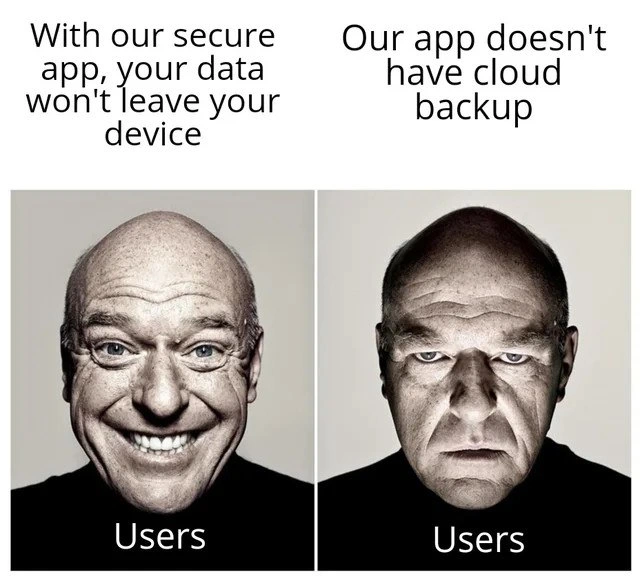
All the user’s information goes into the phone’s storage, and there’s no function call to send it to any cloud server. The meme’s top-left caption, “With our secure app, your data won’t leave your device,” is exactly this kind of positive spin. It highlights a DataPrivacy angle: no data leaving the device means no chance for outside parties to snoop on it. This sounds reassuring because it implies the company isn’t even touching your information – a win for trust and privacy. It’s playing into user concerns over data breaches and creepy tracking by basically saying, “Don’t worry, we physically can’t leak what we don’t have!”

Now the top-right caption flips the coin: “Our app doesn’t have cloud backup.” Stated so plainly, it triggers the opposite reaction. Modern users have grown to expect that any important data created in an app (photos, notes, messages, game progress, you name it) will be safely backed up to some CloudStorage service or at least synced across devices. Hearing there’s no backup at all makes a user think, “Uh oh, so if I lose my phone or uninstall the app, all my stuff is gone forever?” The exact same architectural choice suddenly feels like a glaring omission rather than a comforting feature. The user goes from “Great, my data stays with me” to “Wait, my data only stays with me?!” in an instant.

The humor here hits home for developers who've had to deal with these kinds of trade-offs and then watch how they’re messaged to users. It’s common for a team to make a tough call — like keeping data local due to limited resources to build a cloud service, or due to strict security policy — and then try to put the best face on it. Internally, everyone knows they’ve introduced a potential risk of data loss: one stolen phone, one hardware failure, one accidental deletion, and that user’s data is toast. That’s the unspoken downside we usually lose sleep over. But externally, the marketing department might be touting, “We care so much about your privacy that we don't even use a server!” Somewhere, the engineers and support team are nervously hoping no one experiences that catastrophic loss. It’s a bit of a tightrope walk.

This double-sided framing can lead to confusion and frustration (end user confusion, as the tags put it). A user might initially download the app because they like the sound of “secure” and “your data won’t leave your device,” thinking it aligns with their values of privacy. But later on, that same user might become the one frowning in the meme when they realize it also means “if something happens, we can’t help you get your data back.” We’ve seen real-world examples: secure note-taking apps that don’t sync (and then users complain when a phone loss means note loss), or messaging apps like earlier WhatsApp versus Signal debates – WhatsApp for a long time offered convenient cloud backups (though unencrypted, raising security concerns), while Signal offered no cloud backup (great for privacy, but you better not misplace your phone without making your own backup). Each approach had its vocal supporters and unhappy critics.

From a developer’s perspective, this meme is a nod to how one design decision can split the audience depending on how it’s pitched. It also pokes fun at how we as an industry can put a positive marketing spin on something that’s fundamentally a limitation or security trade-off. The image using the same bald man’s headshot twice labeled “Users” is the perfect visual punchline: it’s pointing out that nothing has actually changed at all between the two panels — the user (and the underlying reality) is identical. The only thing that changed is the phrasing. One phrasing makes that user jubilant, the other makes him upset. It’s a hilarious reminder that in tech, communication is key. You can have the exact same feature described as either a selling point or a shortcoming. And as many seasoned engineers know, sometimes teams really do end up selling a lack of a feature as a feature. The meme feels ridiculously true to anyone who’s been in those meetings or dealt with those support tickets, and that’s why we crack a knowing smile (or facepalm) when we see it.

Level 4: Confidentiality vs Availability

At the deep security architecture level, this meme hints at a classic tension in the CIA triad of information security: maximizing confidentiality often comes at the cost of availability. In other words, keeping user data strictly on-device (enhancing privacy and limiting exposure) inherently reduces redundancy and fault tolerance. By ensuring that user data “won’t leave your device,” the app maximizes confidentiality (a core part of data privacy and PrivacyByDesign). Any information that never traverses the internet or sits on a cloud server has a dramatically reduced attack surface – it’s like the data lives in a locked vault that only the user holds the key to.

However, this benefit comes at the expense of data durability. With no off-device copy, the user’s phone becomes a single point of failure for all their information. In reliability engineering, having a lone storage location is a big no-no because if that one location fails, everything is lost. We can even quantify the risk: if the probability of a phone being lost or destroyed over a year is $p_{\text{lose}}$, then with no cloud backup the probability of catastrophic data loss is essentially also $p_{\text{lose}}$. Introduce even one remote backup and that risk plummets to roughly $p_{\text{lose}} \times p_{\text{cloudFail}}$ (the chance both your device and the backup location fail at the same time) – much, much smaller. In short, availability (and data safety) increases drastically with replication of data to the cloud. But connecting to the cloud introduces a new risk: the chance of a data breach or unauthorized access on that server, which is a hit to confidentiality. It’s a classic security trade-off that illustrates you can’t have everything at once.

This fundamental trade-off is well-known to system architects. Do you prioritize keeping data under tight lock and key (no external copies), or do you prioritize keeping data accessible and persistent (multiple copies in different places)? It’s reminiscent of trade-offs in distributed systems and cryptography: more Cloud distribution means better fault tolerance, while less distribution means a smaller attack surface. For example, consider the design of the secure messaging app Signal. Signal keeps messages only on your device and doesn’t store your chat history on any server – that’s great for confidentiality and privacy (nothing for hackers or governments to grab from the cloud). But the flip side is if you lose or switch your phone, those messages aren’t automatically recoverable – a conscious sacrifice of availability for the sake of privacy (unless you took the extra step to manually export an encrypted backup). Fundamentally, the meme’s two statements highlight opposite ends of this spectrum: one side touts the DataPrivacy maximum of data isolation, the other points out the availability nightmare of having no safety net. The humor comes from the fact that a serious architectural dilemma — how to balance privacy vs. resilience — is being distilled into two deceptively simple, contradictory-sounding sales pitches.

Description

Two-panel meme with identical passport-style headshots of a bald man on a gray background; both faces are centered and labeled "Users" underneath. Top-left caption reads "With our secure app, your data won't leave your device" while the top-right caption reads "Our app doesn't have cloud backup". The visual joke is that the exact same image is used for both scenarios, highlighting how marketing can frame the same architectural choice - keeping data local - as either a privacy feature or a missing convenience. Technically it pokes fun at the trade-off between on-device privacy and the operational risk of no off-device backups, a tension familiar to engineers balancing Data Privacy, Security, and Cloud-storage expectations

Comments

8
Anonymous ★ Top Pick “Your data never leaves your device” sounds great in the CISO’s deck - right up until a user bricks their phone and the SRE has to explain that a zero-cloud footprint comes with an infinite RPO and a very finite career horizon
  1. Anonymous ★ Top Pick

    “Your data never leaves your device” sounds great in the CISO’s deck - right up until a user bricks their phone and the SRE has to explain that a zero-cloud footprint comes with an infinite RPO and a very finite career horizon

  2. Anonymous

    Users want their data quantum-encrypted in an air-gapped vault but also accessible from their new phone before they've even logged in

  3. Anonymous

    Ah yes, the classic product management paradox: users demand end-to-end encryption and local-only storage until they switch phones and realize their 'secure architecture' means manually exporting SQLite dumps. Turns out 'your data never leaves your device' is a feature until it's a bug report titled 'WHERE IS MY DATA?!' with priority: CRITICAL. The same users who praised your zero-knowledge architecture in the App Store review are now one-starring you because they expected iCloud sync to magically work without, you know, sending data to the cloud. Welcome to the impossible triangle of security, convenience, and user comprehension - pick any two, and the third will file a GDPR complaint

  4. Anonymous

    Everyone loves "on-device only" until they get a new phone; suddenly zero-knowledge without key escrow becomes a sev-1 titled "Where's my cloud restore?"

  5. Anonymous

    Nailed privacy with on-device CP in CAP theorem; users demand CA and bail when P fails on a bricked phone

  6. Anonymous

    Marketing: “Data never leaves the device.” DR translation: RPO = entire dataset, RTO = however long it takes the user to buy a new phone

  7. Deleted Account 4y

    Yep

  8. @igordata 4y

    Encryption, fucking encryption, bitch

Use J and K for navigation