Skip to content
DevMeme
3355 of 7435
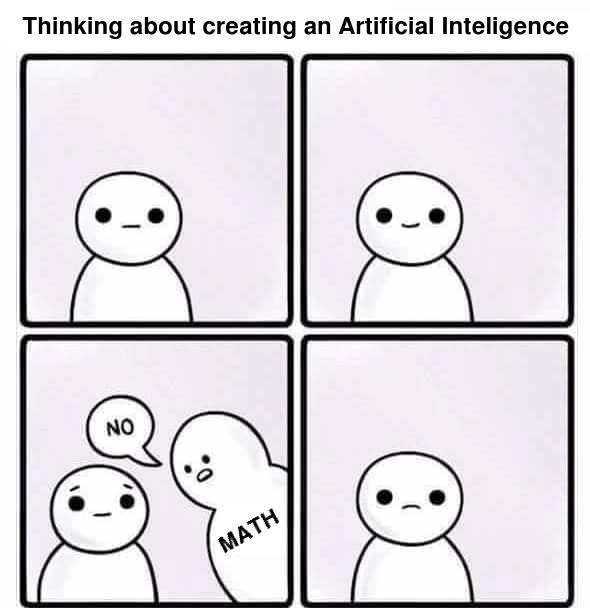
Four-panel meme where math stops aspiring AI developer in tracks
AI ML Post #3686, on Sep 12, 2021 in TG

Four-panel meme where math stops aspiring AI developer in tracks

Why is this AI ML meme funny?

Level 1: Homework Before Playtime

Imagine you’re a kid who got a shiny new build-your-own-robot kit. You’re super excited to start building your robot friend – that’s like the developer dreaming of making an AI. Now, just as you’re about to begin, your parent or teacher shows up like a ghost and says, “Hold on! You have to do your math homework first.” Instantly, your big fun plan deflates. You go from happy and eager to disappointed. In the meme, the ghost saying “NO” is just like that adult voice saying “not so fast.” The funny part is how suddenly the mood switches – one moment you’re smiling, thinking of all the cool things you’ll do, and the next moment you’re pouting because you found out there’s hard work needed before the fun part. It’s like wanting to play your favorite video game, but the game pops up a message: “Solve this math problem to continue.” This comic makes us laugh because we’ve all felt that feeling: you can’t skip the boring basics (like homework) even when you just want to jump to the cool project. It’s a little reality check wrapped in a joke – first dream big, then realize you might need to study a bit more, just like having to finish your homework before you can go play.

Level 2: Some Math Required

Let’s break down what’s happening in simpler terms. The meme title says “Thinking about creating an Artificial Intelligence,” which is our character’s grand idea. Artificial Intelligence (AI) means making computers perform tasks that seem smart – like understanding language, recognizing images, or making decisions. One popular way to build AI is through Machine Learning (ML), which involves algorithms that learn patterns from data (instead of explicit step-by-step rules). Now, here’s the catch: to create these smart behaviors, developers use a lot of math under the covers. The ghost labeled “MATH” represents all those ml_prerequisites – the math skills you need to actually build or understand an AI system. When the ghost says “NO,” it’s like the math is telling the developer “You shall not pass (until you study me)!”

The first two panels have an empty background and a stick figure because everything is all in our protagonist’s head – they’re daydreaming. Initially, they’re expressionless (just thinking), and then they smile: they’re excited about the idea of making an AI. Maybe they imagine coding up a cool robot or a self-learning app. This reflects a common developer expectation: “I know how to code, so I can probably handle an AI project, right?” It’s optimism before knowing the details.

In the third panel, the ghost-like figure appears with “MATH” written on it and says “NO.” This is the moment reality kicks in. The ghost shows up unexpectedly, just like hard math concepts tend to pop up unexpectedly when you dive into AI. For example, you might start following a tutorial on making a simple image classifier and suddenly the tutorial talks about linear algebra (which is math about vectors and matrices). Vectors are like lists of numbers (for instance, an image’s pixels can be one big list of numbers), and a matrix is like a grid of numbers (you can arrange those pixel values in a grid). Linear algebra is crucial in ML because it provides tools to handle all those numbers efficiently – like adding, multiplying, and transforming these huge grids of numbers that represent data or model parameters. If you haven’t encountered matrices and operations like multiplication of matrices or finding determinants, it can feel like a foreign language. That’s one part of the math_barrier.

Then there’s calculus, another big part of the ghost. Calculus is the math of change – how tweaking something a little bit changes the outcome. In machine learning, calculus shows up in training algorithms. To improve an AI model, we measure its error and see how changing each little weight in the model would affect that error – that’s done by taking derivatives (a core concept in calculus). If you’ve seen $\frac{d}{dx}$ or $\frac{\partial}{\partial w}$ in formulas, that’s calculus in action. For someone who hasn’t touched calculus in a while (or ever), seeing an equation with those symbols while trying to build an AI can be daunting. It’s as if the project suddenly demands you solve a math puzzle.

The ghost also stands for probability and statistics, because AI often needs those too. Probability is about dealing with uncertainty – like an AI might give a 90% probability of an image being a cat. To interpret and tune that, you need to know a bit about probability distributions and concepts like Bayes’ theorem or standard deviation. These are not extremely advanced, but if your background is mainly writing web apps or simple scripts, it might feel like a lot of CS fundamentals coming back all at once.

So, panel four’s disappointed frown is totally relatable: our would-be AI creator just realized this isn’t going to be a quick, fun coding venture without homework. In essence, the meme is saying “AI requires math”. It’s a gentle poke at anyone (and there are many) who get excited by AI’s possibilities – building a game AI, a smart chatbot, the next Jarvis – but then hit the learning curve of actually having to understand equations or at least use them. It’s tech humor wrapped in a simple comic. The categories listed (AI_ML, CS_Fundamentals, Mathematics) are basically the ingredients at play: a dash of AI ambition, a cup of core CS/math knowledge, and a humorous scenario to mix them. The common tags like LearningCurve and AILimitations underline that message: there’s a steep learning curve in AI, and one limitation for developers is often that they can’t ignore the math part. In short, the meme uses the ghost to personify how math prerequisites haunt the process of learning AI. If you’ve ever felt suddenly out of your depth in a machine learning class or project because of math, this little comic hits home immediately.

Level 3: The Algebra Ambush

This meme resonates especially with developers who’ve dabbled in machine learning humor or taken an “Introduction to AI” course, only to be ambushed by heavy math. It’s poking fun at a classic expectation vs. reality scenario in tech. The first panels show the developer’s naive enthusiasm – maybe they’ve watched a cool demo of an AI doing voice recognition or saw a viral blog about building a chatbot. They think, “Sure, I can whip up an AI in Python over the weekend!” That’s the developer_expectation_vs_reality setup. In the third panel, reality (in the form of math equations and theory) literally leans in and says “NO.” This is the math_barrier hitting full force. It’s funny to seasoned devs because we’ve all seen that wide-eyed junior (or been that person ourselves) who underestimates the learning curve of AI. It’s a learning curve cliff, really – everything seems doable until the documentation starts talking about gradient functions or the professor starts deriving formulas on the whiteboard.

The combination of elements here – a bright-eyed character and a blunt ghost saying “NO” – satirizes the abruptness of that realization. In real life, it might happen when you open an ML library’s source code or a research paper and see a wall of summation signs (∑) and sigmas. “MATH” feels like a mischievous poltergeist haunting the realm of AI, always there to say “Not so fast!” to over-enthusiastic plans. This reflects a common industry pattern: AI limitations aren’t just computing power or data – ml_prerequisites like understanding algorithms and theory can be the biggest obstacle. There’s communal trauma and comedy in remembering the first time you tried to implement a neural network from scratch. Perhaps you thought it’d be straightforward, then found yourself wrestling with linear algebra operations or debugging a loss function that kept diverging because you inadvertently messed up a calculus step (d/dx of your activation function, anyone?).

Senior developers nod knowingly because they’ve seen colleagues attempt to build fancy predictive models without the groundwork. For instance, a team might eagerly start an “AI project” to classify users or forecast sales, only to realize their team needs a crash course in CS fundamentals like matrix multiplication and probability theory. The meme’s ghost saying “NO” is basically the collective voice of senior engineers and data scientists who know that skipping fundamentals leads to failure. It’s a bit of dark humor in tech: “We wanted to add machine learning, but none of us remembered our calculus, so… nope!” The ghost_of_math can also represent old college math courses coming back to haunt you. You thought you’d never use that linear algebra class, but now every equation in the ML book looks like those homework problems you skimmed over.

This “math ambush” in AI development is as real as technical debt. Companies sometimes hire “AI specialists” or use off-the-shelf models to avoid dealing with math directly, but then get stuck when something goes wrong or needs customization. It’s similar to thinking you can copy-paste code from Stack Overflow without understanding it – except here it’s copying a formula from a ML library. The humor has an edge of truth: if you don’t understand the mathematical model underneath, you’re effectively haunted by a black-box. Many of us have shared that moment of staring at a formula or training curve at 3 AM and realizing, “I actually need to brush up on this math to proceed.” The meme condenses that entire journey (excitement → shock → humility) into four simple panels.

To put it in everyday development terms, imagine writing code like this:

model = NeuralNetwork(layers=3)
model.fit(X_train, y_train)  # Under the hood, linear algebra & calculus are hard at work!

That one-liner model.fit() seems harmless. But hidden inside are tons of matrix multiplications, gradient calculations, and probabilistic computations. The tech humor here is that from the outside, AI development looks like just calling high-level libraries (so easy!), but the moment you scratch that surface – maybe trying to modify the training algorithm or debug why model.predict() is giving nonsense – you’re confronted with formidable equations. It’s learningCurve humor: the learning curve for doing AI properly suddenly spikes upward. The developer’s smiling face in panel two is the “this will be a fun project!” optimism, and the frown in panel four is the “I didn’t sign up for all this math” realization. Seasoned devs laugh (perhaps a bit ruefully) because they remember that punch-in-the-gut feeling when theory catches up with enthusiasm.

Level 4: Ghost in the Matrix

At the cutting edge of AI/ML, under the hood of every flashy demo, lurks a dense forest of mathematics. This meme’s ghost labeled “MATH” embodies the theoretical underpinnings of artificial intelligence – a spectral reminder that building an AI is not just coding wizardry, but a rigorous exercise in linear algebra, calculus, and statistics. The optimistic stick figure imagines creating an AI, but like a segfault in their daydream, the ghost of math appears with a firm “NO,” echoing the immutable truth: advanced machine learning is built on formal math.

In technical terms, any non-trivial machine learning model reduces to solving equations or optimizing functions in high-dimensional space. Developing a neural network, for example, means manipulating weight matrices (linear algebra) and tuning them by gradient descent (calculus). Underneath a friendly fit() API call, algorithms are computing things like tensor dot products, partial derivatives, and probability distributions. It’s as if the aspiring developer’s grand plan hits the wall of a giant formula. Imagine our hopeful coder encountering an equation from a textbook:

$$ W_{new} ;=; W_{old} - \alpha \nabla_W J(W), $$

which in plain English means “adjust your model’s weight matrix $W$ by subtracting a learning rate $\alpha$ times the gradient $\nabla_W J(W)$ of the cost function.” To many, that nabla symbol $\nabla$ might as well be a little hieroglyphic ghost. The humor here comes from how CS fundamentals resurfaces unexpectedly: the chain rule from calculus becomes the backbone of backpropagation, and eigenvalues and vectors (concepts from linear algebra) determine how data is transformed in a neural network layer. In academic AI research, such math isn’t optional – it’s the native language. The meme winks at this reality: you can’t conjure an intelligent system without invoking the spirits of math.

On a deeper level, this scenario hints at the No Free Lunch Theorem in machine learning – informally, there’s no “free” magical AI solution without paying the price in careful mathematical reasoning. Anyone thinking about creating an Artificial Intelligence must confront core theory like the bias-variance tradeoff (statistics) or the curse of dimensionality (geometry of high dimensions). These aren’t just buzzwords; they’re why a seemingly simple AI task turns into a calculus conundrum. The ghost saying “NO” symbolizes fundamental limits and complexity: much like a physics engine saying you can’t break the laws of gravity, the math says you can’t skip learning the rules that govern learning algorithms. The joke lands because it’s AI humor with an element of truth – the spectral norm of a matrix might literally haunt your project if you don’t know what it is. The aspiring developer in the first panel optimistically sees the glamour of AI, but by the third panel, they’re essentially face-to-face with the intimidating formulas and Greek letters that gatekeep that glamour.

Description

The image is a minimalist four-panel comic with a black title across the top that reads, "Thinking about creating an Artificial Intelligence." In the first two empty-background panels, a simple round-headed stick figure silently imagines, first expressionless, then smiling with optimism. In the third panel, a ghost-like figure labeled "MATH" leans in from the side and says "NO" in a speech balloon, startling the protagonist. The final panel shows the original character alone again, now wearing a disappointed frown. The joke riffs on the hard mathematical foundations (linear algebra, calculus, probability) that ambush many developers who casually decide to build machine-learning systems, highlighting the gap between AI enthusiasm and the underlying CS and math fundamentals required
Comments

8
Anonymous ★ Top Pick Every time product says “just bolt on some AI,” I hear the ghost of tensor calculus whisper, “cool, which part of your monolith is differentiable?”
  1. Anonymous ★ Top Pick

    Every time product says “just bolt on some AI,” I hear the ghost of tensor calculus whisper, “cool, which part of your monolith is differentiable?”

  2. Anonymous

    After 15 years of shipping production ML systems, I've learned the real artificial intelligence is convincing stakeholders that the linear regression you wrapped in a neural network architecture is actually 'deep learning' - the math stays the same, but the PowerPoint slides get fancier

  3. Anonymous

    Every senior engineer has had this exact moment - usually around 2 AM when they realize their 'revolutionary neural network' requires understanding eigenvalue decomposition, and their last formal math class was in 2003. The brutal truth is that you can't just npm install intelligence; those TensorFlow tutorials conveniently skip the part where you need to actually understand why gradient descent converges, what a Jacobian matrix represents, and why your loss function is behaving like a drunk random walk. Math isn't just a suggestion in ML - it's the bouncer that keeps the Dunning-Kruger crowd from deploying production models that think every image is a hotdog

  4. Anonymous

    “Let’s build AI.” Math checks the data: class imbalance, ill‑conditioned features, and a loss surface shaped like our incident graph - stamp: NO

  5. Anonymous

    “Just slap AI on it” - then linear algebra taps your shoulder asking about condition numbers, autodiff graphs, and why the loss is NaN after epoch one

  6. Anonymous

    AI: Where 'just MATH' meets vanishing gradients, data swamps, and Kubernetes pods that ghost you at inference time

  7. @DanPoloz 4y

    Why?

    1. @satyr_bravo 4y

      Too hard

Use J and K for navigation