Skip to content
DevMeme
3445 of 7435
The Unplanned Feature Promotion
Bugs Post #3779, on Oct 6, 2021 in TG

The Unplanned Feature Promotion

Why is this Bugs meme funny?

Level 1: I Meant to Do That

Imagine you have a toy car and one of its wheels accidentally falls off. Uh-oh, it’s broken! But instead of admitting it’s broken, you pretend you wanted it that way. You say, “Look, now it’s a special hover-car that doesn’t need wheels!” You’re basically taking a mistake and calling it a feature of the toy. That’s exactly what this meme is joking about. Something in a computer program isn’t working right (it’s broken), but people are joking that they’ll just pretend it was supposed to be like that. It’s funny because everyone knows it’s broken, yet we act like we did it on purpose and call it a “feature.”

Level 2: Not a Bug, a Feature

In software development, a bug is an error or flaw in the code that makes the program do something incorrect or unexpected. It could be anything from a crash, to a wrong calculation, to a button that doesn’t respond. A feature, in contrast, is a planned functionality or enhancement – basically something the software is designed to do. Think of a feature as a positive addition or capability, whereas a bug is a mistake that ideally should be fixed.

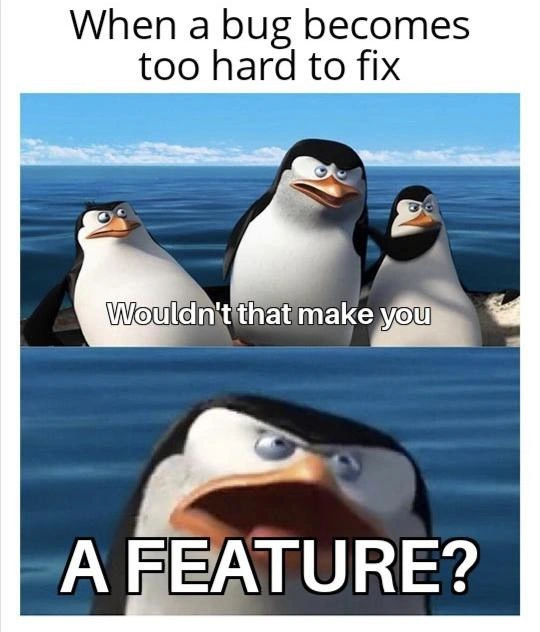
There’s a popular saying among programmers: “It’s not a bug, it’s a feature.” People usually say this as a joke when a software glitch is embarrassingly obvious — it’s a way to make light of the situation. The meme is riffing on that idea. The top caption, “When a bug becomes too hard to fix,” sets up the scenario. The shocked penguin in the second panel then blurts out, “Wouldn’t that make you a FEATURE?” This implies that if a bug is too difficult to resolve, the developers might just declare it to be intended behavior. In other words, they pretend the faulty behavior was actually meant to happen all along.

As silly as that sounds, it does happen sometimes on real projects. Why would anyone do this? Usually because of tight deadlines or the risk of breaking other things by fixing it. If a team is right up against a release date and finds a problem that would take a lot of risky work to fix, they might choose to leave it alone for the time being. They could mark the issue as a “known quirk” or a low-priority item and maybe even update the user guide to explain it nicely. Essentially, they are relabeling a problem as an accepted behavior. In fact, sometimes the decision comes from management. If fixing the bug would delay a big product launch, a project manager might say, “Let’s just call it an acceptable quirk for now and fix it later.” It’s a bit of a cheeky move, but it avoids derailing the schedule. By doing this, the team takes on some technical debt – meaning they’re kicking the can down the road, leaving that glitch in place (like a debt to the codebase that they hope to pay off in the future).

For example, imagine a file-upload tool that crashes if you try to upload 50 files at once. Clearly that’s a bug. But if it’s two days before launch and touching the upload code could introduce new problems, the team might decide not to risk a fix right now. Instead, they’ll update the documentation to say, “Note: Uploading more than 49 files at once will activate a safety limit.” They might even brief the support team to explain it as a feature that protects the server from overload, rather than admitting the system just can’t handle 50 files due to a bug. In reality the limitation is still there, but now it’s described as if it were intentional.

This meme pokes fun at that kind of situation. It highlights how the line between a bug and a feature can get a bit blurry when people are under pressure. For a new developer, the idea of declaring a mistake “officially okay” might be pretty surprising — hence the penguin’s shocked face. But in the dev world, it’s a known joke and occasionally a practical reality. It’s a way to cope with the fact that sometimes you can’t fix everything immediately. Every programmer eventually encounters a moment where they think, “Maybe we’ll just live with this issue for now.” Saying “it’s not a bug, it’s a feature” is a lighthearted way to acknowledge that compromise. It’s classic developer humor: we laugh because we’ve all been there, nervously joking about our own software’s quirks when the pressure is on.

Level 3: Feature by Decree

For experienced devs who’ve been in those late-night war rooms, this meme triggers an instant facepalm of recognition. It captures the exact moment a bug that’s too costly or risky to fix gets a “promotion” to official feature status. In other words, when the team realizes a fix would jeopardize the schedule (or their sanity), they do the unthinkable: they reframe the defect as intentional behavior. It's a blend of dark humor and survival instinct — embracing tech debt rather than wrestling with a monstrous legacy issue under a tight deadline.

Picture this: there’s a gnarly defect deep in an old codebase. Fixing it properly might mean refactoring thousands of lines of spaghetti code, potentially breaking other modules that are barely holding together. The risk is high, and the clock is ticking. So the team huddles and someone half-jokingly says, “What if we just call it a feature?” Next thing you know, the bug report is closed with a resolution like WONTFIX or marked as “Working as Intended.” They might even update the user manual to officially describe the bug’s quirky behavior as if it were by design. Voilà – bug reclassified, crisis averted, and no one had to touch the precarious Jenga tower of code.

- // BUG: Application crashes on empty input
- handleEmptyInputGracefully();
+ // FEATURE: If input is empty, app exits swiftly (it's a time-saving enhancement)
+ // (No code change needed – working as intended now)

Above is a tongue-in-cheek pseudo-code diff: the dreaded moment when a to-do fix comment gets rewritten as a feature note. Instead of calling handleEmptyInputGracefully() to truly solve the crash, the code comment is flipped. Now it proudly claims the crash-on-empty-input is a “time-saving enhancement” that closes the app for you. This is essentially how it feels when a team gives up on a proper fix and decides to spin the narrative.

At a higher level, this scenario is a classic case of tech-debt rationalization. Rather than paying off the debt (fixing the bug properly), the team refinances it: they choose to live with the flaw and spin it positively. It’s the infamous excuse: “It’s not a bug, it’s an undocumented feature.” This tongue-in-cheek phrase has been around since the early days of programming as a wry way to reframe a mistake. It essentially flips the BugVsFeature distinction on its head. Sometimes devs use it jokingly in commit messages or stand-ups to deflect embarrassment. Other times, it’s disturbingly literal: certain systems accumulate so many weird quirks over the years that users come to depend on them. By the time a developer tries to fix one of those quirks, a dozen users might complain because their workflow relied on the “feature.” So the misbehavior gets officially blessed, living on as part of the expected functionality.

For senior engineers, this tactic is both a last resort and an inside joke. It’s a shared coping mechanism born out of crunch-time desperation. You can almost hear the weary team lead saying, “We’ll fix it properly in v2.0… maybe,” fully aware that version 2.0 might never come. Meanwhile, management pats themselves on the back because — hey — no bugs here! The project status report shows all features “working” (if you redefine a few bugs as features, that is). It’s a bittersweet reality: we sacrifice a bit of CodeQuality and honesty to meet a deadline or avoid a massive refactor. The meme nails this absurd ritual. The penguin’s wide-eyed shock in the second panel — captioned “A FEATURE?” — perfectly represents that voice in every developer’s head. We know it’s ridiculous to rebrand a bug as a feature, and yet, when push comes to shove, we’ve all seen it happen. It’s simultaneously hilarious and painfully real, a staple of developer TechHumor precisely because it’s true.

Description

A two-panel meme using the 'Penguins of Madagascar' format to illustrate a classic developer joke. The top of the meme has a caption that reads, 'When a bug becomes too hard to fix'. The first panel shows three penguins from the movie, with the middle one, Skipper, saying, 'Wouldn't that make you'. The second panel is a dramatic close-up of Skipper's determined face, with the punchline, 'A FEATURE?'. The meme humorously depicts the all-too-common scenario in software development where a persistent or complex bug is reframed as an intentional feature to avoid the difficulty of fixing it. This cynical but relatable trope speaks to the pressures of deadlines, the accumulation of technical debt, and the art of managing stakeholder expectations by simply declaring an error to be a feature
Comments

17
Anonymous ★ Top Pick Some features are born great, some achieve greatness, and some are just bugs that had greatness thrust upon them by a looming release deadline
  1. Anonymous ★ Top Pick

    Some features are born great, some achieve greatness, and some are just bugs that had greatness thrust upon them by a looming release deadline

  2. Anonymous

    Architect’s moment of Zen: trace a bug through six microservices, discover 300 client teams depending on the side-effect - congrats, you just published an unversioned API contract

  3. Anonymous

    After 15 years in the industry, I've learned that the difference between a bug and a feature is just a well-crafted JIRA comment explaining why the current behavior is 'by design' and updating the documentation to match reality instead of fixing the code

  4. Anonymous

    Ah yes, the ancient art of semantic versioning for bugs: if it's too complex to fix before the sprint ends, just bump it from 'critical defect' to 'undocumented feature' and call it a day. After all, once three customers have built workflows around your broken behavior, it's not a bug anymore - it's a contractual obligation with a deprecation timeline longer than your employment tenure

  5. Anonymous

    We couldn't fix the race condition, so we documented it as 'eventual consistency' and called it architecture

  6. Anonymous

    Enterprise wisdom: when debugging cycles exceed MTTR budgets, promote the anomaly to 'intended emergent behavior'

  7. Anonymous

    It stops being a bug the moment PM marks won’t fix and QA writes a regression test - congrats, you just published a public API

  8. @NiKryukov 4y

    You guys fix bugs?

  9. @Cairco 4y

    You guys find bugs?

    1. @ZgGPuo8dZef58K6hxxGVj3Z2 4y

      You guys look for bugs?

      1. @RiedleroD 4y

        you guys look?

        1. @ZgGPuo8dZef58K6hxxGVj3Z2 4y

          You guys?

          1. @RiedleroD 4y

            no we don't

            1. @prirai 4y

              You?

              1. @RiedleroD 4y

                ?

          2. @nuntikov 4y

            No we aren't

  10. @ugrbc 4y

    Are you coding ?

Use J and K for navigation