Skip to content
DevMeme
3446 of 7435
Learning a 'New Language' the Analog Way
Learning Post #3780, on Oct 6, 2021 in TG

Learning a 'New Language' the Analog Way

Why is this Learning meme funny?

Level 1: Learning with a Pencil

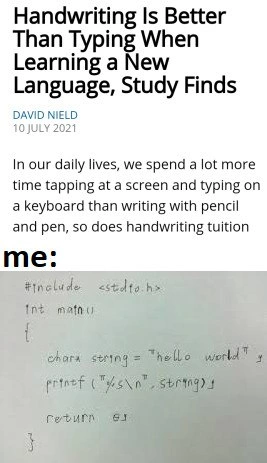
Imagine you read a tip that says, “If you write things by hand, you’ll remember them better when learning a new language.” Most people would think, “Okay, I’ll practice writing Spanish or Chinese words with a pen to help me learn.” But a programmer has a one-track mind about code. So in this joke, the programmer hears that advice and goes, “A new language, you say? I’m learning the C programming language right now… I guess I should write my C code in a notebook to remember it!” It’s a silly, literal twist on the advice. The picture shows exactly that: the person actually took a pencil and neatly wrote out a little C program that says “hello world.”

Why is this funny? It’s because nobody really writes their computer programs on paper these days — you normally type them on a computer. Writing code out by hand is kind of like doing homework for a class, not the way real software is built. The humor comes from treating programming language learning like grade-school language practice. It’s as if someone learning English wrote out “Hello, world” over and over in a notebook to remember it — except here it’s in C code! This exaggerated response makes us laugh because it’s combining two different worlds in a goofy way. The programmer is so enthusiastic about learning code that they’ll even break out a pencil and paper to do it. In simple terms: a study said “writing helps you learn,” and our friend thought, “Great, I’ll write my computer code to learn it better!” It’s a lighthearted joke about being an eager learner, with a nerdy twist. We find it funny and charming because it shows how far a coding geek might go – even doing something a bit absurd – all in the name of learning something new.

Level 2: Hello World by Hand

In the top half of the meme, there’s a screenshot from an article titled “Handwriting Is Better Than Typing When Learning a New Language, Study Finds.” This refers to research suggesting that when you write new words or sentences by hand, you remember them better than if you type them. Now, usually “learning a new language” would mean something like Spanish, French, or Chinese. But in developer circles, the word “language” immediately also means a programming language (like Python, Java, or C). The meme plays on that double meaning. The bottom half, labeled “me:”, shows the joke response: a snippet of the C programming language, carefully handwritten on lined paper as if it were a practice exercise. Essentially, the meme-maker is saying: “Oh, handwriting helps you learn a language? Then I’ll write my new coding language by hand to learn it!”

Let's break down what’s on that sheet of paper. It’s a complete C program to print “hello world”, written out with pencil. In coding tradition, a Hello World program is the first simple program you write when learning any new programming language – it just outputs the phrase “hello world” to confirm everything works. Here’s roughly what that C code on the paper looks like:

#include <stdio.h>   // include the Standard I/O library for printing
int main() {
    char string[] = "hello world";   // store the text in a char array (string)
    printf("%s", string);           // print the string to console using printf
    return 0;                       // return 0 to indicate the program executed successfully
}

Even without a computer, a programmer can recognize this as a valid C program. Let’s explain it in simpler terms:

  • #include <stdio.h> tells the compiler to include the Standard Input/Output library, which contains the definition for the printf function.
  • int main() { ... } defines the main function – the entry point of every C program. The code inside { } will run when the program executes.
  • char string[] = "hello world"; creates a variable named string that holds the text "hello world" (in C, char[] is how you define a string literal array).
  • printf("%s", string); calls the printf function to print out the contents of that string. The %s is a placeholder for a string that printf will replace with the actual text.
  • return 0; ends the main function, and returning 0 typically means the program finished without errors.

If you typed this into a computer and ran it, the output would simply be:

hello world

In the meme though, it’s all on paper—so obviously, you can’t run a sheet of paper in a computer! The joke is that the person isn’t trying to execute it; they’re writing it out to help themselves learn. This plays on the handwriting_vs_typing idea: maybe by writing code manually, you pay more attention to every semicolon and curly brace, just like a student carefully writing new foreign words. It’s a quirky study technique: the developer is treating C syntax like vocabulary to memorize.

This meme format, with a real article excerpt on top and a humorous personal example below, is a common article_headline_meme style. The top gives a straight-faced fact or study, and the bottom shows how an individual (the “me”) humorously over-applies or misapplies that information. In this case, the dev’s response is both clever and a bit tongue-in-cheek. It resonates with anyone who has gone through a LearningToCodeJourney. When you’re learning to code, especially a language as tricky as C (which is one of the classic CFamilyLanguages known for manual details like semicolons and memory management), you often do whatever it takes to grasp it. Some people read books or watch tutorials; others might retype examples. This meme’s author jokes: “I’ll even handwrite my code if that helps me learn!” It’s funny because it’s unusually thorough – normally we rely on our text editors and compilers to catch mistakes, but writing code by hand means you have to recall everything and get it right on paper. It’s like studying programming in hardcore mode.

So, essentially, the meme is highlighting the crossover between learning a human language and learning a programming language. Both involve learning new symbols and rules. The article says using pen and paper is better for memory, and the dev humorously says, “Roger that, I’m learning C, so pass me a pencil!” 🤓. As a result, anyone who codes can laugh at the image of a fellow programmer earnestly copying out printf("hello world") in a notebook. It’s equal parts nerdy and relatable: nerdy because who writes code on paper for fun, and relatable because we’ve all been beginners willing to try odd study tips to conquer that new language.

Level 3: Compiled on Paper

This meme brilliantly blends a cognitive science insight with hacker literalism. The top panel references a real study claiming handwriting is better than typing when learning a new language. Any seasoned dev will immediately spot the twist: we usually think of spoken languages in such studies, but here our developer applies it to a programming language. In the bottom panel (captioned “me:”), they've literally written out a C Hello World program by hand on lined paper. This is classic DeveloperHumor – taking an academic tip from everyday life and giving it a nerdy spin. It pokes fun at the way coders can’t resist interpreting “learning a new language” as learning a new coding language. So of course, the response is to practice programming_language_learning with pen and paper!

For experienced programmers, the joke lands on multiple levels. First, there's the absurd yet endearing image of handwritten_c_code: #include <stdio.h> and printf("%s", string); neatly penciled in a notebook. It’s a sight to make any C veteran smirk, because who writes out code longhand in 2021? Yet, ironically, many of us have done something similar. Think about whiteboard interviews or college exams where you're forced to write code without a computer. In those moments, your brain becomes the compiler and debugger, catching missing semicolons and mismatched braces by careful thought alone. This meme riffs on that experience – the dev is essentially doing “Pencil-Driven Development”, a playful nod to test-driven or agile methods, but with a literal pencil 😀. The code in question is the archetypal beginner’s program, Hello World, which every coder knows is the first thing you output in any new language. By handwriting it, the dev is performing a kind of analog dry-run, almost like manually executing the code on paper. It’s both funny and nostalgically relatable: older programmers might recall that in the really early days of computing, writing code on paper was standard! (Programs were hand-written on coding forms and then transferred to punch cards – talk about old-school HelloWorld by hand.) So in a weird way, this meme’s joke has a historical echo that senior devs appreciate.

There’s also a grain of truth from a learning perspective. The research headline implies that writing with a pen engages your brain more deeply than typing. Seasoned developers know that when you write out code or algorithms on paper, you’re forced to understand each part without relying on instant compilation or Google. It’s a bit like the discipline of desk-checking your code. Here our enthusiastic coder is hoping that by physically writing the C syntax, they’ll cement the language’s concepts in memory – akin to how writing new vocabulary helps in a foreign language. The humor, of course, is in the over-the-top literalness of the approach. No one is actually suggesting budding programmers ditch their IDEs for pen and paper. But every dev recognizes that quirky passion: when you’re on the LearningToCodeJourney, you’ll try anything to master a tough new CFamilyLanguages syntax, even if it means going completely analog! The meme format (serious headline on top, funny personal example below) delivers this punchline perfectly. We chuckle because we see ourselves – the earnest, language-loving geek – in that “me:” writing out int main() { ... } longhand, taking a study’s advice way beyond its intended context. It’s an extra level of dedication that’s as amusing as it is admirable.

Description

A two-part meme that plays on the literal interpretation of 'language.' The top section displays a screenshot of an online article with the headline: 'Handwriting Is Better Than Typing When Learning a New Language, Study Finds,' dated 10 July 2021. Below this, under the label 'me:', is a photograph of a piece of paper with a 'Hello, World!' program written by hand in the C programming language. The handwritten code includes '#include <stdio.h>', 'int main()', 'char* string = "hello world";', 'printf("%s\n", string);', and 'return 0;'. The humor stems from the classic developer pun of conflating natural human languages with programming languages. The meme satirizes the article's advice by applying it to a context where it is completely impractical, as no developer would choose to handwrite code over typing it in an editor

Comments

22
Anonymous ★ Top Pick The original whiteboarding interview. The code review involves checking your penmanship, and debugging requires a very, very good eraser
  1. Anonymous ★ Top Pick

    The original whiteboarding interview. The code review involves checking your penmanship, and debugging requires a very, very good eraser

  2. Anonymous

    Handwriting my C hello-world to “learn the language” was easy - the hard part is convincing Git to resolve spiral-notebook merge conflicts without a rebase that involves scissors

  3. Anonymous

    Sure, let me just handwrite my next microservices architecture in Kubernetes YAML - I hear the indentation errors really build character when you're using a #2 pencil

  4. Anonymous

    Ah yes, the classic 'learning by handwriting' approach - where you simultaneously discover that your muscle memory knows neither C nor Python, but has somehow created a Frankenstein language that won't compile in any known runtime. Bonus points for the '#include' followed by Python's print statement - a true polyglot nightmare that would make any linter weep. This is what happens when academic studies on language learning meet the reality of programming: you end up with code that's syntactically invalid in multiple languages at once, proving that the only thing you've truly learned is that your IDE's autocomplete was doing a lot more heavy lifting than you realized

  5. Anonymous

    If handwriting helps you learn languages, I’m practicing C on paper - the only runtime where undefined behavior won’t segfault and memory leaks are just ink stains

  6. Anonymous

    Handwriting C: assigning a string literal to char - the pencil-powered path to instant segfault enlightenment

  7. Anonymous

    Great for retention, terrible for toolchains: pen -> OCR -> clang -> undefined behavior

  8. Deleted Account 4y

    our school pcs run linux

    1. Deleted Account 4y

      maybe one of them still has ghc installed

  9. Deleted Account 4y

    bc windows is too slooow

    1. @affirvega 4y

      oh yeah, no unicode in console—

  10. @oficsu 4y

    Can handwriting fix the missing const keyword in definiton of string?

    1. @ShiningFlames 4y

      Handwriting can fix every bug.

      1. @Cairco 4y

        Handwriting doesn't run bugs

        1. @QutePoet 4y

          Handwriting is a bug of spending paper or whatever you write on. Spending paper makes spending trees on it's first step when paper is made. But it's to possible to create paper from hemp but there is not much popularity of making paper from it. But it can change nicely and wisely.

          1. @Cairco 4y

            And what if I handwrite on my own skin?

          2. @freeapp2014 4y

            You can use a tablet with a stylus if you don’t want to waste paper

            1. @RiedleroD 4y

              or you can write on the bones of your enemies with the blood of the damned

            2. @QutePoet 4y

              I have used such thing but it's vulnerable to direct sunrays so it died in light.

              1. @freeapp2014 4y

                Hm?

  11. @okutaner 4y

    Wrong asterisk position

  12. @Stepan_Poznyak 4y

    Yeah Celeron, 1GB DRR2 and Windows 10😍

Use J and K for navigation