Skip to content
DevMeme
3444 of 7435
Joining Amazon: Developer vs. Prime Member
Career HR Post #3778, on Oct 6, 2021 in TG

Joining Amazon: Developer vs. Prime Member

Why is this Career HR meme funny?

Level 1: Already a Member of the Club

Imagine you have a special membership card for a big toy store that lets you get toys delivered fast and watch fun shows (that’s like what Amazon Prime is for grown-ups, with packages and movies). Now, one day you see a sign or an ad that says, “Hey you! Go learn how to build toys so you can work at our toy company!” You’d probably scratch your head and say, “Huh? I already joined your club as a member. I just want to get toys and enjoy them, not start making toys for you!”

That’s exactly the silly situation this meme shows. The person in the picture is confused and a bit hurt, like, “Why are you hitting me with this crazy suggestion?” They’re joking that Amazon (a company many people shop from) is acting like being a loyal customer isn’t enough — as if it’s now also asking them to become a toy-builder (or in real life, a computer coder) for Amazon. It’s funny because it mixes up two things: being a customer (like having that membership card) and being an employee (like working for the company). The poor guy in the meme thought he was already on the team just by being a faithful customer, and now these ads make him feel like he’s supposed to go get a whole new job there!

In simple terms, the joke is like if you love a pizza place and have their VIP card for free pizza slices, and then you see an ad from the pizza company telling you to go to cooking school to come make pizzas for them. You’d be like, “Um, I just came here to eat pizza, not cook it!” It’s that mix-up between enjoying something and working for the thing. The meme makes us laugh because we understand that feeling: “I’m already a part of this as a fan/customer — why are you acting like I need to sign up again, in an even bigger way?”

Level 2: Customer vs Coder

Let’s break down the meme in simpler terms. Amazon Prime is a paid subscription service for regular customers of Amazon. If you’re a Prime member, you pay Amazon a monthly or yearly fee and in return you get benefits like free two-day shipping on purchases, access to Prime Video streaming, and other shopping perks. In contrast, an Amazon software developer (or any Amazon employee) is someone Amazon pays to work for them — a job on the corporate side, often involving coding and developing the technology that keeps Amazon’s services running. The joke here is mixing up these two very different ways of being “with” Amazon: one is as a customer (Prime member) and the other is as an employee (especially a programmer).

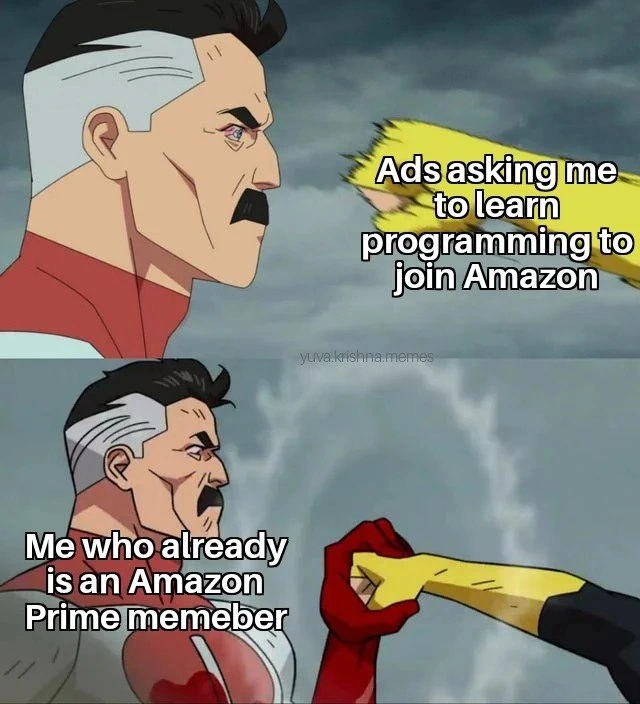
The first panel of the meme shows a scene from the animated series “Invincible,” where a superhero character (Omni-Man) is being punched. The overlay text of the punching fist says “Ads asking me to learn programming to join Amazon.” This refers to advertisements, often seen online, urging people to start learning computer programming so they can “join Amazon.” Typically, “join Amazon” in these ads means “get a software engineering job at Amazon’s company.” These could be actual recruiting ads by Amazon or more often ads by coding bootcamps or online courses. A coding bootcamp is a short, intensive training program that teaches people programming skills quickly, with the promise (or hope) that graduates can land developer jobs at tech companies afterward. In recent years, it became very common to see marketing like, “Want a high-paying job at Google or Amazon? Learn to code with us!” This is the programming_bootcamp_marketing the meme description mentions. It’s part of a broader trend where there’s a lot of hype around working at famous tech companies — sometimes abbreviated as FAANG (which stands for Facebook, Amazon, Apple, Netflix, Google). These companies are known for paying well and having prestige, so many people dream of working there, and ads often play into that dream.

Now, the second panel shows Omni-Man after taking the punch — he’s bloodied and a bit shaken, but he’s turning back with a look of confusion and annoyance. The text over him says “Me who already is an Amazon Prime memeber.” (Notice “member” is misspelled as “memeber,” possibly a typo or a cheeky way to slip “meme” into the word.) This text represents the person seeing the ad. It’s saying: “Why are these ads telling me to join Amazon by learning to code? I already joined Amazon — I’m an Amazon Prime member!” Of course, being a Prime member just means you subscribe to Amazon’s services, not that you work there. But the humor is that the wording “join Amazon” could sound like “be part of Amazon” in any sense. The person in the meme is pretending (for comedic effect) to misunderstand the ad by taking “join Amazon” literally as if it were about membership, not employment.

So, basically we have a customer vs coder confusion. The customer side is “I pay for Amazon Prime, I’m in the club of Amazon users,” and the coder side is “No, we meant join Amazon’s workforce by becoming a coder.” The meme is funny to people in tech because they often see these over-the-top HiringHumor ads and roll their eyes. A lot of developers remember when they were newbies or career-switchers and got bombarded with messages like “Break into tech! Land a job at Amazon or Google just by taking our 3-month coding course.” It’s become a bit of an IndustryInJoke. If you’re already a developer, you know getting into a company like Amazon is not that straightforward. And if you’re not a developer (maybe just someone who likes shopping on Amazon), those ads might feel really out of place — like, “Huh? I was just trying to watch cat videos, why am I seeing an ad about learning Python to work at Amazon?”

The meme uses the Invincible_format to dramatize this. Omni-Man being punched is like saying the ads are attacking or startling the viewer. The viewer (who’s “already a Prime member”) is left rubbing their jaw, thinking, “What was that for?” It’s poking fun at how over-saturated and mis-aimed these ads can be. The viewer in the meme didn’t ask for a career change; they’re just a consumer of Amazon’s products. The big_tech_ads have accidentally targeted the wrong person, and it’s humorous because it’s so common. Many people who have shown even the slightest interest in tech online (maybe they watched a tech YouTube video or searched for a programming course once) end up seeing a deluge of such ads. It becomes annoying, so people joke about it to vent.

Let’s clarify the two “Amazon” concepts with a quick comparison:

Amazon Prime Member (Customer) Amazon Developer (Employee)
Pays Amazon a subscription fee for benefits (e.g. free shipping) Gets paid by Amazon to build or maintain its software and services
Part of Amazon’s customer base – enjoys Amazon’s products like Prime Video, fast shipping, etc. Part of Amazon’s workforce – builds the products and features customers use
No coding skills required to join – just a credit card and a sign-up form Strong coding skills required – typically needs a computer science background or equivalent experience, and passing tough interviews
“Joins” Amazon by signing up for a service (easy and instant) Joins Amazon by earning a job offer (hard and competitive)
Role: Consumer – main interaction is spending money for convenience and entertainment Role: Developer – works on internal projects, writes code, possibly deals with on-call duties, deadlines, etc.

This table shows why the person in the meme finds the ad ridiculous: they’ve already fulfilled the “join” action in one context (signing up for Prime), which is trivial compared to the other context (going through the gauntlet to be hired at Amazon).

Another detail: the meme text “Amazon Prime memeber” with “memeber” might just be a simple spelling mistake, but it unintentionally contains the word “meme.” That’s fitting because, well, this is a meme about being an Amazon Prime member. It gives it an extra chuckle for the observant: an Amazon Prime “meme-ber” is literally someone who’s part of a meme about Prime. 😅 (Whether that was on purpose or an accident, it kind of works out humorously!)

In summary, at this level we see the meme is playing on a straightforward mix-up. It’s making fun of the massive LearningToCodeJourney advertising trend by responding in a literal, deadpan way: “Why learn to code to join Amazon when I have already joined by paying for Prime?” It highlights the gap between how tech industry ads talk to everyone as a potential recruit and how a regular person might interpret that messaging. It’s a gentle roast of both the ads’ simplicity and the absurdity of confusing membership with employment.

Level 3: When Prime Isn’t Enough

In this meme, Big Tech recruiting hype meets a facepalm-worthy misunderstanding. It highlights how career ads for Amazon’s software jobs have become so ubiquitous that they’re smacking even regular Amazon customers in the face. The first panel’s punch labeled “Ads asking me to learn programming to join Amazon” represents the barrage of programming_bootcamp_marketing promising a fast track into FAANG jobs. The second panel is the bewildered response: “Me who already is an Amazon Prime memeber”. Here our protagonist (a loyal Amazon Prime subscriber) is bloodied and perplexed, essentially saying, “I’m already part of Amazon’s world as a paying customer—why are these ads acting like I need to sign up for something else?” It’s a classic mix-up played for laughs, where “join Amazon” in the corporate Career_HR sense gets confused with being a Prime member in the consumer sense.

This confusion taps into a real IndustryTrends_Hype phenomenon. Around 2020-2021, there was an explosion of ads pushing folks to “learn to code” with the end goal of landing a job at a big tech firm like Amazon or Google. These ads often promise that after a short bootcamp or online course, you could be hiringHumor-ously catapulted into a six-figure software engineering role at a FAANG company. Developers who live and breathe this industry see the humor: they know joining Amazon’s engineering team isn’t as simple as watching a few coding tutorials or finishing a 12-week bootcamp. It requires passing tough technical interviews, having strong coding skills, and often competing with thousands of experienced candidates. TechHumor arises from that contrast between ad-fueled fantasy and hard reality. The meme exaggerates it – the poor Prime subscriber has effectively been punched in the face by a misleadingly targeted ad. It’s like the internet’s over-eager hiring algorithm didn’t differentiate between someone who pays Amazon and someone who might want to get paid by Amazon.

# A tongue-in-cheek pseudocode for the ad targeting logic:
user = get_current_user()
if user.is_amazon_prime_member:
    show_ad("Learn programming and join Amazon as a developer!")
# The algorithm naively assumes Prime customers want to become Amazon developers.

Seasoned developers chuckle (and maybe cringe) at this because they’ve seen or felt the LearningToCodeJourney gold rush. It’s an IndustryInJoke. Many have been spammed by YouTube videos or website banners with those exact promises: “Join Amazon (or another top tech firm) by taking our course!” The meme’s punchline is basically the veteran Prime customer saying, “I’ve already joined Amazon, thank you very much – via my credit card.” It’s a wry nod to the idea that Amazon doesn’t distinguish between different ways of “joining” them: one as a consumer, one as a coder. And it hints at fatigue in developer culture: we’re a bit bruised and tired (like Omni-Man in the second panel) of constant messages implying that everyone should jump on the coding bandwagon to work at Big Tech.

There’s also an undercurrent of sarcasm here about big_tech_ads. Amazon’s massive brand spans both the consumer realm (Prime deliveries, video streaming) and the tech career realm (AWS, software development). The meme pokes fun at how those worlds collide. The text even spells “member” as “memeber,” which could be a simple typo but feels fitting in a meme — almost highlighting the word “meme” inside “member.” It’s as if even the spelling can’t escape memetic irony. Seasoned folks might smirk at that detail: an ad telling you to be a developer can’t even spell “member” correctly. The whole scenario invites a “Really, Amazon?” kind of eye-roll: Prime members are already loyal to the company’s services, and now aggressive recruiting ads are making them feel attacked for not being loyal enough (by also becoming employees). It’s CareerHumor born from the tech industry’s intense growth mode, where companies like Amazon need armies of developers and bootcamps eagerly supply them — sometimes overshooting their target audience.

In essence, the humor at this level comes from recognizing a truth about tech culture: the hype machine sometimes gets so overzealous that it loses nuance. The meme exaggerates a scenario where Amazon’s outreach to hire programmers is so broad that it’s accidentally clobbering its own Prime customers. Experienced devs know the subtext: “Working at Amazon is not the same as shopping with Amazon, but try telling that to a generic ad algorithm.” It’s a little cynical, a little cutting — a reflection of how hype can overstep and how developers cope with it through jokes.

Description

A two-panel meme using the 'Omni-Man Blocks a Punch' format from the animated series 'Invincible.' In the first panel, the character Omni-Man stands stoically as a powerful punch approaches his face. The incoming fist is labeled, 'Ads asking me to learn programming to join Amazon.' In the second panel, Omni-Man has effortlessly caught the fist, stopping it completely. His character is now labeled, 'Me who already is an Amazon Prime memeber' (with 'member' misspelled as 'memeber'). The meme's humor is derived from the deliberate, sarcastic misunderstanding of the phrase 'join Amazon.' While the ads refer to the difficult path of becoming a software engineer at the tech giant, the meme's protagonist counters with the trivial act of being a paying subscriber to their Prime service, implying they are already 'part of' the company
Comments

10
Anonymous ★ Top Pick One way to 'join Amazon' gets you two-day shipping. The other way gets you two-day shipping... of your entire application stack to a new region before the next re:Invent
  1. Anonymous ★ Top Pick

    One way to 'join Amazon' gets you two-day shipping. The other way gets you two-day shipping... of your entire application stack to a new region before the next re:Invent

  2. Anonymous

    Bootcamp ad: “Learn to code, join Amazon.” Buddy, after 15 years of shipping prod on AWS, Amazon’s already onboarded to my org - they just send me the invoice instead of a W-2

  3. Anonymous

    I've been deploying to us-east-1 for years, but apparently that doesn't count as "Amazon experience" on my resume

  4. Anonymous

    The real senior engineer move: achieving immunity to 'Learn to Code and Join FAANG!' ads not through ad blockers or browser extensions, but through the ultimate defense mechanism - already being a paying customer of the company they're advertising. It's the technical equivalent of 'I can't join your company, I'm too busy subsidizing your free shipping and streaming your shows.' Peak irony: Amazon's recommendation algorithm hasn't figured out that Prime members probably aren't the target demographic for entry-level SDE bootcamp ads

  5. Anonymous

    Adtech did a fuzzy join between “careers” and my Prime account: “Learn to code to join Amazon.” Classic proxy-metric win - CTR up, intent zero

  6. Anonymous

    Adtech's ML model: perfectly overfits to bootcamp leads, massively underfits on spotting grizzled Prime devs who've been shipping to S3 since launch

  7. Anonymous

    Ad-targeting ML sees “Amazon” and assumes FAANG job seeker; my only JOIN with Amazon is INNER JOIN billing ON plan='Prime' - and the bar-raiser I pass monthly is my credit limit

  8. @Truth_0000 4y

    Memeber indeed😂

  9. Deleted Account 4y

    They had us in the first half of the second line, not gonna lie...😂

  10. @nuntikov 4y

    Do programmers in Amazon have to piss in bottles too?

Use J and K for navigation