The Unnoticed Bug: A Developer's Dual Emotion
Why is this Bugs meme funny?
Level 1: Hidden Mistake
Imagine you have a big, important chore: every day you’re supposed to put a fresh bowl of water out for your pet cat. 🐈 For months, you think you’ve been doing a good job because, well, you don’t hear any complaints – the cat isn’t meowing angrily or anything. One day, you look behind the couch and discover the water bowl you’ve been filling was leaking the whole time, and the poor cat’s water never stayed full! 💧🐾 You suddenly realize that for months the bowl was actually empty soon after you filled it, but weirdly, the cat never acted thirsty or upset enough for you to notice. Your face goes from calm 😐 to absolutely shocked 😲 – how could this problem hide for so long?!
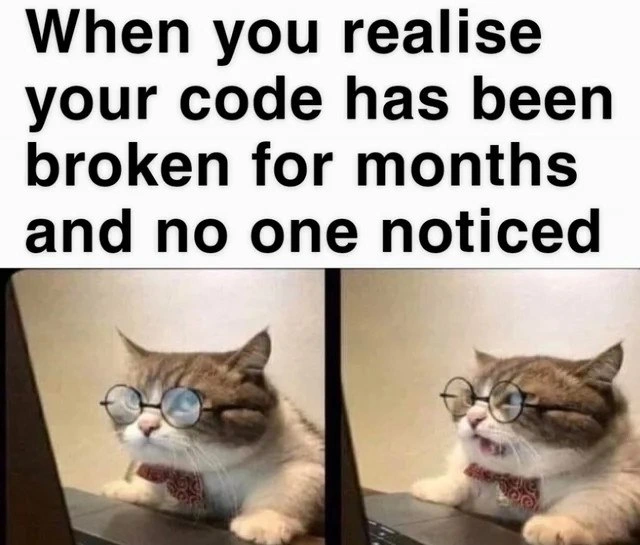
That’s exactly the feeling this meme shows. The cat at the computer thought everything was fine (like you did with the water). Then it “realises the code has been broken for months” – meaning a big hidden mistake was there the whole time. And since “no one noticed,” it’s like nobody told the cat or gave any sign that something was wrong. It’s funny in a way, but also kind of wow! because it reminds us that sometimes things can be wrong for a long time and we might not know until we really look closely. Just like you’d feel surprised and a bit guilty about the cat’s water, the developer feels surprised and worried about the code. The meme makes us laugh because the cat’s goofy shocked face is exactly how we all look (on the inside at least) when we discover a secret mistake that’s been hiding right under our noses!
Level 2: No Alarms, False Calm
Let’s break down the technical terms and scenario for a newer developer (or anyone new to this debugging horror story):
“Broken in production” – Production refers to the live environment where real users interact with the software (the website, app, or service that’s actually out in the world). When code is “broken in production,” it means there’s a bug or defect in the live system. This isn’t a harmless glitch in a developer’s local machine or a testing environment; it’s an issue affecting the real product. In our meme’s context, the cat (acting as a developer) realizes some part of their software has been malfunctioning on the live site for a long time. That’s a pretty big deal – it’s like discovering that the car you sold has had faulty brakes for months, and nobody noticed or reported it. 🚗💥
Bug / Defect: A bug (also called a defect) is a mistake or error in the code that causes it to behave in a way that wasn’t intended. Maybe the program crashes, or maybe it just quietly does the wrong thing (calculates wrong, skips an action, etc.). Here, the meme implies the latter – the code wasn’t doing what it was supposed to (“broken”), but it didn’t cause a big crash that drew attention. It was a sneaky bug lurking silently.
No one noticed: This phrase is both funny and scary. It means that for all the time this bug was in production (months!), nobody realized something was wrong. There were no user complaints, no support tickets, no monitoring alerts – nothing. Typically, when something breaks, users might see an error message or a feature just doesn’t work, and they’d complain (“Hey, I can’t click this button, it does nothing!”). The fact that didn’t happen suggests a few things:
- The feature isn’t critical or widely used. If few people use that part of the app, few would encounter the bug. For example, imagine a software has a special report generation feature that only a handful of power-users ever try. If that feature has been broken, the majority of users wouldn’t even know. Only those few might notice, and maybe they didn’t bother to report it.
- Users encountered it but weren’t aware or didn’t bother. Sometimes users think “Hmm, that’s odd,” but they move on, or assume they did something wrong. If it’s a subtle failure (like a discount code that quietly doesn’t apply, but the purchase still goes through), a user might not even catch it. Or maybe they tried the feature once, it failed silently, and they just gave up using it without telling anyone.
- The system failed silently. If the bug doesn’t produce a visible error (like no big red error message), users might not realize anything broke. The software might say “Operation successful” even when it wasn’t – yikes!
Observability & Monitoring: These are practices and tools used by developers and IT teams to keep an eye on systems.
- Monitoring usually means having automated systems that check the health of your application. This could involve alerts (like emails, texts, or dashboard warnings) that fire when something goes wrong – e.g., an alert if the website’s error rate suddenly spikes, or if an important background job fails. Monitoring often uses metrics, which are numeric measures like “requests per minute” or “error count per hour.” If something unusual happens, the monitoring system will ideally notify the team.
- Observability is a broader term that means how well you can understand what’s happening inside your system from the outside. It often involves three key things: logs, metrics, and traces.
- Logs are like the application’s diary entries – lines of text written every time something happens (e.g., “User 123 requested the report at 10:05PM”). If something goes wrong, ideally there’s an error log entry saying what failed.
- Metrics are those numeric health indicators (CPU usage, number of failed logins, etc.).
- Traces follow a request as it travels through various parts of a system (useful in microservices or complex architectures).
Observability helps developers see inside the running program. In a perfect world, if code in production breaks, the observability tools should catch it – maybe an error log is recorded and an alert is sent, or a metric goes out of bounds and triggers a warning. In the scenario of the meme, there was likely a lack of observability around the broken code. That’s why nobody knew about the bug for so long. No logs or alerts flagged the issue. The meme calls attention to this gap: if you don’t have good monitoring, a bug can snooze in production for ages, unnoticed.
Test coverage: This refers to how much of the code is covered by automated tests (such as unit tests or integration tests). High test coverage means most of the code’s behaviors have tests verifying they work correctly. If there’s a gap in test coverage – say a particular feature or edge case isn’t tested – then a bug in that area can slip through. The description mentions “gaps in test coverage.” That implies the broken code probably wasn’t well-tested (otherwise, a test would have failed and caught the bug before it ever went live). For a junior dev: think of tests as safety nets or those bumpers in the bowling alley. If you don’t have them in certain lanes, the ball (bug) can fall straight into the gutter without anyone stopping it. 🎳 Here, our bug rolled right past any tests into production because that lane had no bumper.
Post-deploy validation: This is a fancy term for checking the software after it’s been deployed (released) to make sure everything is actually working in the live environment. Some teams do this with automated smoke tests (basic checks that run on the live system after deployment), others with a careful manual checklist. If such validation was missing or incomplete, it explains how the bug went live and stayed live. It’s like launching a rocket but not checking if all systems are go once it’s in orbit – ideally someone should verify, but maybe no one did for this feature.
Debugging & Troubleshooting: Once our poor developer realizes the code is broken, they’ll probably enter debugging mode. Debugging is the process of investigating and finding the cause of a problem in software, then fixing it. Troubleshooting is a similar term, often used interchangeably, which just means solving problems step-by-step. The meme itself is about the moment before the actual debugging starts – that sinking feeling when you first confirm “Oh no, something’s definitely wrong.” For many developers, it’s followed by an intense session of digging through logs, replicating the issue, and eventually patching the code. The tags like
BugsInSoftwareandDebuggingFrustrationhint at the emotional journey here: frustration, surprise, and the urgency to fix something that’s been wrong for so long.
Now, how does this relate to early-career experiences? Imagine you’re a new developer and you deploy your first big feature to production. You’re proud and everything seems fine because no errors pop up immediately. Months later, while working on something else, you stumble upon a weird behavior in that feature. You investigate and realize it never worked properly to begin with! It’s a shock: “Why didn’t anyone tell me? Why didn’t our tools catch this?” This meme is basically depicting that scenario. The cat with glasses represents the developer (because, let’s face it, devs have a reputation for loving cats and a lot of us wear glasses from staring at screens 😹). In the left image, the cat/dev is calm, possibly reviewing code or logs with a confident, scholarly vibe – thinking everything is okay. In the right image, the cat/dev has an open mouth and wide eyes, the moment of “Eureka – but in a bad way!” The developer has just realized their code wasn’t doing what it was supposed to do for a long time, and nobody caught it. That look is a mix of panic, horror, and disbelief.
For a junior, this scenario teaches important lessons:
- Always include monitoring for critical features. If you release a feature, have some way to know it’s working (for example, track how many times it’s used or if it fails). If a tree falls in a forest and you have a sensor on it, yes, it will make a sound (in your monitoring dashboard)! 📊🔔
- Test your code, especially the edge cases. Sometimes the bug is in a path that isn’t obvious. Writing tests or doing thorough QA (Quality Assurance) might catch those.
- Users won’t always report issues. Don’t assume “no complaints == no problems.” Users might not bother or might not notice. Part of being a responsible developer is proactively finding issues, not just reacting to loud problems.
- Be ready for surprises. In software, things can be broken for a while before discovery. It’s not the end of the world – it’s fixable – but it’s a humbling experience. The senior devs joking about it (with that meme) have been through it and want others to learn: even if you’re careful, it can happen, so don’t get complacent.
So, the meme in simpler terms: a developer finds out a bug lived in their software for months with zero signals or complaints. It highlights concepts of observability (having those signals), the importance of testing, and the reality of debugging in production. It’s funny in a “laugh so I don’t cry” way – because every developer dreads the idea of a flaw slipping past them for so long. And yes, it even happens to the best teams, which is why everyone from juniors to seniors can relate (and why the meme got shared among dev circles). After all, who wouldn’t react like that shocked cat upon such a discovery? 🐱💻😱
Level 3: Schrödinger's Bug
"If a bug is deployed to production and nobody notices, did it ever exist?" – a seasoned sarcastic twist on the old adage.
In this meme, a dignified cat with round glasses (looking like a scholarly senior dev) calmly reviews a laptop screen in the first panel. In the second panel, the same cat’s mouth drops open in utter shock. This captures that horrifying moment of clarity when a developer discovers their code has been broken in production for months and yet no one noticed. It’s a paradox worthy of Schrödinger: the code was both broken and “not broken” (from the users’ perspective) until the developer observed it. The humor cuts deep for experienced engineers because it highlights a silent failure – a bug that lived in a quantum state of indeterminacy, never reported or alerted on, quietly lurking in the system. Only when the developer peeks (like opening Schrödinger’s box) does the reality collapse into “broken code” – and cue the shocked cat face. 😼💥
From a senior developer’s perspective, a bug persisting unnoticed in production is nightmare fuel wrapped in absurdity. On one hand, there’s relief: apparently the broken code didn’t trigger any on-call 3 AM pages or major incidents (phew?). On the other hand, it’s terrifying: it means your observability failed, your tests missed something, and possibly that the feature is so rarely used (or users so resigned to it not working) that nobody even yelled. The combination of these elements is what makes it darkly funny and painful:
No Monitoring Alerts: Clearly, the system had
state-of-the-artno alerting for this functionality. In a well-monitored system, even a minor exception or unusual behavior would trigger a metric spike, an error log, or a pager alarm. Here, silence prevailed. As every battle-scarred ops engineer knows, silence isn’t golden – it’s suspicious. Maybe the monitoring pipeline was misconfigured, or that part of the app was deemed “not mission-critical” and got zero dashboards. The result? A false sense of security. No alarms rang, so everyone assumed “all is well,” while the bug lay low like a sleeper agent. It’s the classic “no news is good news” fallacy in software – sometimes no news means your news-wire is down.Rarely-Used Code Path: The meme hints that perhaps no user noticed the issue. This often means the buggy feature was an edge case or a little-used feature. Maybe it was a new microservice endpoint hardly any client called, or a report generation tool that few cared about. The code could be broken as in not functioning at all, but if no one ever takes that path, it’s effectively a tree falling in the forest with no one around. A cynical veteran might joke: Did we spend weeks developing a feature no one actually needed? It’s a bitter thought – you toiled on code, it’s been broken the whole time, and literally zero users complained. In one darkly comic sense, that’s preferable to angry customers... but it also hints you built something irrelevant or user-unfriendly (ouch).
Silent Failure (No Errors Surfaced): Another possibility is that the code failed silently. Perhaps an exception was caught and never logged, or a default value masked the failure. This is like having a smoke alarm with no battery: a failure happens but the system says nothing. Consider a snippet of anti-pattern pseudocode:
try {
processOrder(orderId);
} catch (Exception e) {
// Swallowing the exception: no log, no rethrow.
// The failure is completely hidden.
}
In the above example, if processOrder throws an error, the catch block absorbs it quietly. The order isn’t processed, but the system moves on as if nothing happened. If there’s no log and no external monitoring, this bug could persist indefinitely. Many seasoned devs have encountered such ghost bugs – the ones that don’t crash the app outright or scream in logs. Instead, they fail in the shadows. The cat’s wide-eyed horror in the second panel? That’s the look of a developer reading code like this in production and realizing “Oh no... we never knew this was failing!”
- Lack of Test Coverage & Post-Deploy Checks: The meme implicitly roasts the team’s test coverage and deployment validation. If proper unit or integration tests existed for this code, the bug likely wouldn’t have made it to production. And if a thorough post-deploy validation or smoke test had been done, someone might have caught it on day one. But in reality, teams under pressure often skip these safeguards (or have gaps in them). A jaded engineer will chuckle here because we’ve all seen the test suite proudly claim “98% coverage” while the 2% untested is exactly where the production bug lived. Murphy’s Law of Software Testing: the bug lurks in the untested corner.
The humor also comes from the shared trauma this scenario represents. Developers bond over war stories of the bug that lived undetected: “Remember that time the login analytics were broken for a whole quarter and we only noticed when doing QBR slides?” or “We found out the discount coupon code never actually applied any discount… six months later!” These stories are funny after the fact (usually told over beverages or in Slack threads with a laughing-crying emoji 😅). At the moment of discovery, though, it’s pure panic and dread. The cat’s transformation from calm to shock is a mirror of a dev’s face during that dreaded “Oh 💩” moment. First, quiet analysis (“Hmm, everything looks normal… let's check this one log…”) then – jaw-drop – “How long has THIS been broken?!”. Cue the internal screaming and the scramble to assess damage.
From an industry perspective, this meme skewers some real anti-patterns and systemic issues:
Overconfidence in “no news”: Organizations often assume if users aren’t complaining, the software is fine. Experienced folks know better: maybe users didn’t find the bug yet, or didn’t bother reporting it. Maybe an entire reporting tool is spewing nonsense and customers just worked around it quietly. The cat’s shock is every senior dev’s nightmare that we only find bugs when we trip over them months later.
Neglecting Observability: There’s a big push in modern DevOps for Observability – making systems measurable and transparent so that failures can’t hide. This includes detailed logging, metrics for key actions (e.g., counting how often a function succeeds/fails), and alerts for abnormal conditions. The fact that “no one noticed” the bug for months indicates a gap in monitoring – perhaps no metric was tracking that feature’s usage or outcome. A hardened engineer might cynically quip: “We had one job – to monitor our *&$% features – and we blew it.” It’s common in legacy systems to find whole subsystems with zero health checks. They’re like dark corners of a warehouse: nobody’s looked there in ages, and who knows what’s festering. This meme is essentially shining a flashlight into one of those corners and finding a skeleton (the broken code) that’s been there all along.
Communication and Team Silos: Sometimes a bug goes unnoticed because of poor communication. Perhaps QA assumed devs were monitoring it, devs assumed Ops or SRE had alerts on it, and Ops had no clue the feature existed to monitor it. Everyone thought someone else was minding the store. The end result: 😿 “Oops, nobody was watching that.” The shock isn’t just at the bug, but at the realization that our process failed. This can trigger pretty serious retrospectives in a seasoned team: “How did this slip past us for so long? What does that say about our teamwork and processes?” The dark humor here is that only a cat with glasses was “watching”, and even it is stunned by the negligence.
The “It Worked in Dev” Syndrome: There’s also an ironic possibility that in the developer’s own environment or tests, this code did work (or at least appeared to). Perhaps a different config, a missing real-world scenario, or simply never testing the exact condition allowed the bug to ship. So the dev was blissfully confident (like the cat in panel one, all scholarly and composed). Only in the real world of production – months later – does the truth emerge. The meme’s text “When you realize your code has been broken for months...” is basically the lead-in to every embarrassing post-mortem. The cynic in us laughs because we’ve been on those calls: “Apparently this never actually processed payments correctly since last quarter, but because our revenue numbers overall didn’t tank, no one noticed.” It’s the stuff of imposter syndrome nightmares and a reminder that reality has a way of humbling you.
Finally, there’s an unspoken existential dread wrapped in humor: if the code was broken and no one noticed, was our work even important? 💀 That’s the quiet dread behind the cat’s eyes. Engineers take pride in their work making a difference. Discovering that your carefully written feature failed silently begs the question: did this code matter at all? The veteran developer in me finds this both grimly funny and sadly true. Many of us have fixed bugs that have been in production for ages, only to realize maybe nobody really needed that feature working in the first place (or they found workarounds long ago). It’s a blow to the ego and a lesson in humility. As a cynical veteran, I’ll joke that this is almost a rite of passage in software development: eventually you discover you had a catastrophic bug that apparently hurt no one (until it embarrassingly surfaces). The key is whether you treat it as a lucky break to improve your process, or just quietly fix it and hope no one else notices either. 😏
In summary, the meme blends bug-related trauma, observability failures, and a cat’s comedic timing to deliver a scenario that’s too real for senior devs. It’s the laugh of “oh no, been there, done that.” The top text sets up the situation, and the cat’s double-take face perfectly delivers the punchline: that heart-stopping moment of production bug enlightenment. If you’ve been on call or maintained a system for a few years, you likely have the emotional scars (and maybe some late-night Slack messages) to match the cat’s expression. This meme speaks to those shared experiences – and that’s why it hits home so hard among the developer community.
Description
A two-panel meme captioned, 'When you realise your code has been broken for months and no one noticed'. The meme features a fluffy cat wearing round glasses and a patterned bow tie, looking intently at a laptop screen. In the first panel, the cat has a calm, focused expression. In the second panel, its expression shifts to one of shock and alarm, with its mouth open as if gasping. This meme captures the conflicting feelings a developer experiences upon discovering a long-standing, unnoticed bug. There's the initial horror of realizing the code is faulty (the second panel's reaction), quickly followed by the dawning, somewhat concerning realization that the broken feature is either unused or its failure is indistinguishable from its intended behavior. It's a humorous take on legacy code, technical debt, and the importance (or lack thereof) of certain features
Comments
7Comment deleted
It's not a bug, it's an undocumented feature that provides 'business value' by not being used. The real horror is when someone finally notices and you have to fix it
That face when you realise our only “observability pipeline” is the finance team noticing revenue dip - turns out the health-check has just been `return 200` since the last migration
The real bug was thinking anyone actually used that enterprise reporting module you spent three sprints perfecting - turns out the CEO still exports to Excel and the data team wrote their own SQL queries six months ago
The most terrifying realization in software engineering: discovering your 'critical' feature has been throwing 500s for three months, but your error budget looks pristine because literally nobody uses it. It's the production equivalent of Schrödinger's bug - simultaneously broken and working until someone actually observes it. At least now you have empirical data for that 'feature deprecation' discussion you've been avoiding
100% SLOs achieved: the alert query summed err0r_count while the service emitted error_count
Realizing a service has been 500’ing for months and nobody noticed: SLOs are green because dashboards watch /health, the error budget survives zero traffic, and the only caller is a cron behind a feature flag named “someday.”
The holy grail of microservices: a broken endpoint so orphaned, its 500s formed their own fault-tolerant cluster