Skip to content
DevMeme
924 of 7435
The Evolution of a Programmer's Google Search
Learning Post #1044, on Feb 23, 2020 in TG

The Evolution of a Programmer's Google Search

Why is this Learning meme funny?

Level 1: The Magic Word

Imagine you are learning about something new and you don't even know the right word for it. In the beginning, you ask in a very roundabout way. It's like if you saw a strange animal for the first time, you might ask, "What is that big stripy cat at the zoo that roars?" You're using a whole sentence because you're not sure of the name. Then someone tells you, "That's a tiger." Next time, you just ask, "Where does the tiger live?" See how much shorter the question became? You learned the magic word ("tiger"), so now you can ask faster and get your answer more easily.

This meme is showing the same idea but with coding. At first, the person doesn’t know the special programming word "lambda", so they type a long question into Google, almost like they're asking a teacher for help. Later, they learn the exact term "lambda function" (and that it's a thing in Python), so they can ask with fewer words. Finally, they're comfortable enough to just use a tiny phrase – kind of like using a secret code – because they know Google will understand it. The joke is that as you get better at something (like programming), you also get better at knowing the right words to use when looking for help. And finding answers faster makes you feel proud, like, "Hey, I really know what I'm doing now!"

Level 2: From Questions to Keywords

Let's break down what's happening in the meme for someone newer to coding. It’s showing the learning curve of a programmer by using Google searches related to Python's lambda functions. Each search bar represents a stage in the developer’s knowledge:

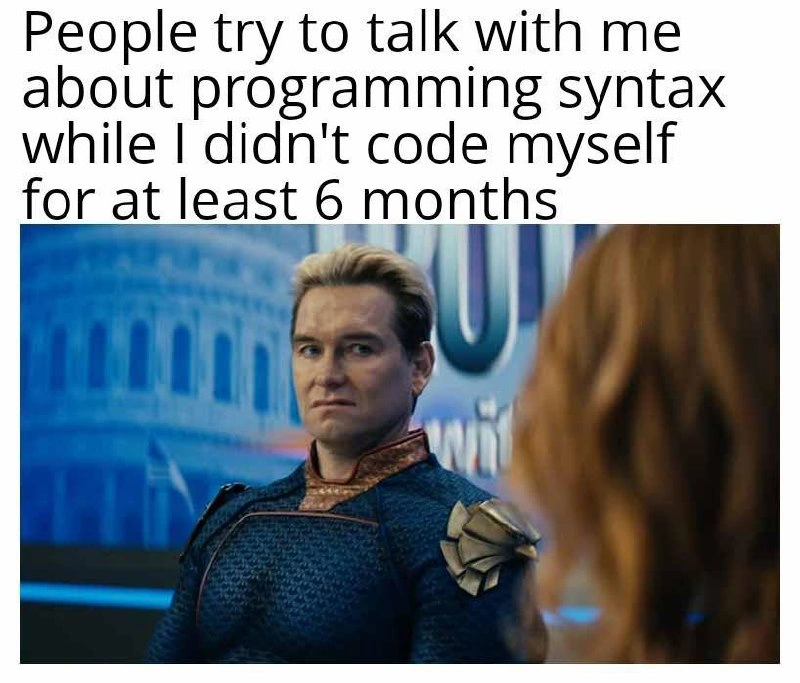
  • First search: how to use python lambda functions – This is a very beginner-style query. When you're new, you often type a whole question into Google, like you're asking a teacher. Here the person probably just heard about "lambda functions" in Python and isn't sure what they are or how to use them. So they ask Google in a complete sentence. The query explicitly says how to use and mentions Python lambda functions to make sure Google knows the context (Python programming) and the topic (lambda functions).
  • Second search: python lambda example – Now the developer has a bit more confidence. Instead of a full question, they use a shorter, focused phrase. They know they want an example of a lambda function in Python. By this point, they understand that if they just search the keywords Python and lambda, plus the word example, Google will likely show a relevant code snippet or a helpful tutorial. It's common when learning to code to look for examples, since seeing actual code helps more than a theoretical explanation. The query has dropped the extra words like "how to use" because the person has learned that Google can figure it out from just keywords.
  • Third search: py lambda – This is the most condensed form. Here the developer is using an even shorter abbreviation: "py" instead of "Python". It's like programmer shorthand. Many developers informally use "py" to mean Python (just like "JS" for JavaScript or "SQL" for Structured Query Language). The search query now is super minimal – just the essential terms. By now, the person clearly knows that lambda is the feature they care about, and they're likely just looking for a quick reference or confirmation. They might expect to see the official Python documentation or a relevant Stack Overflow thread pop up immediately (Stack Overflow is a popular Q&A site for programming questions). The downward arrows in the image show that this is a progression over time: each arrow means "then later..." indicating that after some learning, the search became shorter.

So why does this progression happen? When you're new to programming (a junior), you might not know the exact words to use. Google is pretty forgiving, but as a beginner you aren't sure of that – so you provide as much detail as possible, just in case. Also, beginners often treat the search bar like asking a question in natural language. As you grow more experienced, you start thinking in more precise terms. You realize that if you search the specific concept name (like "lambda function") and the context (Python), you'll get better results. In other words, part of the learning curve for coding is also learning how to refine your searches. By trial and error, you pick up a few handy Google search tips:

  • Google ignores common words like "how", "to", or "use". These filler words are called stop words, and the search engine usually drops them and focuses on the important terms.
  • The order of words and having the right keywords matters more than writing a full sentence. Typing just python lambda example is enough to bring up relevant answers because those words likely appear in documentation titles or in a Stack Overflow answer.
  • Abbreviations are usually understood. If you're frequently searching programming stuff, Google kind of "knows" that "py" likely refers to Python. It has learned from millions of similar searches by developers that Py = Python (especially if your search history or the context includes programming topics).

Now let's clarify the key technical term here: Python lambda function. In Python, lambda is a keyword used to create an anonymous function (a function without a name) in a single line. It's a way to write a quick throwaway function without defining a full def function block. For example, you could write:

# A normal function to square a number
def square(x):
    return x * x

print(square(5))  # Outputs 25

# An equivalent lambda function to square a number
square_lambda = lambda x: x * x
print(square_lambda(5))  # Also outputs 25

In the second part, lambda x: x * x creates a tiny function on the fly that multiplies x by itself. Beginners often find this syntax strange at first (since it's different from a normal def function), hence they might search for something like "how to use python lambda functions" to understand it. A tutorial or documentation page will show examples like the one above. After seeing an example or two, you get the hang of it. Next time, you might just search "python lambda example" to quickly remind yourself of the syntax or see another use case. And once you're really comfortable, you might not even need the word "example" or the full word "Python" – you just punch in "py lambda" because you're pretty sure that'll get you the answer you need.

This meme is categorized under Learning and Languages (since it's about learning a programming language feature) and it perfectly portrays a junior developer experience. It highlights a part of the developer's LearningCurve: not only learning the code itself but also learning how to look up coding questions effectively. Every developer goes through this refinement of their search query habits. In the beginning, you might even copy-paste entire error messages or ask very broad questions like "how do I fix ___ in Python?". As you gain experience, you figure out the important keywords (like the specific error name or function name) that will lead you to the answer faster. It’s a key part of becoming a more self-sufficient programmer.

Another thing to note is the sense of accomplishment. The text at the top, "Guys, I'm Getting Better at Programming," shows the developer is proud that they can use the proper terms now. It might seem like a small thing, but to someone who's been learning and struggling, realizing that you can just search "lambda Python" and immediately understand the results (and the code you find) feels like a big win. It's a sign of developer growth: you’ve moved past the stage of not even knowing what to search for, to knowing exactly the word or snippet you need.

And of course, there's a wink of developer humor here: Googling things is a huge part of programming. People joke that being a programmer is 50% writing code and 50% searching the web for how to do things. This meme plays on that truth. The more you code, the more you optimize your Google searches. It's like leveling up an unseen skill. When you finally start using concise queries (and they work!), you definitely feel like, "Yes, I'm becoming a real programmer."

Level 3: The Art of Google-Fu

As an experienced developer, you know that mastering programming isn't just about writing code – it's also about knowing how to search for solutions efficiently. This meme humorously demonstrates the evolution of a developer's search habits. In the image progression, we see Google search queries going from how to use python lambda functions to python lambda example, and finally to a terse py lambda. This is the developer's Google-Fu improving over time: queries become shorter and more precise as the programmer gains confidence with the jargon and what to look for.

What makes this funny to seasoned engineers is that it captures a universal learning milestone. Early in our learning to code journey, we all tend to type out full, verbose questions into Google – almost as if we're asking a human instructor. The phrase "Guys, I'm getting better at programming" above the meme nails the sense of triumph in a dev discovering they can now find answers faster. It's poking fun at the junior vs senior dynamic: a junior developer might politely ask Google, "How do I use Python lambda functions?", whereas a senior developer just types the critical keywords, trusting the search engine to understand. In essence, the meme highlights how you go from explaining your problem in plain English to searching with just the right technical terms.

There are several reasons this progression happens:

  • Familiarity with terminology: At first, you may not even be sure "lambda functions" is the right phrase, so you include context ("how to use", "Python") to make sure. Later, you know the exact term (lambda), and that becomes enough by itself.
  • Search engine savvy: Experienced devs learn that Google (and the inevitable Stack Overflow results) thrive on keywords. They know Google typically ignores fluff like "how to use" and focuses on substantive terms. By the time you're searching py lambda, you're essentially doing a database-like query: language:Python AND concept:lambda. It’s a quick incantation that summons the answer from the internet almost magically.
  • Efficiency and speed: Removing extra words is faster to type and often yields the same top results. An engineer on a deadline doesn't want to waste keystrokes. It's like writing code: concise and to the point. Fewer words also mean less chance of misinterpreting the query. (For example, Google might treat "how to use python lambda functions" and "python lambda example" almost the same, since it drops common words and zeroes in on "Python" and "lambda". Knowing this, an experienced dev just skips to the essentials.)
  • Confidence in context: Notice the final query uses "py" instead of "Python". A seasoned programmer is confident that Google (and their own brain) will infer "py" means Python. This is a subtle flex of expertise – as if the developer is on a first-name basis with the technology. Similarly, an expert might search just an error code or function name, trusting that minimal input will yield the best result.

Another layer to this joke is the pride behind it. The caption "Guys, I'm Getting Better at Programming" suggests that the person equates improved searching technique with becoming a better programmer. And truthfully, knowing how to quickly find answers is a real developer skill. There's an industry saying that good programming isn't about knowing everything, it's about knowing how to Google effectively. This meme hits home because we've all felt that mini-eureka moment realizing, "Wait, I don't have to type the whole question – I can just enter the key parts and voila!" It's almost as if the developer turned a long magic spell into a quick incantation: fewer words, same effect – the answer appears.

The humor resonates on multiple levels with experienced devs: it's about that shared journey of becoming fluent in both a programming language (here Python) and in the unspoken language of search queries. It's a gentle roast of our past newbie selves and a celebration of developer growth – going from needing training wheels in Google searches to doing search query wheelies like a boss. And maybe, just maybe, it hints that writing code and querying Google have more in common than we admit – both get better when you know the magic words.

Description

A three-panel meme titled 'Guys, I'm Getting Better at Programming' that illustrates the progression of a developer's Google searches as they gain experience. The first panel shows a beginner's verbose query: 'how to use python lambda functions'. The second panel, representing an intermediate level, shows a more concise search: 'python lambda example'. The final panel, epitomizing an experienced developer's search, is simply 'py lambda'. Each search bar is a screenshot from Google, and downward arrows connect the panels, indicating the progression over time. The humor lies in the relatable journey of developers learning to search more efficiently, relying on shorthand and keywords as their knowledge grows. It's a subtle nod to the fact that a significant part of programming is knowing what to Google, and how to do it quickly
Comments

7
Anonymous ★ Top Pick The progression is real. Soon it'll just be a single, incomprehensible emoji pasted into the search bar, and Google will somehow know you need the Eigen library documentation
  1. Anonymous ★ Top Pick

    The progression is real. Soon it'll just be a single, incomprehensible emoji pasted into the search bar, and Google will somehow know you need the Eigen library documentation

  2. Anonymous

    Seniority milestones: you start with “how to use python lambda functions,” level up to “python lambda,” and by staff-engineer you’re just typing “λ” into the omnibox - same philosophy we use when we refactor ProductCatalogService into pc-svc and call it “self-documenting.”

  3. Anonymous

    The real evolution is when you stop searching entirely because you've memorized that lambda syntax from fixing the same code review comment across seventeen microservices

  4. Anonymous

    The real senior move is when you skip Google entirely and just grep through your own codebase for that lambda you wrote three years ago, can't remember why it works, but know it does. Bonus points if the search progression actually ends at 'py lam' because autocomplete has learned your habits better than you have

  5. Anonymous

    Seniority is compressing “how to use python lambda functions” to “py lambda” and still summoning the same 2009 StackOverflow answer: “just use def.” Query compression is the only FP I consistently ship

  6. Anonymous

    Real seniority is when the TF-IDF in your head reduces every query to 'py lambda' and your browser auto-opens the same 2012 accepted answer

  7. Anonymous

    Lambda mastery unlocked: when 'py lmbda' + Tab beats reading PEP 335 every time

Use J and K for navigation