Data Type Empathy: When 'F' is More Than a Char
Why is this Languages meme funny?
Level 1: One Little Letter
Imagine you have two friends trying to cheer you up when you’re sad. One friend can speak in full sentences and gives you a big warm message: “I’m so sorry you’re sad. Everything will be okay.” The other friend isn’t able to say much – in fact, they can only say one single letter. It might sound silly for a friend to just say a letter, but in this story that letter is special. The friend says “F”, and somehow, that one little “F” makes the sad computer feel a bit better. Why? Because in the computer’s world (and gamer talk), saying “F” is like a secret handshake that means “I’m here for you, I understand your pain.”
Think of it like this: sometimes a small gesture can mean a lot. Maybe your quieter friend doesn’t talk much, but they give you a thumbs-up or a pat on the back when you’re upset. That’s their simple way to show they care. In this comic, the blue friend (Char) can only give a tiny symbol of support – one letter – but that letter carries a caring message. The orange friend (String) can give a long hug in words, and the blue friend gives a short nod of sympathy with “F.” Both together help the computer (the person with the monitor head) feel comforted.
It’s funny and cute because we usually think one letter alone wouldn’t be enough to cheer someone up. But here, the sad computer understands the meaning behind that single “F” and appreciates it. It’s like how sometimes your buddy might just say, “Hey,” and put a hand on your shoulder, and you know it means “I’m sorry, friend.” In the end, even a little letter can have a big heart. The computer stops crying and smiles a bit, all thanks to a one-letter friend and a friend with lots of words.
Level 2: Character Limit
This meme is a cute example of coding humor that plays on the difference between a char and a string – two basic data types you learn in programming. If you’re new to coding:
- A char (short for character) is a data type that holds exactly one character. For example,
'A'or'F'or'?'– just a single letter, number, or symbol. In many languages you write char literals with single quotes. - A string is a data type that holds a sequence of characters, basically text of any length. You write string literals with double quotes, like
"Hello"or"I am sorry". A string is like a bunch of char values chained together (in some languages it’s essentially an array or list of chars under the hood).
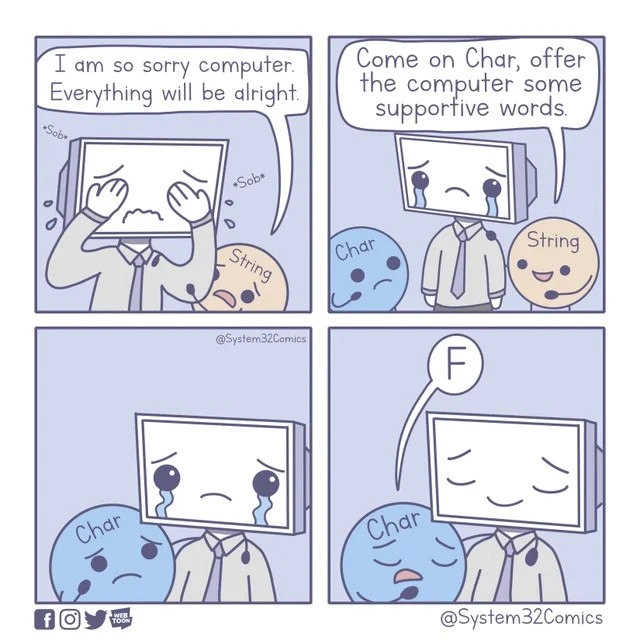
In the comic, these abstract concepts are turned into characters: Char is drawn as a little blue circle that can say one letter, and String is an orange circle that can say whole sentences. The computer (with a monitor for a head) is sad and crying in the first panel. The String character gives the computer a full supportive sentence: “I am so sorry computer. Everything will be alright.” That’s something a string variable could easily hold since it’s multiple characters long. Then String nudges the Char character: “Come on Char, offer the computer some supportive words.”
Now the funny twist: Char wants to help, but because he’s literally a char (one character), he can only offer one character worth of advice. So in the third panel Char just leans on the computer silently (since he doesn’t have a multi-character sentence ready). Finally, in the last panel, Char musters his single character of support: the letter “F.”
Why the letter F? This is referencing a popular gamer/internet meme “Press F to pay respects.” In a famous video game scene, players were told to press the F key on their keyboard to show respect at a virtual funeral. That idea took on a life of its own in internet culture. Now people often just use the letter "F" as a shorthand to show sympathy or respect when someone shares bad news or a failure. It’s like a one-letter way of saying “I’m sorry, that sucks” or “I feel for you.” You might see folks in a Twitch chat or forum just typing F when something sad or unlucky happens to someone.
So, in this comic, Char’s “F” is basically him paying respects or saying “I feel you, buddy.” That single letter ends up being a perfectly fitting kind of comfort in geeky language. The computer understands the reference and is actually comforted by it (you see the computer calm down and close its teary eyes when Char says "F"). It’s a sweet moment because even though Char could only contribute one letter, it was the right letter – a small gesture that carries a lot of meaning for those in the know.
This also subtly teaches the concept of char vs. string in programming. If you’ve just started coding, you might have run into a situation where you used the wrong one. For example, writing something like char letter = "A"; in C++ or Java would cause a type error, because "A" in double quotes is a string literal, not a char. You’d need to use 'A' (single quotes) for a char. Similarly, a char can’t hold more than one character – if you try to do char letter = 'AB'; most languages will complain (since 'AB' is two characters). A lot of beginners learn this the hard way when first dealing with text data types! This comic takes that exact constraint and imagines: what if a char and a string were people? The string person can speak whole words, the char person can only get out one letter at a time.
Another layer to appreciate is how System32Comics often turns technical ideas into friendly characters. Here we have a data type personification: the Char and String are like little cartoon buddies with their type names written on them. The scene of “computer crying and being consoled” is a play on how developers sometimes have to console (pun intended) a computer or how we feel when our computer has problems. The LanguageQuirks tag fits because it’s highlighting a quirky thing about programming languages – that a char isn’t the same as a string, even if they seem related. And the CodingHumor is strong: anyone who has debugged a program or been around dev forums will likely chuckle at the single tearful “F”. It’s the kind of joke you’d share with your programming friends when someone’s having a rough day (like a build failing or a bug that made you cry, metaphorically).
In short, the meme is funny and heartwarming to a junior developer because:
- It explains a basic concept (chars vs strings) in a creative, memorable way.
- It ties in a bit of meme culture (using "F" to show support) that many younger folks on the internet recognize.
- It shows that even something very small in coding (one character) can have significance, which is a neat little insight (sometimes a single character in code can make the difference between a working program and a crashing one – like missing a semicolon or using
=instead of==. Here a single character makes a difference emotionally).
By connecting these dots, the comic manages to be educational and funny at the same time. A new coder might read this and never forget the difference between char and string, all because Char could only spare an "F". And if you didn’t know the "press F" meme before, well, now you’ve learned a cultural reference as a bonus!
Level 3: One Byte of Empathy
At the highest level, this comic highlights a fundamental data type quirk that seasoned developers immediately recognize. In programming, a char (character) is typically one byte of data that can store a single character, whereas a String is a sequence of characters (often a dynamically sized array of bytes). The cartoon personifies these types: an orange bubble labeled "String" and a blue bubble labeled "Char" are comforting a sad computer (a humanoid figure with a CRT monitor for a head). The String friend has plenty of capacity, so it offers a whole sentence of comfort: “I am so sorry computer. Everything will be alright.” In contrast, the Char friend is inherently limited to one character of output. The humor comes from the fact that Char wants to help but can literally only supply a single letter of sympathy.
This limitation is depicted when String encourages Char: “Come on Char, offer the computer some supportive words.” Char leans in, struggling in silence at first (you can almost imagine a buffer underflow of words), and finally manages to emit just one letter: the character "F". For experienced developers, this hits on two levels:
Type capacity & syntax: In many languages (C, C++, Java, C#), a
charvariable can hold exactly one Unicode/ASCII character. It’s even denoted with single quotes in code ('F'is a char literal, while"F"would be a string literal). The comic takes that literally: Char has a one-character memory buffer for comforting words. If Char tried to say"OK"or"Hi", it would be like a char buffer overflow in C – totally impossible without causing an error. The comic cleverly avoids that by keeping Char’s output to one letter.Cultural context – “Press F to pay respects”: The choice of the letter F is no accident. It references the gamer meme "Press F to pay respects." This originated from a scene in Call of Duty: Advanced Warfare where the player was prompted to press the F key to show respect during a funeral cutscene. It became an internet in-joke: nowadays, when something sad or unfortunate happens (even in developer chat threads), people half-jokingly post “F” as a way to show support or condolences. So here the Char’s single “F” isn’t a random character – it’s a perfect one-letter show of solidarity that any tech-savvy person understands means “I’m sorry, I acknowledge your pain.”
From a senior developer’s perspective, this comic is a love letter to Language quirks and shared nerdy culture. It blends a technical truth with an emotional scenario. We’ve got a computer crying (maybe over a crashed program or lost data, though it’s not explicitly stated) and two data types stepping out of the code and into human roles to comfort it. This is drawn in the signature System32Comics style – pastel colors, simple characters with kind expressions – which often turns abstract CS concepts into relatable slices of life. Here, the datatype personification trope is strong: we instinctively know String is verbose and Char is terse by their very definitions in code.
For those of us who have dealt with low-level data types, there’s an extra chuckle: a char is often 8 bits (one byte) in C/C++, just enough to store something like 'F' (which is 0x46 in ASCII). A string on the other hand can be thought of as an array of chars, plus a terminator or length indicator, allowing it to hold sentences. So in a way, the String friend physically has more memory to hug the computer with words, while the Char friend is doing the best with his 1-byte heart. We can even imagine that Char’s internal buffer only accepts one character, and he chose the most meaningful one. It’s a tiny syntax humor gem that also warms the heart: even a one-byte friend can express empathy if you understand the code.
Let’s illustrate the concept in code to see why Char’s stuck with a single letter:
#include <string>
using namespace std;
char supportLetter = 'F';
// Char can only hold one character. 'F' fits in a char (1 char long).
string comfortingWords = "I am so sorry computer. Everything will be alright.";
// String (often std::string in C++) can hold many characters (here a whole sentence).
char invalid = 'FX'; // error: too many characters in character literal
// ^ You can't put "FX" into a single char. Only one character is allowed.
In the above C++ snippet, supportLetter is analogous to our Char friend – it’s just one character. If we tried to assign 'FX' (two characters), the compiler would throw an error (just as Char would freeze up trying to say more than one letter!). Meanwhile, comfortingWords is like the String friend: it easily holds a long comforting message. This is exactly what’s happening in the comic panels: Char’s one-letter limit vs. String’s long-form compassion.
Ultimately, the meme is a multi-layered joke that lands well with developers. It takes a simple programming lesson (the difference between char and string) and fuses it with an internet meme to create a scenario that’s absurd yet endearing. We laugh because we’ve been there – not necessarily consoling a crying computer, but definitely dealing with strict type limits and communicating in geeky shorthand. The computer’s final contented smile (with tears drying up) after receiving that single “F” is the punchline. It’s as if the computer and Char share an inside joke that one byte of sympathy was enough. In coding, as in friendship, even small things (or small data types) can make a big difference.
Description
A four-panel comic strip by @System32Comics featuring anthropomorphic data types comforting a sad computer. In the first panel, a character named 'String' hugs a crying computer, saying, 'I am so sorry computer. Everything will be alright.' In the second panel, 'String' encourages a blue, circular character named 'Char' to 'offer the computer some supportive words.' In the third panel, the computer continues to cry while 'Char' looks on helplessly. In the final panel, 'Char' offers a single letter in a speech bubble: 'F'. The computer immediately stops crying and looks serene and content. The joke is a multi-layered pun. Technically, a 'char' data type can only hold a single character, making 'F' its only possible offering. Culturally, 'F' is a reference to the 'Press F to Pay Respects' meme from gaming culture, used to express sympathy. The humor lies in the fact that this single, meme-laden character is more comforting than a whole string of supportive words
Comments
7Comment deleted
A String offers verbose, multi-threaded emotional support, but a single Char providing an 'F' in the chat is the atomic operation that truly acknowledges the moment of system failure
At the start of a sev-1 I’m a well-formed UTF-8 String full of reassuring words; three hours in I’ve down-cast myself to a single Char and spent my only byte on a quiet ‘F’
After 20 years in the industry, you realize the real tragedy isn't that Char can only say 'F' - it's that in production, that single character response would somehow still cause a buffer overflow, three race conditions, and mysteriously work perfectly in dev but fail spectacularly when the CEO demos it
The beauty of this comic lies in its perfect encapsulation of type constraints: when you're a char, even your most heartfelt emotional support is bounded by sizeof(char). String wanted to offer comfort, but Char's API only accepts single-character input - so naturally, they went with the most universally recognized single-character expression of solidarity in gaming culture. It's a poignant reminder that sometimes our type systems constrain our expressiveness in ways that are both technically accurate and emotionally inadequate. At least they didn't try to concatenate - that would've required a whole different kind of memory allocation
Spec said 'supportive words'; someone modeled it as CHAR(1). Now every prod incident gets the same response: F
When the API expects “supportive words” but the interface exposes only a char, you ship “F” - minimal payload, zero allocation, universally understood semantics
Char's the ultimate microservice: minimal footprint, but zero scalability for heartfelt condolences