Scrum master rates the house party at exactly five story points
Why is this Agile meme funny?
Level 1: Counting Fun Points
Imagine you’re at a birthday party and everyone is dancing, laughing, and having a good time. But there’s one friend who’s standing in the corner with a notepad, trying to rate how good the party is with points as if it were a test or a project. He’s also wishing that the other kids followed the plan he made for the party (maybe he had a checklist like “play games at 8:00, eat cake at 8:30” that everyone ignored). Sounds silly, right? While everyone else is just enjoying the music and cake, he’s treating the party like it’s serious work, giving it a score of “5” and worrying that nobody looked at his to-do list. This is funny because a party is supposed to be about having fun and being carefree. If someone tries to organize fun with rigid rules or work terms, it feels out of place – kind of like a teacher grading a recess game. The lonely guy in the cone hat is basically mixing up work and play. He can’t stop thinking about tasks and points, even though it’s play time. We laugh at the picture because we all understand that feeling: when you’re too caught up in something (like a hobby or work), you might see it everywhere. It’s as if he learned a special way to plan projects and now he can’t turn it off, even at a dance. In simple words, the joke is that he’s taking a fun party way too seriously, and that contrast is what makes it humorous. Everyone else is partying without a care, and here he is, the only one treating the party like homework.
Level 2: Backlog on the Dance Floor
Let’s break down what’s happening in simpler terms. This meme is using Agile software development jargon in a totally non-software setting (a house party) to get a laugh. In Agile (and specifically the Scrum framework), teams manage their work in a structured way:
- They keep a backlog, which is essentially a prioritized to-do list of all the work that needs to be done. Think of it like a shopping list of features and fixes, except for building software. The Scrum team regularly does backlog grooming (also called backlog refinement) to make sure those to-do items are well-defined and ordered by priority.
- They estimate each task in the backlog using story points. A story point is a made-up unit that measures how big or hard a task is relative to other tasks. It’s not an exact number of hours or days – it’s more like a size category. For example, a simple bug fix might be 1 point (very small), adding a medium feature might be 5 points, and overhauling a whole module could be 8 or 13 points (bigger). Teams often use a fun game called planning poker to do this: each team member privately picks a card with a number (1, 2, 3, 5, 8, etc.), then everyone reveals them to see if they agree on the effort. It’s a way to get the whole team to discuss how complex a task feels.
- There’s also a person called a Scrum Master. This isn’t a boss or a master in the sense of a schoolmaster; it’s more like a coach or facilitator. The Scrum Master’s job is to make sure everyone follows the Agile process, remove roadblocks (impediments) that slow the team, and help organize meetings like sprint planning (where the team decides which tasks from the backlog to do in the next batch of work, called a sprint). They’re the ones always reminding the team “let’s update the estimates” or “let’s not forget to groom the backlog.”
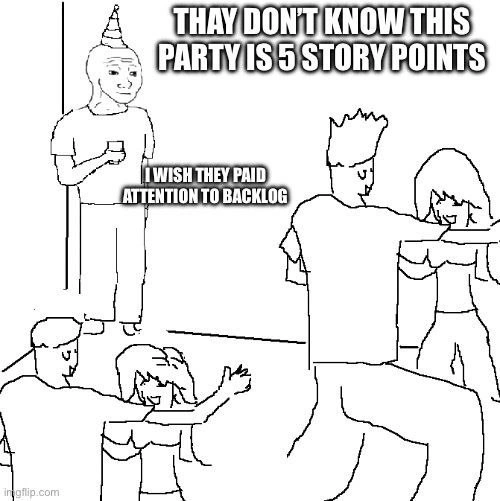
Now put this in the context of a party. The meme shows a goofy drawing of people dancing, with one guy off to the side thinking in these work terms. The top text says, “THAY DON’T KNOW THIS PARTY IS 5 STORY POINTS.” Despite the typo (“THAY” instead of “THEY”), the idea is clear: he’s jokingly estimating the entire party as if the party itself were a task in a software project. In a real Agile team, calling something “5 story points” means it’s of moderate complexity – not trivial (1 or 2 points) but not huge either (like an 8 or 13). So to this guy, the party is a moderate piece of work 😄. Of course, in normal life nobody rates a party with story points – you might say “this party is fun” or “lame” or at best give it a 5/10 in a casual way, but story points are a very niche way to describe it. That’s why it’s funny: it’s mixing a mundane situation with super nerdy lingo. It’s as if he’s speaking a secret language only software teams understand. The other partygoers in the image have no idea what he’s thinking (“they don’t know”), which is the whole joke – he’s alone in this super-specific view of the world.
The smaller text near him says, “I WISH THEY PAID ATTENTION TO BACKLOG.” This doubles down on the Agile reference. The backlog in software is that list of tasks to do. If someone “isn’t paying attention to the backlog,” it means they’re ignoring the to-do list or not keeping the work items updated. Now imagine applying that to a house party: it’s like he’s saying, “I wish they had planned this party properly and were keeping track of all the things we need to do (and actually checking them off).” Maybe in his mind there was a plan – get snacks, set up music, invite certain people – but in reality, everyone else is just winging it and having fun. He’s the kind of person who might think, “Did we follow the checklist for this party? Who’s the Product Owner of this event, and did we meet the acceptance criteria for ‘fun’?” It’s an absurd mismatch, which is why it evokes a laugh. For a junior developer or someone new to Agile, here’s the connection: the meme is poking fun at how people in tech (especially those deep into Scrum meetings) sometimes carry that structured thinking into regular life. Maybe you’ve caught yourself or a colleague saying, “Let’s put that in the backlog” about fixing a lightbulb at home, or estimating a weekend project like it’s a user story (“Cleaning the garage? Hmm, 3 points, probably half a day”). It’s done tongue-in-cheek, of course. This meme takes that quirky habit and cranks it up — the guy is at a dance party yet he’s effectively doing sprint planning in his head!
In simpler terms: all the jargon aside, the picture is funny to developers because it’s one of those “if you know, you know” scenarios. The phrase AgilePainPoints in the tags hints that constantly thinking in story points and backlogs can actually be a pain at work (endless meetings about estimates can get tiring). So seeing it applied to a party is like saying, “Our poor friend here can’t escape work mindset, even when he’s supposed to relax.” The meme’s crude drawing style even resembles the typical format of they_dont_know_meme where one character has a unique knowledge or obsession. So if you’re a newcomer: yes, the party isn’t literally part of a Sprint, and nobody really assigns story points to hanging out — that’s the joke. It’s a mash-up of an everyday situation with project management geek-speak. Once you’ve sat through enough sprint plannings, you might find yourself accidentally rating your day’s errands in points or wishing your roommates would attend your “backlog grooming meeting” about cleaning the apartment. This meme just takes that to a cartoonish extreme for comedic effect. It’s basically saying: developers sometimes can’t stop being developers, even at a party. And the fact that the main character is a wallflower (standing aside, not dancing) adds to it: instead of joining the fun, he’s stuck in his head with his SprintPlanning thoughts. Classic developer humor!
Level 3: Party Planning Poker
At first glance, this meme is a cheeky nod to how deeply Agile culture can infiltrate a developer’s mindset. We have a classic “they don’t know” party scenario – a crudely drawn group dancing and one awkward figure in the corner with a thought bubble. The humor kicks in because that wallflower is essentially a Scrum Master mentally running an Agile sprint at a house party. He’s looking at people having fun and thinking, “They have no clue I’ve estimated this party at exactly 5 story points.” In agile software development, story points are an abstract measure of effort or complexity for a task – teams use them to estimate work (often via planning poker, where each member throws down a card with a number like 1, 3, 5, 8, etc.). It’s hilariously out-of-place here: a social event judged with the same rubric as a refactoring ticket! Five points might mean a medium-sized task on a Fibonacci scale – not too easy, not too hard. The absurdity is that he’s treating a carefree party like a sprint backlog item, as if “fun” could be broken down and scored. This resonates with seasoned devs because after enough sprint cycles, you half-jokingly start to see story points everywhere (“Doing laundry tonight? Eh, 2 points tops”).
The top caption’s misspelling – “THAY DON’T KNOW” – mimics the low-effort meme aesthetic and signals the insider nature of the joke. It’s like the meme itself is an inside joke about inside jokes, much like agile jargon is inside baseball for tech teams. Only those who live in JIRA boards all day would chuckle at a party being “5 points.” And speaking of JIRA, the wallflower’s secondary caption, “I WISH THEY PAID ATTENTION TO BACKLOG,” is dripping with Agile pain. The backlog is that ever-growing list of work items (user stories, tasks, bugs) that teams groom and prioritize. This party-goer’s lament suggests he had a to-do list or plan for the party that everyone else ignored. It’s a sly poke at the scrum habit of always worrying about unfinished tasks. Maybe the chips-and-dip were supposed to be refilled (backlog item #5), or the playlist had user stories that weren’t implemented – and nobody but him cares! Seasoned engineers recognize this feeling: when you’re so used to organizing and optimizing at work, you can’t turn it off, even off-hours.
The meme brilliantly captures an AgileHumor moment: the Scrum Master brain in leisure time. In real-life software teams, Scrum Masters facilitate sprint planning, stand-ups, and backlog grooming sessions, constantly urging folks to size their work and mind the backlog. It’s a running joke that some Scrum zealots start treating everything like a sprint. Here, that joke is made literal. The poor guy at the party is essentially conducting a one-man sprint retrospective on why the partygoers aren’t following the plan. It’s too real for anyone who’s sat through meetings where even trivial things get story-point estimates (“Deploying on Friday? That’s a 13-point risk!”). We laugh because we’ve either been this person or worked with this person – the one who can’t stop using work jargon in casual settings. The senior dev perspective picks up on another nuance: story points are team-specific and relative. A story scored “5 points” by one team might be an “8” for another. Outside the context of a software team, calling something “5 story points” is utterly meaningless – which perfectly matches the text “they don’t know.” Of course they don’t know – only he understands his team’s point scale, so to the rest of the party he’s just a weird guy in the corner with a cone hat.
This comedic scenario also pokes at the cult-like side of corporate Scrum culture. Agile coaches often encourage thinking in user stories, points, and continuous improvement everywhere. Taken to the extreme, you get the stereotype of an engineer who can’t attend a potluck without yearning for a Kanban board. It’s funny, but it’s also commentary: when workplace processes are overemphasized, they creep into your psyche. A battle-hardened dev might chuckle and cringe remembering that one manager who tried to assign story points to “team-building events” or the colleague who joked about prioritizing the beer-pong bracket in the next sprint. The meme succinctly says: “We’ve all been there – over-structuring the unstructured.” And by exaggerating it (turning a party into a sprint backlog), it reminds us how silly it can get. At least the guy in the meme didn’t whip out a Scrum board on the living room wall with sticky notes for each dance move (though you can imagine him thinking about it!). The senior crowd appreciates this layered humor: it’s not just “ha ha, he said story points at a party,” it’s also laughing at our own tendency to apply engineering metrics to human experiences. After years in development, you catch yourself doing it – and it’s equal parts useful, absurd, and endearing. In short, the meme lands a direct hit on that shared experience, with the Scrum Master wallflower reminding us to maybe leave the backlog at work when it’s time to party. (And please, no mid-party stand-up meetings to discuss why the music is a blocker.)
Description
Hand-drawn black-and-white ‘they don’t know’ party meme: several stick-figure style people dance in a living-room scene while one introverted figure wearing a cone party hat stands at the wall holding a solo cup. Large top caption reads, “THAY DON’T KNOW THIS PARTY IS 5 STORY POINTS.” A secondary caption over the wallflower says, “I WISH THEY PAID ATTENTION TO BACKLOG.” The humour plays on agile estimation culture - treating a social event like a sprint backlog item - highlighting how seasoned engineers can’t stop thinking in story points even off-hours. The deliberately misspelled “THAY” and crude drawing reinforce classic meme aesthetics while nodding to the inside-baseball nature of agile jargon
Comments
8Comment deleted
Somewhere a product owner just added ‘refill the punch bowl’ to the sprint because it’s clearly a quick win with high business value
The real party trick is explaining why that '5 story points' feature somehow took three sprints, two hotfixes, and a complete architectural redesign - but at least it's not the 13-pointer that's been haunting the backlog since Q2 2019
The real tragedy isn't that they don't know the party is 5 story points - it's that you've internalized Fibonacci estimation so deeply that you can't even enjoy social events without mentally sizing them. Meanwhile, your PM is over there dancing, blissfully unaware that the 'quick feature' they added yesterday just turned your two-week sprint into a three-month death march. But sure, let's keep pretending story points aren't just hours with extra steps and existential dread
If this party is 5 story points, tomorrow a PM will convert it to 12 hours, demand a burndown for the dance floor, and call it an Epic when someone adds ‘pizza’ to the acceptance criteria
5 points? Optimistic - forgot the 'cleanup spike' and post-party retrospective user story
Call it 5 story points and by Monday a VP will compare it to another team’s 5, declare a velocity regression, and schedule a retro on ‘fun delivery.’
That's the point of this story, nobody fucking knows. Poor people whose bosses like the agile scrum something methodology are forced to estimate their work in abstract "story points", while a story is an attempt to explain some task by looking at it from different perspective (user's, admin's etc.) Comment deleted
It suppose to be complexity but become effort Comment deleted