User Ignores System Warnings, Surprised by Predictable Failure
Why is this Bugs meme funny?
Level 1: Touching the Hot Stove
Imagine your parent tells you, “That stove is hot, don’t touch it.” You’ve been warned clearly: if you touch it, you’ll get hurt. But feeling a bit stubborn or curious, you say, “It’ll be okay, I know what I’m doing,” and you touch the hot stove anyway. What happens? Ouch! 🔥 Your hand gets burned. Now you’re standing there with wide eyes and an open mouth, completely surprised that you got hurt – even though you were literally told this would happen.
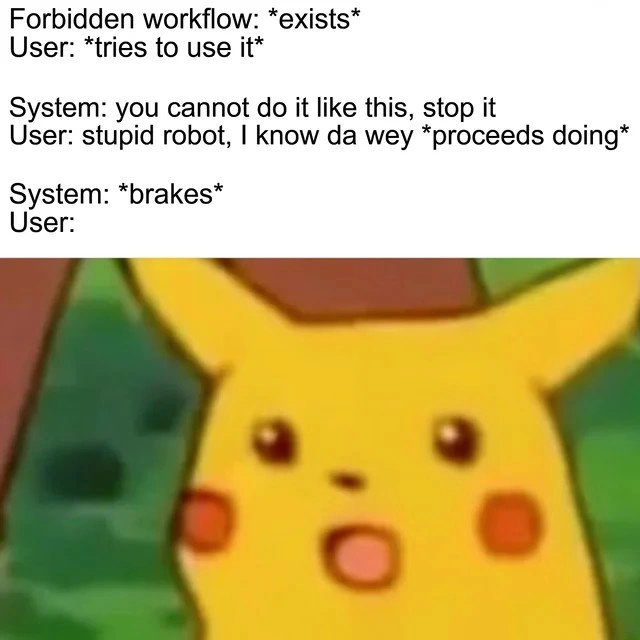
That’s exactly the joke of this meme. The computer system was like the parent saying “Stop, don’t do that, you’ll break something.” The user is like the kid who didn’t listen and did it anyway. And the result – the system broke, just like the kid’s hand got burned. The funny part comes from the user’s shocked reaction, like “Oh no, it broke!” Everyone else knew it was a bad idea, but the person is still astonished. It’s the same kind of humor as watching someone press a big red “Do Not Press” button and then acting surprised when a loud alarm goes off. We laugh because the outcome was so obvious. In simple terms: they were warned, they ignored the warning, and then they got exactly the consequence they were warned about – and their Pikachu-face shock is the cherry on top. It’s a playful reminder to listen when you’re warned, or you might end up surprised by something completely predictable.
Level 2: What Could Go Wrong?
Let’s break down the meme’s scenario in simpler terms. The top text describes a user trying to do something that the system has clearly flagged as “forbidden” or not allowed. Think of a forbidden workflow as a procedure that everyone has agreed you shouldn’t use because it’s known to cause problems. For example, imagine your project’s rules say “Never deploy code to the website without running tests.” That’s a rule to prevent bugs. Here, Forbidden workflow: exists means such a risky method is theoretically possible, but clearly marked as a bad idea. Now, User: tries to use it — this means some person goes ahead and attempts that risky, disallowed action anyway.
The system immediately responds with a warning: “you cannot do it like this, stop it.” In real life, this could be an error message popping up, or a tool refusing to proceed. For instance, if you try to merge code that hasn’t been reviewed, the system might block it and say “❗ Permission denied: this workflow is not allowed.” The user, however, ignores this warning. The meme has the user saying “stupid robot, I know da wey”. “I know the way” (spelled humorously as da wey) is referencing a viral meme, but here it basically means “I know what I’m doing, silly computer. I’m going to do it anyway.” The user is brushing off the system’s caution, calling it stupid for trying to enforce the rule. In a real scenario, this might be someone saying, “Ugh, this deployment script is too cautious. I’ll just manually copy the files, it’ll be fine.” They click “Proceed” on a big warning dialog or use some override command to force the action.
Next, System: brakes. That’s a typo or intentional pun on “breaks” – meaning the system stops working properly (like a car slamming its brakes). In plain terms, the software or service crashes or malfunctions because the forbidden action indeed had the bad effect everyone feared. The thing we tried to prevent has happened. If this was a website deployment, maybe the site goes down or users start seeing errors. If it was a code merge that was blocked due to failing tests, and the user pushed it anyway, now the application might be full of bugs that those tests would have caught. The forbidden workflow has led to exactly the kind of ProductionIssue it was supposed to avoid.
Finally, we have User: followed by the image of Surprised Pikachu. Pikachu is a famous Pokémon, and the face shown is a meme template used to express shock or surprise. The user’s reaction is basically 🤷 “What?! It broke?!” — they are acting astonished that ignoring the rules and warnings actually resulted in the system breaking. This is the comedic payoff: the user is shocked, even though it was obvious (to everyone else) that this would happen. It’s as if they genuinely believed “Nah, nothing will go wrong,” and then are dumbfounded when something did go wrong. It’s a meme way of saying “Cause, meet Effect.”
In a practical sense, this scenario is very common in software development and IT. DevOps engineers and SRE (Site Reliability Engineering) teams set up safeguards to keep production systems stable. They might include things like:
- Pre-deployment tests and checks – to catch errors before they affect real users.
- Role permissions and warnings – for example, a production database might flash “Are you sure? This is live data!” before letting you make a dangerous change.
- Runbooks and policies – documents telling everyone the proper, safe way to do things (and which workflows are forbidden because they can cause outages).
A DeveloperMistake or UserError in this context is when someone on the team says, “I’ll just skip those steps, it’ll be fine.” Maybe they’re in a hurry or overconfident. For instance, a junior developer might see a failing test and think, “That’s a flaky test, I’ll ignore it and deploy my code anyway.” Or an admin might think, “This warning about high memory usage is probably nothing, let’s push through.” Nine times out of ten, these risky shortcuts lead to ProductionBugs – real errors that impact the live system. And then the website could crash or an important service goes down. The DevOps folks get an alert that something broke, and a debugging session starts. When everyone traces back what happened, it often ends with an awkward conversation like: “So... it appears you bypassed the safety check that said ‘Don’t do that,’ right?” The person responsible usually has a Pikachu-like expression: wide eyes, maybe a nervous smile, essentially surprise and a bit of “oops.”
The meme is funny to developers because it’s a caricature of those situations. It exaggerates the dialogue between the system and the user, but it’s not far from reality. We’ve all seen someone (or ourselves) dismiss a computer’s warnings like “Eh, this machine doesn’t know what I need, I’ll force it.” For example, think about trying to delete an important file: the computer might say “Are you sure? This file is required by the system.” If you ignore that and delete it anyway, you might break your OS and then be shocked when the computer stops working correctly. Or ignoring a browser’s security warning about an unsafe site, then being surprised when the computer gets infected with malware. In day-to-day life, it’s like pulling out a USB drive without safely ejecting, despite warnings – if the drive gets corrupted, it shouldn’t be a surprise (though it’s still an unpleasant shock).
So, what could go wrong? A lot, and the meme highlights that in a humorous way. It teaches a simple lesson: those warnings and rules exist for a reason. The “forbidden workflow” isn’t just there to annoy you – it’s based on real past incidents. Ignoring blatant warnings is a recipe for disaster, whether you’re coding, deploying, or just using a computer. And if you do ignore them, you might end up as the Pikachu-face person, amazed that your risky shortcut actually caused the very problem you were warned about. In tech, as in life, when you find yourself saying “It’ll be fine, trust me” while bypassing safeguards… well, that’s when you should expect a surprise (and not the good kind).
Level 3: Shockingly Predictable
Deep in the trenches of DevOps and SRE, this scenario is a classic facepalm waiting to happen. The meme narrates a sequence every seasoned engineer recognizes: a forbidden workflow (a process explicitly marked “Don’t do this, it will break things”) is attempted by a user who thinks they know better. The system dutifully responds with a warning or error — essentially the software equivalent of, “🚫 Stop: that action is not allowed.” At this point, any experienced developer’s alarm bells are ringing. But our intrepid user shrugs off the warning, muttering something akin to “Stupid robot, I know what I’m doing” (parodied as “I know da wey” in the meme, echoing an old viral catchphrase). They proceed to force the action anyway. Predictably, the system breaks (or as the meme humorously puts it, “System: brakes*, implying it screeches to a halt). And then comes the punchline: the user’s stunned silence, represented by the wide-eyed Surprised Pikachu face. They’re in utter disbelief that their brilliant bypass led to a ProductionIssue.
For veteran engineers, the humor here lies in the blatant inevitability of the outcome. It’s the DevOps Pikachu moment: everyone in the room knew this would happen except the person who triggered it. It’s a shared trauma in tech — we’ve all watched someone ignore automated safeguards and then act astonished when a bug or outage erupts. In many teams, this exact story has played out at 2 AM on a weekend: a critical safeguard was overridden by human impatience or hubris, leading to a frantic Debugging_Troubleshooting war room. The meme perfectly captures that “told you so” irony. The system said “you cannot do it like this” for a reason! Often that reason is historical: every guardrail and red warning in a codebase or deployment pipeline exists because some poor soul previously discovered the hard way that doing it “like this” causes a catastrophe. The seasoned Site Reliability Engineer reading this is probably nodding, recalling a dozen post-mortems ending with: “Root cause: process not followed, a human did the forbidden thing.” 🤦♂️
This is essentially a story of HumanError outmaneuvering technical safety nets. In theory, robust systems include checks to prevent known dangerous actions (e.g. requiring code review before merge, or disallowing direct writes to a production database). But as the meme shows, if a determined user has enough privileges or stubbornness, they might find a way around those checks. We have a tongue-in-cheek saying for this: “Make a system foolproof, and the universe will build a better fool.” The user in the meme is that “better fool” — ignoring the very mechanisms designed to save them from themselves. In a professional context, this could be a developer force-merging code that failed tests, an admin manually editing a server config labeled “DO NOT TOUCH”, or someone clicking “Proceed” on every warning dialog without reading it. The immediate result? The forbidden workflow triggers a cascading failure, and the entire service might go down. It’s like watching someone dismantle a smoke detector because it kept beeping, only to be surprised when a fire actually breaks out. Everyone else can only shake their head at the predictability of it all.
Real-world incidents abound that mirror this meme. Picture a continuous integration pipeline that says, “❌ Deployment blocked: tests failed.” Most developers will sigh and go fix the tests. But one overconfident dev finds the --no-verify flag or an override button and forces the deploy to production anyway:
$ git push origin main
> [ERROR] Push denied: Tests failing or approval missing.
# The stubborn user, confident they know better, bypasses the checks:
$ git push origin main --no-verify
# (Bypassing safety hooks and force-deploying the code)
# ...Later in production...
# System logs: "Unhandled exception: Service X is down, out of memory at line 42"
# Outage triggered, everyone alerted.
Moments later, the on-call engineer’s phone is buzzing because the site is down. When the team assembles to investigate, they find the deploy logs and essentially re-enact the meme: System warned “don’t do it”, user did it anyway, system broke. The guilty party’s expression as everyone turns to look at them is the living embodiment of that blurry Pikachu face 🙀. It’s equal parts shocked and caught in the act. The humor here is darkly cathartic — if you’ve been on the firefighting side of these incidents, you laugh to keep from crying. Every DevOps veteran has a collection of these “Surprised Pikachu” moments, usually accompanied by war stories of all-nighters spent fixing the carnage.
What makes this meme so relatable is the universal pattern of user error trumping system design. It highlights a kind of hubris-driven development, where overconfidence leads someone to disregard process. The “Forbidden workflow” could be something like deploying to production on a Friday at 5 PM despite company lore saying that’s asking for trouble. Or running a database script that the runbook explicitly marked as dangerous, because “nah, it’ll be fine.” There’s a reason experienced teams put up warnings and guardrails: they’re trying to prevent known disasters. So when a person blows past those roadblocks, the resulting failure feels utterly unsurprising to everyone except the person who caused it. The shock in Pikachu’s face is funny because it’s so misplaced – it’s the one face you should not be making after you’ve ignored all the red flags. Yet, time and again, that’s exactly the face we see on the culprit in real outages. It’s the look of a developer who just learned in real time why the rule they ignored existed.
Ultimately, this meme is poking fun at a serious truth in engineering: the hardest part of system reliability often isn’t the computers – it’s the humans. We can design robust architectures, implement strict policies, and add fail-safes, but if someone decides “the rules don’t apply to me” or “the system is being overly cautious,” there’s only so much the software can do. The result is often a production fire that could have been easily avoided. That mix of preventable chaos and the culprit’s feigned surprise resonates deeply (and sometimes painfully) with developers. It’s both a laugh and a lesson: when the system earnestly says “stop, don’t do that,” maybe listen – unless you enjoy making the Pikachu face in front of your team.
Description
A two-panel meme using the 'Surprised Pikachu' format. The top panel contains a script-like text exchange on a white background. The text reads: 'Forbidden workflow: *exists*', 'User: *tries to use it*', 'System: you cannot do it like this, stop it', 'User: stupid robot, I know da wey *proceeds doing*', 'System: *brakes*', 'User:'. The bottom panel is a close-up image of the Pokémon character Pikachu, looking utterly shocked with its mouth wide open, a classic reaction image indicating surprise at a completely expected outcome. The meme humorously captures the dynamic where a user disregards explicit system warnings, confidently proceeds with an unsupported action, and then is shocked when the system fails exactly as predicted. The phrase 'I know da wey' is an intentional misspelling and a reference to the 'Ugandan Knuckles' internet meme, further emphasizing the user's misplaced and slightly nonsensical confidence
Comments
9Comment deleted
This is the user who submits a ticket complaining the API is broken after they hit the rate limit 10,000 times in a minute, despite the documentation having a whole page on exponential backoff
When the “immutable infrastructure” champion hot-patches prod with kubectl exec + vi, then does the Surprised-Pikachu face when the next rolling update erases the fix and pages everyone at 2 AM
After 20 years in tech, you learn that 'forbidden workflows' are just undocumented features that worked perfectly fine until someone in compliance found out about them and made you add 47 validation checks that break legitimate use cases
Ah yes, the classic 'forbidden workflow exists for a reason' scenario. Senior engineers know this dance well: you implement guardrails, rate limits, and validation checks after years of production incidents. You document why certain workflows are forbidden. You add warnings, confirmations, and circuit breakers. Then a user discovers the workflow, decides they 'know da wey' better than your battle-tested architecture, bypasses every safeguard you carefully crafted, and acts shocked when the system does exactly what you warned it would do. The surprised Pikachu face is perfect here - it captures that moment when they're standing in the rubble of a broken production system, wondering how this could have possibly happened, while you're pulling up the audit logs showing they ignored seventeen different warnings. It's the engineering equivalent of watching someone remove the safety guards from machinery because they're 'in the way,' then being surprised when things go catastrophically wrong. The real kicker? You'll spend the next sprint adding even more guardrails, knowing full well that determined users will find creative ways around those too
System: 'Invalid YAML.' Dev: 'Stupid robot, I know da wae.' *Cluster evaporates.*
Shocked Pikachu is the user who “knows the way,” bypasses the release workflow to kubectl edit prod, and gets denied by OPA/Gatekeeper - turns out governance isn’t a suggestion
Every time branch protections save prod, someone files a ticket titled “CI is broken” - the policy engine didn’t break, it braked
*breaks Comment deleted
*brakes it's a car Comment deleted