Devil Promises Readable Variable Names - Child Writes ASCII Art in Code
Why is this CodeQuality meme funny?
Level 1: When the Name is a Picture
Imagine a parent tells their kid: “Always label your stuff with clear words so everyone knows what it is.” For example, put a big text label saying “TOYS” on a toy box so it’s obvious. Now, picture that the kid doesn’t write a word at all. Instead, they draw a huge detailed cartoon on the box as the "label". The drawing might even be of a funny red monster face. It covers the whole box and looks artistic, but nowhere does it actually say whose box it is or what’s inside. The parent said to use a readable name, but the child’s “name” is a fancy picture that only they understand (and maybe they did it just to be cheeky!).
This is funny because the parent had a simple, sensible rule – use a clear name – and the kid completely ignored it in the most over-the-top way. It’s like a teacher instructing students to write their names on their homework, and one student responds by sketching an elaborate comic instead of writing letters. The result? The teacher and everyone else are confused about whose homework it is, even though it looks cool. In the same way, in the meme the mom or dad devil wanted the child to use easy-to-read names in code, but the kid made the name a big picture. It’s a silly twist showing how a straightforward guideline can be hilariously ruined by someone’s wild creativity. Everyone laughs because it’s a classic case of a good rule being followed in the wrong way – the name turned into art – which completely defeats the purpose of having a name at all!
Level 2: ASCII Art Variable Name
In programming, a variable name (also called an identifier) is the word you use to refer to a piece of data or a function. For example, if you want to store the number of users online, you might write let userCount = 5 (in a language like F# or JavaScript, etc.). Here, userCount is a nice, readable name – it clearly tells you it's counting users. This clarity is part of good naming conventions: a set of rules or recommendations that help developers choose names in a consistent and meaningful way. Following these conventions makes CodeReadability better, meaning other developers (and future you) can understand the code without confusion. It's a key aspect of writing clean, high-quality code and improving the overall DeveloperExperience (DX) when working in a team.
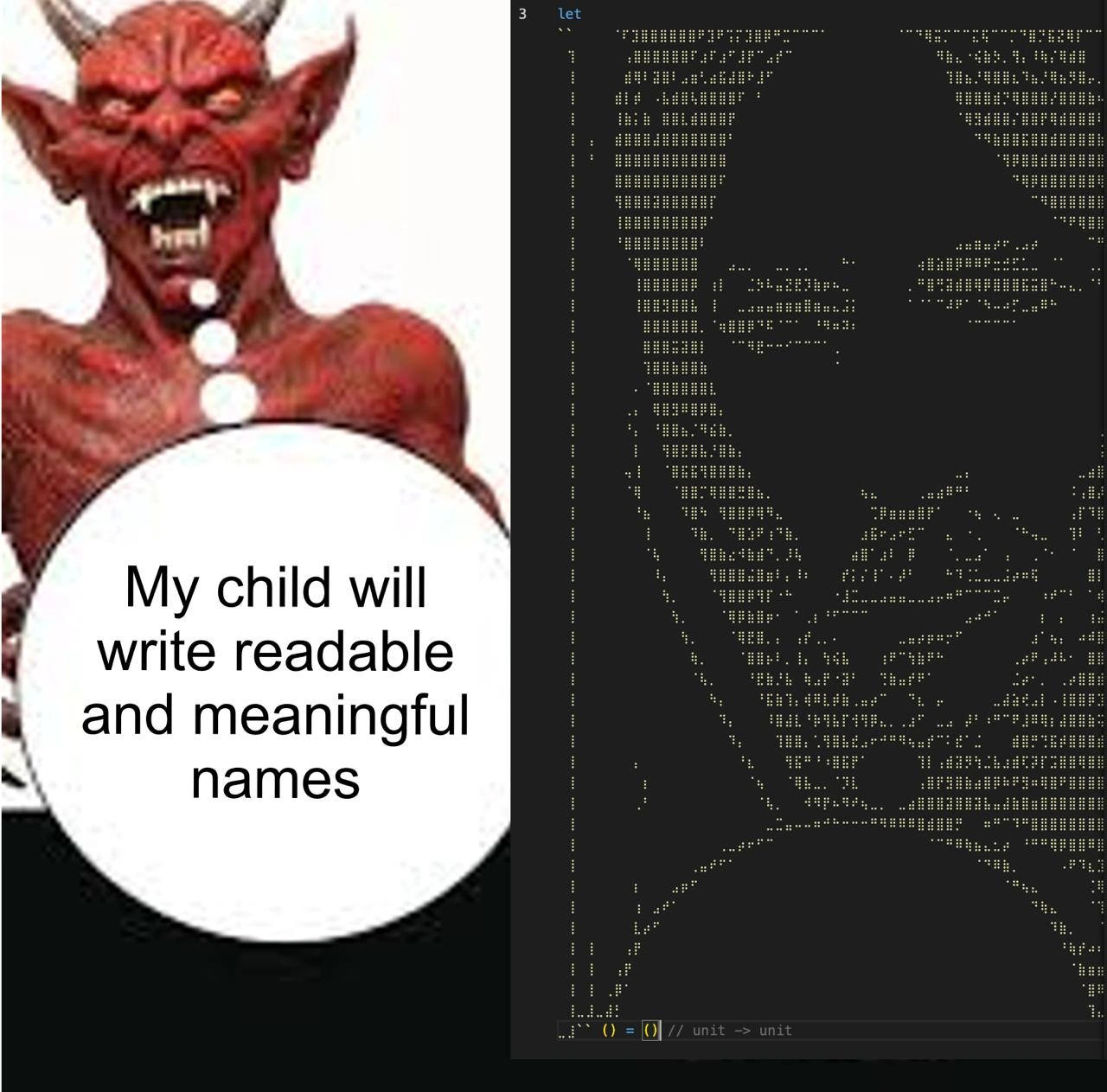
The meme’s joke is that the parent (a red cartoon devil character) proudly declares that their child will use good, readable names – basically saying “my kid will follow all the clean coding rules I believe in.” However, the child’s action (shown on the right) completely undercuts that promise in a ridiculous way. Instead of a normal word-like name for a variable, the child wrote a giant ASCII art picture as the name. ASCII art is the technique of creating images using the characters available on a standard keyboard (like letters, numbers, punctuation). For instance, using a bunch of periods, commas, slashes, etc., you can draw shapes – it’s something people often do in text editors or comments for fun. In the image, all those tiny yellow dots and symbols are arranged to look like a devil’s face (with horns and a grin). It’s very detailed, essentially a picture made of text characters.
Now, using ASCII art is fine for decoration or fun comments, but here it’s embedded where a variable name should be. Think about what that means: normally a variable name is something you can type out and pronounce (like score or isGameOver). But an ASCII picture isn’t a word – it’s dozens (or hundreds) of characters arranged spatially. If that were literally the variable’s name in code, it would be almost impossible to re-type or even say out loud. It’s unreadable in the sense that you can’t really read it as a word at all. This utterly destroys the idea of a “meaningful name.” It’s like the child found the most absurd loophole to avoid following the rule – by technically giving a name, but making that name a huge graphical jumble.
Let’s decode a bit of the tech context shown. The code editor on the right is likely Visual Studio Code (VS Code) in a dark theme (common among programmers for its eye-friendly contrast). The code snippet starts with let, which is a keyword used in many languages (especially functional ones like OCaml or F#) to define a value or function. The presence of () // unit -> unit in the status bar at the bottom is a strong hint we’re dealing with an F# or OCaml environment. In those languages, () represents a special value called unit that signifies “no useful value” (kind of like null or void in other languages, but used explicitly). A function of type unit -> unit means it takes nothing meaningful and returns nothing meaningful – essentially a do-nothing or a side-effect-only function. This suggests that the ASCII-art monstrosity might be being treated as a function name or value that ultimately does nothing (which is fitting, because a name like that is not going to be useful in any typical sense!).
So why do developers find this hilarious and painful at the same time? Because it’s a relatable exaggeration of a real problem: bad variable naming. Every programmer has encountered code where the names of things were confusing or non-sensical – for example, variables named a, foo, or thing that tell you nothing about their purpose. That’s frustrating because you have to dig deeper to understand the code. This meme blows that frustration up to comical proportions. Instead of foo or a, here we have a name that is literally an artwork. It’s as if the developer said, “You thought short gibberish names were hard to read? Hold my keyboard, I’m going to draw an entire devil face.” It highlights the importance of good naming by parody: clearly, a drawn face is the opposite of a good descriptive name.
Using such an ASCII-art name would make the code nearly impossible to maintain. Maintainability is all about how easy it is to update and work on the code in the future. A maintainability_nightmare is something that makes future changes a horror story. If you saw this in a codebase, you’d probably have to copy-paste that crazy name whenever you wanted to use it because typing it by hand (with all the exact spaces and dots) would be impractical. Searching for it is equally crazy – imagine trying to search your repository for a line of code that looks like a devil face! And if another developer joined the project, they’d be utterly perplexed: “What does this symbol even mean? What value or concept is this supposed to represent?” It turns the simple act of naming – which is meant to aid understanding – into a puzzle or art appreciation exercise.
For junior developers or those still learning: this meme is a tongue-in-cheek reminder that while creativity in coding can be fun, there are conventions for a reason. NamingThings properly is a crucial skill. It’s so crucial that veteran programmers often joke that “naming things is one of the two hard problems in computer science.” Good names make code self-explanatory. If you break those conventions too much (like using an image instead of text), you make life hard for everyone. The devil parent saying “My child will write readable names” represents the mentor or senior dev hoping to instill good habits. The child doing the ASCII art is like the mischievous new programmer who thinks doing something wild is cool or funny, but in a real team, that wouldn’t fly. This meme is DeveloperHumor because it exaggerates a real SharedPain – and every dev can chuckle while also shaking their head thinking, “Please, no one on my team actually do this!”
Level 3: Naming Conventions from Hell
At first glance, this meme sets up the ultimate code readability irony. On the left, we have a devilish parent figure boldly proclaiming a pledge: “My child will write readable and meaningful names.” It's basically the embodiment of every seasoned developer or tech lead who swears by Clean Code principles and strict naming conventions. We’ve all been there – preaching in code reviews about using clear, descriptive variable names for better CodeQuality. It's almost a holy commandment in software development: choose identifiers that reveal intent and make the code self-documenting.
Now look to the right half: a Visual Studio Code editor (with the obligatory dark theme, of course – because real devs live in the dark mode 😈). Line 3 starts with the keyword let (a sure sign of an ML-family language like F# or OCaml) followed by... not a word, not an acronym, but an entire ASCII-art devil face as the variable name. It's an enormous block of meticulously arranged yellow characters forming horns, eyes, and a menacing grin. This is a literal demon of an identifier. The child in the meme has not just broken the “readable names” pledge; they've incinerated it in theatrical fashion. The contrast is hilarious and horrifying to any experienced developer: we expect maybe a sloppy variable like x or data as a worst-case – but this? This is a maintainability_nightmare turned up to eleven.
Why is this so funny to veteran engineers? Because it’s a perfect satirical mash-up of CleanCodePrinciples versus chaotic reality. In theory, every developer promises to follow good naming conventions. In practice, we've all encountered that one code file (probably at 3 AM on an on-call night) where some joker has used an avant-garde naming scheme that makes you question your career choices. This meme is the extreme endpoint of that frustration: an identifier so ornamented and obtuse that it transcends mere “bad naming” into the realm of code absurdity. It's like the developer said, “Can’t think of a good variable name? Fine, I just won’t use words at all – here’s a full drawing instead.” Talk about the devil being in the details! Here, the devil is literally the detail.
From a DeveloperExperience_DX perspective, this scenario is both comical and nightmarish. Imagine being the poor soul who has to review or maintain this code. How do you even refer to that variable in conversation? “Uh, the devil-face variable... I guess?” Good luck grepping this symbol in the codebase or trying to type it without copy-paste. It's essentially an unpronounceable glyph. This goes beyond the usual NamingThings struggle – it’s an abdication of naming. Normally, when we talk about hard-to-read code, we mean variables like a1 or foo that lack meaning. Here we have the opposite problem: an identifier so over-the-top that it’s pure visual gibberish to the compiler (and to your teammates). It's CodeReadability gone straight to hell.
Let’s unpack the technical shenanigans a bit. The code editor status bar ominously shows () // unit -> unit at the bottom. That hint tells us we’re likely in an F# or OCaml environment, where () is a value of type unit (analogous to void in other languages) and a unit -> unit function is basically one that takes nothing useful in and returns nothing useful out. In other words, this devilish variable might be defined as a function that does nothing (no side effects, no return – a fitting tribute to the uselessness of its name). In languages like OCaml/F#, you declare values or functions with the let keyword. Usually, you’d see something sane, like let userName = "Alice" or let calculateTotal x y = x + y. But here, presumably using some trick (perhaps F#’s backtick-quoted identifiers or just a bit of meme magic), the name is one giant ASCII art. It’s likely not even valid code in reality – this is a visual joke – but the humor lands because in theory, some languages do allow quite exotic Unicode in identifiers. A rebellious coder could, for instance, name a variable 😀 or 💀 in languages that permit Unicode letters as identifiers. This meme cranks that idea up to epic levels by using old-school text art.
The parent’s quote on the left is also dripping with irony. Notice the parent is literally a red demon with horns – not exactly who you’d think is lecturing about “meaningful names.” This might be a sly nod to how even in hellish codebases that are otherwise full of sins (be it global state, spaghetti logic, or copy-paste hacks), there’s often someone trying to uphold a shred of code quality. Or perhaps it’s hinting that the child – being the spawn of a devil – would naturally do something deviant like this. In any case, the juxtaposition is golden: the righteous declaration of clean code intentions versus the diabolical reality of what the next generation actually does. It’s a shared pain many senior devs find relatable: you set up all these strict guidelines and linters, yet somehow an ASCII-art variable slips through like a demon in the night.
In real-world terms, this scenario parodies the clash between best practices and developer creativity (or folly). Naming conventions exist for a reason: they make code understandable for teams. But there's always that one individual who takes a joke too far or doesn’t appreciate why we avoid overly clever names. Sure, once in a blue moon, we encounter a codebase artifact that feels like codebase_archaeology – deciphering it is like decoding an ancient rune. Usually it's an obscure abbreviation or an inside joke in the identifier. Here it’s literally an ancient-looking ASCII rune of a devil. The meme exaggerates it to emphasize just how absurd and un-maintainable that is. It's essentially saying: if you think a variable named data or x is bad, how about a variable you can’t even read?
Ultimately, this meme tickles developers because it captures a truth in a ridiculous package. Clean code and meaningful naming are hard-won disciplines – every team tries to instill them (like a parent instilling good habits in a child). But the reality is, people will still introduce WTFs into the code. Here the "child" went above and beyond the usual minor WTF; they delivered a masterpiece of unreadability. It's a cautionary tale cloaked in humor: no matter how much you swear “My code (or my team’s code) will be tidy,” the unexpected can always punch through, leaving you staring at something that belongs in a hacker art gallery rather than production code.
Description
A two-panel meme. Left panel: A red devil/demon holding a crystal ball with the text 'My child will write readable and meaningful names.' Right panel: A dark code editor showing ASCII art made entirely of hash/block characters forming a devil's face, with the keyword 'let' at line 3 and a single line of code at the bottom reading '() = {0} // unit -> unit'. The contrast between the devil's aspiration for clean code and the reality of code where variable names are replaced by incomprehensible symbols and ASCII art illustrates the eternal gap between coding aspirations and reality. The right side demonstrates an extreme case of code obfuscation using identifiers that form an image rather than conveying meaning
Comments
22Comment deleted
Satan's parenting goals vs reality: 'My child will use descriptive variable names.' The child: *makes the variable declaration spell out a pentagram in the IDE minimap*
Sure, it breaks every style guide, but on the upside, you'll never have a merge conflict on this line
Some kids draw on the fridge; this one commits it between ‘let’ and the type annotation - good luck grepping THAT during the next refactor
After 20 years of enforcing clean code standards and conducting countless code reviews about meaningful variable names, you discover your team's latest PR where they've named their critical authentication service '👹' because 'it's Unicode-compliant and self-documenting' - and technically, they're not wrong
Ah yes, the eternal optimism of 'meaningful variable names' - right before your build pipeline runs Terser with mangle:true and your beautiful 'userAuthenticationService' becomes '𝓊' in production. At least the demon is honest about what actually ships to prod: a Lovecraftian horror of Unicode that makes you question whether you're debugging code or summoning an elder god. The real kicker? That unit -> unit type signature at the bottom suggests this abomination still type-checks perfectly fine
It type-checks as unit => unit; the real side effect is turning grep, blame, and diff into an ASCII summoning ritual
The type checker infers unit => unit; reviewers infer entropy => infinity
Satan vows readable vars - until webpack minifies the family legacy into single-letter purgatory without source maps
thanks Comment deleted
Relatable Comment deleted
Fuck Safari Comment deleted
Nah, if I'm fucking a browser it's gunna be Firefox 🥵 Comment deleted
Gotta be r3dfox for me Comment deleted
Do you mean this one Comment deleted
The browser Comment deleted
Which language is that? Comment deleted
english Comment deleted
In the right half I mean Comment deleted
JavaScript Comment deleted
F# Comment deleted
Probably Comment deleted
Come on I have used windows 7 until like month ago before i swith to linux but i never heard of r3dfox Comment deleted