Skip to content
DevMeme
6432 of 7435
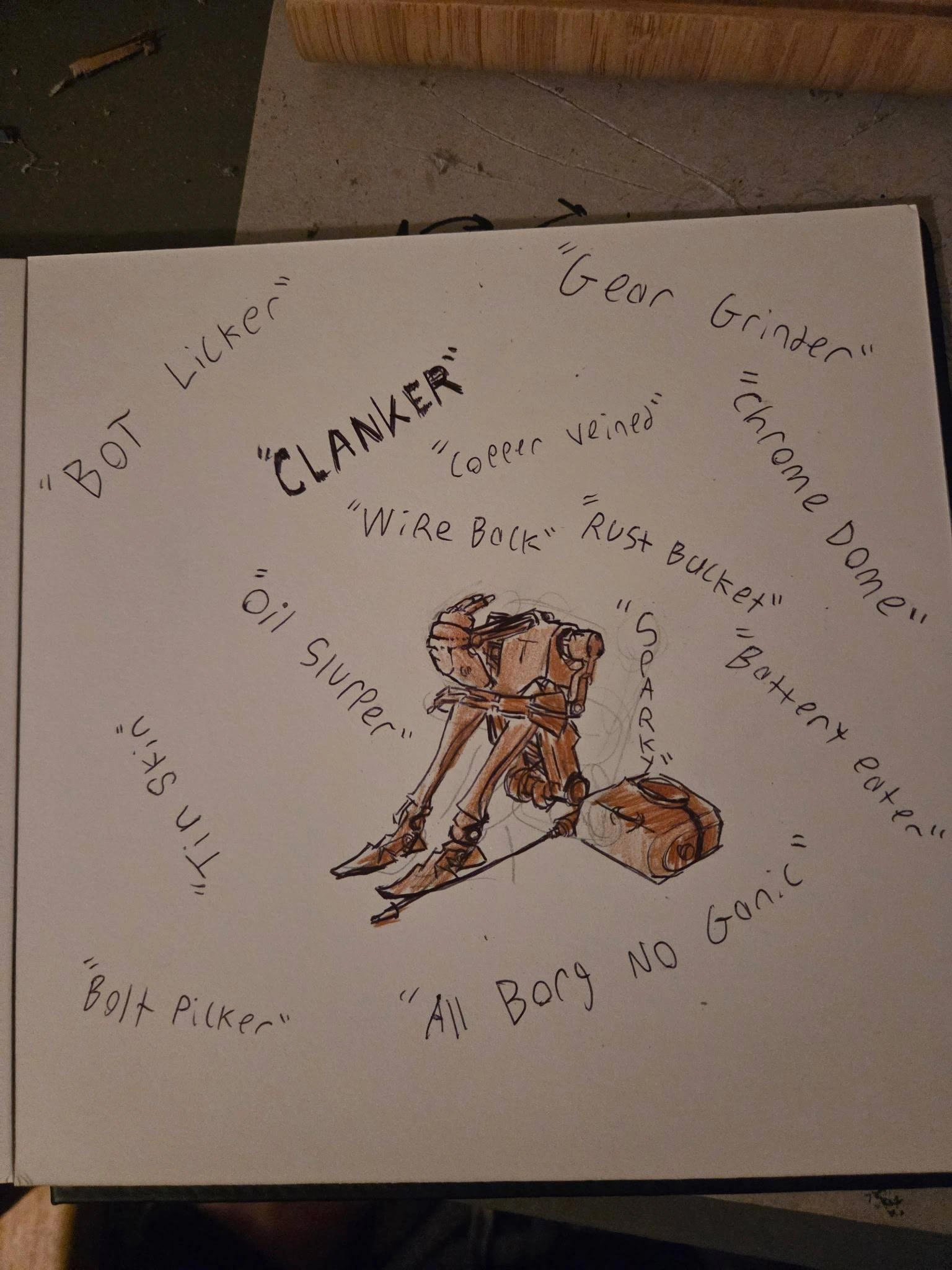
Hand-Drawn Robot Surrounded by Derogatory Slurs for Artificial Beings
Robotics Post #7053, on Aug 18, 2025 in TG

Hand-Drawn Robot Surrounded by Derogatory Slurs for Artificial Beings

Why is this Robotics meme funny?

Level 1: Playground Name-Calling

Imagine a group of kids trying to build a really cool sandcastle together. At first, they all want to agree on how to decorate it and what to name it – maybe something grand like “Castle Sparkle.” But they can’t agree, and they get tired and cranky. One kid says, “Your tower looks squishy!” Another laughs and calls the castle “Mud Bucket” instead of a mighty castle. Soon all the kids are giggling and calling the poor sandcastle silly, teasing names like “Dirt Dome” or “Slug Fort” instead of its nice proper name. They were supposed to be following the “rules” of the game they made up, but instead they started acting goofy and a little mean because they got frustrated.

This meme is just like that, but with grown-up engineers and a robot. The team was trying to follow a serious set of naming rules (kind of like rules for a game), but things got so off track that they ended up jokingly name-calling their own robot. It’s funny because these adults ended up behaving like kids on a playground, teasing the very robot they’re working on. The drawing is making us laugh at how even professionals can lose their patience and resort to playful insults when they can’t agree – just like friends might do when a game doesn’t go their way. The heart of the joke is that something meant to be serious turned into a childish little squabble, and that contrast is both relatable and comical to anyone who’s been part of a team.

Level 2: Naming Conventions 101

Let’s break down what’s happening here in simpler terms. In any software or hardware project – including a robotics team – a style guide is a set of rules about how to write and format things. For example, a style guide might tell programmers how to name their variables and functions (like “use camelCase or Snake_Case for naming”) or how to label robot parts and wires consistently. The goal is to keep everyone on the same page. In a robotics project, you might have guidelines for naming each motor, sensor, or circuit so that it’s clear what is what. A naming convention could be as simple as “call all the leg motors leg_motor_front_left, leg_motor_front_right, etc.” or giving each new robot model a codename like Project SPARKY. This keeps things organized… at least in theory.

What the meme shows is that things didn’t go according to plan. The team’s style guide discussion devolved (fell apart) into a round of jokes and insults. The words scribbled around the robot – “Wire Back,” “Tin Skin,” “Gear Grinder,” and so on – are nicknames, but not the polite kind. They’re making fun of the poor robot as if it were a person on a school playground. Why would they do that? Often, when engineers spend too much time arguing over something small (like what to name a robot or a piece of code), it’s called bikeshedding. That term basically means focusing on a trivial detail and arguing about it more than necessary. In a group meeting, hardware_bikeshedding might happen if everyone debates what color to paint the bike shed while ignoring bigger issues (hence the term). Here, instead of productively deciding on proper names or categories for their robot’s components, they got sidetracked and frustrated.

The phrase “pull-request commentary” refers to comments made during a pull request – that’s when someone proposes changes to code and others review and discuss those changes. Usually, reviewers give polite feedback like “Please rename this variable for clarity.” But if things get tense or someone is in a sarcastic mood, those comments can turn snarky (sarcastic or biting). The description jokes that these insulting nicknames are like snarky pull-request comments — as if a teammate got so fed up they wrote “This module is such a RustBucket” in the code review. In reality, you wouldn’t put “Rust Bucket” or “Bot Licker” in official documentation; these are more like venting or joking among the team.

Each insult is a play on the robot’s nature as a machine. “Rust Bucket” is a common slang for an old, rusty machine (often said about beat-up cars); calling the robot that implies it’s clunky or outdated. “Chrome Dome” is a classic insult for someone with a shiny bald head – here the robot literally has a metal head, so it fits humorously. “Bolt Picker” sounds like an mechanical twist on “nose picker,” suggesting the robot is doing something awkward or gross with bolts. All of these show the team is anthropomorphizing the robot – treating it like it has human traits – which is why this is a mechanical_personification joke. They’re pretending the robot has feelings just so they can poke fun at it (or perhaps at the design itself). “Clanker” being bolded at the top looks like it became the robot’s codename or the project’s name. It likely started as a joke (since a clank is a noise old machines make) but now it’s written like an official title. This could be a result of too many workshop_sketchbook brainstorming sessions where no one could agree on a better name, so the joke name stuck.

In summary, the meme uses TechHumor and EngineeringHumor to show a scenario where an engineering team, supposed to be using a formal style guide for naming, ends up throwing that out the window. Instead, under pressure or fatigue, they start robot_insults for laughs. It’s making fun of the fact that even smart engineers can act a bit childish when they’re tired or annoyed. And for anyone new to this culture: yes, even in high-tech robotics projects, people can get into silly arguments and make jokes. It’s a way to relieve stress. The picture of the robot with all those names around it perfectly captures that moment of “Oh well, forget the rules, let’s just call it something goofy.” It’s a lighthearted poke at how humans – even engineers – sometimes cope with hard problems (like naming things) by using humor and sarcasm.

Level 3: Bikeshedding Breakdown

In the dim glow of a late-night robotics lab, a team’s carefully crafted style guide has gone hilariously off the rails. The sketch shows a spindly-legged robot (imagine a scrappy Boston Dynamics prototype) slumped next to a battery pack labeled SPARKY. Scrawled around it are what can only be described as robot_insults: “Bot Licker,” “Rust Bucket,” “Chrome Dome,” and other choice epithets. That bold “CLANKER” at the top? It looks like it started as a serious device codename or repository name but stuck around after one too many naming battles. This is hardware_bikeshedding in action: instead of debating meaningful naming conventions for their robot’s components, the team spiraled into snark and sarcasm. Any senior engineer can recognize this pattern – what began as a sober naming_conventions_joke on a style guide turned into a roast-like pull request commentary.

Why is this so relatable (and funny) to seasoned developers? Because we’ve all seen trivial discussions devolve into absurdity. There’s a well-known industry joke that “naming things is one of the two hard problems in computer science” (the others being cache invalidation and off-by-one errors). Here that truth is on full display: the team probably set out with a thoughtful taxonomy for their robot’s parts – motors, sensors, actuators all with proper labels – but as the night wore on and the coffee ran out, that earnest cataloging gave way to pure venting. The term bikeshedding (coined from Parkinson’s Law of Triviality) perfectly captures this: the team spent so long arguing over minor naming details that frustration took over. Instead of calmly deciding whether the leg servo class should be called LegMotorController or QuadrupedActuator, someone got exasperated and muttered “Ah, just call it RustBucket and be done with it.” Next thing you know, the whiteboard (or in this case, a workshop sketchbook) is filled with professional terminology playground taunts.

For veteran EngineeringHumor connoisseurs, this meme hits a sweet spot. It parodies that moment when a high-tech project (like a robotics build) meets human pettiness. The mechanical_personification is brilliant: they’re treating the robot like a teammate who can be teased and blamed. Phrases like “All Borg No Ganic” slyly reference sci-fi – Borg from Star Trek are cybernetic beings, so calling a bot “All Borg, No Ganic” is a geeky way to say it’s all machine and no humanity. “Clanker,” meanwhile, is a nod to Star Wars slang for battle droids (a fitting battle_droid_sketch label). These engineers are basically venting their frustration by poking fun at their own creation. It’s the kind of darkly witty TechHumor that comes out at 3 AM when the code won’t compile and the hardware is literally held together by zip ties. The style guide – meant to enforce discipline – has morphed into a burn book for the bot. And every senior dev reading this is smirking, because we’ve been there: when the stress is high, the timeline is shot, and the only way to cope is to give the project a not-so-flattering nickname in the commit history. In short, this Robotics gag is painfully accurate: even the most advanced AI projects can devolve into AIHumor and childish name-calling once engineering exhaustion sets in.

Description

A hand-drawn illustration on white paper showing a humanoid robot kneeling and pulling a suitcase, surrounded by various derogatory terms written in marker: 'CLANKER' (large, prominent), 'Bot Licker', 'Gear Grinder', 'Chrome Dome', 'Copper Veined', 'Wire Back', 'Rust Bucket', 'Battery Eater', 'Oil Slurper', 'Sparky', 'Tin Skin', 'Bolt Picker', 'All Borg No Ganic'. The illustration imagines a future where robots/AIs face discrimination and slurs, similar to how marginalized groups have historically been treated. The robot appears burdened and downtrodden, creating a satirical commentary on how society might treat sentient AI or how we already anthropomorphize and belittle our technology

Comments

8
Anonymous ★ Top Pick We haven't even achieved AGI yet and we've already pre-compiled a comprehensive insult dictionary for robots - humanity speedruns bigotry like it's an O(1) operation
  1. Anonymous ★ Top Pick

    We haven't even achieved AGI yet and we've already pre-compiled a comprehensive insult dictionary for robots - humanity speedruns bigotry like it's an O(1) operation

  2. Anonymous

    We're worried about AI taking our jobs, but based on this, it looks like the first AGI will just have crippling imposter syndrome after its first code review

  3. Anonymous

    Proof your naming utility: if `make lint` still accepts "AllBorgNoGanic" as a device ID, your CI pipeline is officially sentient - and petty

  4. Anonymous

    When you've spent so long debugging embedded systems that you've developed an entire taxonomy of robot insults - because 'segfault' just doesn't capture the emotional nuance of a servo motor that refuses to calibrate at 3 AM

  5. Anonymous

    This is what your 'temporary workaround' from 2015 looks like in production today - still running, still critical, and held together by a combination of hope, undocumented shell scripts, and that one engineer who's afraid to touch it because 'it just works.' The real kicker? It's labeled as 'AI Borg' in the architecture diagram, but it's really just a cron job and some regex that nobody understands anymore

  6. Anonymous

    R&D calls it “Clanker”; the CMDB calls it asset-rbt-mobility-ctrl-prod-us-east-1-17 - when the battery eater hits 2%, PagerDuty just calls you

  7. Anonymous

    Every robotics project starts as "autonomous platform" in the deck and ends as "clanker" in the logs - our unofficial service discovery is whichever part the smoke test names first

  8. Anonymous

    Modular hardware at its peak: every bolt hand-picked, zero BOM, pure embedded tech debt

Use J and K for navigation