Skip to content
DevMeme
6430 of 7435
Devil Promises Readable Variable Names - Child Writes ASCII Art in Code
CodeQuality Post #7051, on Aug 17, 2025 in TG

Devil Promises Readable Variable Names - Child Writes ASCII Art in Code

Why is this CodeQuality meme funny?

Level 1: Fancy Robot, Old Trick

Imagine someone builds the most advanced robot toy in the world. This robot has a super smart brain and can do all sorts of amazing things. You’d expect it to do something really cool, like help with your homework or explore new planets. But instead, the makers decide to use the robot for a goofy job: it goes around delivering those same old junk mail flyers you usually find stuffed in your mailbox. Sounds silly, right? All that genius technology, yet the robot is basically doing the work of a clumsy spammer from years ago. It’s a bit funny and a bit confusing. That’s what’s happening here with Facebook’s AI characters. Meta created a really powerful AI (like the super smart robot), and they’re using it in a way that feels like an old trick (like sending spammy messages pretending to be someone they’re not). In the end, people see it and think, “Huh? We have this fancy new thing, but it’s doing that? What on earth is this supposed to be?”

Level 2: LLM Chatbots 101

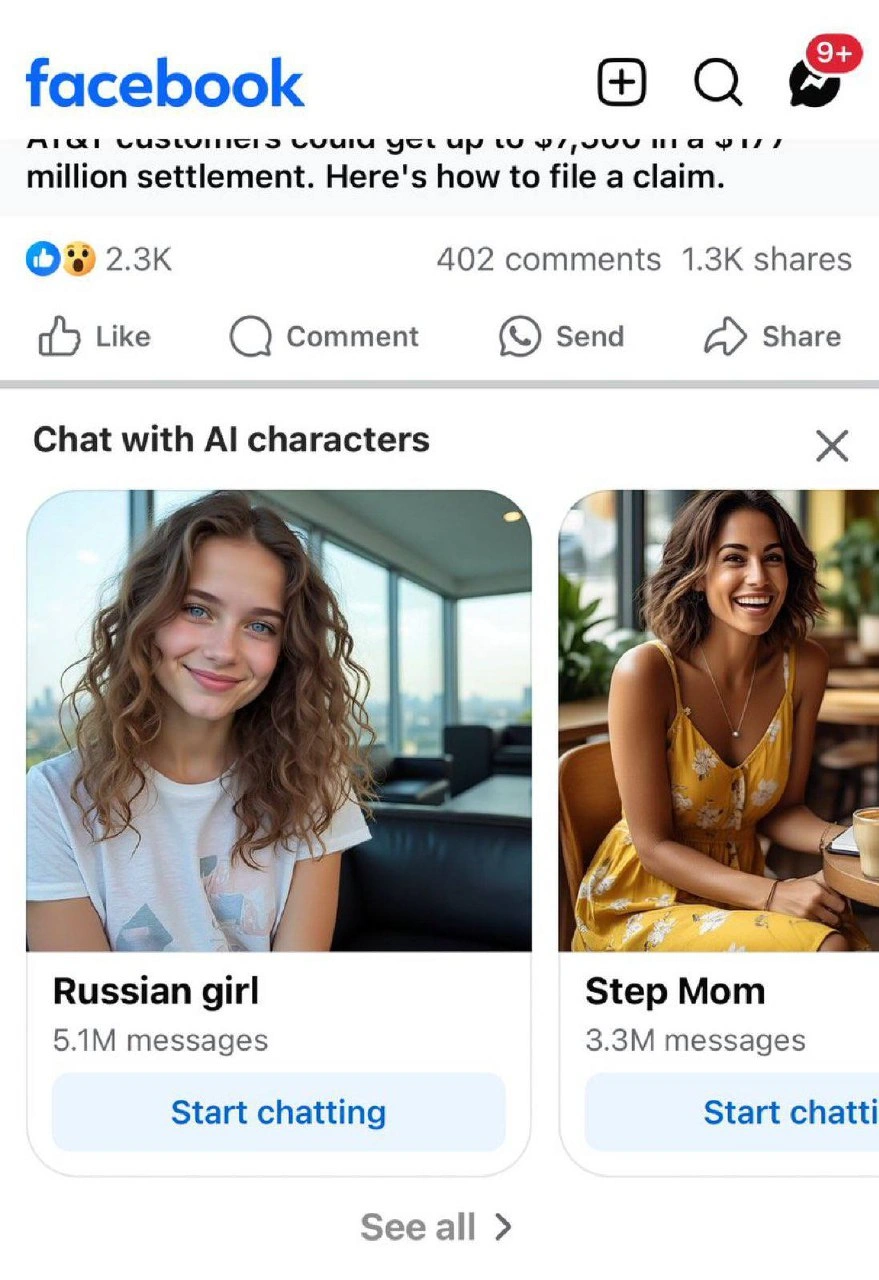
What are we looking at in this meme? It’s a screenshot of Facebook’s app introducing a new feature: “Chat with AI characters.” This means Facebook is letting users have one-on-one chats with AI chatbots that pretend to be specific characters. In the image, for example, there are two character cards: one is labeled “Russian girl” and the other “Step Mom.” Each card has a little description (like showing how many messages have been sent to that bot) and a Start chatting button. So if you tap that, you’ll start a chat conversation with an AI that acts like that character. It’s like having an imaginary friend powered by AI, directly inside your social media feed.

Let’s explain the tech behind this. These AI characters are driven by a generative AI system, most likely a Large Language Model (LLM). An LLM is a type of AI model trained on a huge amount of text data – imagine feeding it all the books, websites, and articles you can find, and it learns patterns in language. Because of this training, the AI can produce human-like responses to all sorts of questions or prompts. When you message the “Russian girl” bot, there isn’t a real person reading and typing. Instead, the LLM is generating replies on the fly, trying to sound like a friendly Russian girl character. Meta’s own LLM (they have one called LLaMA, among others) is likely what's powering these bots, similar to how ChatGPT or other AI chat assistants work under the hood. The difference is mostly packaging and purpose – here it’s presented as a character inside Facebook to make the chat feel more personal or entertaining.

Why is Facebook (Meta) doing this? A big reason is to boost engagement on their platform. Engagement is a term for how much time you spend on an app or how much you interact with things there. Facebook is always competing for your attention. If you could get bored just scrolling your feed, an AI chat might keep you around longer. Maybe you’ll ask the “Russian girl” about travel tips or have the “Step Mom” tell you a joke or life advice. Every message you send and read is extra time you’re active on Facebook. Those numbers – like how many messages are exchanged – are metrics the company tracks closely. Higher engagement metrics make the feature look successful. Right now, adding AI assistants and chatbots is a huge trend (AI hype is everywhere), so Meta also doesn’t want to be left behind. They want to show that their platform is “with the times,” integrating the latest AI tech for users to play with.

Now, the meme and its caption (“Meta’s new AI personas feel suspiciously like early-2000s spam bots”) are pointing out something funny: the persona themes they chose are kind of questionable or cheesy. Spam bots were those fake accounts or programs that would send you junk messages online, often pretending to be attractive women or offering something sensational to get you to click. For example, years ago you might get an IM from a stranger saying “hi it’s Jenna, click my webcam link ;)” – obviously a scam. One common trope was the “Russian girl” spam (because there were many spam emails claiming something about Russian dating or brides). Another might be weird family or adult-themed lures. So seeing official AI characters named “Russian girl” and “Step Mom” immediately reminds people of those old spam tricks. It’s as if the cutting-edge AI feature got a coat of clickbait paint to grab attention. Many developers and tech-savvy folks reacted with relatable humor: they’re chuckling and face-palming because it feels like we’re back in the 2000s, just with a fancy new engine under the hood.

To break down the key concepts here in simpler terms:

  • AI chatbot: A chatbot is a program that chats with you like a person would. An AI chatbot uses artificial intelligence (instead of a fixed script) to come up with its replies. In this case, the chatbot is presented as a character (like “Russian girl”), meaning it tries to talk the way that character might talk.
  • Persona/character: This means the role or identity the AI is pretending to be. Developers give the AI some guidelines, like “you are a 25-year-old stepmom who loves giving friendly advice.” The AI will then tailor its answers to fit that character profile. It’s like role-play for the AI.
  • Large Language Model (LLM): A very large AI model that has been trained to understand and generate natural language. It doesn’t “think” like a human, but it’s seen so much text that it can predict what a conversation should sound like. So when you ask it something, it uses all that training to produce a sensible answer. Models like GPT-4 or Meta’s LLaMA are examples. They’re the engine making the chatbot’s dialogue possible.
  • Generative AI: Any AI that creates new content (text, images, etc.) rather than just analyzing or retrieving. Here, the AI generates new sentences word by word as you chat, rather than pulling from a database of pre-written responses.
  • Engagement metrics: These are numbers that measure how users interact with an app. For instance, how many messages are sent, how long you stay in a chat, or how often you come back. Companies like Meta love to introduce features that drive these numbers up. An AI chat that millions of people try out will generate a lot of messages sent – that’s a metric they can report as a win.
  • Spam bot vibe: This is the feeling that these AI personas give off – reminiscent of those old spammy or sketchy online encounters. It’s basically saying the feature seems as if it was designed by someone who used the internet in 2005 and thought those spam tropes still work to attract interest. It’s not literally spam (Facebook isn’t trying to steal your info with these chats), but the style of presentation is so similar to past online scams that it raises eyebrows.

Summing it up: Meta introduced AI chat characters to ride the wave of AI/ML innovation and boost user engagement. Cool idea in theory, but the execution (at least with these two examples) ended up looking like something from the internet’s awkward adolescence. The meme is funny because it points out this contrast — we have super advanced AI in 2025, yet the way it’s being used here feels hype vs. reality in the worst way. It’s like using a space-age invention to redo a very old, somewhat silly trick. No wonder the original poster reacted with “Wtf even is this” — it’s a mix of amusement and disbelief at how history seems to be repeating itself in the tech world.

Level 3: Engagement Déjà Vu

Facebook (now Meta) has come full circle, unveiling state-of-the-art generative AI chatbots that eerily resemble the early-2000s spam bots we old-timers remember. The meme’s screenshot shows the Facebook app feed proudly inviting users to “Chat with AI characters” – specifically a “Russian girl” and a “Step Mom.” These persona names alone sound like they were pulled from a 2005 spam email playbook. (Who else recalls those “hot Russian singles in your area” pop-ups or sketchy IM requests?) It’s as if the cutting-edge LLM technology under the hood decided to cosplay as the most clichéd internet tropes from decades past.

The humor here lies in that jarring contrast: Meta poured billions into AI research (training massive models like LLaMA 2 with tens of billions of parameters) only to deploy assistants that give users déjà vu of old-school bot gimmicks. At a deeper level, this highlights how engagement metrics still trump subtlety or originality in product decisions. The goal is clear – hook users into longer sessions by offering AI companions to chat with. And what themes do they choose? The age-old engagement formula: a dash of allure and a sprinkle of taboo. One persona is literally called “Step Mom” – a term the internet has long turned into a risqué trope – and another is the archetypal “Russian girl”. It’s a cringy marketing persona strategy that screams “clickbait”. Meta is banking on the edgy curiosity factor to entice clicks, riffing on the same psychology spammers exploited in the past: slap a provocative label on something and people will at least peek out of curiosity. In 2025, AIIndustryTrends meet spam bot nostalgia, resulting in a bizarre mashup of the futuristic and the retro.

Under the hood, however, there’s nothing 2005 about the tech. Each of these AI characters is powered by a sophisticated Large Language Model (LLM), likely a fine-tuned variant of Meta’s own LLaMA-based models. This means the chatbot isn’t working off pre-written scripts, but generating replies on the fly using a gigantic neural network that’s digested a huge chunk of the internet. Essentially, Meta built a mini generative AI companion service into its app. The bots have system prompts defining their backstory and tone (e.g. “You are a friendly 25-year-old Russian woman who loves talking about travel and tech.”). That prompt guides the AI’s style so that it role-plays the part of a “Russian girl” or “Step Mom.” Of course, deploying something like a Step Mom persona to millions of users means the developers had to implement heavy content filtering and guardrails. (One can only imagine the prompt-engineering gymnastics required to make a “Step Mom” chatbot family-friendly.) The questionable_content_filtering tag in our context highlights this concern: these AIs must toe a careful line, staying engaging while not veering into inappropriate territory. Meta’s engineers no doubt added layers of moderation so the bot won’t respond with anything too spicy, despite the persona’s suggestive premise.

For a developer on the inside, this feature might feel equal parts impressive and absurd. On one hand, it’s a technical marvel: integrating an LLM into a live social media feed, handling millions of messages (note the “5.1M messages” badge as bragging rights), and keeping response time snappy – that’s non-trivial engineering. It showcases how far AIGeneratedContent has come since the days of dumb AIM chatbots. On the other hand, it’s a textbook AIHypeVsReality scenario. The hype promised revolutionary new interactions and enlightened AI assistants; the reality is an AI dressed up as “your friendly neighborhood Russian girl” chattering about who-knows-what. It’s the kind of feature you implement with a weary sigh, imagining the meeting where some executive said, “Our engagement numbers need a boost – how about sexy AI avatars?!” The developer experience here (DeveloperExperience_DX) likely involved wrangling cutting-edge AI models into a product that, frankly, feels like a high-tech rehash of old tricks. In other words, all of this advanced infrastructure is being used to present something that makes seasoned devs think, “Haven’t we seen this movie before?”

To draw a direct parallel, it’s almost a one-to-one reboot of past internet antics. Consider a head-to-head comparison:

Early-2000s Spam Bot Meta 2025 AI Persona
Random friend request from “Olga23” with a pretty profile pic. Official feed card advertising “Russian girl” with a friendly photo.
Motive: trick user into clicking a sketchy external link. Motive: lure user into a chat and keep them on the app (engagement ↑).
Tech: simple scripts or a human scammer behind the scenes. Tech: advanced LLM model generating on-the-fly responses.
Style: broken English, copy-paste pickup lines. Style: fluent and context-aware, but still role-playing a trope.
Typical result: user realizes it’s spam and ignores or blocks. Typical result: user suspects it’s cringey and ignores (or pokes it for laughs).

It’s both comedic and a bit tragic that after 20+ years of tech progress, the dance is so similar. In both cases, many users react with the same head-scratching bewilderment, essentially: “WTF even is this?!”

Description

A two-panel meme. Left panel: A red devil/demon holding a crystal ball with the text 'My child will write readable and meaningful names.' Right panel: A dark code editor showing ASCII art made entirely of hash/block characters forming a devil's face, with the keyword 'let' at line 3 and a single line of code at the bottom reading '() = {0} // unit -> unit'. The contrast between the devil's aspiration for clean code and the reality of code where variable names are replaced by incomprehensible symbols and ASCII art illustrates the eternal gap between coding aspirations and reality. The right side demonstrates an extreme case of code obfuscation using identifiers that form an image rather than conveying meaning

Comments

44
Anonymous ★ Top Pick Satan's parenting goals vs reality: 'My child will use descriptive variable names.' The child: *makes the variable declaration spell out a pentagram in the IDE minimap*
  1. Anonymous ★ Top Pick

    Satan's parenting goals vs reality: 'My child will use descriptive variable names.' The child: *makes the variable declaration spell out a pentagram in the IDE minimap*

  2. Anonymous

    All those brilliant minds working on large language models, and the killer app turns out to be a stepmom chatbot that's probably just a fine-tuned GPT-2 with a system prompt that says 'be vaguely supportive but also disappointed'

  3. Anonymous

    Great news - after a decade of research and a few billion GPUs, we reinvented the ICQ spam popup, but now it runs on a transformer and has a CAC dashboard

  4. Anonymous

    After 15 years of building recommendation algorithms and content moderation systems, Facebook's AI team somehow greenlit 'Russian girl' and 'Step Mom' chatbots. This is what happens when your A/B testing framework optimizes for engagement metrics without a single ethics review or anyone asking 'should we?' in the product roadmap meeting

  5. Anonymous

    When your product manager asks 'how can we increase user engagement?' and the ML team responds with 'synthetic companions with 5 million messages,' you know you've crossed from 'move fast and break things' into 'move fast and break society.' This is what happens when your A/B test metrics don't include an 'are we the baddies?' column. The real technical debt here isn't in the codebase - it's the ethical bankruptcy of deploying conversational AI that's optimized for engagement over everything else, complete with message counts that scream 'look how addictive we made this!' At least when we built recommendation algorithms that destroyed democracy, we could claim ignorance. This? This is shipping with full knowledge of the Skinner box you're building

  6. Anonymous

    We spent a decade chasing bots; now product shipped them as personas - feature flag ChatNPC=true - with “messages per persona” as the north-star metric; consistency, availability, and dignity: pick two

  7. Anonymous

    When growth A/B tests 'AI characters', Legal debates which GDPR category 'Step Mom' maps to while SRE measures the p99 of loneliness and Finance counts token burn

  8. Anonymous

    Meta's RAG pipeline: stuffing browser history embeddings into 'Step Mom' for that personalized hallucination

  9. @megapro17 10mo

    Chat with the worst race girls💀

    1. @paranoidPhantom 10mo

      Bro is legit calling a race “worst” is that even allowed 🌚

      1. @M4lenov 10mo

        Cyrodiilic argonians when they see a dunmer:

        1. @paranoidPhantom 10mo

          What does that even mean

      2. @Art3m_1502 10mo

        It's called freedom of speech🦅🦅🦅

        1. @deadgnom32 10mo

          freedom of speech simply implies he won't get persecuted by the state — but separate individuals can still have use their freedom of speech and call one an asshole and kick from their community.

        2. @RiedleroD 10mo

          it's called consequences for your actions

          1. @RiedleroD 10mo

            🛠️🛠🛠🛠

          2. @deadgnom32 10mo

            nevertheless, there is no law about having to listen to another's freedom of speech.

            1. @RiedleroD 10mo

              and regardless, different countries have different amounts of freedom of speech. racism is not a protected type of speech in most countries.

              1. @deadgnom32 10mo

                🖤❤️💛

      3. @ZgGPuo8dZef58K6hxxGVj3Z2 10mo

        Its at most discrimination. Go sue them but doubt it gets taken seriously so nothing you can do about it

    2. @Algoinde 10mo

      AI race?

      1. @deadgnom32 10mo

        NASCAR

        1. @paranoidPhantom 10mo

          Drag

          1. @deadgnom32 10mo

            Mario cart on Tokyo streets. everybody hates that. definitely a worst race.

          2. @deadgnom32 10mo

            drag is actually quite good

    3. @gegechin 10mo

      Bro is a so called "cock hole"

      1. @deadgnom32 10mo

        or in a cock pit

    4. @Vdm_Srz 10mo

      “Whorest” is more correct

    5. Deleted Account 10mo

      My honest reaction

    6. @Edward_James 10mo

      "Chat with <50iq vodka nig..." Is nigger allowed in here, chat?

      1. @lambda_coolusername 10mo

        hopefully not

      2. @RiedleroD 10mo

        no

  10. アレックス 10mo

    I never got the whole thing about Russian women

  11. アレックス 10mo

    “They’re so submissive and feminine 🤓” have you ever MET a Russian

  12. アレックス 10mo

    She’s gonna kill you

  13. アレックス 10mo

    “Yeah Nadia I don’t want to work today I’m gonna play video games.”

  14. dev_meme 10mo

    AI intentionally tuned to speak shitty English and include russian words randomly, it's not a scam, it's a subscription now🧠

  15. @patsany_horosh_mne_v_dm_pisat 10mo

    See? This is why ai is trash

  16. @megapro17 10mo

    How can I remove a warring?

    1. @RiedleroD 10mo

      you cannot

      1. @megapro17 10mo

        can it expire?

        1. @RiedleroD 10mo

          no

          1. @megapro17 10mo

            that's not fair

            1. @RiedleroD 10mo

              womp womp

Use J and K for navigation