Skip to content
DevMeme
3521 of 7435
Corporate Idealism vs. Reality
CorporateCulture Post #3857, on Oct 24, 2021 in TG

Corporate Idealism vs. Reality

Why is this CorporateCulture meme funny?

Level 1: That's the Neat Part

Imagine you’re a kid who really wants to help everyone in your town. You set up a lemonade stand, not to make money, but to give out free lemonade on a hot day so everyone can feel good. That’s like the coder wanting to make the world better. But now think of the kid’s parent, who paid for the lemons and cups. The parent comes over and says, “Hey, we can’t just give lemonade away for free. We need to sell it to cover our costs.” In this little story, the parent is like the company. The parent basically tells the kid, “I know you want to do something nice for the world, but we have to worry about making money to keep things running.” The kid feels disappointed because their big helpful idea is kind of shut down.

That’s exactly what the meme is showing: the coder is like the kid with a big dream to do good, and the company is like the parent saying “That’s the neat part – you don’t get to do that.” It’s a funny-but-sad joke. We smile because we understand the feeling: wanting to be a hero, but being told to be practical instead. In simple terms, the meme is poking fun at how grown-up work (especially at a company) often isn’t about being a superhero – it’s about doing what the boss needs, so the company can keep going. It’s like being told to do your homework instead of going out to save the world. The humor makes the hard truth a little easier to swallow.

Level 2: Welcome to Corporate

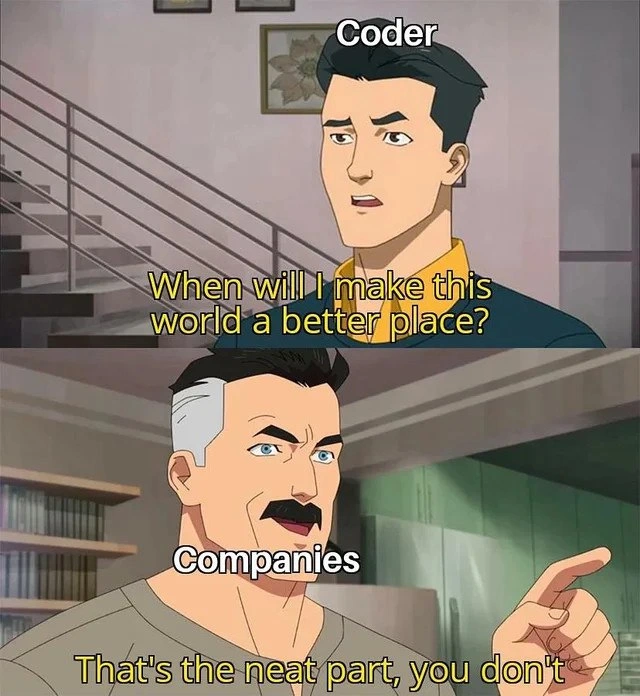
Think back to your first coding job or internship: you’re excited, thinking “I’m going to write code that matters!” This meme shows exactly what happens next in many cases. The top panel’s character, the Coder, represents a developer (often a newbie) brimming with idealism. He literally asks, “When will I make this world a better place?” – which is something a lot of us quietly wonder when we start working. We enter the tech industry believing our skills can improve lives, maybe because companies often talk about lofty missions during hiring. You know, those slogans like “making the world a better place through technology” that tech firms love to put on their about page.

Now, the bottom panel is the reality check. The dad figure labeled Companies (i.e., the corporation or the bosses) bluntly answers, “That’s the neat part, you don’t.” Oof! In plain terms, he’s saying the coder’s work isn’t going to have the grand, positive impact on the world that the coder hopes for. Why would he say that? Because in a corporate environment, the primary goal isn’t philanthropy or social overhaul – it’s making sure the business is profitable and survives. This is the essence of CorporateCulture in the meme: companies care about things like revenue, market share, and keeping investors happy.

Let’s break down some terms from the tags to make sense of the tension here:

  • StakeholderPressure: “Stakeholders” are people who have a stake (interest or investment) in the company – think big bosses, investors, shareholders, or major clients. They put pressure on the company (and thus on developers and managers) to meet certain goals. For example, a stakeholder might expect the product to gain X thousand new users this quarter or increase sales by Y%. This pressure often dictates what projects you work on. So if a coder’s cool idea for a charitable feature doesn’t align with those goals, it’s likely not going to get approved. It’s not necessarily because the company is “evil” – it’s because they have commitments and targets to hit to keep the business running. It’s WorkplaceReality: even if your company touts a heartwarming mission, day-to-day tasks are tied to business needs.

  • ManagementVsEngineering: This refers to the sometimes conflicting priorities between management (the people planning the business and strategy) and engineering (the developers building the product). Managers are often concerned with timelines, budgets, and customer or market demands. Engineers might be more concerned with code quality, innovation, or doing things that are technically interesting (or socially beneficial). In our meme, the coder is the engineering mindset – wanting to do something profound – and the “Companies” voice is management saying, “Nope, focus on the plan.” It’s a friendly exaggeration of how management might shoot down an engineer’s starry-eyed idea because it doesn’t fit the current strategy or it won’t make money. This dynamic is a common DeveloperFrustration: engineers sometimes feel like their creative or idealistic ideas are dismissed by management, while managers feel engineers can be unrealistic about business constraints.

Now, why is this funny to developers? Because it’s true enough to be recognizable. It’s WorkplaceHumor drawn from real encounters. Many developers have had that exact thought, “Am I really helping anyone with this code?” Especially if you’re working on something like an e-commerce site’s discount coupon system or an ad recommendation algorithm, it can feel far from “making the world better.” The meme puts that feeling into a simple Q&A format. The joke is basically: New coder has heroic aspirations; experienced company says the only heroics here are meeting our quarterly goals.

Another way to look at it: The coder in the meme might remind you of yourself (or a colleague) when you first contributed to a serious project. Perhaps at a hackathon or in college, you built an app to help people (like a charity fundraiser site or a health tracker). Then you join a big company, and instead of curing cancer with code, you’re asked to implement a “Refer-a-Friend” button on a shopping app. It’s a bit disheartening! The meme’s yellow subtitle text (“When will I make this world a better place?” / “That’s the neat part, you don’t.”) captures that disillusionment in a snappy, humorous way.

The Invincible meme format is popular because it shows a strong authority figure lecturing a younger idealist, which fits perfectly here. The father’s pointing finger and serious expression amplify how blunt the statement is. It’s like your boss or CEO telling you with a smile that your grand vision isn’t on the agenda. It resonates with DeveloperCulture because tech folks often joke about this contrast — for example, the classic cynicism of “We wanted to change the world, but all we got was this onboarding to the ad tech team.” We laugh, sometimes a bit sadly, because we recognize the truth in it.

To put it simply: the meme is saying “You thought your coding job would let you be a hero? Surprise! The company just wants you to code what they need for business.” It’s not that code never makes a difference; it’s that in a corporate setting, especially early in your career, you rarely get to decide the purpose of what you build. The company sets the purpose. And usually that purpose is tied to making money or beating competitors, not directly saving the world.

Seeing this spelled out in a meme is funny because it’s so blunt. Real managers might not outright say “you’re not making the world better”, but they often redirect idealistic proposals with comments like “Interesting idea, but how does it align with our OKRs (Objectives and Key Results)?” or “What’s the business value here?”. The meme cuts through that corporate speak with a simple “you don’t” – it’s the truth behind those polite rejections. And developers share it around because it’s a way of bonding over that shared reality. It’s like saying, “Yep, been there. Welcome to corporate life, my friend.”

Level 3: Profit Over Purpose

In this Invincible meme format, a bright-eyed Coder asks, “When will I make this world a better place?” The father figure labeled Companies (or "Corporates") responds with a crushing truth: “That’s the neat part, you don’t.” This punchline hits home for anyone steeped in CorporateCulture and DeveloperHumor. It satirizes the clash between developer idealism and corporate cynicism.

Every seasoned developer has seen this movie before. A new engineer joins a company brimming with altruism and grand ideas to improve lives with code. The company, however, is laser-focused on KPIs (Key Performance Indicators), revenue targets, and making the quarterly numbers. The meme humorously captures that moment when WorkplaceReality sets in and StakeholderPressure douses the coder’s heroic ambitions. It’s a classic case of ManagementVsEngineering priorities: management cares about ROI (Return on Investment) and market share, while the engineer dreamed of changing the world one commit at a time. This stark contrast is exactly why developers smirk (and maybe cringe) at the meme – it’s painfully relatable DeveloperCulture commentary.

The Invincible scene is the perfect backdrop. Omni-Man (the father) is an unbeatable, intimidating figure – here representing the Companies that control resources and call the shots. The coder, like Omni-Man’s idealistic son, gets a harsh lesson: in the corporate world, code is usually a means to an end (profit), not an end in itself (social good). The father’s line “That’s the neat part, you don’t” is a darkly funny answer to “When will my work have grand meaning?” – essentially, “It won’t, because that’s not what we’re paying you for.” WorkplaceHumor often thrives on exaggeration, but for many devs this hits close to reality. Companies love to market themselves as world-changing (how many startups claim they will “disrupt and improve everyday life”?), yet the average developer might end up optimizing ad click-through rates or tweaking a shopping cart UI. Making the world a better place becomes an ironic catchphrase when your day-to-day tasks feel trivial or purely profit-driven.

This meme cleverly highlights the unspoken truth in tech jobs: even if a company’s mission statement trumpets making the world better, its immediate focus is typically on business outcomes. It’s a bit of a DeveloperFrustration anthem. The humor is a coping mechanism – laughing at the disillusionment that many coders experience when they realize they’ve become a tiny cog in a big money-making machine. CorporateCulture often turns lofty promises into maximize shareholder value “deliver customer value” initiatives. In other words, the code you write usually serves the company’s strategy first, and society’s benefit… well, that’s a hopeful side effect at best.

To an experienced dev, the meme is almost like a rite-of-passage joke. We’ve all been that naïve coder at some point, enthusiastically asking when our heroic coding quest begins, only to be pointed toward the Jira backlog of banal tasks. The laughter (or groan) it evokes comes from recognizing a universal scenario in tech workplaces: the coder vs. corporate tug-of-war. It’s not that software can’t improve the world – it certainly can – but in a big company, any world-improvement project usually needs to align with a business case. Like Omni-Man’s blunt lesson to his son, the corporate viewpoint often feels invincible and inevitable. The meme format lets us momentarily step back and chuckle at this harsh mentorship.

In essence, the joke lands because it condenses a complex workplace dynamic into a one-two punch dialogue. It’s sarcastic and a bit dark (hallmarks of a battle-scarred CynicalVeteran outlook). The father’s retort, “you don’t,” is both absurd and truthful – absurd because no one would actually say it so blatantly, truthful because it reflects what many developers eventually sense. This hits on the collective memory of countless stand-up meetings and executive all-hands where someone asks “are we really helping people with this feature?” and gets silence or a marketing spin in response. DeveloperHumor often blooms from these shared ironies: we all know that feel when the code we hoped would “make a difference” ends up making a deliverable for EOY Q4 instead. The meme’s popularity in programming circles shows that this coder vs corporate theme is a common experience that engineers bond over – laughing so we don’t cry, as the saying goes.

Let’s translate the meme’s message into pseudo-code for the techies:

def make_world_a_better_place(coder):
    try:
        coder.build(innovative_solution_for_good)
    except CorporateException as e:
        # Caught an exception: feature not in roadmap
        coder.assign(task="Increase quarterly earnings")
        log("World improvement deferred: no ROI this sprint")

In this exaggerated snippet, whenever the coder tries to execute their noble plan, a CorporateException interrupts, redirecting them to a profit-driven task. It’s a tongue-in-cheek way to show that developer idealism often gets handled (or rather, silenced) by corporate priorities. The comment # feature not in roadmap echoes the StakeholderPressure that filters out projects without immediate business value. It’s humorous because it’s true enough: unless “innovative_solution_for_good” can justify itself to the higher-ups, it’s likely to be shelved in favor of something that moves the needle on sales or user engagement.

Ultimately, this meme distills a core tension in tech careers. On one side, programmers often start with a mission-driven mindset (build great software, solve real problems, leave the codebase a little cleaner – maybe even change the world). On the other side, corporations have a profit-driven mandate (survive competition, grow revenue, satisfy investors). When these collide, the idealist coder might feel like a superhero being told the real battle isn’t saving the world, but saving the company’s bottom line. The Invincible reference adds an extra wink: even superheroes in fiction face disillusionment, so why should coders be any different? The seasoned engineers chuckle because they’ve lived this story. They know that making the world better with code is possible – just not on that strict deadline, and not unless someone figures out how to monetize it first.

Description

This is a two-panel meme from the animated series 'Invincible.' In the top panel, the character Mark Grayson is labeled 'Coder' and asks with a hopeful expression, 'When will I make this world a better place?'. The bottom panel features the character Omni-Man, labeled 'Companies,' who cynically replies, 'That's the neat part, you don't'. The meme captures the common disillusionment experienced by software developers who enter the industry with idealistic goals of creating meaningful, world-changing technology. It contrasts this ambition with the often mundane or purely profit-driven reality of corporate work, where the primary objective is shareholder value rather than societal benefit. This resonates with experienced engineers who have seen company mission statements about 'making the world a better place' translate into projects like optimizing ad-clicks or building internal dashboards
Comments

8
Anonymous ★ Top Pick Our company's mission is to revolutionize the world. My current ticket is to change the color of a button to a slightly different shade of blue. We're getting there
  1. Anonymous ★ Top Pick

    Our company's mission is to revolutionize the world. My current ticket is to change the color of a button to a slightly different shade of blue. We're getting there

  2. Anonymous

    Twenty years in, I’ve learned that at most companies “make the world a better place” decompiles to one line: UPDATE customers SET engagement_score = engagement_score + 1 WHERE ad_clicks > 0; - ship it

  3. Anonymous

    After 15 years of optimizing database queries and reducing latency by microseconds, you realize the biggest impact you've made is helping users doom-scroll 0.3% more efficiently while your company's ESG report sits unopened in the investor relations PDF graveyard

  4. Anonymous

    Every developer starts their career wanting to build the next platform that changes humanity - until they spend three sprints optimizing ad click-through rates and realize 'making the world better' was just the recruiting pitch. The real mission statement is always in the quarterly earnings call, not the company values page

  5. Anonymous

    From 'disrupt the world' pitch to 'disrupt the monolith' - priorities realigned by sprint zero

  6. Anonymous

    After 20 years I finally found the feature flag for “make the world better” - it’s owned by Finance and stuck at 0% rollout

  7. Anonymous

    Dev: When will my code make the world better? Company: When “world” becomes a KPI on the OKR dashboard - until then, move DAU and call it impact

  8. @zherud 4y

    You won't*

Use J and K for navigation