Skip to content
DevMeme
6322 of 7435
The Strategic Importance of an AI Researcher's Job Change
AI ML Post #6933, on Jul 2, 2025 in TG

The Strategic Importance of an AI Researcher's Job Change

Why is this AI ML meme funny?

Level 1: Losing Your Star Player

Imagine you’re on a soccer team, and your very best player – the one who scores all the goals and helped create your winning playbook – suddenly gets hired by a rival team because they offered a lot of money and a chance to win the big championship. One day, your coach leans in and whispers to the team captain, “We just lost Alex, our star striker, to the team across town.” The captain’s face falls, looking as if the sky is falling.

Now picture that star player announcing on social media, “Excited to join our rivals! The championship trophy is now within reach 🚀.” That’s essentially what this meme is about, but in the world of high-tech AI research instead of sports. The boss is like the coach hearing the bad news, and the researcher is like the star player switching teams. It’s funny in a cheeky way because the reaction is so dramatic – the boss looks as though a huge crisis hit, all over one person leaving. And the person leaving is jubilantly proclaiming that now they’ll achieve something incredible (like winning the championship, or in this case building a super-smart computer).

The humor comes from how relatable this feeling is: if your best teammate or friend suddenly goes to a rival group, you’d feel worried or even betrayed, and the rival would be boasting about their great new addition. It’s a mix of panic on one side and celebration on the other. We laugh because we see this in everyday life – from sports to school competitions – not just in companies. In simple terms, the meme is showing a “oh no!” moment for one team and a “hooray!” moment for the other, all because a key person switched sides. The rocket ship emoji in the tweet just makes the boasting a bit cartoonish, like saying “we’re going to the moon with this!” It’s a playful way to poke fun at how losing or gaining one star player (or researcher) can cause such an emotional rollercoaster.

Level 2: AI Rivalry 101

At its core, this meme is about a big rivalry in the AI world and the drama when a valuable person switches sides. Imagine two top tech labs, one being OpenAI (famous for things like ChatGPT) and another being Meta’s AI lab (Meta is the company behind Facebook, and they also work on cutting-edge AI). Both are racing to create extremely advanced AI – sometimes people talk about an ultimate “superintelligence” (an AI much smarter than humans). In this race, having the best experts is a huge advantage, kind of like needing star players on a sports team.

Now, Trapit Bansal (the person named in the meme) is portrayed as one of those star experts in a field called reinforcement learning (RL). RL is a type of machine learning where an AI learns by trial and error, getting rewards for good decisions – similar to how you might train a pet with treats for good behavior. It’s a big deal in AI because it’s how we taught AIs to play games like Go, Dota, or solve complex tasks by themselves. Trapit is said to have started an “O series and RL paradigm with Ilya Sutskever.” That hints he worked closely with Ilya Sutskever, who is a real and very famous AI researcher (one of the brains behind many AI breakthroughs and a co-founder of OpenAI). The “O series” isn’t a widely known term publicly; it sounds like an inside nickname (perhaps for a series of AI models or projects at OpenAI – maybe a playful nod to beating DeepMind’s famous Alpha series of AIs, with “O” possibly standing for OpenAI or a last letter like Omega). The key point for a newcomer: Trapit was important in building some advanced AI stuff at OpenAI alongside one of the top minds in the field.

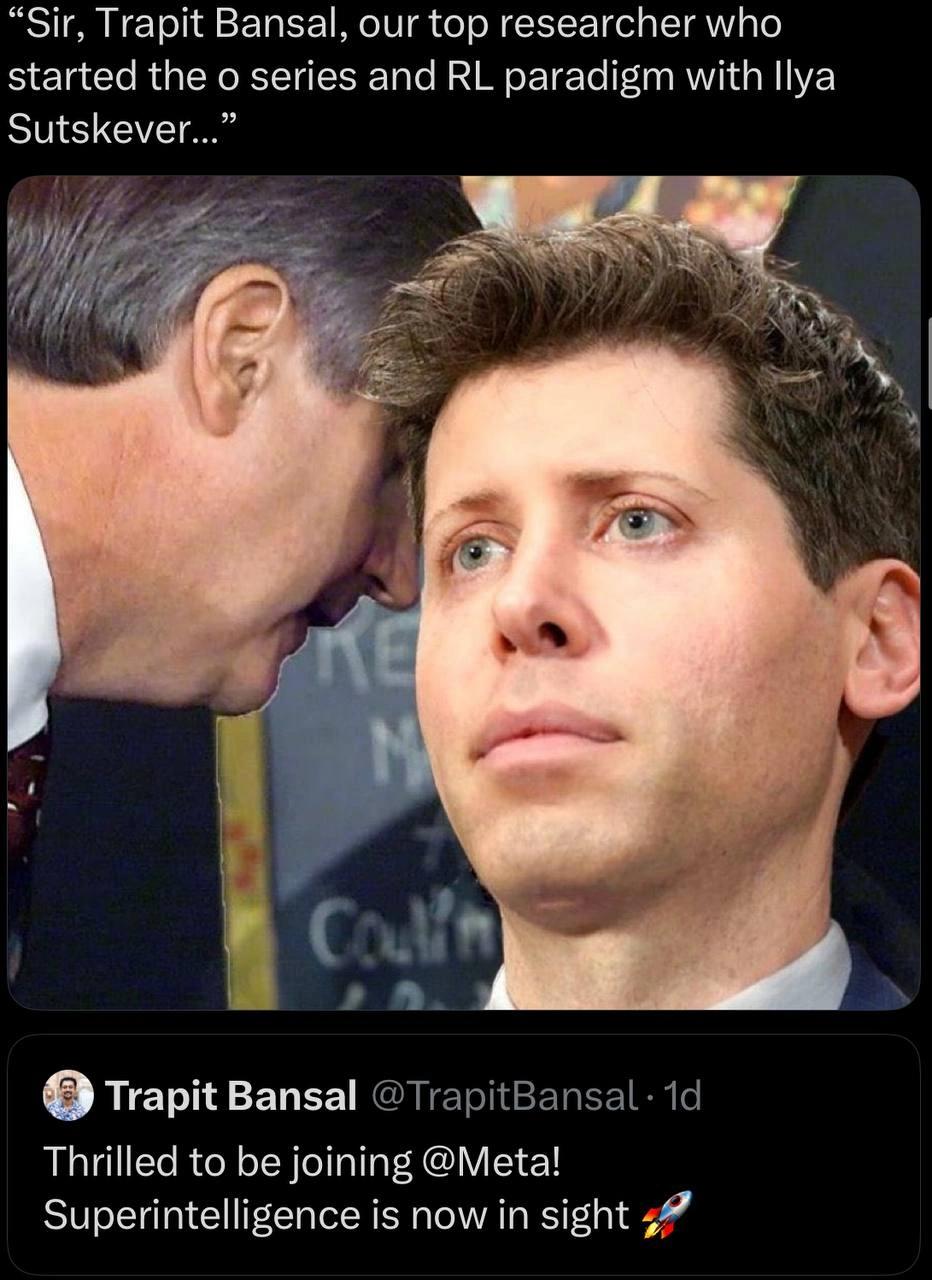
The meme shows an older executive whispering very urgently to a younger man in a suit. For context, that younger man is Sam Altman (OpenAI’s CEO), and the whisper likely goes: “Sir, bad news: Trapit Bansal, our top researcher… has left us.” The urgency and the look on Sam’s face (wide-eyed concern) tell you this is bad news for their team. Why so dramatic? Because it means their rival (Meta) just snagged someone who could help them leap ahead in developing powerful AI. This concept is known as talent poaching — when a company recruits a prized employee from a competitor, like stealing a star player from another team by offering a better deal.

The bottom part of the meme is a screenshot of Trapit Bansal’s tweet announcing his move: “Thrilled to be joining @Meta! Superintelligence is now in sight 🚀”. Breaking this down:

  • He’s announcing he’s joining Meta, the rival company’s AI group.
  • He expresses big excitement (thrilled, with a rocket emoji for emphasis).
  • He claims “superintelligence is now in sight”, implying that with this move, achieving a super-smart AI is closer than ever.

For someone newer to tech, that tweet might sound a bit boastful or overly optimistic. In the AI community, people often joke about claims like “we’re close to AGI (Artificial General Intelligence)” because it’s a very ambitious claim – we’ve been making progress, but a true superintelligent AI is still a huge leap away and somewhat speculative. So, seeing a researcher say that just because he’s changing jobs is humorously exaggerated. It’s like a sports player saying “championship is now guaranteed” because they joined a new team – a mix of excitement and hype.

This situation gets a laugh (especially from those in tech or corporate jobs) because it’s relatable and absurd at the same time. Career humor aspect: if you’ve ever been at a company where a key team member leaves, you know managers can freak out. Here it’s blown up to epic proportions: it’s not just any employee, it’s a leading AI researcher, and the stakes aren’t just a project deadline but the race for world-leading AI. Also, corporate humor comes from that whisper image – usually such an image might be used for a dire secret (“the stock is crashing” or “we’re being sued”), but here it’s “our employee left for a competitor,” which in this context feels equally dire to them.

To summarize in simple terms: This meme is joking that OpenAI’s boss just found out one of his best AI researchers left to join Meta, and he’s panicking because that researcher was a big part of OpenAI’s success (especially in RL, a key AI technique). The researcher’s public tweet about joining Meta is full of excitement and even suggests this move will help achieve a major AI breakthrough (that’s the 🚀 hype). It’s funny because it combines the seriousness of corporate competition with a bit of over-the-top AI hype. Even if you don’t know all the names, you can relate it to any scenario of one giant company stealing talent from another and claiming it’s a huge victory.

Level 3: Talent Poaching Panic

This meme captures a scenario tech insiders know all too well: a high-stakes AI talent war playing out like a corporate thriller. The top panel’s image (an anxious executive whispering urgent news to a stunned-looking younger man) sets the stage — it’s basically the “Sir, we have a situation” moment. The caption spells out the drama: “Sir, Trapit Bansal, our top researcher who started the O series and RL paradigm with Ilya Sutskever…”. You can almost fill in the rest: “…has accepted an offer from Meta.” The younger man being whispered to is widely recognized as Sam Altman (OpenAI’s CEO), and the news hitting him is that one of his key reinforcement learning experts just defected to a rival. It’s the AI lab equivalent of hearing your star player signed with the competing team. No wonder he looks shell-shocked — this is talent poaching panic in action.

The bottom panel confirms it with a tweet from @TrapitBansal: “Thrilled to be joining @Meta! Superintelligence is now in sight 🚀”. This is a cheeky portrayal of the real-world phenomenon where top researchers announce their big moves on Twitter, often with a dose of AI hype. The 🚀 rocket emoji and the claim “Superintelligence is now in sight” exaggerate the excitement (and perhaps hubris) that can accompany these announcements. It satirizes how every big hire is spun as a game-changer in the frontier-model race. Industry veterans chuckle here because they’ve seen similar storylines: one company’s loss is another’s triumphant press release. It’s corporate humor blended with AI insider knowledge — the tweet language is exactly the kind of optimistic PR-speak that makes seasoned engineers roll their eyes and say, “Here we go again with the ‘now we’ll achieve AGI’ fanfare.”

What makes this funny (and a bit painful) for those in tech is the exaggerated importance placed on individuals due to the AI hype cycle. In fast-moving AI research, certain people are seen as rock stars. When one of them leaves, especially from a place like OpenAI (where Ilya Sutskever himself is a legend), it triggers alarm bells. There’s a shared understanding of the “researcher brain drain” issue: if too many visionaries flock to one side (Meta, in this case), the other side fears falling behind. The meme strikes a chord because it satirizes the all-too-real meetings and Slack messages that happen behind closed doors: “How did we let him slip? Could we have counter-offered more? What does he know that we don’t?!” It’s common in Career/HR circles to treat such departures as existential crises, especially in fields like AI where the next breakthrough (or catastrophe) feels imminent.

From a senior developer or researcher’s perspective, this scenario has layers of irony. On one hand, it’s rational: talent poaching is a tried-and-true strategy in tech. Companies like Meta and Google famously have massive budgets for hiring AI PhDs — they’ve optimized their recruiting pipelines much like their models, scanning for the best and snagging them with huge salaries, equity, or promises of unlimited compute power. Losing a top performer can set back projects, delay product launches, or even cause investors to worry. So the panic in the meme isn’t far-fetched; it mirrors reality (there are tales of entire research directions stalling because a key person left).

On the other hand, there’s dark humor in how dramatic it all is. The whispering executive treating this like classified intel, and Sam Altman’s haunted stare, exaggerate what is basically a job change. It pokes fun at the superintelligence arms race mentality: the idea that “whoever has the best team will create God-like AI first.” In such an atmosphere, even a single defection is viewed like losing a critical chess piece. Seasoned folks recall parallels in tech history — like the 1990s battles for PC OS talent, or how Google’s recruitment of Geoff Hinton or OpenAI luring Andrej Karpathy were seen as strategic coups. There’s even a Cold War echo: it’s akin to how superpowers felt when a nuclear scientist defected. This parallel isn’t lost on the intended audience, and it adds a layer of wit: today’s “arms race” isn’t about missiles, but about mathematicians and ML algorithms.

The text of the meme itself name-drops Ilya Sutskever (co-founder and chief scientist of OpenAI), signaling to those in the know that Trapit was instrumental to OpenAI’s work (the mysterious “O series” hints at some internal project or model family). So losing him to Meta isn’t just any turnover — it’s like the lineage of OpenAI’s RL research being handed to a top competitor. That’s both the cause of the (overstated) panic and the punchline: even the whisperer’s phrasing (“our top researcher who started the O series and RL paradigm with Ilya…”) reads like a formal HR report of credentials, emphasizing how important this person is. It’s over-the-top in a way that makes tech folks smirk: we’ve all heard managers talk in reverent tones about “key players” just like that.

Ultimately, the meme lands because it’s AI industry humor reflecting real trends: cutthroat competition between labs like OpenAI and Meta, the almost fanatical chase for LLM and RL talent, and the sensationalism that every new hire might bring “superintelligence in sight.” The experienced reader nods knowingly because, yes, this is exactly the kind of internally freak-out, externally tweet optimism dichotomy that defines today’s AI gold rush.

Level 4: Offer Gradient Descent

In this meme’s universe, even HR seems to be doing math with partial derivatives. The phrase “slips through an offer-optimization gradient” wittily recasts a cutthroat hiring move as a gradient descent process. In machine learning, gradient descent is the iterative algorithm that nudges model parameters in the direction that reduces error — here, Meta is tweaking a job offer in the direction that maximizes acceptance. It’s as if Meta’s HR performed gradient steps on salary, research freedom, and perks until the loss function (losing the candidate) hit near-zero. The reinforcement learning twist makes it richer: think of the star researcher as an RL agent whose reward function is a mix of career growth and impact. Meta discovered a higher reward state and backpropagated that knowledge into a better offer, leading the agent (the researcher) to update his policy — i.e., jump ship.

This isn’t far-fetched as a metaphor. In multi-agent reinforcement learning, agents adapt to each other’s strategies. Here, two agents (companies) are competing in the environment of the AI talent market, adjusting their actions (compensation, projects, prestige) to maximize a reward (having top talent). The result is an emergent Nash equilibrium of astronomical offers for AI superstars. The meme humorously implies Meta found a winning policy by hill-climbing the compensation landscape just enough to cross the competitor’s value function threshold. One might say the researcher’s loyalty had a non-convex reward surface — and Meta found a higher local optimum.

We can even liken this to a transfer learning hack. Instead of training a super-intelligent model from scratch, Meta is acquiring pre-trained weights: the knowledge and experience residing in Trapit Bansal’s brain. It’s reminiscent of big labs absorbing talent to accelerate progress, much like models distill knowledge from each other. The “o series” mentioned is likely referencing some internal lineage of models or research (perhaps a play on OpenAI’s projects to rival DeepMind’s Alpha-series). If Trapit co-initiated that with Ilya Sutskever, those contributions are high-value model weights indeed. By hiring him, Meta essentially performs a one-step parameters update on its research “model,” injecting fresh weights to push closer to the coveted superintelligence. In theory-speak, it’s optimizing the intelligence function via an abrupt parameter jump rather than slow gradient steps — a kind of stochastic jump in the weight space of innovation.

To an academic, there’s also a whiff of the exploration-exploitation trade-off. OpenAI exploited Trapit’s expertise for the “o series” and RL breakthroughs; Meta decided to explore a new move by bringing him in, gambling on greater long-term reward (the 🚀 “Superintelligence in sight” boast). It’s like Meta executed a bold policy action expecting a big future reward: if Trapit’s work accelerates Meta’s AI, the payout could be dominance in the superintelligence arms race. Under the hood, this arms race is constrained by fundamental resources (compute, data, talent) much like how theoretical limits (like compute scaling laws or algorithmic complexity) cap any one lab’s progress. The humor is that even though AI is fueled by cutting-edge math and compute, at the end of the day human brains are a critical parameter — and optimizing for those is an equally complex game.

# Pseudo-code: Competitor optimizes a job offer using gradient ascent
offer = initial_offer(package="standard")  
learning_rate = 5000  # step size in dollars or perks

while not candidate.accept(offer):
    # Calculate "gradient": what does the candidate value more?
    grad = candidate.preference_gradient()  # e.g., more salary, more research freedom
    offer += learning_rate * grad  # adjust offer in the direction of candidate's preferences
    if offer.too_high():
        break  # maybe out of budget (a local optimum we can't exceed)
# If we've broken out, either candidate accepted or we've hit our limit.
print("Final offer:", offer)

Above: A tongue-in-cheek “algorithm” for how Meta might have converged on the perfect offer. It’s essentially gradient ascent on the candidate’s happiness landscape. In reality, of course, negotiating an offer isn’t so nicely differentiable – but the joke lands because AI folks see everything as an optimization problem, even hiring. The meme takes a jab at how aggressively optimized these competitive offers have become. It’s a reminder that behind lofty AI equations (like Q-learning updates or policy gradients) there are human decisions, egos, and good old negotiation tactics – all now couched in the dramatic terms of an AI endgame.

Description

This is a two-part meme. The top portion features the 'President Whispering to Man' or 'Ron Baron and Elon Musk' meme format, where an older man in a suit whispers intently into the ear of a younger man who has a stoic, slightly bewildered expression. An overlaid caption reads, '"Sir, Trapit Bansal, our top researcher who started the o series and RL paradigm with Ilya Sutskever..."'. The bottom part of the image is a screenshot of a tweet from user Trapit Bansal (@TrapitBansal), posted '1d' ago. The tweet announces, 'Thrilled to be joining @Meta! Superintelligence is now in sight 🚀'. The meme satirizes the intense and often dramatic world of AI talent acquisition in big tech. It juxtaposes the gravitas of a secret, high-level briefing with the public, hype-filled pronouncements common in the AI industry. The mention of real AI figures like Ilya Sutskever grounds the joke in the current, highly competitive landscape, making it a sharp commentary on how strategic hires are perceived as pivotal moments in the race for Artificial General Intelligence (AGI)
Comments

10
Anonymous ★ Top Pick In the world of AI, changing your employer on LinkedIn is now considered a significant step towards achieving AGI. The roadmap is just a series of job offer letters
  1. Anonymous ★ Top Pick

    In the world of AI, changing your employer on LinkedIn is now considered a significant step towards achieving AGI. The roadmap is just a series of job offer letters

  2. Anonymous

    Forget RLHF - the hottest objective function in 2024 is Maximize (RSU ÷ Non-compete)

  3. Anonymous

    Nothing says 'superintelligence is near' quite like watching your top RL researchers optimize their compensation packages at Meta while your production models still hallucinate basic facts and your context windows struggle with a moderately sized codebase

  4. Anonymous

    When your top researcher who helped pioneer the breakthrough 'o' series models and worked alongside Ilya Sutskever announces they're joining Meta for 'superintelligence,' it's the AI equivalent of watching a Michelin-star chef announce they're opening a food truck - technically still cooking, but the existential questions about the menu are unavoidable. The uncomfortable truth: in tech, 'superintelligence is now in sight' often translates to 'the compensation package was definitely in sight.'

  5. Anonymous

    Ilya's star RL pupil bolts to Meta - proof that the ultimate reward function is a fat RSU package

  6. Anonymous

    Amdahl’s law of AGI: add one superstar and the capability curve barely moves - the only thing scaling superlinearly is the press release

  7. Anonymous

    In enterprise AI, “superintelligence is now in sight” usually means one senior hire, a fresh OKR, and the roadmap quietly sliding two quarters to the right under “emergent paradigm.”

  8. Max 1y

    We need fusion power first

  9. @SamsonovAnton 1y

    Iran is weeks away from enriching its intelligence enough to gain superintelligence level

    1. @ashit_axar 1y

      Netanyahu is like: common Iran, the world is watching us, be quick, i don't have time my whole life. Iran: Ok ok, i will work. Just one more change and it will be ready...

Use J and K for navigation