Linus Torvalds Defines 'Vibe Coding' for Bill Gates
Why is this DevCommunities meme funny?
Level 1: Fun First, Work Later
Imagine you have a big school project due, but instead of doing it step by step like the teacher told you, you decide to have a little fun with it. You turn on your favorite music, pull out all your colorful pens, and start doodling and decorating the project pages for hours. 😄 You’re having a great time – you’re in your zone, maybe humming along to tunes and adding glitter and stickers – but here’s the thing: you haven’t actually finished much of the real assignment yet. It’s taking a lot longer to get to the actual important parts because you got carried away with making it look cool and just enjoying yourself. In the end, your project might look sparkly and you definitely had fun, but you’re kind of behind on actually solving the problems or writing the report.
This meme is laughing about that same idea, but with computer programming. “Vibe coding” is like when programmers code in a just-for-fun way, not the most efficient or quickest way. It’s like saying, “I was coding, but mostly I was just vibing” – which really means I was doing it because it felt good, not because I was trying to be super productive. So when someone asks in the meme, “What does VIBE stand for?” the funny answer given is “Very Inefficient But Entertaining.” In super simple terms, that means “It’s not a smart fast way to work, but it sure is fun!” Everyone finds it funny because it’s true – sometimes we all choose doing things the fun way over the fastest way, and we can laugh at ourselves for it. It’s like if your parent asked why your homework is taking so long and you jokingly answered, “Because I’m doing it Very Inefficiently But it’s Entertaining!” They’d probably give you that look, but you’re just being honest: you’re enjoying the process, even if you’re not getting it done quickly. That’s the whole joke – having a good time, even if it’s not the best for getting results fast, is something we all do once in a while. And hey, sometimes those are the moments we remember and enjoy the most!
Level 2: Entertainment Over Efficiency
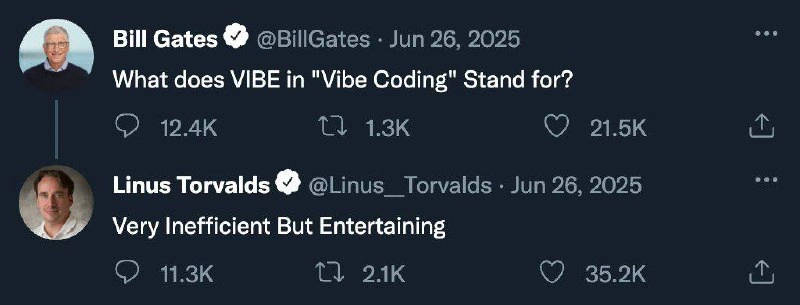
Let’s break down what’s going on in this meme. We have a screenshot styled like Twitter (in the beloved dark mode UI that so many devs prefer) with two tweets stacked as a conversation. In the first tweet, the user shown as Bill Gates (yes, the co-founder of Microsoft, though this is just a parody account in the meme) asks: “What does VIBE in ‘Vibe Coding’ stand for?” He’s essentially saying, “Hey, I see people talking about this ‘vibe coding’ thing – is ‘VIBE’ an acronym for something?” The second tweet is a reply from Linus Torvalds (the creator of Linux and Git, known in real life for having a bit of a sharp tongue online). Linus responds with the phrase “Very Inefficient But Entertaining.” If you take the first letter of each of those words – V, I, B, E – you get “VIBE.” So he’s humorously pretending that the word vibe is actually made of these four words. This kind of answer is called a backronym – where you take an existing word (“vibe”) and create a joking phrase to fit the letters. Here it labels vibe coding as very inefficient but entertaining. In plain terms, he’s saying vibe coding means it’s not efficient at all, but it sure is fun.
Why is this funny to developers? Well, “vibe coding” isn’t a strict technical term; it’s more of a slang in DevCommunities for when programmers code in a relaxed, feel-good way rather than a highly focused, goal-driven way. Picture a programmer late at night, headphones on, playing some chill music (often those popular “lo-fi beats to code to” playlists), maybe dim lighting – basically coding for the vibe of it. They might not be following a to-do list or an agile sprint plan; instead, they’re tinkering with whatever interests them, maybe refactoring some code, trying out a new tool, or building a quirky feature idea that popped into their head. It’s coding that’s driven by mood and curiosity more than by efficiency or an immediate need. In terms of DeveloperLifestyle, vibe coding is those feel-good coding sessions we sometimes indulge in, especially outside normal work hours, to remind ourselves that coding can be fun and not just about deadlines.
Now, each word in Linus’s answer carries meaning:
- Very Inefficient: If something is inefficient, it means it uses a lot more time or resources than necessary to get a result. So Linus is joking that vibe coding wastes time or isn’t the fastest way to build something. A lot of effort might be spent for little practical output, like writing code that doesn’t end up in the final product or just polishing something trivial for hours. In software terms, think of efficiency as getting things done with as little waste as possible – vibe coding is the opposite; it’s knowingly taking the scenic, slow route.
- But Entertaining: Entertaining means it’s enjoyable or fun. Even though it’s inefficient, developers find it enjoyable. Those late night coding jams can be a blast. You’re not crunching on a stressful bug or cranking out required features; you’re exploring and playing with the code. It’s like a form of coding relaxation or creative expression. So the phrase admits: we know this isn’t the best use of time productivity-wise, but hey, we’re having a good time and that counts for something in terms of personal satisfaction or team morale.
The context here is also part of the humor. Bill Gates asking the question sets up a scenario: Bill is famously a very results-oriented business person (Microsoft didn’t become a giant by being inefficient). The idea of him asking “What is vibe coding?” is funny because you’d imagine a person like him might be baffled by programmers doing something that’s not maximally productive. Linus Torvalds, on the other hand, represents the archetype of the grizzled programmer who tells it like it is. Linus in real life has often bluntly critiqued bad code or silly ideas. So in the meme he’s the perfect character to drop the sarcastic answer. When he says “vibe coding is very inefficient but entertaining,” it’s as if the voice of the seasoned engineer is defining this trendy term in plain, somewhat critical terms. And the fact that his reply in the meme has tens of thousands of likes means the developer community on Twitter found it relatable or hilarious – they agree, “Yep, that’s vibe coding for you!”
From a newcomer’s perspective: vibe_coding isn’t something you’ll find in textbooks – it’s more a tongue-in-cheek label. If you’re a junior dev or just getting into coding, you might not have heard the phrase, but you might still have experienced the concept. For example, have you ever spent an evening making your code look just a little nicer, or rewriting something in a new style, even though nobody asked you to, just because you felt like it? Or maybe you got carried away experimenting with a new programming language feature that wasn’t needed for your project, but it was cool to try. That’s “vibe coding.” You’re following your enthusiasm rather than a strict task list. It’s a bit like improvising in jazz music versus playing a rehearsed piece: one is about feeling it and exploring, the other is about executing a plan efficiently.
The tweet meme format used here is also worth explaining. This image looks like a real Twitter conversation, but it’s fabricated for the joke. Meme-makers often use templates or fake tweet generators to create these. They’ll pick notable figures (like Bill and Linus) to act out the scenario. The dark-mode UI (white text on a dark background) is chosen not just because devs love dark mode (we do – it’s easier on the eyes during long coding sessions), but also because it’s instantly recognizable as Twitter and looks sleek. The accounts have those little verified checkmarks (to mimic real famous accounts), and there are large like/retweet counts to make it feel authentic and also to imply “lots of people agree with this.” None of it is an actual screenshot from Twitter; it’s all staged. These two probably never had this exchange, but by presenting it this way, the meme taps into our familiarity with social media and the personas of these tech icons. It’s much funnier to imagine Bill Gates genuinely asking what “vibe” stands for and Linus Torvalds quipping back, than if two random unknown users tweeted it. It adds a layer of geeky fan-fiction to the joke.
Finally, let’s touch on why this is tagged under DeveloperExperience_DX, DeveloperProductivity, CodeQuality, etc. The meme is essentially commenting on developer experience vs productivity: vibe coding improves the developer’s experience (it makes the coder happy, engaged, and entertained), but it usually doesn’t improve productivity (in fact, it’s inefficient). DX is a term that means making developers’ lives easier and more enjoyable – vibe coding is something devs do for their own enjoyment. Meanwhile, companies care about productivity and code quality – they want features shipped and the code to be reliable. The joke implicitly acknowledges that what makes developers happy (like a relaxing late-night code session trying fun stuff) isn’t always what makes the project manager happy (because it might not produce useful work output or it might introduce messy code). It’s a very relatable humor in tech circles because balancing these two – keeping developers motivated and creative, yet keeping projects on track – is an ongoing dance in the software world. When Linus says “very inefficient but entertaining,” he’s summing up that balancing act in a snarky one-liner. Everyone in the dev community kind of nods along, like “haha, guilty as charged.” It’s an in-joke about our own work habits. So if you ever hear colleagues say “we were vibe coding last night,” they mean “we were coding for fun and maybe not following the plan – don’t ask about the sprint progress.” And now you know: it might not fly with Bill Gates, but even Linus Torvalds understands the appeal!
Level 3: Lo-Fi, Low ROI
On the surface, this meme stages a Twitter exchange between two tech legends to deliver a punchline about “vibe coding.” Bill Gates innocently asks, “What does VIBE in 'Vibe Coding' stand for?” and Linus Torvalds replies with the cheeky backronym “Very Inefficient But Entertaining.” It’s an absurd fictional Q&A (they didn’t really tweet this), but it lands because each character fits their role: Bill, the pragmatic industry titan, lobs a straight question, and Linus, the famously candid engineer, drops a truth bomb disguised as an acronym. Notice how Linus’s snappy answer garnered more likes than the question – even in meme-land, the witty technical truth steals the show. The capital letters V-I-B-E aligning with “Very Inefficient But Entertaining” is a classic dev-humor move: turn a buzzword into an acronym that exposes reality. Seasoned developers recognize a double meaning here. The joke isn’t about actual music or vibes; it’s poking fun at a common DeveloperLifestyle pattern where coding becomes less about strict productivity and more about the flow or "vibe" of the moment. It’s coding as a mood – fun, liberating, but not exactly DeveloperProductivity gold.
Digging deeper, the meme highlights a tension in DeveloperExperience_DX: the trade-off between CodeQuality/efficiency and developer morale. “Vibe coding” refers to those late-night coding sessions bathed in the glow of a dark IDE theme, lo-fi beats bumping in the background, and a hot cup of caffeine fueling a programmer’s creativity. No Jira tickets, no project manager nagging – just pure, self-directed coding bliss. Every senior dev has indulged in this at some point: spending hours refactoring a trivial part of the codebase or building a funky tool or UI flourish nobody asked for, simply because it felt rewarding in the moment. The code produced in such a lo-fi flow might be technically sound questionable, and it often lacks clear purpose. But wow, was it fun to write! The tweet’s punchline, “Very Inefficient But Entertaining,” perfectly labels this scenario. It’s inefficient in terms of pure output (you burned a whole night and the sprint burndown chart flatlined), but entertaining for the developer’s soul. In corporate terms, it’s low ROI on company time; in human terms, it’s a much-needed dopamine rush during a slog of a project. The humor here is how blatantly Linus’s answer prioritizes the entertainment factor over any business metric – a sentiment every jaded engineer understands far too well.
Why do veteran engineers smirk at this? Because they’ve lived it. They remember the “all-nighter” coding marathons in their early careers, when the only plan was no plan – chasing whatever idea sparked joy at 2 AM. They’ve seen teams emerge from a “vibe coding” bender with a bizarre feature or massive refactor that wasn’t on the roadmap, all while actual deadlines loom. It’s relatable humor born from collective experience. There’s an unwritten chapter in the DeveloperCommunities handbook: for every official hackathon or sprint, there’s that unofficial vibe-driven detour where the real fun happens (and where schedule sanity goes to die). Senior devs have also felt the aftermath: the bleary-eyed standup next morning, mumbling “it seemed like a good idea last night,” and the scramble to undo or polish the wild code written in the haze of creativity. They know that code quality often takes a hit during these “just for fun” sessions – tests might be skipped, architectures bent out of shape – leading to mini on-call nightmares later. It’s the sort of hard-earned wisdom that makes Linus’s curt acronym so spot-on. In other words, vibe coding sessions create technical debt as fast as they create joy. The meme cleverly has Linus (a figure synonymous with no-nonsense code quality in Linux) call it out with a smile.
In true cynical veteran fashion, the industry context is clear: this is a gentle roast of how modern CodingCulture sometimes fetishizes the aesthetic of coding (dark mode everything, neon-lit home office, synthwave soundtrack, #indieHack nights) over the efficient delivery of software. It’s not condemning fun – it’s acknowledging a reality. Leadership might champion productivity and DeveloperProductivity metrics, but developers will still occasionally indulge in “very inefficient but entertaining” experiments for the sake of their sanity. In fact, many tech companies institutionalize this via 20% time or hack days, essentially formalizing vibe coding because it keeps developers happy and creative. The meme gets a knowing chuckle because it’s Bill Gates – a symbol of productivity and shipped products – unwittingly setting up a perfect shot for Linus Torvalds – emblem of open-source passion and brutal honesty – to confess what vibe coding truly entails. This contrast amplifies the joke: even the legends would acknowledge that sometimes coders just wanna have fun, efficiency be damned. And truthfully, every senior dev has a war story of a “creative coding” night that produced more laughs (and maybe DevCommunity forum posts) than usable code. It’s a rite of passage. In summary, the humor hits home because it reveals a paradox every engineer grapples with: the code that was a blast to write often isn’t the code that ships on time. Sometimes, we prioritize “the vibe” over the deliverable – and we’re self-aware enough to laugh about it when someone like “Linus” bluntly calls it out.
- Signs of Vibe Coding in the Wild: Developers familiar with this Very Inefficient But Entertaining mode will recognize a few telltale markers:
- Commit messages that read like inside jokes or song lyrics (
git commit -m "🪩 midnight trail mix experiment 🎶") instead of clear descriptions. When the version control history looks like a playlist, you know the vibe was strong. - Cosmetic code changes and quirky additions: adding a fancy ASCII art comment, flipping all the app colors to a synthwave palette, or integrating a useless but cool API (because why not?). The codebase grows sideways, not forward.
- Neglected backlogs and “flow state” detours: the team’s planned tasks are untouched, but there’s a spontaneous new mini-project or massive refactor that wasn’t in the sprint. Everyone was “in the zone” working on what inspired them rather than what was assigned.
- Post-vibe hangovers: next morning’s stand-up involves a lot of awkward chuckling and “so, funny story…” explanations. There might be broken builds or weird bugs, and someone is gulping coffee while hastily writing the unit tests they ignored last night. The vibe was achieved at the cost of some CodeQuality cleanup today.
- Commit messages that read like inside jokes or song lyrics (
Veteran engineers have a love-hate relationship with this pattern. It’s entertaining and can even spark innovation or team bonding (who doesn’t love a good late-night breakthrough story?), but it’s inefficient in terms of immediate DeveloperProductivity and often introduces more work down the line. Yet, ask any seasoned dev and they’ll admit: sometimes those “inefficient” nights keep the passion for coding alive. That’s the underlying truth in the humor. Linus’s fictional reply isn’t just a one-liner – it’s a knowing sigh from every coder who’s spent a whole evening on a joyous tangent, merging absolutely nothing to production by dawn. The meme uses the tweet_meme_format (complete with dark-mode UI and fake verified badges) as a vessel to deliver this inside joke. It resonates strongly because it’s our inside joke – a candid acknowledgment that coding isn’t always about hitting KPIs; occasionally, it’s about chasing a feel-good groove even if the only thing you ship is a meme about it.
Description
A screenshot of a fictional Twitter exchange between two iconic figures in technology. The top tweet is from Bill Gates (@BillGates) on June 26, 2025, with his profile picture showing a smiling headshot. He asks, 'What does VIBE in "Vibe Coding" Stand for?'. This tweet shows engagement metrics of 12.4K comments, 1.3K retweets, and 21.5K likes. Below it, a reply from Linus Torvalds (@Linus_Torvalds), with his own thoughtful-looking profile picture, dated the same day, reads, 'Very Inefficient But Entertaining'. His reply has 11.3K comments, 2.1K retweets, and 35.2K likes. The meme derives its humor from the clash of personalities and development philosophies. 'Vibe coding' refers to a modern, intuition-led approach to programming that often contrasts with the rigorous, structured engineering practices championed by figures like Torvalds. His witty, backronym-style definition perfectly encapsulates the skepticism of seasoned engineers toward buzzword-driven development trends, making it highly relatable to a technical audience that values efficiency and discipline
Comments
10Comment deleted
Vibe-driven development is just agile without the sprints, stories, or semblance of a plan. It's the 'trust me, bro' of software engineering methodologies
Sure, it’s Very Inefficient But Entertaining - just like that legacy service we containerized, server-less-ified, and benchmarked at 30% slower, yet everyone swears the DX ‘feels’ amazing
The real VIBE methodology: spending 3 hours configuring your terminal to look aesthetic while your kernel maintainer is still using ed because 'vim is bloat' - both approaches somehow ship production code that powers half the internet
When Bill Gates asks about 'Vibe Coding' and Linus Torvalds responds with 'Very Inefficient But Entertaining,' you know we've reached peak AI-assisted development discourse. It's the perfect encapsulation of 2025's coding zeitgeist: we've gone from 'move fast and break things' to 'vibe check your commits.' Torvalds, who's spent decades optimizing kernel code down to the nanosecond, watching developers let LLMs write their loops must feel like Gordon Ramsay watching someone microwave a steak. The real irony? This exchange got more engagement than most actual code reviews, proving that in tech, entertainment value still trumps efficiency - even when we're discussing efficiency itself
Vibe coding: prototypes in vibes, production in prayers - Linus gets it
VIBE coding is great until your DORA metrics start vibing too - deployment frequency drops, MTTR spikes, and the roadmap turns into a playlist
VIBE mode converts story points into dopamine and tech debt; the error budget burns while the APM stays suspiciously flat
He's not wrong tho... Comment deleted
This is fake. Linux doesn't have X Premium. -------- 这是假的。Linus 没有 X Premium。 Comment deleted
horribly correct Comment deleted