Skip to content
DevMeme
6321 of 7435
A Historical Archive of Internet 'Brainrot'
TechHistory Post #6932, on Jul 2, 2025 in TG

A Historical Archive of Internet 'Brainrot'

Why is this TechHistory meme funny?

Level 1: Always Been Silly

Imagine a grandparent saying, “Kids these days watch such silly stuff on their phones – it’s all nonsense that will rot their brains!” Now, instead of arguing, you pull out an old dusty VHS tape (or a comic book) from when they were young, and on it is a ridiculous Looney Tunes cartoon where characters are whacking each other with frying pans and blowing things up for laughs. You show it to Grandpa and say, “You see? Silly stuff isn’t new – you had it too!” 😁 The grandparent might have just forgotten that when they were younger, they loved goofy, mindless entertainment as well.

That’s exactly what this meme is doing. The older person calls today’s internet content “brainrot” (meaning it’s dumb and rots your brain). The younger person (the “intellectual”) responds by showing a bunch of old internet cartoons and memes from the early days of the web that are just as wild and foolish. It’s like saying, “See? The internet has always had goofy, crazy content!” People have always enjoyed a bit of nonsense for fun, whether it was silly animations on websites 20 years ago or viral videos today. The big text “Always Been” across the pictures is basically shouting: “It was always this way!” So the funny part is realizing that every generation thinks the next generation’s entertainment is dumb, even though they had equally silly things in their time. The internet didn’t suddenly become silly – it was born that way!

Level 2: Flash Memes 101

This meme is highlighting that silly, mind-numbing internet content is not a new phenomenon. The top text quotes a boomer (slang for an older person, likely someone who didn’t grow up with the internet) saying “the internet is just brainrot these days.” Brainrot in this context means content so stupid or frivolous that it might rot your brain. The response is “Me, an intellectual:” which is a common meme phrase meaning “let me counter that with some knowledge.” In other words, the meme’s author is about to prove the older person wrong in a cheeky way.

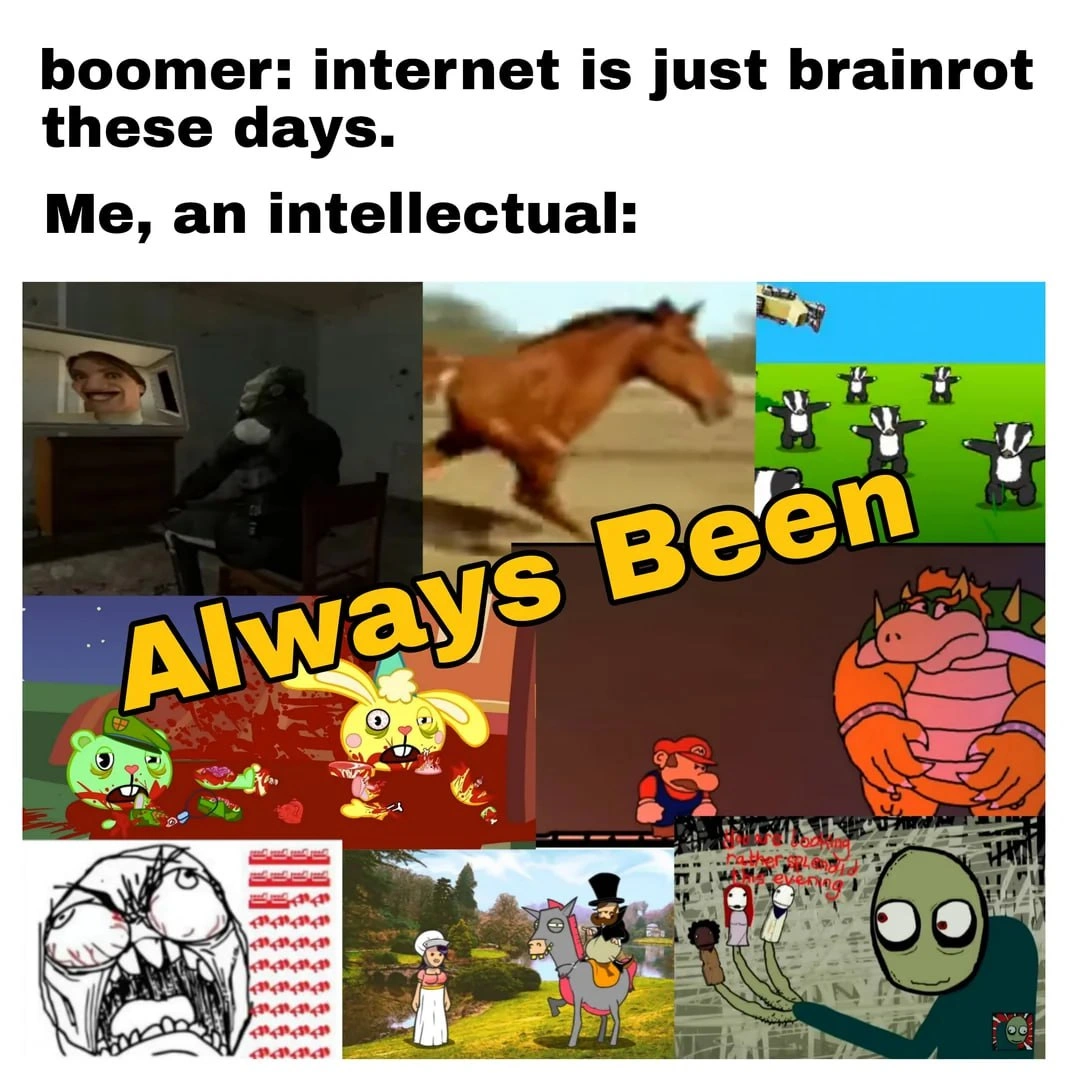
Below that, instead of a formal argument, the meme shows a collage of nine images – all references to famous early-2000s internet memes and Flash animations. It’s essentially saying: “You think the internet’s dumb now? Here’s proof it was always dumb (and fun).” The big yellow text “Always Been” plastered across the images is a nod to the "Always has been" meme (where an astronaut discovers a surprising truth about Earth, and another astronaut reveals “Always has been.”). By saying “Always Been,” the meme implies the internet has always been this way. So the joke is that the older generation just didn’t realize it back then.

Let’s break down some of the images in the collage, because they’re chock-full of early internet nostalgia:

  • Badger Badger Badger: A legendary Flash animation from around 2003. It showed a bunch of cartoon badgers dancing to a silly song that just repeated the word “badger” over and over, then “mushroom, mushroom,” and occasionally a snake would appear (cue the singer yelling “Snake! It’s a snake!”). It’s nonsensical and catchy – exactly the kind of thing that went viral via email chains and forum posts in those days.
  • Happy Tree Friends: An animated web series that looked like a cute kids’ cartoon (with bunnies, squirrels, etc.) but was actually extremely violent. In each short episode, the adorable characters would end up in horrific bloody situations (played for dark comedy). It was one of the early internet’s shock-value hits, often delivered as Flash videos on sites like Newgrounds.
  • Salad Fingers: Another early-2000s web cartoon, but this one was known for being creepy and surreal. It features a green, droopy-eyed character (named Salad Fingers) who speaks in a haunting voice and is obsessed with touching rusty spoons. Many people found it bizarrely fascinating or nightmare-inducing. It became a cult classic in the Flash animation world.
  • Rage Comic “FUUUU” Face: This is the black-and-white drawn face scrunching up in a scream of frustration, often accompanied by “FFFFFUUUU–!!”. It comes from rage comics, which were simple comics made by internet users, especially on sites like 4chan and Reddit around 2008-2011. These comics had a set of meme faces (like Trollface, Forever Alone, and this “rage guy”) to express emotions. The “FUUUU” face was used when something went horribly wrong (like your code compiling with 0 errors but crashing on run 😡). Seeing it here is a reminder that meme faces were a thing even before modern reaction GIFs and emoji.
  • Charlie the Unicorn: An absurd Flash animation (later a YouTube video) that came out in 2005. It’s about a grumpy unicorn named Charlie who is tricked by two other hyperactive unicorns into going on an adventure to Candy Mountain (where he promptly gets his kidney stolen – yes, it’s weird!). The collage shows what looks like a scene styled like an old Victorian illustration with Charlie and friends; in one of the sequels or scenes they have a random old-timey setting. Charlie the Unicorn was hugely popular for its random humor and quotable lines (“Candy Mountain, Charlie!”).
  • Garry’s Mod Soldier on CRT: Garry’s Mod (often G-Mod) is a sandbox PC game based on the Half-Life 2 engine that came out around 2004. People used it to pose game characters in funny scenarios and made videos (called machinima). One popular trope was putting the Combine soldier (a gas-mask wearing soldier from Half-Life) into odd situations. The image here shows that soldier sitting in a room, looking at a big happy face on a chunky old CRT monitor – it’s an example of the kind of random, comedic skits gamers shared in the mid-2000s. Essentially, it’s early meme video content made by remixing game assets.
  • 8-bit Mario and Bowser: These refer to fan-made animations using characters from the Super Mario video games. In the early meme era, people loved to take the pixelated sprites from NES or SNES games (like Mario and Bowser from Super Mario Bros.) and create parody videos. For example, one might show Mario getting fed up with always saving the princess, or Bowser complaining about his job as a villain. These were done in Flash or simple GIFs and were popular on gaming forums and sites like Newgrounds. Seeing Mario looking annoyed in the collage, next to a goofy drawn Bowser, represents all those early gamer memes.

All of these are pre-2010 internet phenomena, many of them enabled by Flash animation technology. Adobe Flash (originally by Macromedia) was a browser plugin that let websites run interactive animations, games, and videos long before HTML5 could handle it. Creators would make content in the Flash application and export it as an .swf file which could play in your browser via the Flash Player plugin. In the 2000s, if you were browsing funny sites like eBaum’s World, Albino Blacksheep, or Newgrounds (which was a huge community for indie animators and developers), you’d see these kinds of Flash cartoons everywhere. You might remember right-clicking on a video and seeing “About Adobe Flash…” in the menu – that was the telltale sign the content was Flash-based.

However, Flash didn’t last forever. It became a LegacyTech as the web evolved. There were problems: Flash content was heavy on CPU, had lots of security holes (hackers could exploit it), and it didn’t work on mobile devices (Apple’s iPhone famously refused to support Flash). Over time, open web standards caught up. By the early 2010s, new capabilities in HTML5 and JavaScript meant browsers could play video, display animations (with <canvas> or SVG), and do fancy graphics without a plugin. So, the industry moved on, and Adobe officially discontinued Flash at the end of 2020. Modern browsers now block Flash content outright. That means many of these old .swf animations won’t run unless you use an emulator or find a YouTube version. They truly became internet artifacts.

Meanwhile, today’s “silly internet content” often comes in the form of short videos on TikTok, YouTube, or Instagram, and web apps built as Single Page Applications (SPAs). An SPA is a modern web app that loads a single HTML page and dynamically updates content without full page reloads. Common SPA frameworks include React, Angular, or Vue. These let developers build very interactive sites (like social networks or meme apps) using just web standards (JavaScript, HTML, CSS) – no extra plugins needed. For example, instead of loading a Flash file to show an animation, a site might use a <video> element or an HTML5 canvas drawing. This makes content more accessible and mobile-friendly.

The meme’s collage draws a parallel between the content of then and now. Even if the tech delivery changed from Flash to HTML5/SPA, the actual stuff people enjoy (silly dances, weird cartoons, random humor) hasn’t changed. It’s basically saying: people have always used the internet for “brainrot” entertainment. So when the boomer says “the internet is brainrot these days,” the response is to literally show them a compilation of old-school internet brainrot from the Flash era and say “See? It’s always been like this!” The “Me, an intellectual” part is tongue-in-cheek – the meme creator isn’t actually delivering a scholarly lecture, but by presenting historical evidence (in meme form), they pretend to be the smart one in the room.

For a younger developer or internet user who didn’t experience those early days, this meme is also a quick history lesson. It’s highlighting the continuity of InternetCulture. If you laugh at TikTok cringe compilations or bizarre YouTube vlogs now, well, a decade or two ago people were laughing at looping badger songs and demented unicorn cartoons. The tools (Flash vs. modern web tech) and formats (desktop web vs. smartphone app) evolved, but the fun, weird spirit is the same. And importantly for devs: a lot of early programmers, designers, and animators cut their teeth making these Flash memes and games, forming communities (like Newgrounds) that were the predecessors of today’s content creator communities. So in a sense, this meme is also tech nostalgia. It reminds us that behind every silly animation was some WebDev tinkering with code and timelines in Flash, much like today a teenager might tinker with code to make a Discord bot or a small game.

In summary, the meme’s joke is a generational “gotcha”. It uses the evidence of legacy internet memes to playfully argue that the internet didn’t suddenly become stupid – it was always a bit ridiculous. The phrase “Always been” drives that home in two words. For anyone in on the joke (familiar with these old memes), it’s a hilarious bit of “I see what you did there” humor. And if you’re not familiar, now you know: our internet forefathers in the 2000s were watching dancing badgers and murderous cartoon critters long before today’s trends. 😄

Level 3: Always Been Brainrot

For developers with long memories, this meme is a time capsule of early-2000s internet culture hidden in plain sight. The setup is a generational clash: a boomer (older person) claims "the internet is just brainrot these days", and the meme-maker – self-declared "Me, an intellectual" – responds with a chaotic collage of classic Flash-era web memes as evidence to the contrary. Slapped across this nostalgia bomb is huge yellow Impact-font text reading "Always Been" – a clear riff on the astronaut "Always has been" meme – underscoring the punchline: the internet has always been full of bizarre, brain-rotting fun. In other words, today’s TikTok absurdities are nothing new; we had equally questionable content 20 years ago, delivered via Adobe Flash instead of mobile apps.

The nine-panel collage is basically an hall-of-fame of the Wild West Flash era. Each tile references an infamous viral animation or meme from the early web:

  • Badger Badger Mushroom – A 2003 looping Flash cartoon by Weebl featuring crudely drawn badgers popping out of holes to a catchy song (“badger, badger, badger…”), occasionally interrupted by a lone mushroom or a surprise snake. It was insanely repetitive and insanely popular – an earworm and visual gag that spread like wildfire.
  • Happy Tree Friends – A cute Flash cartoon series of forest animals that invariably ended in ridiculously graphic violence. Think cuddly cartoon bunnies meeting chainsaw accidents – shock humor that was oddly beloved on early internet sites.
  • Salad Fingers – A surreal, creepy animated series by David Firth about a green, mentally unsettling character who adores rusty spoons. It was one of the weirder viral Flash cartoons, leaving viewers equal parts fascinated and disturbed (and quoting lines like “I like rusty spoons”).
  • Rage Comic “FFFFFUUUU” Face – A crudely drawn, red-in-the-face cartoon scream. This comes from rage comics (circa 2008-2010), which were DIY web comics using recurring meme faces to express everyday frustrations. The “FUUUU” guy is basically the ancestor of today’s reaction memes – an early meme format where developers and users alike shared war stories in comic form.
  • Charlie the Unicorn – An absurd animated adventure (originally a Flash video in 2005, later famous on early YouTube) about a grumpy unicorn dragged to Candy Mountain by two insanely upbeat unicorns. The scene in the collage – with Victorian attire and a fancy countryside – nods to one of Charlie’s random dream sequences, highlighting the nonsense humor that was emblematic of the era.
  • G-Mod Soldier & CRT – A reference to Garry’s Mod machinima videos. Garry’s Mod (built on the Half-Life 2 game engine) let players pose characters in goofy scenarios. Here we have a masked Combine soldier sitting in a dingy Source-engine room, staring at a smiling face on a CRT monitor. It’s the kind of random gamer humor that flourished on forums and early YouTube – essentially the pre-meme meme for gamers.
  • 8-Bit Mario & Bowser Parodies – Pixelated Mario and a caricature of Bowser appear, referencing the countless fan-made Flash animations parodying classic Nintendo games. Early internet creators loved to rip sprites from Mario or Zelda and make silly videos – like Mario getting fed up with his job or Bowser singing a ridiculous song. These were the gaming community’s beloved inside jokes, done with simple 8-bit art and a lot of creativity.

This visual cacophony purposely has clashing art styles, bright colors, and low-resolution graphics – exactly the aesthetic of the early web. Back then, the internet felt like a giant messy art jam. One moment you’re watching vector cartoon badgers dance on a lime-green background, next you’re witnessing pixelated carnage in Mushroom Kingdom, then a creepy green man crooning about spoons. It was chaotic and cognitively questionable… and we loved it. The meme’s humor comes from pointing out that this kind of “mindless” entertainment isn’t a new low for the internet – it’s the original state of the internet. The caption “Always Been” is the intellectual’s tongue-in-cheek way of saying to the boomer: checkmate. The younger generation isn’t dumber; we’re just continuing the grand tradition of online silliness that you never realized existed.

From a technology standpoint, this meme also highlights a shift in web development and LegacySystems. All those early memes ran on Adobe Flash, a browser plugin that was essentially a mini virtual machine for multimedia. Creators would publish their cartoons and games as .swf files (ShockWave Flash) and embed them in web pages. Flash provided the animation tools, sound playback, and an embedded scripting language (ActionScript) to add interactivity. In the 2000s, if you viewed a site like Newgrounds or Albino Blacksheep (popular Flash content hubs), your browser’s Flash Player plugin was doing all the heavy lifting to render dancing badgers or screaming stick figures. Flash was a single, monolithic platform within the browser – a plug-in sandbox separate from the normal HTML/JavaScript environment.

To illustrate, embedding the Badger Badger Badger animation on a webpage in 2003 meant writing something like:

<!-- Old-school embedding of a Flash animation -->
<object data="badger.swf" type="application/x-shockwave-flash" width="550" height="400">
  <param name="movie" value="badger.swf"/>
  <param name="quality" value="high"/>
</object>

This <object> tag loads the Flash plugin and plays the content. Today, in contrast, we’d just use a standard HTML5 element (no extra plugin needed):

<!-- Modern equivalent: HTML5 video of the same animation -->
<video src="badger.mp4" width="550" height="400" autoplay loop muted></video>

The funny part is that we’ve replaced the old plug-in monolith with modern Single Page Applications and built-in web tech, but the content itself – dancing animals, cartoon violence, goofy animations – remains as silly as ever. Modern meme platforms use React, WebGL, and algorithms to serve up short-form videos, whereas Flash was a single proprietary platform distributing homemade cartoons. Technically, everything changed: Flash is now a legacy tech (discontinued in 2020, effectively purged from modern browsers), and we build rich web content with open standards (Canvas, <video>, JavaScript frameworks, etc.). But human nature didn’t change: people still love to create and consume “brainrot” content.

This meme resonates with veteran devs and internet old-timers because it’s a truth we find both hilarious and comforting. It says: don’t pretend there was a golden age of high-brow internet content. Even TechHistory shows that the earliest viral hits – from the Dancing Baby GIF in 1996 to the Hamster Dance webpage in 1998 – were wonderfully pointless and goofy. The Flash era took it to new heights with interactive media, and now TikTok and memes carry the torch. The DevCommunities that built those Flash gems (shoutout to all the Newgrounds creators and random college kids experimenting in Macromedia Flash) paved the way for today’s content creators on YouTube and beyond. So the meme isn’t just dunking on a boomer; it’s also paying homage to the internet’s long legacy of ludicrous entertainment. The “Me, an intellectual” character in the meme is basically the software historian in all of us, rolling our eyes and saying: The internet rotted brains long before you noticed, and we’re oddly proud of that.

Description

A meme that refutes the idea that the internet has only recently become 'brainrot'. The top text reads 'boomer: internet is just brainrot these days.' followed by 'Me, an intellectual:'. Below this is a large collage of iconic and bizarre content from the early-to-mid 2000s internet. The collage includes scenes from the creepy Flash animation 'Salad Fingers', the violent cartoon 'Happy Tree Friends', the repetitive 'Badger Badger Badger' song, a fan-made animation of a sad Mario, a rage comic face, a low-resolution running horse video, 'Charlie the Unicorn', and a Garry's Mod scene. Overlaid in the center is large yellow text that reads 'Always Been', implying that the internet's chaotic nature is not a new phenomenon. The humor is aimed at those who experienced this era of the web, ironically positioning the memory of this old, weird content as a form of intellectualism and historical knowledge, countering the narrative of a recent decline in content quality
Comments

22
Anonymous ★ Top Pick The internet's frontend stack has been completely refactored from Flash to modern frameworks, but the user-generated content layer remains a legacy monolith of pure, unadulterated chaos
  1. Anonymous ★ Top Pick

    The internet's frontend stack has been completely refactored from Flash to modern frameworks, but the user-generated content layer remains a legacy monolith of pure, unadulterated chaos

  2. Anonymous

    Adobe may have sunset Flash in 2020, but the brainrot microservice has enjoyed 99.999% uptime since the Macromedia 5 release - no amount of Kubernetes can scale it down

  3. Anonymous

    This is what happens when you let junior devs design the microservices architecture - technically it works, nobody understands how, and explaining it to stakeholders requires a 3-hour meeting and several therapy sessions

  4. Anonymous

    Senior engineers defending their legacy codebase like 'the architecture was always this chaotic' - turns out both internet culture and our monolithic applications have been gloriously unhinged since day one, we just didn't have the self-awareness to meme about it yet

  5. Anonymous

    Boomers call it brainrot; we've been parsing that surreal mess in production logs since SVN days

  6. Anonymous

    Brainrot didn’t get worse; it got distributed - Flash monoliths refactored into React microfrontends with Kafka-backed engagement pipelines. Same event loop, now horizontally scalable

  7. Anonymous

    The internet didn’t get dumber - we just ported SWF memes to SPAs: same 12‑fps loop, now with 1,200 transitive npm dependencies and a webpack config

  8. @imfreetodowhatever 1y

    *millenial

    1. @deadgnom32 1y

      boomers are more like:

  9. @imfreetodowhatever 1y

    Tbh YTPs are the pinnacle of teh internets, don't know anything that can top them

    1. @chupasaurus 1y

      Doom Crossing: Eternal Horizons

  10. @Conkylot 1y

    🦡 🦡 🦡 🦡 🍄

    1. @loomingsorrowdescent 1y

      Snaaaaake snaaaaaaake

  11. @kralala 1y

    badger badger badger badger badger badger badger badger badger badger badger badger MUSHROOM MUSHROOM

  12. @kralala 1y

    - Look at my horse, my horse is amazing. Give it a lick - Mmm, it tastes just like raisin

    1. @qtsmolcat 1y

      Horses are deprecated, please upgrade to donkeys

    2. @SamsonovAnton 1y

      Look at my hose! My hoarse is a mazing!

  13. शठे शाठ्यं समाचरेत् 1y

    david firth

  14. @lilfluffyears 1y

    My biggest problem is that nowadays there are more and more ipad kids

    1. @Daonifur 1y

      It's like people keep multiplying somehow

      1. @lilfluffyears 1y

        I didn't meant it that way xD

  15. @patsany_horosh_mne_v_dm_pisat 11mo

    The better times

Use J and K for navigation