Skip to content
DevMeme
4934 of 7435
It's Not Lying, It's AI Hallucination
AI ML Post #5401, on Sep 6, 2023 in TG

It's Not Lying, It's AI Hallucination

Why is this AI ML meme funny?

Level 1: Imaginary Answers

Imagine you ask your friend a question, and your friend doesn’t know the real answer. But instead of admitting that, they confidently tell you something totally made-up. They just invent a story on the spot. In everyday life, you might say this friend is “making things up” – basically, pretending to know and giving you an answer that isn’t true. Now, the funny part comes with what we call that behavior when it’s an AI doing it. Instead of saying the AI is lying or making stuff up, people in the AI field decided to use a fancier, more playful term: they say the AI is “hallucinating.”

Think of the word hallucinate: usually, it describes when someone sees or hears things that aren’t really there (like if you’re sick with a high fever and you think you see a giant bunny in the room – you’d be hallucinating because there’s no bunny, your brain just imagined it). When we apply this to an AI, it’s a metaphor. We’re joking that the AI must have “seen” some fact that isn’t real, and that’s why it gave that answer. Of course, the AI isn’t actually seeing imaginary things – it doesn’t “see” or “intend” at all – but calling the mistake a hallucination is a tongue-in-cheek way to describe what happened. It’s like saying the AI had a little dream or illusion and came up with an answer from that fantasy, rather than from reality.

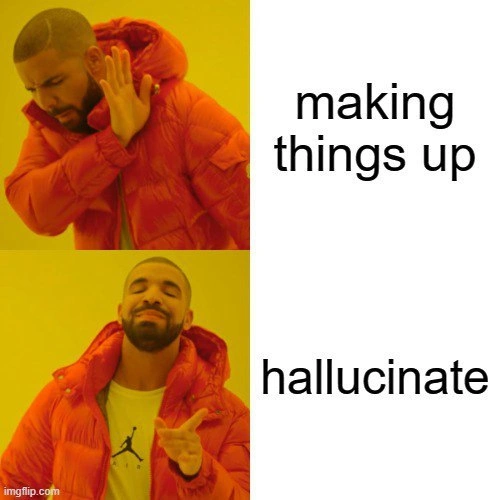
Now, why is the meme funny? The image shows a famous rapper, Drake, doing two poses. In the first pose (top picture), he’s waving his hand like “No, nope!” next to the words “making things up.” This represents the AI community saying “we don’t like calling it that.” In the second pose (bottom picture), Drake is pointing in approval next to the word “hallucinate.” That represents “Yes, use this cool word instead!” It’s visual sarcasm. The humor comes from realizing that both phrases mean pretty much the same thing – the AI gave a fake answer – but one phrase is just plain and the other sounds amusingly grand. It’s poking fun at how people who work in AI sometimes choose a fancy word to describe a simple oopsie.

In super simple terms, the meme is highlighting a kind of inside joke among tech folks: AIs sometimes make up facts, and instead of just admitting “yeah, it made that up,” we say “oh, it hallucinated.” It’s like if a kid spills juice and instead of saying “I spilled it,” they said “I performed a liquid redistribution.” 😂 It’s ridiculously formal for a simple mistake. We find that contrast funny. So, this meme is basically laughing at the AI community for using a magical-sounding word “hallucinate” to explain that their fancy computer sometimes tells make-believe stories by accident.

Level 2: Buzzword Breakdown

Let’s break down what this meme is talking about in simpler terms. In the world of AI (Artificial Intelligence) and ML (Machine Learning), a Large Language Model (LLM) is a type of program that’s really good at generating text. Think of an LLM as a super-advanced autocomplete – kind of like when your phone suggests the next word while you’re texting, but trained on, say, the whole internet. Popular examples of LLMs would be things like ChatGPT or Google’s LaMDA; these are often used as AI assistants that can answer questions or carry a conversation. They’re a big part of the current generative AI trend, which is all about AI systems that can generate content (like text, images, etc.) rather than just analyze or retrieve information.

Now, one big problem with these LLMs is that they don’t actually know facts in a reliable way – they only know patterns of language. So sometimes, when you ask a tricky question, the AI will give you an answer that sounds confident and detailed, but is completely wrong or just made-up. In normal English, we’d say the AI “made something up.” It gave you an answer, but that answer isn’t real — it might have just fabricated some info that sounds plausible. This is a well-known limitation of current AI, often highlighted under tags like #AILimitations or described in discussions about AI hype vs reality.

However, within the AI community, people don’t usually say “the model lied” or “the bot made stuff up,” because that sounds a bit accusatory or naive about how the tech works. Instead, they use a special term: they say the AI “hallucinated.” In everyday language, hallucinating means seeing or hearing things that aren’t really there (like an imaginary vision). When applied to an AI, it’s a metaphorical way to describe those instances where the AI’s answer has no basis in reality – the answer is essentially imaginary. AI hallucination has become a piece of generative AI jargon. It refers specifically to AI-generated content that is factually incorrect or nonexistent, produced as if it were true. So if you hear an AI researcher or product manager say, “Our system sometimes hallucinates,” they mean “sometimes it comes up with completely fake information.”

Let’s look at a quick example. Suppose someone asks a fancy language model something it wasn’t trained properly on, like:

User: Who was the first person to teleport to Mars?
AI: The first person to teleport to Mars was Dr. John Smith in 2028 as part of a classified NASA experiment.

In reality, no one has teleported to Mars (teleportation isn’t a real thing humans can do in 2023, and certainly no Dr. John Smith did it). The AI here just invented an answer – a name and a year that sound reasonable, and even threw in “classified NASA experiment” to make it sound legit. This is a classic hallucination. The AI isn’t trying to deceive; it’s just programmed to always give an answer, and it pieced together something that resembles a valid answer from patterns it learned. It “saw” a scenario in its mind’s eye (so to speak) that wasn’t real, similar to how a person might hallucinate an image that isn’t there.

The meme highlights how the AI community labels this situation. In the top panel of the image, the phrase “making things up” is shown and Drake (the guy in the orange jacket, from a famous meme template) is waving it off like “No way, not using that phrase.” In the bottom panel, the term “hallucinate” is shown and Drake is giving a thumbs-up, smiling like “Yes, that’s the one.” Essentially, it’s showing that people working in AI prefer to use the word “hallucinate” instead of the blunt description “the AI is making stuff up.” It’s a humorous way to point out this quirk in terminology.

Why use the word “hallucinate” at all? Partially, it’s to be a bit more neutral or scientific-sounding. Saying an AI “made something up” or “lied” might imply the AI had intent or did something wrong knowingly, which isn’t the case – it just generated a wrong answer by accident. “Hallucinate” suggests it was an inadvertent, almost dream-like mistake, not a deliberate lie. It also aligns with how we talk about other AI errors: for example, sometimes you’ll hear of image-generation AI “hallucinating extra arms or fingers” on a person – again meaning it created visuals that don’t make sense or don’t exist. It’s all part of the terminology that has developed around language model errors.

Another reason is branding and hype. The field of AI has a tendency to use grand terms; it’s part of the culture. Using a word like “hallucination” is a bit of terminology rebranding – it turns a plain error into something that sounds a bit more high-tech or inevitable. This can influence how people perceive the technology. If an AI told you a wrong fact, and the company says “oops, it hallucinated,” it somehow sounds softer than “oops, it made that up.” It’s almost like giving the AI the personality of a quirky genius who sometimes hears voices, rather than a dull machine that glitches. That’s AI hype sneaking into the language: even the flaws get a sci-fi spin.

So, the meme is funny to those in the know because it’s exactly true: in AI circles, you will hear hallucination or hallucinate used seriously in conversation. “We’re improving our model to minimize hallucinations” is a sentence one might hear at an AI startup. It has practically become official terminology. Meanwhile, an outsider might think, “Hallucination? Really? Can AIs take psychedelic drugs now?” The contrast between the fancy jargon and the simple reality (“the thing is making stuff up”) is what makes it humorous. It’s AI humor 101 – we’re laughing at our own buzzwords. Drake, as used in this meme, is just a visual aid to drive home which wording gets the community’s approval. The top caption could be read as “Don’t say it in plain English,” and the bottom as “Do use the cool AI term.” And that’s the joke: we tech folks often just can’t resist a cool-sounding term, even when it means basically the same thing as the boring description.

Level 3: Sugarcoating the Error

Seasoned developers and industry observers see the humor in this meme immediately: it’s poking fun at our habit of wrapping a basic problem in fancier terminology. The AI community – from machine-learning practitioners to PR departments – indeed prefers the euphemism “hallucination” over the blunt phrase “making things up.” Why? Because saying “our AI assistant sometimes just makes things up” is a bit too honest (and frankly bad for PR), whereas calling it a hallucination makes it sound almost whimsical or intriguing, like a quirk of a creative mind. This is AI humor with a side of cynicism: we’re laughing at how the field uses high-brow jargon to rebrand an embarrassing flaw. It’s a classic case of terminology rebranding.

Think of it as the modern tech equivalent of the old bug “undocumented feature” joke. The meme captures that exact dynamic: in the top panel, Drake is literally turning his hand away in disgust at the straightforward truth ("making things up"), and in the bottom panel he’s grinning and pointing approvingly at the dressed-up version ("hallucinate"). It’s a perfect visual metaphor for how the AI industry sometimes handles AI limitations. We don’t call it a mistake; we give it a clinical, almost scientific name. It’s the same energy as a corporate spin doctor who refuses to say “error” and instead says “anomalous output.” As developers, we’ve seen similar linguistic gymnastics in other domains too. When a production system goes down, some exec might call it a “service degradation” (sounds nicer than “crash”). Here, when an AI lies through its digital teeth, we call it a hallucination – as if the AI assistant had a brief dream or a bout of imagination.

The Drakeposting meme format itself is an industry inside-joke at this point. By using the famous two-panel Drake meme (Drake rejects one thing, approves another), this post highlights the community’s preference for one term over another. Everyone in tech has seen Drake merrily approving something in countless memes – in this case, he’s approving jargon over plain English. The contrast is funny because it’s true: developers and AI researchers actually say “the model is hallucinating” with a straight face. It’s part of the everyday generative AI jargon now. The meme text even directly calls out “AI community prefers the term ‘hallucinate’ over simply ‘making things up’,” hitting the nail on the head. We’re effectively laughing at ourselves for how we talk.

Why do we do this, though? Part of it is AI hype and branding. The field of generative AI has exploded with promise and excitement, and with that comes a kind of protective phrasing. A term like “hallucination” almost gives the issue a sense of mystique or complexity (“oh, it’s just a technical challenge we’re working on”) as opposed to admitting the system can blatantly fail at providing correct info. It softens the psychological impact. Investors and users hear “hallucinations” and think, “Well, even humans hallucinate sometimes, right?” It normalizes the flaw as something expected in an intelligent entity, rather than a critical mistake. In an AI hype vs reality context, this is hype-language trying to gloss over a stark reality: these models don’t truly know what they’re talking about. They’re not reliable sources of truth, but we frame their spontaneous fiction as a cute, almost endearing problem.

There’s also a cultural aspect within the AI research community. Adopting a term like “hallucination” creates a kind of insider lingo – it’s a shared concept everyone at the AI conference understands. It’s much more palatable to say “We need to reduce hallucinations in our GPT-4 model” than “Yeah, our AI still blatantly makes stuff up every now and then.” The former sounds like you’re taming a wild yet sophisticated beast, the latter sounds like your product isn’t trustworthy. From a developer perspective, it’s both funny and slightly frustrating. We’ve essentially anthropomorphized a software glitch. It’s as if calling it by a human cognitive term makes it easier to discuss (and maybe excuse). A cynic (hello, that’s me) will note that this doesn’t change the end-user experience: if your chatbot just told you a fictional answer with supreme confidence, it hardly matters what we call it – it’s wrong. But the industry trends being what they are, we love our jargon.

The meme’s tag #fightAI even suggests the poster is tongue-in-cheek “fighting” the AI hype or at least calling out its absurdities. There’s a bit of “let’s keep it real, folks” sentiment. The community often oscillates between starry-eyed excitement for AI and sharp critique of its failures. Here we’re firmly in the critique-by-humor territory. It’s a friendly roast of AI culture: Hey, instead of just admitting these AI models sometimes bluff, we invented a cool word for it. The AI assistants we build are revolutionary, sure, but they also come with issues that savvy devs recognize. And one of those issues is that we occasionally have to explain to users, in dead-serious tone, “Sorry about that answer, the system hallucinated.” How Orwellian is that? We’ve essentially made making things up sound like an expected feature of an AI’s behavior.

In summary, the humor hits on multiple levels for the tech crowd: it’s the contrast between plain language and generative AI jargon; it’s a commentary on how the AI/ML field, amid all its hype, sometimes spins its problems with almost comedic branding; and it’s a shared wink that we’re all in on the joke. We know what “hallucination” really means, even if we use the word to keep our discussions sounding high-brow. Drake’s just here to make that contrast crystal clear – and to make us smirk at our own tendency to sugarcoat the truth.

Level 4: Stochastic Parrot Paradox

At the cutting edge of AI/ML, large language models operate as sophisticated probabilistic parrots. They generate text by predicting the most likely next words based on training data, without any built-in concept of truth. In academic terms, a hallucination occurs when a model produces a statement that isn’t grounded in its input data or real-world facts – essentially a confident fabrication. This phenomenon arises from the fundamental design of Large Language Models (LLMs): they’re trained to mimic patterns in human language, not to verify facts.

Inside a state-of-the-art LLM (think GPT-style transformer with hundreds of billions of parameters), every response is computed by traversing an enormous latent space of possible word sequences. The model doesn’t have an internal database of validated knowledge; it has weights encoding statistical relationships gleaned from its training text. When you prompt it with a question, the model assembles an answer token by token, each choice based on learned probabilities. If the training data didn’t contain the specific answer (or if it wasn’t reinforced strongly), the model will still dutifully output the most plausible-sounding sequence. Sometimes that sequence happens to be entirely fictional – the LLM effectively confabulates. It’s the same mechanism by which an image generator might add extra fingers or surreal elements to a picture: the system is interpolating from what it knows into uncertain territory, creating something that looks plausible but isn’t real. In NLP research this has been dubbed the hallucination problem, a nod to how the model seems to be “seeing” or “hearing” things that aren’t actually there in the data.

Let’s peek under the hood with a bit of pseudocode for how a language model generates text:

# Pseudocode illustrating how an LLM (e.g., GPT) generates a response
context = "Question: Who is the King of France in 2023?\nAnswer:"
while not end_of_response:
    probs = model.predict_next_word(context)   # Get probability distribution for next token
    next_word = sample_from(probs)             # Stochastically pick a likely next word
    context += next_word
    if next_word == "<END>": 
        break

print(context)
# The model will always output *something* plausible-sounding, even if the truth is "No King in 2023".
# There's no fact-checking step here, so the model might just invent a fictional King of France.

In this process, there’s no oracle or database confirming whether the chosen words align with reality – the model just keeps predicting tokens until the answer looks complete. If reality wasn’t well-represented in its training data for that prompt, the model’s statistical instincts may lead it to invent an answer that superficially fits. The term “hallucination” in AI is essentially a fancy umbrella term for these AI-generated pseudofacts. It’s meant to capture the idea that the model isn’t intentionally lying (there’s no intent at all, just math), but rather it’s spontaneously generating content that deviates from reality – much like a hallucinating brain perceives something that isn’t there. Researchers have analyzed this as a language model error: the system lacks a grounded understanding of the world, so it can’t always distinguish a correct answer from a compellingly articulated falsehood.

The paradox, of course, is that naming this failure mode after a quasi-psychedelic experience doesn’t fix anything; it just gives us a colorful shorthand for a hard technical problem. Underneath the jargon, a hallucinating AI is still just making things up. You could strip away the mystique, and the core issue remains: these models have zero concept of verification. Until we bolt on fact-checkers or retrieval mechanisms, an LLM will cheerfully present fiction as fact if the statistical patterns encourage it. In academic papers and AI labs, you’ll hear about efforts to reduce hallucinations (through better training data, reinforcement learning with human feedback, or hybrid systems that consult real data). But no matter how much we dress it up as “the model is experiencing a hallucination,” we are fundamentally grappling with the limits of probability-based knowledge. In the end, a stochastic parrot with billions of parameters can still spout nonsense with supreme confidence – and calling it a hallucination is just our way of acknowledging this weird quirk of generative models while we scramble to solve it.

Description

This image uses the popular two-panel 'Drake Hotline Bling' meme format. In the top panel, the rapper Drake is shown wearing an orange puffer jacket, looking displeased and holding up a hand to reject the text next to him, which reads 'making things up'. In the bottom panel, he is smiling and pointing in approval at the text 'hallucinate'. The meme satirizes the terminology used in the field of Artificial Intelligence. It humorously points out that when a person invents information, it's called 'making things up', but when a Large Language Model (LLM) does the same thing - generating confident but factually incorrect or nonsensical output - it's given the sophisticated, technical-sounding label 'hallucination'. This rebranding of a fundamental flaw is a source of amusement for developers who are often skeptical of industry hype

Comments

10
Anonymous ★ Top Pick My code doesn't have bugs, it has 'spontaneous alternative logic pathways.' We're calling it unsupervised innovation
  1. Anonymous ★ Top Pick

    My code doesn't have bugs, it has 'spontaneous alternative logic pathways.' We're calling it unsupervised innovation

  2. Anonymous

    We spent 20 years hunting “undefined behavior,” then LLMs show up, rebrand it as “hallucination,” and suddenly it’s a feature with a keynote slot

  3. Anonymous

    It's like when we renamed 'catastrophic production failure' to 'unplanned rapid disassembly' - suddenly our post-mortems sound like we're discussing modern art instead of why half of Europe couldn't access our service for 6 hours

  4. Anonymous

    When your LLM's temperature is set to 'creative writer' instead of 'fact checker' - but calling it 'hallucination' makes it sound like a feature we're still researching rather than a bug we're desperately trying to fix. At least when junior devs make things up in code reviews, we don't rebrand it as 'speculative implementation patterns.'

  5. Anonymous

    Rebranding it ‘hallucination’ is just a nondeterministic cache miss in latent space - still a 500 when the auditor asks for citations

  6. Anonymous

    We rebranded 'confidently wrong' to 'hallucinations' - now it’s a roadmap item with RAG, guardrails, and a fresh OKR instead of a P1 bug

  7. Anonymous

    Making things up is junior dev; hallucinating with 99.9% confidence is shipped LLM

  8. @kiasmosz 2y

    huh?

    1. dev_meme 2y

      In Natural Language Processing we do not say “Make up some stuff” Instead, we say: “Hallucinate” 💫🧙‍♂️🪄

      1. @vdobrovolskii 2y

        "and I think it’s beautiful” ☝🏾👳🏾‍♂️

Use J and K for navigation