Skip to content
DevMeme
4933 of 7435
The 3 AM Ping: A Shared Moment of Despair
MentalHealth Post #5400, on Sep 6, 2023 in TG

The 3 AM Ping: A Shared Moment of Despair

Why is this MentalHealth meme funny?

Level 1: Past Bedtime Chat

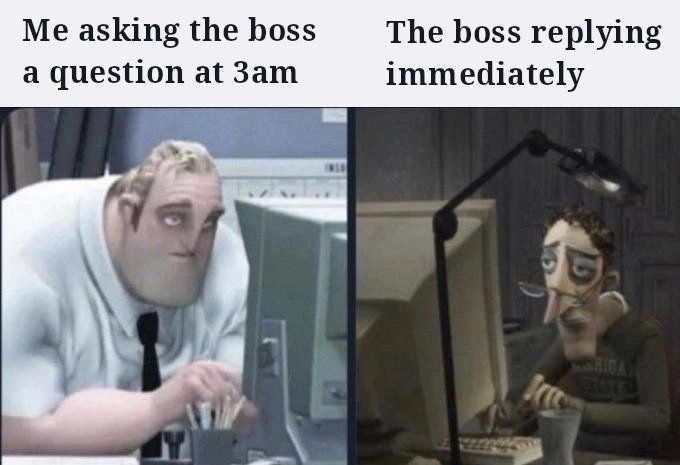
Imagine it’s the middle of the night and everyone is supposed to be asleep. You quietly send a message to your teacher or your friend at 3 AM, asking a question, thinking they’ll see it in the morning. But instead, you get a reply right away! 😲 That’s pretty surprising, right? This meme is funny for the same reason. In the picture, a worker sends a question to his boss at 3 o’clock in the morning. Normally, you’d expect the boss to be sleeping – it’s way past bedtime! But the boss answers immediately, meaning the boss was also awake at 3 AM, just sitting there ready to reply. It’s like if you sneaked into the kitchen late at night for a snack, and you found your parent already there also getting a snack. Both of you look at each other with sleepy eyes, thinking, “What are you doing up so late?”

So the humor here is that nobody is sleeping when they probably should be. Both the employee and the boss are awake and working in the middle of the night. It’s a silly, exaggerated way to show that their work might be a bit too demanding or that they’re both very dedicated (or maybe just can’t sleep because they’re worried about work!). It makes us laugh because it’s an unexpected situation: we don’t usually picture the boss as a night owl answering questions at that hour. In simple terms, the meme is saying: “Wow, even the boss isn’t getting any sleep around here!” and we find that both funny and a little crazy.

Level 2: Always-Oncall Life

Let’s break down what’s happening here in simpler terms. We have a software developer and their boss, both awake at 3:00 in the morning, talking over Slack. Slack is an instant messaging tool that many workplaces use for communication — think of it like a group chat app for the office, where you can message individuals or channels (groups) in real-time. Unlike an email (which you might check in the morning), a Slack message often pops up instantly like a text, which can create pressure to respond quickly. Slack even shows if someone is “online” or not. In healthy practice, people set Do Not Disturb modes or status like “Away” when off work, but here it seems both the employee and boss are very much online well past midnight.

Now, why on earth are they working at 3 AM? This touches on on-call duty and remote work culture. On-call means a developer is designated to be available outside normal hours to handle urgent problems (usually with a rotating schedule among team members so it’s not the same person every night). If something breaks in the production environment (the live system that real users use), the on-call person gets alerted. Often companies use special alert systems (like PagerDuty or just an automated Slack alert) that will ping your phone or Slack with a loud notification. It’s basically saying, “Wake up, something’s wrong!” In this meme, the developer likely got one of those alerts about a serious issue and needed additional help or approval, so they messaged the boss.

Remote work and time zones can also play a role. In a global team, one person’s 3 AM is another’s normal work time. TimeZonesAreHard – scheduling across different parts of the world is tricky. It could be that the developer is in one country and the boss in another. However, from the exhausted look of the boss (dark eye circles, coffee cup at hand), the joke is that it’s 3 AM for the boss and the developer. They’re both in the same boat of sleep deprivation. This isn’t just a friendly “good morning” message across oceans – it’s a real late-night crisis or question.

For a junior developer or someone new to this environment, a few realizations come from this scenario:

  • Work emergencies happen: Sometimes things break at odd hours. If you eventually take an on-call shift, you might be that person getting woken up by a notification saying, “Server down! Please fix ASAP.” It’s a bit scary, but teams usually have processes so you’re not totally alone in solving it.
  • Boss involvement: It might be surprising to see your boss respond at 3 AM. You might have thought, “I’ll message now so they see it in the morning,” only to get an immediate reply. This could mean your boss is very dedicated (they got the same alert and jumped in) or that the company has an expectation that leadership is always available. In some tech startups, it’s common for even managers to stay involved in technical emergencies. If the boss is technically savvy (say a CTO who codes), they might actually join the fix. On the bright side, a boss who’s awake and helpful at 3 AM can be a relief – you have backup! On the downside, it hints that work-life balance in this org might need improvement.
  • RemoteWorkCulture and boundaries: Working remotely often blurs the line between “work time” and “personal time.” When your office is literally your home, you might find yourself checking messages late at night. Many new devs in remote roles learn they have to set boundaries (like logging off Slack, or scheduling notifications off) to avoid an always_online_expectation. If you don’t, you could end up like our meme characters: answering pings around the clock. This meme exaggerates it for effect – it’s humor, but with a grain of truth. It reminds us that just because we can work from anywhere at any time doesn’t mean we should be always working.
  • Communication at odd hours: When people are tired, communication can suffer. If you’re groggy at 3 AM, there’s a higher chance of misunderstanding something or making a mistake. That’s why teams usually limit late-night exchanges to only what’s truly necessary (like “the site is down” is definitely necessary). A casual question could usually wait until morning. Here, the midnight_slack_ping implies it was urgent enough to ask, and the boss responding instantly implies it was indeed important (or the boss really doesn’t sleep). New developers learn to gauge what qualifies as urgent. For example, prod is down (the website or service isn’t working for users) = urgent ping anytime. But a question about code style or a non-blocking bug? Probably wait until working hours, so you don’t cause a communication breakdown by annoying a sleeping colleague.

In summary, this scenario resonates in tech because it shows an extreme of OnCall_ProductionIssues and remote communication: an employee and a boss, both awake at an insane hour, coordinating over Slack. It’s both humorous and a bit cautionary. As a newcomer, you might chuckle at the absurd image, but also take note: part of being a developer (especially in backend, ops, or any critical infrastructure role) can mean being a night-time problem solver once in a while. And if you ever do find yourself messaging your lead at 3 AM, don’t be too shocked if they reply with equal alertness – it happens more than you’d think in the wild world of software development!

Level 3: The Slack Witching Hour

At 3:00 AM, Slack stops being a casual chat app and turns into an incident command center. This meme hits seasoned devs right in the sleep-deprived feels. Why? Because we've all been there: the after_hours_question you desperately shoot to your boss on Slack, and the shock (or dread) when they reply immediately.

Let's set the scene: the left panel shows a weary developer (looking a bit like an exhausted Mr. Incredible) leaning into a beige CRT monitor’s glow. Caption: “Me asking the boss a question at 3am.” This poor soul is likely on OnCallDuty, dealing with some production issue that decided to erupt in the dead of night. The right panel? A gaunt, zombified manager under a dim desk lamp, coffee mug on standby, replying at once – caption: “The boss replying immediately.” The humor is dark: both employee and boss are awake at an unholy hour, bonded by the always_online_expectation of modern RemoteWorkCulture and on-call life. Misery loves company, and apparently it Slacks together at 3 AM.

Why is this funny to experienced devs? It’s painfully real. In a healthy world, 3am is for sleep, not debugging. But in tech, critical issues love to follow Murphy’s Law of Deployments: if something can go wrong, it’ll go wrong in the middle of the night. That Slack ping at 3 AM usually means one thing: production is on fire (and it’s probably just a minor bug a complete dumpster fire). The developer is likely facing an error that’s over their access level or knowledge. Reaching out to the boss is the bat-signal: “Halp, the server’s down!” And the boss’s instant reply means they were up anyway, possibly staring at the same alert. It’s funny in that oh-no way – your boss is just as sleepless and stressed as you are. Not exactly comforting, but at least you’re not alone in the nocturnal nightmare.

Consider what this scenario says about WorkplaceCulture: when the higher-ups are responding to Slack at 3 AM, it sets a precedent. You might think twice about ever muting notifications. An always online boss can make it feel like OncallLife is 24/7 for everyone. (Nobody wants to be the only one caught snoozing when the CTO is doing graveyard ops heroic midnight troubleshooting.) It’s a commentary on remote work communication norms: Slack and other instant messengers have blurred the line between work and personal time. Working from home too often becomes living at work. You log off at 6 PM... but your phone still pings at midnight with “just one quick thing.” Here, both the dev and boss exemplify that blur — each in their dark home office, zapped awake by the ether of the internet.

This meme also hints at the global team dynamic. In distributed teams, someone’s 3 AM Slack might be another’s 3 PM query. TimeZonesAreHard, and mis-coordination can mean late-night pings. But from the boss’s bleary eyes, we suspect he’s not in a fresh daytime timezone; he’s simply not sleeping. Cue the veteran dev sarcasm: sleep is deprecated. The coffee mug by the boss’s keyboard is basically a standard-issue peripheral at this point. It’s a visual punchline: both sides of this conversation are propped up by caffeine and sheer anxiety.

Let’s be real – this image is practically a DevOps rites of passage snapshot. 🔥 Production on fire? Check. ☕ Coffee-fueled troubleshooting? Check. 😵‍💫 Dark circles and thousand-yard stare? Oh yeah, check. The experienced engineers laugh (and groan) because they have war stories exactly like this: the 3 AM database migration that deadlocked, the memory leak that waited until the night to crash the app, the cron job from hell that always runs at 3:00 AM for no good reason:

# Murphy's infamous cron job, scheduled at the worst possible hour:
0 3 * * * /opt/scripts/murphy_breaks_production.sh   # runs every day at 3 AM, of course

In fact, the oncall nightmares depicted here are so routine that jokes abound in the industry. We say things like “Nothing good happens after 2 AM in code” or “The server only crashes at night, it’s basically tradition.” The meme captures that shared dark humor. It’s cathartic: you have to laugh, otherwise you’d cry (from exhaustion).

Finally, consider the boss’s perspective. If the boss is replying instantly at 3 AM, two possibilities exist, both a bit absurd:

  1. Boss is equally on-call – In small startups or tight-knit teams, the boss (maybe a CTO or tech lead) is as deep in the trenches as the devs. He’s subscribed to the same monitoring alerts on Slack, so the moment an error hits, his phone buzzes too. He’s not just awake by coincidence; he’s awake because he got the PagerDuty-style nudge at the same time. This is camaraderie, but also a sign the team is under-resourced (even the boss can’t escape the firefight).
  2. Boss never disengages – Perhaps no crisis, they’re just a workaholic or insomniac checking Slack at 3 AM. That’s a CommunicationBreakdown of healthy norms. It can create pressure for everyone to be online always. When leadership can’t unplug, it trickles down. The meme’s exaggerated scenario shines a light on that problem with a grin: see, even The Boss can’t sleep thanks to this job!.

In either case, the humor lands because it’s a mix of solidarity (“we’re all in this nightmare together”) and absurdity (“seriously, why are any of us online right now?!”). Seasoned developers chuckle then sigh — they recognize the SleepDeprivation badge of honor, but also know it shouldn’t be normalized. The meme brilliantly snapshots a RemoteWork reality: tech teams may be geographically apart yet unfortunately synchronized in sleeplessness. It’s a little funny, a little sad, and very, very relatable. After all, if your 3am Slack ping gets a reply before the typing indicator even stops, you know you’re living the true dev life™. 😅

Description

A two-panel meme juxtaposing two exhausted animated characters at their computers in dimly lit rooms. The left panel is captioned, 'Me asking the boss a question at 3am,' and features a gaunt, sleep-deprived Mr. Incredible from the 'Mr. Incredible Becoming Uncanny' meme, staring blankly at his monitor. The right panel, captioned 'The boss replying immediately,' shows Charlie Jones, Coraline's father from the movie 'Coraline,' equally drained and hunched over his keyboard. The humor lies in the mutual, unspoken acknowledgment of an unhealthy work culture. The employee's late-night work is met not with surprise, but with an immediate response, revealing the boss is in the exact same state of overwork, creating a grim bond over shared burnout
Comments

8
Anonymous ★ Top Pick That 3 AM ping isn't a question; it's a desperate handshake across the void between two failing liveness probes
  1. Anonymous ★ Top Pick

    That 3 AM ping isn't a question; it's a desperate handshake across the void between two failing liveness probes

  2. Anonymous

    We’re okay with eventual consistency in the database, but Slack’s apparently expected to hit five-nines linearizability at 03:00 UTC - complete with a human read replica in the corner office

  3. Anonymous

    The real distributed system failure here is when your manager's sleep schedule has the same uptime SLA as production - 99.999% availability, including at 3am when the only thing that should be running is your background cron jobs

  4. Anonymous

    The real distributed system failure isn't the service going down at 3am - it's the implicit expectation that human nodes in your org chart maintain 99.999% uptime without circuit breakers, health checks, or graceful degradation. At least our Kubernetes pods get to restart

  5. Anonymous

    If your boss answers a 3am Slack faster than your API’s p99, you didn’t go async - you just rebranded pagers

  6. Anonymous

    When PagerDuty escalates to C-suite at 3 AM, hierarchy flattens faster than a failed rollout

  7. Anonymous

    When leadership’s MTTR is under 30 seconds at 3am, the real incident is organizational

  8. @BenKillsYouu 2y

    Especially when it's Sunday :D

Use J and K for navigation