Skip to content
DevMeme
4935 of 7435
When Ransomware Gangs Have Better Docs Than Your API
Documentation Post #5402, on Sep 6, 2023 in TG

When Ransomware Gangs Have Better Docs Than Your API

Why is this Documentation meme funny?

Level 1: Bad Guy’s Good Guide

Imagine you’re trying to build a big LEGO set, but your friend who gave it to you didn’t include any instructions. You’re left guessing how all the pieces fit, feeling frustrated and lost. Now picture a school bully who takes away your favorite toy. Instead of leaving you completely confused, the bully actually hands you a clear step-by-step note on how to get it back (like a little treasure map with exact directions). It sounds crazy, but the “bad guy” is being more helpful in this story!

This meme is joking that sometimes the people who are supposed to help you (your friend with the LEGO set, or your software team at work) don’t give you any guidance, while even a villain (the bully or a ransomware hacker) at least gives you a set of clear instructions. We usually expect good guys to be helpful and bad guys to be unhelpful. Here it’s the opposite – and that role reversal is both funny and eye-opening. It makes us laugh and also think, because it shows how important clear instructions are, no matter who they come from.

Level 2: Docs vs Ransom Note

Let’s break down the joke in simpler terms. In software development, documentation usually means the written guides that explain how to use or work on a project. This can be a README file in a code repository or pages on an internal wiki. Good docs are like a recipe or instruction manual for your code – they tell you what the software does, how to run it, how to troubleshoot issues, and so on. Unfortunately, many developers treat documentation as an afterthought. New engineers often encounter documentation woes early in their career: you open the guide for a project and it's outdated, unclear, or completely missing. This is classic developer humor – it’s funny (and frustrating) because it’s true that documentation in many teams can be really bad or non-existent.

Now, on the other side, we have ransomware gangs. Ransomware is a type of malicious software (malware) used by cybercriminals to lock or encrypt your files, then demand money (a ransom) to get them back. When ransomware infects a system, it often leaves a ransom note – basically a text file (often literally named README.txt or HOW_TO_DECRYPT_FILES.txt) on your desktop. This note is essentially documentation provided by the hackers. It explains what happened (“your files are encrypted”), and gives the victim instructions on what to do next to recover their data. For example, it might say:

ALL YOUR FILES HAVE BEEN ENCRYPTED!

To restore your files, please follow these steps:
1. Download the Tor Browser from the official website.
2. Visit our secret webpage (on the Tor network) at xyz.onion.
3. Enter your personal decryption ID: [your unique ID here]
4. Follow the payment instructions (amount: 5 Bitcoin).
5. After payment, you will receive a decryption tool to unlock your files.

Surprisingly, those instructions are often very clear and detailed. The criminals actually want you to understand the steps (they literally profit from your ability to follow their guide). It’s a twisted version of good user documentation: they outline each step, assume the reader has no technical background, and sometimes even offer support chat to assist – as if they’re running a business and you’re the customer (albeit a terrified customer).

The meme compares these two worlds: internal developer docs vs. ransomware docs. It’s saying, “I’ve seen better documentation from ransomware gangs.” That implies the documentation at work is so bad that even evil hackers write better guides. For a junior developer or any newcomer, this paints a vivid (and hilarious) picture. Imagine starting a new job, asking “Where are the instructions for setting up this project?” and feeling like the only clear guide you’ve ever seen was in a hacker’s ransom note. It highlights a real problem in tech: oftentimes the bad guys are surprisingly organized and user-friendly in their communication, while the good guys (us developers) neglect our own documentation. This contrast is both funny and a bit embarrassing to anyone in development or IT.

Level 3: Criminally Good Documentation

Even crooks understand documentation matters. This meme hits seasoned developers right in the gut by comparing sloppy internal docs to the shockingly thorough guides from ransomware gangs. It’s a darkly funny observation rooted in truth: some ransomware operators produce better readme files than our own tech teams do. Why? Because in the high-stakes world of cybercrime, clear extortion playbooks are a matter of getting paid – ironically making criminals more motivated to explain their "features" than many devs explaining their code.

In the security realm, ransomware gangs behave like twisted SaaS vendors. They ship a malware product (an encryption payload), then provide a customer support experience via a detailed README.txt left on your desktop. These notes often include:

  • What happened: e.g. “All your files have been encrypted using AES-256.”
  • How to fix it: step-by-step instructions (install Tor Browser, visit a .onion site, input your unique key, pay in Bitcoin, then download a decryption tool).
  • Support info: a victim ID, deadlines, even a chat link for help if the decryption fails.

It’s thorough to the point of tech humor absurdity. Some ransom notes are translated into multiple languages and have better formatting than corporate release notes. The crooks essentially hand over an incident playbook to their victims, complete with troubleshooting tips – because confused victims don’t pay ransoms. Meanwhile, inside our organizations, the documentation woes are legendary. We've all opened a README.md in a mission-critical repo only to find something like:

ProjectX README
(This section intentionally left blank)
TODO: add documentation someday... 🤦

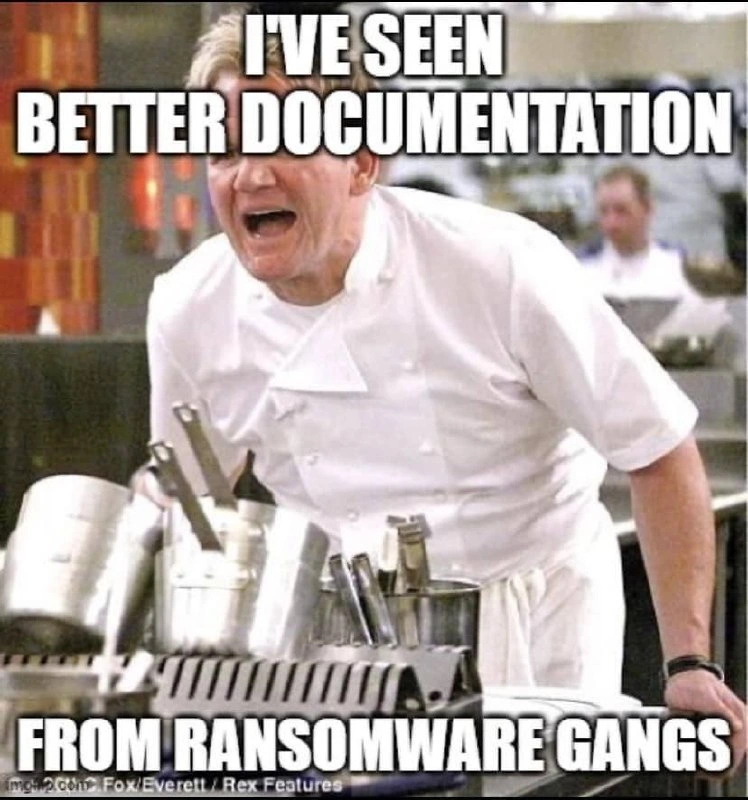
The meme’s punchline lands because developer despair over crappy docs is real. The angry chef (a familiar Gordon Ramsay meltdown from Hell’s Kitchen) perfectly embodies a senior engineer losing it after slogging through nonexistent or outdated docs. It’s the security vs developer standards paradox: the villain’s manual for extortion is written with more clarity and care than the internal docs meant to guide a team of “good guys.” In practice, documentation neglect (readme neglect) leaves developers feeling held hostage by their own codebase. At 3 AM during an incident, discovering the only up-to-date instructions are from a criminal’s note is both horrifying and darkly comedic. The veteran perspective here is clear: if your team’s docs are worse than ransomware notes, something is very wrong.

Description

A meme featuring a well-known image of celebrity chef Gordon Ramsay in a professional kitchen, leaning forward and shouting with an expression of intense frustration. The image is overlaid with a caption in a bold, white, all-caps font. The top text reads, 'I'VE SEEN BETTER DOCUMENTATION', and the bottom text continues, 'FROM RANSOMWARE GANGS'. The humor is a hyperbolic critique of the notoriously poor state of documentation in many software projects. It ironically points out that criminal organizations, like ransomware gangs, often provide surprisingly clear and concise instructions for payment, as their business model depends on victims being able to follow them. This is contrasted with legitimate software where documentation is often an afterthought, leaving developers frustrated and unable to use a tool effectively
Comments

11
Anonymous ★ Top Pick Ransomware gangs are the only organizations that truly understand the importance of a frictionless user onboarding experience
  1. Anonymous ★ Top Pick

    Ransomware gangs are the only organizations that truly understand the importance of a frictionless user onboarding experience

  2. Anonymous

    When the ransom note ships with sequence diagrams and rollback steps, but our prod deploy doc still points to the SVN repo we decommissioned in 2011

  3. Anonymous

    The bitter irony when ransomware groups provide clearer payment instructions, better troubleshooting guides, and more responsive 'customer support' than your enterprise vendor who just charged you six figures for their 'comprehensive solution' with documentation that hasn't been updated since 2019

  4. Anonymous

    The brutal truth is that ransomware operators have evolved sophisticated DevOps practices - complete with detailed deployment guides, troubleshooting wikis, and even customer support portals for their victims. Meanwhile, your internal microservices architecture is documented with a single README that says 'TODO: Add documentation' from 2019. When threat actors are outperforming your engineering org on technical writing standards, it might be time to reconsider your sprint priorities. At least the ransomware gangs understand that good documentation is essential for scaling operations and reducing support burden - ironically, principles we claim to value but rarely practice

  5. Anonymous

    Ransomware operators ship affiliate docs, decryption SOPs, and SLAs; our microservice mesh has a 2018 README and five Slack DM breadcrumbs

  6. Anonymous

    Ransomware ransom notes spell out exact BTC addresses and deadlines; our GraphQL schema docs just whisper 'introspect or perish.'

  7. Anonymous

    When the threat actors ship cleaner runbooks, affiliate onboarding, and a decryptor README than our microservices and their six stale Confluence pages, it’s time to file a doc incident

  8. @RiedleroD 2y

    the best docs always come from illegal groups

    1. @RiedleroD 2y

      not that I'd know ofc

  9. @Dark_Embrace 2y

    This guy feels it https://stackoverflow.com/questions/52135578/where-is-ocamls-alternative-string-syntax-documented

  10. Terry Filch 2y

    😏

Use J and K for navigation