Skip to content
DevMeme
6561 of 7435
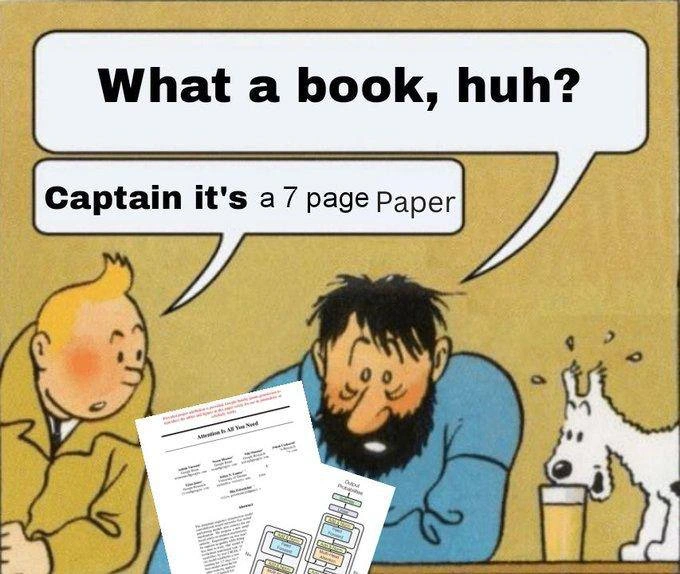
Tintin and Captain Haddock React to the Attention Is All You Need Paper
AI ML Post #7189, on Oct 1, 2025 in TG

Tintin and Captain Haddock React to the Attention Is All You Need Paper

Why is this AI ML meme funny?

Level 1: Little Paper, Big Impact

Imagine you have a tiny book, only a few pages long, that somehow changes the world. You give this little book to a grown-up, and when they finish reading, they flop over like they just ran a marathon! That’s the joke here. The cartoon shows an old sailor (Captain Haddock) saying, “What a book, huh?” like he just read a huge novel. But his young friend (Tintin) says, “Captain, it’s a 7 page paper,” basically, “It was only 7 pages, not a big book at all!” It’s funny because normally 7 pages is nothing – you could read that quickly. But those 7 pages were very hard to read and understand, so the poor Captain feels exhausted, as if it was a 500-page epic story. The idea is that a small thing can be super important and packed with big ideas. It’s like if you had a short set of instructions for a new game but those instructions invented a whole new way to play – everyone starts using them, and suddenly you have toys and games everywhere based on that one tiny booklet. The “little paper” in the meme is a real scientific article about AI that was short but changed a lot of what people do in technology. So the big bearded Captain represents anyone who tried to read it and felt overwhelmed, and Tintin is reminding him (and us) how surprising it is that something so small could feel so large. In simple terms: even a short read can feel huge when it’s full of new, groundbreaking ideas. That contrast – tiny paper, huge effect – is what makes the scene amusing and memorable.

Level 2: Transformer 101

Okay, let’s break down what’s going on here in simpler terms. The meme shows characters from a Tintin comic: on the left is Tintin, a young, savvy guy, and on the right is Captain Haddock, who’s older and a bit overwhelmed (he’s slumped over with a beer, looking exhausted). They’re talking about a document. The Captain exclaims, “What a book, huh?” implying he just finished reading something that felt huge. Tintin replies, “Captain, it’s a 7 page paper,” emphasizing that the thing was actually very short. This exaggeration is the joke’s setup: a short document felt like a long book. And what is that document? The meme shows the cover of a research paper titled “Attention Is All You Need.” This is a real famous paper from 2017 that introduced the transformer architecture in machine learning. It truly is only about 7 pages of main content, but those few pages kicked off an entire new generation of AI models.

So why would a seven-page paper feel like an epic novel? In tech and science, research papers are often dense and require a lot of background knowledge. Attention Is All You Need might be short in length, but it’s packed with advanced ideas about how to build neural networks that handle language. For context, neural networks are computing systems inspired by the brain that learn patterns from data. Before transformers, if you wanted a computer to translate a sentence or talk like Siri/Alexa, you’d likely use a type of network that reads words one by one in order (like RNNs – Recurrent Neural Networks). The transformer paper said, “Hey, we found a better way: let the model look at the whole sentence at once by using an attention mechanism.” In simple terms, "attention" means the model can focus on the important words in the input, almost like how you might skim a paragraph and highlight key phrases. The phrase “Attention is all you need” implies you can get rid of other complicated parts (like recurrent loops) and just use this attention trick repeatedly.

This turned out to be a huge idea. With transformers, AI systems became much better at understanding language and could be scaled up to read literally billions of sentences. That’s how we got very advanced LLMs (Large Language Models) such as GPT-3 or ChatGPT – those are basically very large transformer-based models. So in a sense, that 7-page paper is like the seed that grew into a forest of AI applications. It’s considered a landmark in TechHistory for AI. Engineers and developers who hadn’t focused on machine learning before suddenly heard terms like transformer, BERT, or GPT everywhere after 2017. Many felt like, to keep up in their career, they should at least understand the basics of this new approach. But reading academic papers isn’t like reading a blog post or a tutorial – it’s dense. Every sentence in that paper assumes you’re familiar with a bunch of concepts (linear algebra, deep learning terminology, optimization techniques, etc.). So a lot of folks in tech downloaded this paper expecting to quickly learn about the new hotness, and found themselves saying, “Whoa, this is heavy.” They might have had to look up other papers or textbooks just to follow along. In other words, those 7 pages come with a lot of implied homework! That’s why Captain Haddock in the meme reacts as if he just finished a massive novel — it’s a humorous exaggeration of how mentally taxing reading such a paper can be if you’re not used to that style.

The visual gag using Tintin is also telling. Tintin memes are popular for contrasting a naive or factual statement against an exaggerated or humorous misunderstanding (often with Captain Haddock being dramatic). Here, Tintin’s straightforward correction (“it’s a 7 page paper”) highlights the absurdity that something so short could feel so long to the Captain. The white dog in the image is Snowy (Tintin’s dog) who also looks at the Captain, adding to the comedic scene – even the dog might be thinking, “Really, you’re this tired from 7 pages?” This is tapping into a shared feeling in the developer community: research papers (especially in the AI/ML field) can be deceptively short but demand intense concentration to understand. It’s a mix of AI humor and a gentle jab at how much hype and complexity that single “small” paper generated. If you’re a newcomer (a junior dev or a student), the key things to know are: transformers are a big deal in AI, “Attention Is All You Need” is the famous paper that started it all, and reading academic papers is a skill that even experienced engineers find challenging. The meme simply captures that in one funny exchange.

Level 3: Short Paper, Long Shadow

Why are engineers chuckling at this meme? Because anyone who’s tried to keep up with the LLM revolution knows the feeling: a slim research paper that spawns an entire industry’s worth of technology and buzz. “What a book, huh?” groans Captain Haddock, the grizzled sailor, after “reading” the transformer paper. The punchline: Tintin corrects him, “Captain it’s a 7 page Paper.” The joke lands because in tech, a modest page count can belie massive complexity and impact. That 2017 paper’s formal title might as well be the subtitle of our era – Attention Is All You Need became the cornerstone of modern natural language AI. Just seven pages gave birth to BERT, GPT-3, ChatGPT, and dozens of other acronyms that now dominate computing headlines. Seasoned developers, perhaps comfortable in their domains of web apps or databases, suddenly felt like they needed to digest this arcane manuscript to stay relevant. It’s as if those few pages cast a 500-page shadow: reading it feels like tackling a tome because it implies grappling with all the subsequent research, tooling, and paradigm shifts that followed.

In the industry context, it’s notorious how a bit of AI research can escalate into a full-blown hype cycle. This meme captures that perfectly. One moment you’re casually hearing about a new neural network architecture; the next moment your boss is asking if you can “just add some transformers” to your product because apparently AI is the new electricity. Engineers who glanced at the paper found themselves wading through intricate concepts like self-attention and multi-head dynamics, often stepping outside their comfort zone. The meme’s Tintin format (a beloved comic known for grand adventures) is fitting: adopting transformers in real life often felt like embarking on an expedition with unfamiliar maps. The Captain’s bleary-eyed exhaustion and beer may as well represent the late-night study sessions of developers trying to grok why this tiny PDF has everyone rewriting their machine learning pipelines.

Historically, this isn’t the first time a brief publication reshaped tech. The Unix philosophy was laid out in a few pages of Bell Labs memos; the PageRank algorithm that kicked off Google’s success was distilled in a research paper scribbled by two grad students. But rarely does a paper so short create an upheaval so large in such a short time. By 2025 (when this meme was posted), the term "transformer" left the realm of academics and became everyday tech jargon, thanks to that single paper. It’s become a rite of passage in the developer community: you download Attention Is All You Need, determined to learn what all the fuss is about. Soon you’re googling terms like “positional sinusoidal encoding” or “layer normalization” and discovering each paragraph hides another rabbit hole. AIHumor like this comes from shared struggle — everyone nods, “Yup, tried to read that thing; felt like I was decoding an ancient spell book.” The meme pokes fun at that collective experience: the mix of awe and exhaustion when a revolutionary idea is compressed like a zip file of brain-bending detail.

And let’s not forget the tooling ecosystem that exploded around those ideas. Entire frameworks (from Google’s TensorFlow updates to Facebook’s PyTorch improvements) and libraries like HuggingFace’s transformers emerged to make these concepts accessible. Suddenly job postings wanted “experience with transformers (BERT/GPT).” The pressure on engineers to at least skim that seminal paper was real — nobody wanted to be the Captain who admits, “What a book, huh?” in front of the Tintins of the team who breezily claim “It’s only 7 pages.” The humor has an edge: it highlights a mild generational or experiential gap. The confident Tintin represents perhaps the younger researchers or those deeply immersed in AI, for whom a NeurIPS paper is standard fare. The weary Captain represents the solid veteran developer who finds this new landscape intellectually taxing. It’s a playful acknowledgment that even brilliant experienced folks can feel overwhelmed by new tech breakthroughs. In other words, don’t feel bad if a 7-page paper knocks you out — you’re in good company, as even fictional sea captains are struggling!

Level 4: The Self-Attention Saga

At the cutting edge of AI research, a mere 7-page paper unleashed a revolution. Attention Is All You Need (2017) introduced the world to the transformer architecture, packing years of ideas into a few dense pages. Beneath its brevity lies a whole saga of concepts: sequences encoded into high-dimensional vectors, multiple rounds of self-attention to capture context, and layers of feed-forward networks tying everything together. This paper distilled the essence of sequence modeling so effectively that it rendered older approaches (like recurrent neural networks) almost obsolete for tasks like translation and language modeling. To a seasoned engineer, those 7 pages read like a compressed epic poem of math and code. The core idea is elegantly theoretical: allow every position in a sequence to attend (i.e. focus) to every other position’s content, weighting their importance. Instead of reading text one word at a time like an RNN, the transformer sees the whole sentence at once through a matrix of attention scores.

In practice, this means computing attention as an operation on matrices of queries, keys, and values derived from word embeddings. The famous formula from the paper is a compact nugget of linear algebra that launched a thousand frameworks:

# Pseudo-code for scaled dot-product attention (core of "Attention Is All You Need")
scores = Q.dot(K.T) / sqrt(d_k)   # similarity of queries to keys, scaled by dimension
weights = softmax(scores)         # convert scores to probabilities (attention weights)
attention_output = weights.dot(V) # weighted sum of value vectors

This softmax-weighted sum lets the model "pay attention" to relevant words when producing each part of the output. The beauty is that this mechanism is differentiable and can be repeated in parallel across multiple "heads," hence multi-head attention. Each head learns to focus on different aspects of the data (like syntax or long-term dependencies), making the model’s understanding richer. All these heads and layers could run concurrently on GPUs, exploiting massive parallelism. The result? Training that once crawled now sprints – models see more data, learn deeper patterns, and achieve higher accuracy.

It’s remarkable how these few pages balance theory with practical clarity. They formalize concepts like positional encoding (adding a wave-like signal so the model knows word order despite parallel processing) and residual connections with layer normalization to stabilize deep networks. The authors squeezed in crucial details: e.g., using masked attention for sequence generation (so a word can’t attend to future words), and noting the transformer’s $O(n^2)$ time complexity in sequence length (a trade-off for all that parallelism). The paper’s brevity forces you to unpack each sentence carefully. Under the hood, each paragraph is referencing a trove of prior knowledge: from earlier seq2seq models to optimization tricks. It’s like reading a tiny oracle’s scroll – every line reveals something, but only if you bring context to decipher it. No wonder many of us ended up scouring blog posts, lecture notes, and GitHub repos just to translate those 7 pages into working code and intuition. The transformer paper might be short, but it dropped mathematical and algorithmic insight equivalent to a textbook chapter, condensed into a minimalist narrative. It’s an academic haiku that triggered a thousand-page documentation explosion in the years since. The humor hides in the truth: embracing the transformer meant first surviving a gauntlet of dense equations and concepts jam-packed into an apparently tiny reading assignment.

Description

A Tintin comic panel showing Tintin saying 'What a book, huh?' and Captain Haddock replying 'Captain it's a 7 page Paper'. Below the speech bubbles, pages from the famous 'Attention Is All You Need' paper (the original Transformer architecture paper by Vaswani et al.) are visible, including the architecture diagram and the paper title. Snowy the dog is also present. The meme humorously highlights how a mere 7-page academic paper fundamentally transformed all of AI and launched the entire LLM revolution, making it arguably the most impactful short document in modern computing history

Comments

15
Anonymous ★ Top Pick 7 pages to reshape the entire tech industry. Meanwhile, our internal RFC for changing the button color is on page 43 and still pending review
  1. Anonymous ★ Top Pick

    7 pages to reshape the entire tech industry. Meanwhile, our internal RFC for changing the button color is on page 43 and still pending review

  2. Anonymous

    The 'Attention Is All You Need' paper is the only document where the reference implementation has more lines of code than the source material has words

  3. Anonymous

    Proof that in 2025 you can spend more GPU hours tuning the citation than reading the entire PDF

  4. Anonymous

    Seven pages that spawned a thousand startups, burned through billions in compute, and convinced every PM that their CRUD app needs a 175B parameter model to parse email subjects. The paper that launched a thousand 'we're the Uber of X, but with transformers' pitch decks

  5. Anonymous

    In enterprise architecture, a 7-page paper is simultaneously too long for anyone to read and too short to capture the actual system complexity. It exists in a quantum state of being both 'comprehensive documentation' in the wiki and 'just a quick overview' in the meeting where you're asked to present it in 5 minutes

  6. Anonymous

    That 7-pager didn't just introduce attention - it gave every RNN codebase a swift, merciful EOF

  7. Anonymous

    Attention Is All You Need - plus a feature store, a DAG scheduler, 80GB VRAM, four repos, and an on-call rotation

  8. Anonymous

    Enterprise heuristic: if a document exceeds a Jira ticket, it’s a “book” - which is why our LLM strategy was based on tweets instead of the seven pages that actually invented self‑attention

  9. @Wunschsohn 9mo

    Oml This is so real 😭

  10. @deadgnom32 9mo

    it took me 1 week to read a 10 page paper. but like — to read and understand every aspect, not like just [read ✅]

    1. @vladyslav_google 9mo

      It took 5 days for me to understand the idea of MapReduce and how it works internally, 12 page paper)

  11. @DanialKhoshKholgh 9mo

    if its the original transformer paper then it might as well be a book

  12. @OdinFromAsgard 9mo

    A* original paper is exacrly 7 papers and takes you one week two fully understand the proofs

    1. @deadgnom32 9mo

      and another month to study references and sources.

    2. @MrZarei 9mo

      fr bro

Use J and K for navigation