Skip to content
DevMeme
6562 of 7435
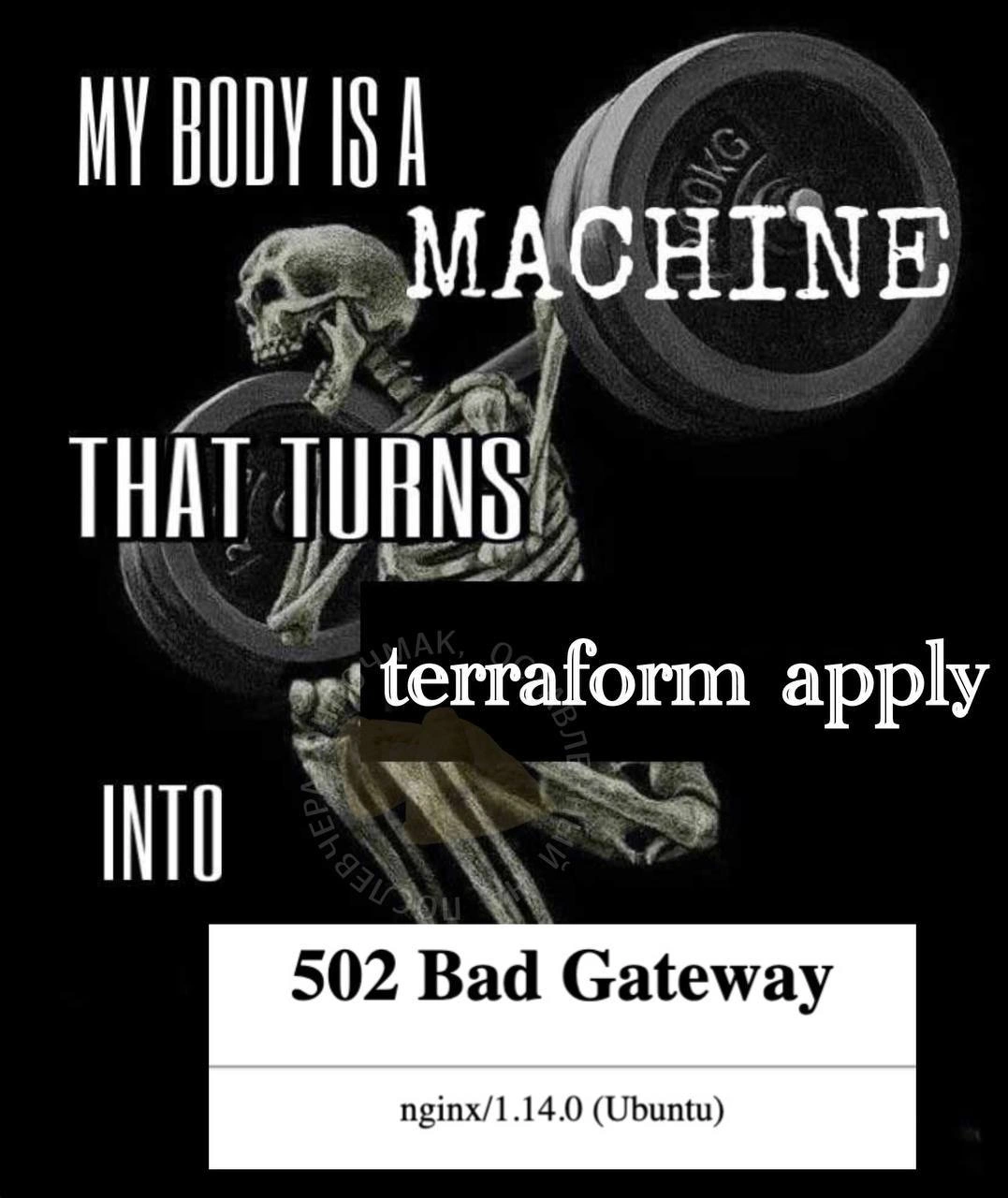
My Body Is a Machine That Turns Terraform Apply Into 502 Bad Gateway
DevOps SRE Post #7190, on Oct 1, 2025 in TG

My Body Is a Machine That Turns Terraform Apply Into 502 Bad Gateway

Why is this DevOps SRE meme funny?

Level 1: When Help Hurts

Imagine you have a special robot that’s supposed to help you clean your room. You press the button expecting a nice, tidy room, but instead the robot knocks over your lamp and throws clothes everywhere. Every time you try to use it, things get more messy instead of clean. It’s silly (and frustrating) because the robot was meant to make things better, not worse! This meme is joking about that same kind of situation. In the picture, a person uses a fancy tool to fix a website, but whenever they run it, the website breaks and shows an error page. It’s funny in a backwards way – the thing that’s supposed to help is causing chaos, which is the exact opposite of what anyone wanted.

Level 2: Gateway to Trouble

Let’s break down the meme’s components one by one. Terraform is a tool that engineers use to manage infrastructure with code – a concept called Infrastructure as Code. Instead of manually clicking around a cloud provider’s console to launch servers or databases, you write a configuration file and let Terraform create or update everything for you. When you run terraform apply, you're telling Terraform to take the setup you've described (your infrastructure plan) and make it real. For example, it might spin up virtual machines, set up load balancers, or configure network routes. It's powerful because it can automate an entire environment setup in one go. But if there’s a mistake in that config, terraform apply will faithfully apply the mistake too – which can quickly turn into a big problem.

Now, what’s a 502 Bad Gateway? That’s an HTTP status code – basically an error message your browser shows – which means one server acting as a gateway or proxy got an invalid response from another server upstream. In our meme, the error page is from Nginx (you can tell by the small text nginx/1.14.0 (Ubuntu) at the bottom of the screenshot). Nginx is a very common web server and reverse proxy. Often, Nginx sits in front of web applications: your browser talks to Nginx, and then Nginx passes your request along to the actual application server (for instance, a backend service or app). If that backend application is down, misconfigured, or unreachable, Nginx can’t get the data it expects to send back to you. Instead, it throws up a "502 Bad Gateway" page to say, "I tried to fetch the response, but something went wrong on the other end." In short, a 502 error means the server you reached couldn’t connect to the part of the system that actually does the work. It’s a common Production issue indicator — the site is up in some sense (you reached Nginx), but the actual content isn’t coming through.

So how do Terraform and a 502 error come together? Imagine an engineer using Terraform to update their website’s infrastructure. Say they change something about the servers or networking – perhaps deploying a new version of the app or moving instances to a different cluster. If they mess up the order of steps or a piece of the configuration, the result can be that the application server isn't ready or reachable when Nginx tries to send traffic to it. For example, the Terraform script might take down the old application instances before the new ones are fully up and registered behind the load balancer. In that gap, any user visiting the site will get the dreaded 502 error because Nginx has no healthy server to talk to. It’s basically an infrastructure-as-code fail: the automation did run, but not in the way you intended. The site’s uptime (time that the service is available) takes a hit, and you’ve effectively deployed downtime. Ouch.

The meme uses the skeleton weightlifter to illustrate this in a goofy way. The text "MY BODY IS A MACHINE THAT TURNS terraform apply INTO 502 Bad Gateway" is a play on a popular programmer saying: "My body is a machine that turns coffee into code." That original joke means a programmer runs on coffee and outputs code as the product of their work. Here it's flipped: this engineer’s body (metaphorically) takes the command they run (terraform apply) and consistently turns it into an error page. The mention of "reps" in the title is a gym joke – doing reps (repetitions) with weights is how you build muscle. So calling them "Terraform reps" implies this person keeps running Terraform over and over, as if they’re working out. But instead of building uptime muscle (making the system stronger and more reliable), they're building 502 muscle – meaning they’re unintentionally getting better at taking the system down. The skeleton image exaggerates it: obviously a skeleton shouldn’t be able to lift a 100kg weight, just like an over-eager script shouldn’t be run repeatedly if it causes errors. Yet in the joke, it is run repeatedly – and the ugly results (the 502 errors) just get bigger. It’s a humorous way to show someone doing something over and over expecting strength/gains, but only the failures are growing.

In plain terms, this meme is pointing out a real-world DevOps oopsie: even though Terraform and other automation tools are meant to help, using them carelessly can create chaos. It’s a lighthearted take on the idea that the very tool meant to improve your deployments can end up hurting them if you’re not careful. Think of it as a friendly warning wrapped in a joke. The next time you excitedly think, "I'll just run this one command to update everything, easy-peasy," remember the skeleton – you might end up flexing a "502 Bad Gateway" instead of a successful update. It’s funny (in a slightly painful way) because it’s true: sometimes automation just means you can break things faster! So the meme gets a chuckle from IT folks who have been there and learned that lesson the hard way.

Level 3: 502 Gains, Uptime Pains

Picture a skeleton doing an intense 100kg barbell curl, with the words "terraform apply" pasted on its effort. Instead of building actual muscle, this bony lifter ends up producing a "502 Bad Gateway" error page. It's a dark slice of DevOps humor that senior engineers know all too well. We boast about using Terraform (the popular Infrastructure as Code tool) to automate our deployment and strengthen our systems, but sometimes it feels like all those automation "reps" just bulk up our collection of error pages. The meme’s text riffs on the classic programmer mantra "my body is a machine that turns coffee into code," twisting it into: “my body is a machine that turns terraform apply into 502 errors.” In other words, every time this engineer runs an infrastructure update, the result is a dreaded production outage – namely, a gateway error served up by Nginx.

Why is this so hilariously on-point for experienced DevOps and SRE folks? Because we've all broken something in this exact way. Terraform is supposed to make managing infrastructure repeatable and safe, but if you misconfigure even one piece of your Nginx setup or network settings, you'll deploy an outage at machine speed. The 502 Bad Gateway means Nginx (often sitting out front as a reverse proxy or load balancer) tried to connect to an upstream service and got nothing back. Perhaps Terraform spun up new app servers but deregistered the old ones a few seconds too early, leaving Nginx pointing at a ghost. Or maybe the Terraform script deployed a config change where the backend server’s address was wrong – so Nginx literally has nowhere to send your request. The result? That default Nginx error page (complete with the ominous nginx/1.14.0 (Ubuntu) stamp at the bottom) becomes your website’s front page. Oops.

This meme hits a nerve because it captures a deployment pain point: automation can amplify mistakes. In the bad old days, a sysadmin might manually update one server at a time; errors were slow and somewhat contained. Now one terraform apply can reconfigure an entire environment in minutes – and if your IaC script has a flaw, you get a massive outage in record time. It's like upgrading from sparklers to dynamite. Sure, your "infrastructure machine" is powerful, but it can just as easily blow up your uptime as improve it. (Everyone preaches zero-downtime updates and blue-green deploys, but under pressure we often skip to applying changes directly on prod... until a 502 teaches us otherwise.) The skeleton doing heavy lifting is essentially us: battle-scarred engineers pushing big infra changes, only to end up exhausted (or looking like death warmed over) when things crumble. Those "502 muscles" represent how good we've gotten at causing errors; it's a bitter irony that sometimes we end up strengthening the wrong outcome (error pages) instead of the intended one (reliability).

Seasoned engineers also recognize the wink in "bigger 502 muscles than uptime." Uptime is the holy grail – keeping services running smoothly. Yet here we are, inadvertently training the opposite metric: downtime. It's a tongue-in-cheek way to admit we've all had streaks where every change we deploy seems to break something. After enough 3 AM incidents, you start joking that chaos is your default state. DevOps veterans swap war stories of an "innocent" Terraform change taking down production, complete with frantic Slack messages and emergency rollback plans. The meme exaggerates it to bodybuilder proportions – as if the engineer is proudly flexing how many outages they can bench-press. In reality, nobody wants stronger 502-fu – that's pure sarcasm born of pain. But the joke lands because the mix of Infrastructure as Code bravado and a misconfigured load balancer is a tale as old as cloud. It’s poking fun at our hubris: we introduce powerful tools like Terraform with great fanfare, only to learn (the hard way) that you still need careful planning and respect for the complexity. The infrastructure may be defined in code, but the real world can still bite if you get the order wrong. As any grizzled SRE will sigh, “automating chaos just makes it faster.” This skeletal gym scene is basically a cautionary comic for the cloud age – terraform apply is a beast, so handle it with care, or you'll be lifting the weight of production failures on your scrawny shoulders.

Description

A skeleton lifting weights meme with dramatic text: 'MY BODY IS A MACHINE THAT TURNS' with 'terraform apply' overlaid in red text, followed by 'INTO' and a browser error page showing '502 Bad Gateway' from 'nginx/1.14.0 (Ubuntu)'. The meme humorously depicts a DevOps engineer whose infrastructure-as-code deployments consistently result in production outages, turning what should be reliable infrastructure provisioning into nginx gateway errors

Comments

9
Anonymous ★ Top Pick terraform plan: 0 to add, 0 to change, 0 to destroy. terraform apply: somehow your entire production cluster is now a smoking crater
  1. Anonymous ★ Top Pick

    terraform plan: 0 to add, 0 to change, 0 to destroy. terraform apply: somehow your entire production cluster is now a smoking crater

  2. Anonymous

    Terraform's greatest feature is its idempotence, reliably ensuring that no matter how many times you run 'apply,' the resulting 502 Bad Gateway is configured identically

  3. Anonymous

    Sure, Terraform gives you immutable infrastructure - right up until your health checks achieve eventual consistency with /dev/null

  4. Anonymous

    After 15 years of 'idempotent' infrastructure deployments, I've learned that Terraform apply is just a fancy way to discover which AWS IAM permission you forgot to add, while your load balancer decides to take a coffee break and your monitoring dashboard lights up like a Christmas tree

  5. Anonymous

    When your Terraform apply completes successfully but the load balancer health checks reveal you've just provisioned a perfectly configured infrastructure for serving 502s at scale. At least the state file is consistent - consistently broken. Senior engineers know that 'nginx/1.14.0 (Ubuntu)' in the error message means someone's about to discover that the infrastructure-as-code didn't include updating the actual application configuration, and now you're serving errors with infrastructure-grade reliability

  6. Anonymous

    Terraform apply is great cardio - forget create_before_destroy once and nginx rewards you with a full-body workout of 502s

  7. Anonymous

    Idempotent IaC: every apply deterministically converges to 502 until the reverse proxy’s upstream stops flapping and someone remembers the ephemeral port range in the security group

  8. Anonymous

    Terraform apply: declarative IaC so elegant, it enforces CAP by picking P=unavailable via nginx 502s

  9. @mmaxmudjonov_proxima 9mo

    apparently, the full command didn't fit to the image: terraform apply -destroy

Use J and K for navigation