Skip to content
DevMeme
6560 of 7435
Everything AI-Related Tagged as Vibe and Too Afraid to Ask Why
AI ML Post #7188, on Oct 1, 2025 in TG

Everything AI-Related Tagged as Vibe and Too Afraid to Ask Why

Why is this AI ML meme funny?

Level 1: Too Afraid to Ask

Imagine you have a favorite toy that can do all sorts of cool things when you tell it what to do. Now, pretend every week the toy gets a new update with a fancy name. One week the toy says it has a “Happy vibe.” Next week, it says “Now with Super vibe!” Everyone keeps talking about these vibes, and you’re sitting there thinking, “Umm, I just want to play… what’s a super vibe?” But you feel a little shy to ask because it seems like everyone else already knows. It’s like when all your friends start using a new slang word and you have no idea what it means, but you nod along so you don’t look clueless.

In this story, instead of just playing with the toy normally, you get so worried about not knowing the new fancy word that you actually stop playing with it. You’re frozen — afraid you might do something wrong because you don’t get this “vibe” thing. It’s a funny situation because usually playing with a toy (or asking a question) should be simple and not scary at all! We’re laughing because we’ve all been in a spot where something simple felt intimidating just because people dressed it up with confusing language. In the end, the joke is showing that even grown-up tech experts feel like a confused kid sometimes, overhearing a new big word and being too afraid to ask what it means.

Level 2: Buzzword Burnout

Let’s break down the technical references and jargon in this meme for a less experienced developer (or anyone new to the AI hype train). The meme is talking about Artificial Intelligence updates, especially in the area of Generative AI (these are AIs like GPT-4, DALL·E, or Midjourney that can create text or images). Every time there’s an update or a new feature, the companies behind them seem to give it a cool, catchy name – lately, that name is often “vibe.”

What does “vibe” mean in this context?
In everyday language, a vibe means a mood or a style – like the overall feel of something. If someone says “this song has a chill vibe,” they mean it feels relaxed and mellow. In AI terms, saying a model has a new “vibe” likely means it can respond with a new style or tone. For example, an AI chatbot might have different modes: a formal mode vs. a friendly mode. Instead of calling these modes or tones, some marketing or product folks decided to call them vibes. So a “professional vibe” could mean the AI will answer you very formally (“Dear Sir or Madam, ...”), whereas a “playful vibe” might make it use more jokes or emojis.

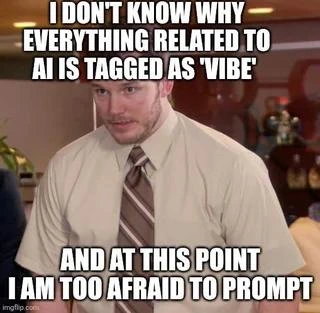
Now, the guy in the meme is frustrated and saying, “I don’t know why everything related to AI is [something] as ‘vibe’.” He’s basically complaining: “Why is every new AI feature labeled as some kind of vibe?” Maybe he saw release notes like: “Introducing ChatGPT with a Helpful Vibe!” or “New Update: Image Generator now supports Artistic Vibes.” After seeing this everywhere, he’s confused and a bit annoyed. It’s like if every new phone app suddenly started advertising “Now with extra vibe!” – you’d wonder, what are they all talking about? Did ‘vibe’ replace an actual technical term? There’s definitely jargon overload happening. In tech, jargon refers to special words or phrases that people in the field use. Here, “vibe” has become jargon in the AI community or at least in AI marketing.

Now, let’s decode the second line: “And at this point I am too afraid to prompt.” This is a humorously exaggerated statement. A prompt is basically the input or question you give to a generative AI. For instance, if you’re using an AI art generator, your prompt might be “a sunset over a mountain in watercolor style,” and the AI will try to draw that. If you’re chatting with an AI like an assistant, your prompt is just whatever question or request you type. Prompting is supposed to be easy – you just use normal language to ask for what you want.

But the meme jokes that our poor engineer is now “too afraid to prompt.” Why would someone be afraid to type a question to an AI? This is where the humor kicks in: it’s poking fun at prompt anxiety, a spin on the term analysis paralysis. Analysis paralysis is when you overthink decisions so much that you become paralyzed and end up doing nothing. Prompt paralysis (or prompt anxiety) would be when you overthink how to write your prompt, or worry about all the fancy new options (like picking the right “vibe”), to the point that you don’t even send the prompt. It’s an absurd scenario – being literally afraid to talk to a computer – which is why it’s funny. It exaggerates the feeling of being overwhelmed by too many new features or unclear instructions.

To someone early in their career (or learning about AI), this highlights a real sensation: “Am I doing this right? There are so many new settings!” When a company keeps adding new knobs and dials (like vibes, modes, tones, or whatever they call them), users can get nervous. Are they supposed to use them every time? Are they “doing it wrong” if they ignore them? The meme’s answer, humorously, is the guy who just freezes up and does nothing – he’s illustrating what not to do, in a tongue-in-cheek way.

Let’s talk about why the meme format (the image and text style) adds to the joke. The image is from The Office, a well-known TV show. In that show, the characters often deal with corporate nonsense and buzzwords (albeit not about AI). By choosing a character who looks visibly perplexed (and maybe a bit fed up), the meme immediately conveys the emotion: confusion mixed with frustration. If you’re a developer, you’ve likely felt that when reading some company’s hyped-up AI announcement. The text is in big bold Impact font with a white color and black outline – this is the classic meme caption style that’s been around since the early internet meme days. It’s intentionally loud and exaggerated, which matches the over-the-top feeling of the message. The top text sets up the situation (everything related to AI is called “vibe”), and the bottom text delivers the punchline (too afraid to even prompt now). It’s structured just like many popular memes where the top line is the setup and the bottom line is the comedic payoff.

Now, for the tags and context: this meme touches on AI hype in the industry. “Hype” means lots of excitement and buzz – sometimes too much. In recent years, AI (especially things like GPT and other LLMs, which stands for Large Language Models) has been super hyped. Every week there’s a new blog post or conference talk about some AI breakthrough or new feature. It can feel overwhelming even to professionals, let alone newcomers. There’s also often a gap between AI hype vs. reality: marketing might call something revolutionary, while developers know the feature is actually a small tweak or something that’s been done before. That’s exactly what’s being joked about here. The engineer in the meme likely knows that labeling everything as a “vibe” is just marketing fluff. But because everyone else seems onboard with it, he feels pressure to not question it openly.

Lastly, consider the cultural reference “too afraid to ask.” There’s a popular meme template that goes: “I don’t know what X is, and at this point I’m too afraid to ask.” It’s used when someone has gone a long time not understanding something, and now they feel embarrassed to admit it. This developer meme puts a tech twist on that idea with “too afraid to prompt.” It’s funny because prompting (asking the AI) is supposed to be the easiest thing – you just type what you want. Being afraid to do it is intentionally silly. But it’s capturing that little voice in our heads that says, “Everyone is talking about this new thing; if I ask a dumb question, I’ll look like I’ve been living under a rock.” In reality, asking is how we learn, but the meme finds humor in the fact that we often hesitate.

So, to recap in simpler terms: the meme jokes that AI companies have been calling every new thing a “vibe” (which is confusing), and the engineer is jokingly saying “I’m so confused by all this hype that I don’t even want to try using the AI anymore.” The tags like generative_ai_jargon_fatigue or prompt_anxiety are fancy ways of describing what’s happening: being tired of all the new AI buzzwords, and feeling anxious about how to even talk to these advanced AI tools now. It’s a playful take on a real feeling many developers have in the face of rapid, hype-driven changes.

Level 3: The Emperor’s New Vibe

In the fast-moving AI/ML world, every product update comes with its own splashy buzzword. This meme hilariously calls out how lately everything in generative AI is casually marketed as a new “vibe.” It’s as if the tech industry found a trendy label and decided to stick it on every feature, whether it makes sense or not. The result? Seasoned engineers rolling their eyes, collectively thinking “The emperor has no clothes – just vibes.”

The humor here is layered. First, the meme uses a classic format: a scene from The Office with bold white Impact font, which instantly signals DeveloperHumor. The character (our balding, exasperated office guy in a yellow shirt) looks utterly done with the situation. His top caption says he doesn’t understand why everything related to AI is “[REDACTED] as ‘vibe’.” The pixelated [REDACTED] is likely covering a spicy adjective (we can almost hear him saying “tagged” or “marketed” with a frustrated expletive). By censoring it, the meme implies he’s so annoyed he’s resorting to language not fit for print – a sentiment many jaded devs know well. This top text encapsulates vibe_taxonomy_confusion: the dude is baffled by the new naming convention. Why is every AI feature suddenly a vibe? Did we miss a meeting where they reclassified everything from algorithm upgrade to vibe update?

Now the punchline: “And at this point I am too afraid to prompt.” 😅 This is a riff on the internet meme phrase “...and at this point I’m too afraid to ask.” It captures a very real developer fear, but in an absurd way. Prompt anxiety is creeping in — the engineer has become so overwhelmed by the hype jargon (“vibes” everywhere!) that he’s hesitant to even use the AI. As developers, we’re supposed to be fearless experimenters, but here hype-induced paralysis sets in. It’s like he’s thinking, “If I don’t even know what vibe to use, I might break something or look stupid. Better not touch it at all.” This is an extreme (and comedic) example of analysis paralysis in the realm of AI prompts. Everyone’s talking about achieving the right vibe in their AI outputs, and he’s stuck wondering what secret sauce he hasn’t been told. It’s developer FOMO taken to an absurd degree — fear of missing out on the latest incantation needed to appease the AI gods.

Why is this so funny (and relatable) to experienced devs? Because we’ve seen this movie before. The tech industry loves its buzzwords:

  • A decade ago everything was “smart” or had “cloud” slapped on it (even if it was just someone else’s computer).
  • A few years back, every product became “AI-powered” (even if it was a couple of if statements and an API call).
  • We went through microservices, blockchain, “Web3” – you name it. Each hype cycle came with its own lingo that marketers and trend-chasers overused.

Now we’ve arrived at the “vibe” era of generative AI. Instead of saying “we added a new style setting”, companies announce “a whole new vibe.” It’s the same pattern of AIHype we’ve seen before, just with slang turned up to 11. The meme nails this AIHypeVsReality disconnect. In reality, that new “vibe” might just be a slight tweak of a model parameter (like adjusting the temperature or injecting a different tone in a prompt). But calling it a vibe makes it sound cool and almost mystical. The seasoned engineer in the meme recognizes the probable fluff behind the term, and that’s where the exasperation comes from. He’s basically saying, “I suspect this ‘vibe’ is nothing but marketing smoke, but I’m surrounded by true believers so I’ll just keep quiet.” It’s generative_ai_jargon_fatigue distilled into one perfect facial expression.

This scenario plays out in real life more often than we admit. Think of a team meeting where a PM excitedly proclaims, “Our chatbot now has a Creative Vibe setting!” Everyone around the table nods earnestly. The senior engineers exchange glances that say, “What the heck does that even mean? Did we just add a new style prompt under the hood?” But nobody wants to be the one to ask, because the last time someone questioned a hype term, they got a 30-minute non-answer filled with even more jargon. So the team lead just notes it down: “Support new vibe”, and plans to figure it out later. This is exactly the Emperor’s New Clothes situation, hence our subtitle “The Emperor’s New Vibe.” No one wants to be the child pointing out that the emperor (or the feature) is kind of naked. The meme’s creator cleverly taps into that shared awkwardness.

On top of that, consider the phrase “too afraid to prompt.” It satirizes the idea that interacting with a state-of-the-art LLM (Large Language Model) has become an intimidating task. Prompts – simple sentences we give to AI – have spawned an entire discipline called prompt engineering where people trade tips on the just-right phrasing to get the best results. It used to be fun to play with these models by typing anything that came to mind. But now, with every update introducing special modes and “vibes,” even experienced users might hesitate: Am I using the right keywords? Is there a hidden command to activate this vibe? The meme exaggerates this feeling to the point of paralysis. It’s mocking the complexity that has seeped into something meant to be simple (just asking a question in plain English). When a tool meant to understand natural language starts requiring insider knowledge of its ever-changing vibe taxonomy, you get users who feel like they’re doing something wrong – or worse, feeling old and out-of-touch.

The choice of imagery amplifies the joke. Using The Office setting (an oh-so-familiar drab corporate bullpen) with a character who looks completely fed up is spot on. The Office is beloved by many developers; its scenes of corporate absurdity mirror the absurdity we often experience in tech companies. The character in the meme (Brian Baumgartner’s Kevin Malone, a guy known for his deadpan confusion in the show) is the perfect avatar for a developer veteran. Kevin often had no clue what corporate-speak meant and wasn’t afraid to show it on his face. Here, he’s basically a stand-in for every engineer who has felt lost reading the latest AI product announcement on Hacker News. The impact_font_office_meme style telegraphs that this is a humorous take on a workplace scenario. The top text yelling about “everything related to AI” being called vibe, and the bottom text delivering the twist of being “too afraid to prompt,” create that one-two punch of setup and punchline. It’s an absurd complaint delivered in a matter-of-fact meme format, which makes it doubly funny.

In essence, this meme makes an insider joke about IndustryTrends_Hype: it highlights how tech culture can ridiculously overuse a term (like “vibe”) until nobody is sure what it means anymore. The veteran dev response in the meme is both sarcastic and resigned — he’s mocking the trend, but also acknowledging he’s stuck with it (too afraid to even ask or try). It’s a form of communal venting. Everyone who upvoted or shared this meme has, at some point, felt completely bewildered by a new AI feature’s description and thought, “Is it just me? Does anyone actually know what this means?” By laughing at it together, developers cope with the constant onslaught of hype. The meme captures that exact vibe (pun absolutely intended): equal parts confusion, annoyance, and reluctant acceptance that this is tech in 2025.

Description

The classic 'Afraid to Ask Andy' meme from Parks and Recreation, showing Chris Pratt's character Andy Dwyer looking concerned. Top text: 'I DON'T KNOW WHY EVERYTHING RELATED TO AI IS TAGGED AS "VIBE"'. Bottom text: 'AND AT THIS POINT I AM TOO AFRAID TO PROMPT'. The meme plays on the 'too afraid to ask' format but replaces 'ask' with 'prompt', referencing the AI/LLM terminology. It satirizes the trend of prepending 'vibe' to everything AI-related (vibe coding, vibe checking, vibe transferring). Watermark: imgflip.com

Comments

8
Anonymous ★ Top Pick We went from 'vibe check' to 'vibe coding' to 'vibe deploying' -- at this rate, next quarter we'll have 'vibe incident response' where you just feel the 500 errors
  1. Anonymous ★ Top Pick

    We went from 'vibe check' to 'vibe coding' to 'vibe deploying' -- at this rate, next quarter we'll have 'vibe incident response' where you just feel the 500 errors

  2. Anonymous

    An AI's 'vibe' is just the user's interpretation of temperature settings and token probabilities. It's the zodiac signs of machine learning

  3. Anonymous

    If architecture docs are now judged on ‘vibe’, I guess our next SLA review is basically a mood board

  4. Anonymous

    The real AGI achievement will be an AI that can correctly categorize what actually counts as 'AI' versus what's just a regex with a marketing budget and vibes

  5. Anonymous

    The real 'vibe' is when your carefully engineered prompt gets the same response as 'pls help' because the model's temperature is set to 0.7 and you're just rolling dice with extra steps. We went from deterministic algorithms to consulting a probabilistic oracle, and somehow 'the AI wasn't feeling it today' became an acceptable debugging strategy in production

  6. Anonymous

    Legacy systems accrue tech debt; AI accrues vibe debt - unquantifiable, unpayable, eternally haunting prompts

  7. Anonymous

    Our new NFRs: p95 “feels smart,” SLO measured in vibe‑score; rollback plan is to add more adjectives to the prompt

  8. Anonymous

    If your tagging microservice returns label='vibe', you didn’t build AI - you shipped a mood ring with an API, and no amount of ‘prompt harder’ fixes a broken schema

Use J and K for navigation