Skip to content
DevMeme
629 of 7435
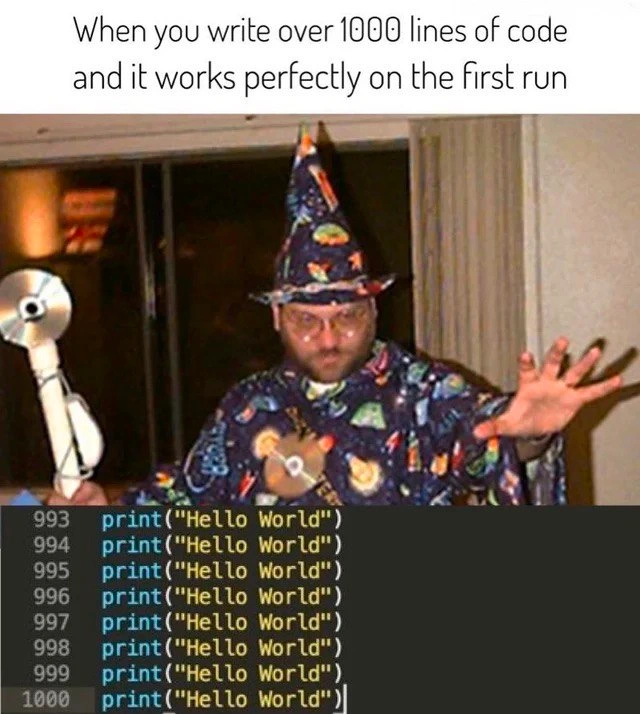
Feeling like a code wizard when 1000 lines compile flawlessly first try
CodeQuality Post #717, on Sep 30, 2019 in TG

Feeling like a code wizard when 1000 lines compile flawlessly first try

Why is this CodeQuality meme funny?

Level 1: Easy Magic Trick

Imagine a student who claims they wrote a huge essay with 1000 perfect sentences and didn't make a single mistake. That sounds unbelievable, like they must be a genius or have some magic, right? But then you look at their notebook and realize every line is just the same simple sentence copied again and again: "Hello World. Hello World. Hello World..." on and on. Suddenly, it doesn't seem so miraculous that there were no mistakes! They basically only had to get one short sentence right, and then they repeated that one correct sentence 1000 times. This meme is funny in the same way. The programmer feels like a wizard for having a big program run correctly on the first try, but it turns out he just did an easy trick: he used the same little bit of code over and over. It's as if he performed a magic show where the only "trick" was doing the same simple thing a bunch of times. Of course it worked every time, but it’s not real wizardry – it just looks impressive from a distance. The humor comes from that contrast: something that seems like an incredible feat at first glance was actually a very simple, repetitive task. Everyone can laugh because we've all felt proud of something that turned out to be much simpler than it first appeared!

Level 2: Copy-Paste Magic

This meme shows a programmer who wrote a program with 1000 lines of code, and amazingly it worked perfectly on the very first run. In the top text, he's basically bragging, "I wrote over 1000 lines and had no errors!" That is a huge deal for developers because usually there are at least some mistakes to fix. The middle image has the guy dressed like a wizard, which is a funny way to say he feels like he pulled off a magic trick. Writing that much code without any bugs or typos on the first try is so rare that it seems almost magical.

Now, when we look closer at the actual code (the bottom part of the meme), we see why it was so error-free. The screenshot from his code editor (an IDE, which stands for Integrated Development Environment, basically a programmer's writing application) shows line numbers 993 through 1000. And on each of those lines, highlighted in blue, we see the exact same command: print("Hello World"). In fact, it's very likely that all 1000 lines above are just print("Hello World") over and over again. In programming, "Hello World" is the classic simple output example – typically the first thing you learn to do in a new language, just to make sure everything is set up correctly. It's the most basic program, which usually prints the text Hello World to the screen. So what did this developer do? Instead of printing "Hello World" once, he literally printed it 1000 times by copying and pasting that line repeatedly. This is why we call it copy-paste coding. He took one working line and duplicated it again and again.

Why is that significant? Well, if you repeat the same correct line 1000 times, you're not likely to introduce new errors. The computer will happily execute print("Hello World") as many times as you ask it to. There’s no variation, no changing logic, nothing new after the first line that could go wrong. It’s basically the safest, simplest code you could write – just very long and very redundant. In contrast, if those 1000 lines were all different (doing various calculations or making decisions), the chance of a mistake somewhere would be extremely high. Normally, after writing a long program, you'd run it and probably see some error messages or incorrect outputs that you'd then have to troubleshoot. That process of finding and fixing mistakes is called debugging. But in this meme’s case, the author cleverly (or lazily!) sidestepped the need for debugging by not actually writing anything complex that could break. It's a bit like writing the same correct answer on a test 1000 times – of course you won't get it wrong after the first time because you’re just copying the answer.

However, just because it worked doesn't mean it's good coding practice. In fact, this is a tongue-in-cheek example of poor code quality. A major guideline programmers learn is Don't Repeat Yourself (DRY), meaning you shouldn't have duplicate code all over the place. If you want to do something 1000 times, it's much better to use a programming construct called a loop rather than copy-pasting a line 1000 times. A loop is a feature in programming that repeats a set of instructions for you so you don't have to write them out every time. For example, instead of writing print("Hello World") on every line, you could write something like:

# Using a loop to print "Hello World" 1000 times
for i in range(1000):
    print("Hello World")

This small snippet does the exact same job as those 1000 lines, but with only a couple of lines of code! Here, for i in range(1000): means "loop from i = 0 up to 999" (which gives us 1000 iterations in total), and each time it runs print("Hello World"). The loop takes care of repetition. This way, if you needed to change the message or fix a typo, you'd do it in one place instead of a thousand places. It’s cleaner, shorter, and so much easier to maintain. Any instructor or experienced colleague would quickly point out this approach rather than manually writing a thousand prints. So the meme is funny because the coder did something that worked, but in a silly way that's usually taught against. He got a working program, but the code is very far from ideal.

This also touches on DeveloperProductivity in a humorous way. A beginner might think, "Wow, I wrote so many lines, I must be super productive!" But in reality, good productivity isn't about the number of lines you type – it's about the results and writing code smartly. 1000 lines of doing the same thing isn't really impressive; it's just tedious. In fact, writing more code than necessary often leads to more mistakes. Here, the only reason it didn't lead to mistakes is because it was the same correct line copy-pasted. It's a bit like bragging that you wrote a 1000-page book, but then revealing every page just says "Hello World" over and over. Sure, it's technically 1000 pages, but it’s not the accomplishment people would assume it is.

To someone still learning, the meme is a goofy reminder that sometimes what looks like a big programming achievement might have a very simple trick behind it. It has a sly lesson: don't measure your skills by how much code you write, and remember that doing things the smart way (like using loops or other efficient techniques) is better than brute forcing it. And if you ever find yourself feeling like a wizard because your code ran correctly on the first try, enjoy the moment – but also double-check that what you wrote is actually doing what you think! In this case, it did work, but only because it wasn't doing anything complicated to begin with. The real magic in coding is writing clean, efficient code, not just a lot of code.

Level 3: Illusions of Productivity

For any experienced developer, the idea of writing over 1000 lines of code that run perfectly on the first try sounds nearly mythical. It's the kind of miraculous scenario that would make you feel like a wizard who just cast an impossibly complex spell. In this meme, that feeling is visualized literally: a programmer dons a galaxy-pattern wizard robe and hat, brandishing a homemade scepter as if he's just conjured a flawless program out of thin air. The caption sets the scene: "When you write over 1000 lines of code and it works perfectly on the first run." It taps into a common developer daydream — avoiding the usual bug-fixing grind and getting everything right in one go, which is about as common as seeing a unicorn.

But the punchline arrives the moment you glance at the dark IDE screenshot in the meme’s bottom panel. The code editor (complete with line numbers in the hundreds) is highlighting lines 993 through 1000, and every single one reads: print("Hello World"). Yes, it appears this "thousand-line" program is literally the same trivial statement repeated over and over. No wonder it compiled without errors or ran without crashing! There's practically zero complexity. It's like casting the exact same simple spell a thousand times — once you've verified it works the first time, repeating it verbatim isn't going to reveal new bugs. In other words, the developer’s magical first-try success is a bit of an illusion because the code has no real variation or logic that could go wrong. It's a cheeky reveal that the wizardry here is just an extremely repetitive (and arguably ridiculous) coding practice.

From a CodeQuality standpoint, any senior engineer would immediately cringe at this approach. Writing print("Hello World") 1000 times is the textbook definition of what not to do in real software development. It violates the fundamental DRY (Don't Repeat Yourself) principle in the most egregious way. Instead of one loop or a function call that prints "Hello World" as needed, the code is copy-pasted line after line. Imagine if you had to change the message or fix a typo – you'd have to edit a thousand separate lines! Maintaining such code would be a nightmare. In a code review, a seasoned developer would jokingly ask, "Ever heard of a loop?" The humor here riffs on the idea that the programmer achieved bug-free output only by brute-force repetition of a trivial command. It's like "cheating" your way to a zero-bug program: you remove any chance of logic errors by avoiding logic altogether. The code works, sure, but it's as far from elegant as you can get. Real productivity in coding is often about doing more with less, not more of the exact same.

There's also a sly jab at DeveloperProductivity metrics. In some environments (especially in bygone eras of enterprise software), managers measured progress by lines of code written. A naive interpretation of this meme’s scenario is: "Wow, 1000 lines and it worked first try, you were really productive!" But seasoned devs know that more code doesn't automatically mean better code – often it's the opposite. This meme exaggerates that idea to absurdity: a programmer literally writing filler lines to pump up the count. It's a satire of the old notion that you could judge a programmer by the volume of code they produce. In fact, there's an old joke in the industry: If you pay programmers per line of code, they'll write you a 1000-line program that could have been done in 10. Here we see exactly that — what could be a one-liner loop is blown up into 1000 lines. The wizard-like feeling of accomplishment is a tongue-in-cheek reference to how disconnected such vanity metrics are from true coding skill. The real "magic" in software engineering is writing clear, concise code, not page after page of repetitive statements.

The meme resonates with developers because it flips the usual Debugging_Troubleshooting narrative. Typically, writing a lot of new code means bracing for errors: your first run might crash, throw exceptions, or at least produce wrong output. Debugging is almost an inevitable phase after writing anything substantial. So when someone claims "it worked perfectly on the first run," veteran coders raise an eyebrow. It's like saying you threw a dart blindfolded and hit the bullseye – possible, but highly unlikely without some trickery. Here the trick is obvious: the code is so simple and repetitive that there was basically nothing to debug. It's essentially the classic "Hello World" program – usually just a single line to print a greeting – simply repeated 1000 times. The meme exaggerates a scenario we've all joked about: occasionally, when a complex piece of code does run on the first try, you feel invincible or suspect you accidentally performed some dark arts. More often though, when something works on the first attempt, a cautious developer might quip, "I must have missed something, it can't be that easy." That skepticism is part of the humor here – we immediately suspect the code must not be doing anything hard, and the screenshot confirms it spectacularly.

Finally, the wizard imagery is a fun acknowledgment of how coding can sometimes feel. There's a running joke that programmers are like wizards: our code is composed of special incantations that make the computer do things. Most of the time, though, our spells (programs) have to be carefully crafted and debugged to work correctly. When they work flawlessly, it does feel magical. In the meme, the developer is fully leaning into that fantasy – robe, hat, mystical pose – celebrating a moment of triumph. The twist is that his "spell book" contained just one extremely simple spell repeated ad infinitum. It's a playful reminder that while we might wish for miraculous one-try successes, real programming wizardry is usually about skill, experience, and yes, a good bit of debugging – not just copy-pasting one line 1000 times. The meme gets a laugh from seasoned devs because it portrays that relatable mix of pride and absurdity: being proud of a smooth run, yet knowing deep down that maybe the feat wasn't as grand as it appears.

Description

The meme is split into three horizontal sections. Top section has black text on a white background saying, "When you write over 1000 lines of code and it works perfectly on the first run" (with the number "1000" in a slightly bolder font). The middle shows a person dressed in a galaxy-pattern wizard robe and pointed hat, one hand raised dramatically and the other holding a homemade scepter; their face is blurred for anonymity. The bottom section is a dark IDE screenshot showing consecutive numbered lines: "993 print("Hello World")", "994 print("Hello World")" … all the way to "1000 print("Hello World")" - each statement highlighted in light-blue syntax coloring. The joke contrasts the perceived sorcery of code running bug-free on the first execution with the reality that the 1000 lines are just repeated "print("Hello World")" statements, poking fun at developer productivity, copy-paste coding, and the rarity of zero-bug first runs
Comments

6
Anonymous ★ Top Pick Need to impress a LOC-obsessed VP? Just unroll the loop into 1,000 `print("Hello World")` lines - CI stays green, Sonar sings 100% coverage, and suddenly you’re a Staff Sorcerer
  1. Anonymous ★ Top Pick

    Need to impress a LOC-obsessed VP? Just unroll the loop into 1,000 `print("Hello World")` lines - CI stays green, Sonar sings 100% coverage, and suddenly you’re a Staff Sorcerer

  2. Anonymous

    The only thing more suspicious than code working perfectly on the first run is when your PM actually believes you wrote 1000 unique lines instead of a for loop that got unrolled during a particularly aggressive copy-paste session after the third refactor meeting of the week

  3. Anonymous

    The real magic isn't that 1000 lines worked on the first run - it's convincing yourself that copy-pasting 'print("Hello World")' 1000 times counts as 'writing code.' Senior engineers know the actual sorcery happens when you refactor those 1000 lines into a single loop with proper abstraction, only to have it fail spectacularly because you forgot Python's zero-indexing. Again

  4. Anonymous

    Senior alchemy: transmuting 1000 print('Hello World')s into 'enterprise-scale' perfection, dodging tech debt entirely

  5. Anonymous

    It worked on the first run because the 'architecture' is 1000 unrolled print statements - the only scaling strategy where LOC explodes while complexity stays O(1)

  6. Anonymous

    Proof that LOC is a terrible KPI: a for loop would have cost you 999 lines and a promotion

Use J and K for navigation